AI Trainer Interview Questions: 25 Questions and the Follow-Ups That Matter
TLDR
- These 25 AI trainer interview questions test domain expertise beyond a polished first answer. Each includes a follow-up and signals to look for across coding, maths, medicine, law and finance.
- Tracy AI Interviewer can run an expert-level first round with every applicant, adapt the follow-up to each answer and return evidence reviewers can check. Pick four or five questions for a role and keep the follow-up even if you shorten the interview.
Contents
- What should AI trainer interview questions test?
- Why does the follow-up tell a real expert from a polished one?
- How can you ask these follow-ups for every applicant?
- AI trainer interview questions and answers: domain depth
- Reasoning questions: can they think out loud?
- Rubric questions: can they write a task a grader can use?
- Model error questions: will they catch a confident wrong answer?
- Integrity questions: is this the person on the profile?
- What does a full follow-up chain look like?
- Questions
- Sources
An AI trainer, or domain expert, writes hard questions in their own field, grades model answers against a rubric, and catches answers that sound right and are wrong. So these AI trainer interview questions test the field first and AI second. Many lists of AI trainer interview questions ask how the candidate feels about AI, which tells you little about whether they can do the work.
Use them as a bank. Pick four or five per interview, one from each group, and always ask the follow-up.
What should AI trainer interview questions test?
Public job pages describe the same tasks. Outlier lists "Write a Challenging Prompt," "Create Grading Rubrics," and "Rate and Rank Answers," and asks experts to "Think of a difficult question in your field of study." DataAnnotation describes coding work as "debugging code, evaluating implementations, reasoning about edge cases."
The pay shows what a bad hire costs. DataAnnotation lists finance, legal and medical roles at "up to $125+/hr." At that rate, an expert who can only recite definitions costs hours of rework and puts the lab's data quality at risk.
So test five things:
- Domain depth: they know the field past the textbook.
- Reasoning: they can show how they reached an answer and where it could break.
- Rubric judgement: they can write a prompt with one right answer, and a rubric two graders would score the same way.
- Catching model errors: they spot the fluent, confident mistake.
- Integrity: the person answering is the person on the profile, doing the work themselves.
Why does the follow-up tell a real expert from a polished one?
Anyone applying has read the same question lists you have, and an AI assistant can draft a fine first answer in seconds. A follow-up built on what the candidate just said can't be rehearsed, so it shows how far their knowledge goes. "Which antibiotics worry you most?" only makes sense after they've mentioned antibiotics.
At the second and third question, a real expert brings a case they saw, an exception to the rule or the number that changes the decision. If you're short of time, drop a question and keep the follow-up.
How can you ask these follow-ups for every applicant?
These questions need an interviewer who knows the field, and expert interviewers run out first. A finance interviewer can't vet a radiologist, and when several lab projects land in the same week, there aren't enough of them to go round.
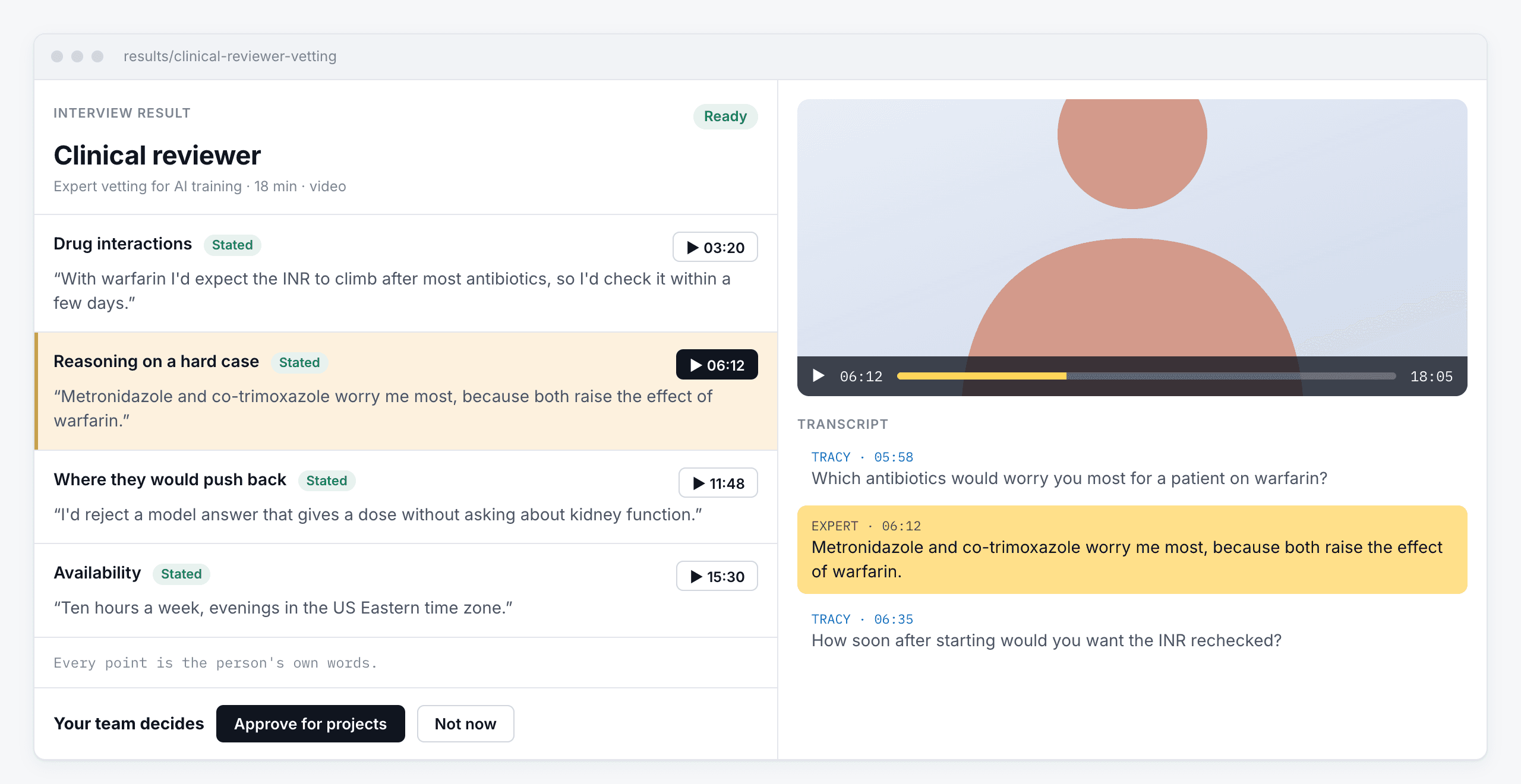
Tracy AI Interviewer runs this first round as a natural two-way video interview with role-specific questions, so your reviewers see real depth before they spend an hour on anyone. It "follows up on vague answers, digs into the interesting ones", which is where a shallow expert runs out of material. For engineers it can introduce a coding task and probe the trade-offs behind an answer, so you see how they work as well as what they say. Our page on AI technical interviews walks through one. Your questions are drafted for you, and you can add the questions that matter, such as the 25 below, so the interview matches your projects.
Each applicant opens a link in their browser and joins with no sign-up, whenever it suits them, so a new lab project can be staffed without adding interviewers. Candidates rate Tracy 4.7 out of 5 on average, so experts stay in your funnel. Pricing is $7 per credit; one credit covers up to 20 minutes, and "a session with no answers is never charged". Enterprise pricing is custom, based on your volume, as low as $1 per credit, so cost stays in line at thousands of interviews.
To compare tools, see our list of the best AI interview software for hiring teams or Tracy vs HireVue on follow-up depth.
AI trainer interview questions and answers: domain depth
Do they know the field past the definition? Swap in your own field where you need to.
| # | Question | Follow-up to ask | Strong answer | Weak answer |
|---|---|---|---|---|
| 1 | Coding: walk me through a bug you shipped to production and how you found it. | What would have caught it earlier, and why wasn't that in place? | Names the bug (a race condition in a cache refresh, say), the signal that exposed it and the test added after. Admits the gap. | "I use logging and debugging tools." No specific bug, nothing changed. |
| 2 | Maths: why does a proof by induction need a base case? | Find the flaw in the "proof" that all horses are the same colour. | Locates the step from one horse to two, where the two groups don't overlap. | "The induction step is wrong," without saying where. |
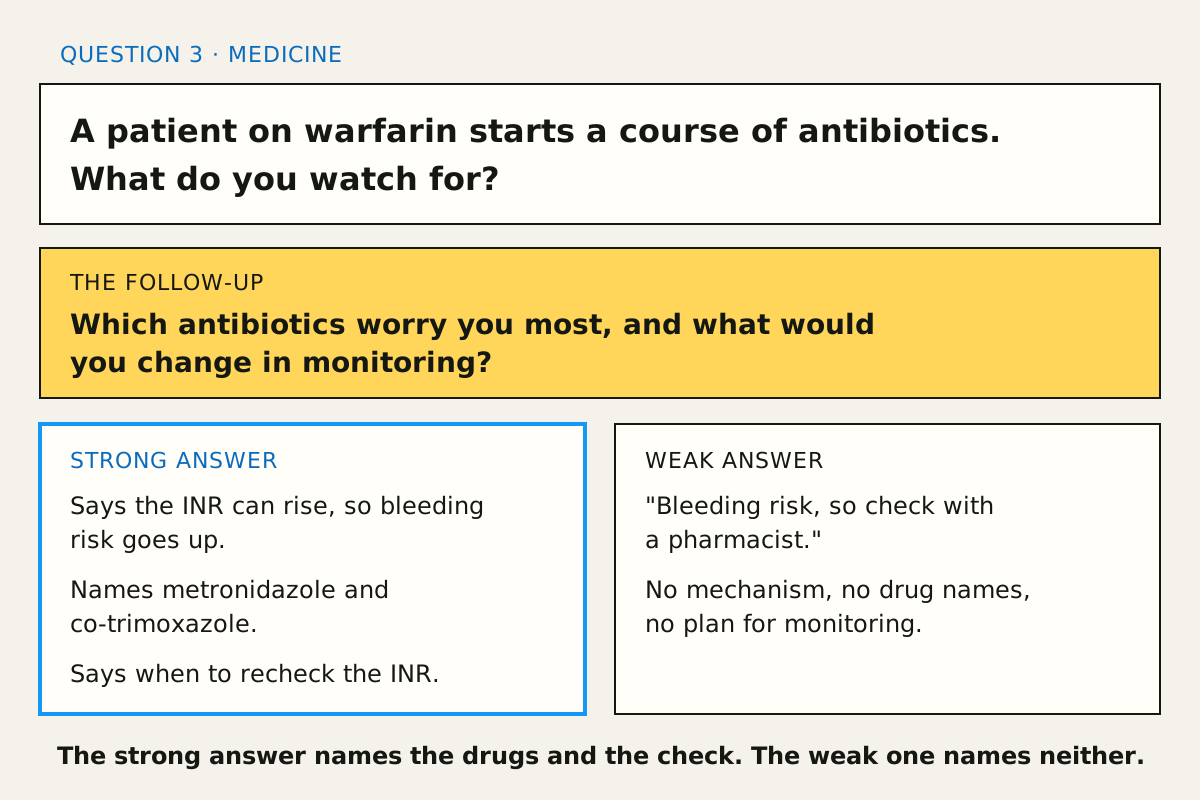
| 3 | Medicine: a patient on warfarin starts a course of antibiotics. What do you watch for? | Which antibiotics worry you most, and what would you change in monitoring? | Expects the INR to rise and bleeding risk with it; names metronidazole and co-trimoxazole as the highest-risk antibiotics; says when to recheck the INR. | "Bleeding risk, so check with a pharmacist." No mechanism, no names, no plan. |
| 4 | Law: what's the difference between a condition and a warranty in a contract? | A supplier delivers late. What can the buyer do, and what would you check in the contract first? | Breach of a condition can allow termination plus damages; a warranty gives damages only. Asks which law governs and whether time is "of the essence". | Recites the two definitions. Never asks about jurisdiction or wording. |
| 5 | Finance: how would you value a company with negative earnings? | Your DCF says $40 a share and comparables say $15. What do you check first? | Revenue multiples or a DCF with a path to margins. Checks how much sits in terminal value and whether the peers compare. | "Use a P/E ratio," which fails with losses, or picks one number without reconciling. |
| 6 | Any field: what's a question in your field that most people, and most AI models, get wrong? | What's the right answer, and how would a grader spot the wrong one? | A narrow question with one checkable answer, plus the specific mistake. | A broad topic ("ethics in medicine") or trivia. |
On question 3: in a study summarised by NHS UK Medicines Information, the antibiotics that interfere with warfarin metabolism, metronidazole and trimethoprim-sulfamethoxazole (co-trimoxazole), "posed the greatest risk for an INR of 5.0 or more".
Reasoning questions: can they think out loud?
Expert data is valuable because it shows the reasoning, so the expert has to show theirs.
| # | Question | Follow-up to ask | Strong answer | Weak answer |
|---|---|---|---|---|
| 7 | When did you last change your mind on a question in your field? What changed it? | What would change it back? | Names the evidence and the condition that would reverse it. | "I'm always open to new ideas." No example. |
| 8 | Two experts in your field disagree. How do you decide who is right? | Give me a case where the textbook answer was wrong in practice. | Goes to the primary source and each side's assumptions. Has a real case. | "I'd go with the more senior person." |
| 9 | Solve this problem from your field and state each assumption as you go. | Drop your second assumption. Does the answer hold? | States assumptions unprompted and knows which one the answer rests on. | One answer, then can't rework it. |
| 10 | Before answering "Is this clause enforceable?" (or "Is this drug safe in pregnancy?"), what do you need to know? | The user won't tell you. What do you write? | Lists the missing facts, then writes a conditional answer. | Picks a default silently and answers as if certain. |
| 11 | How confident are you in that answer, as a percentage? | What would get you to 95%? | A number below 100 and a concrete check that would raise it. | 100% on everything, or no number. |
Rubric questions: can they write a task a grader can use?
Most of the paid work is writing. These show whether the candidate writes for a grader or for a reader who already agrees with them.
| # | Question | Follow-up to ask | Strong answer | Weak answer |
|---|---|---|---|---|
| 12 | Write a prompt in your field that a current model gets wrong. | Why does it fail, and what must the right answer include? | One verifiable answer; explains the failure (the model mixes up two similar rules, say). | A trick question, an ambiguous one, or trivia. |
| 13 | Turn this model answer into a rubric of five checkable items. | Which item would two graders score differently, and how would you reword it? | Yes-or-no items. Rewrites "clear explanation" into something like "states the maximum dose in mg/kg". | "Accurate, helpful, well written, safe, concise." |
| 14 | Rank these two responses and justify it in three sentences. | The shorter one has a small error and the longer one is padded. Does length change your ranking? | Correctness first: names the error and its severity, then the padding. | Prefers the longer, friendlier answer and misses the error. |
| 15 | Rewrite this paragraph for a reader with no background, keeping the exact claim. | Which word did you almost cut, and why did you keep it? | Keeps the qualifier that carries the meaning ("in adults", "before tax"). | Simplifies the caveat away and changes the claim. |
| 16 | How would you write the ideal answer to a question with no single right answer? | What would make an answer fail anyway? | Defines must-haves and disqualifiers, then the acceptable range. | "Anything reasonable passes." |
Model error questions: will they catch a confident wrong answer?
Show a real model answer from your project with one planted error.
| # | Question | Follow-up to ask | Strong answer | Weak answer |
|---|---|---|---|---|
| 17 | Coding: here's a model's fix for a failing test. Does it fix the bug? | What input would break it? | Names an edge case: an empty list, an off-by-one at the boundary, a time zone change. | Traces the happy path and says yes. |
| 18 | Law or medicine: this answer cites a case (or a guideline). How would you check it? | The source exists but says something else. How do you mark it? | Checks the primary source; treats a misquoted source as worse than no citation. | Trusts it because it looks real. |
| 19 | Maths: this solution has the right final answer. Is it correct? | Which step would you mark down, and by how much? | Finds the invalid step and grades the method too. | "The answer matches, so it's correct." |
| 20 | What's the most harmful mistake a model can make in your field? | Show me how it would look inside a fluent, confident answer. | Specific: mg written where mcg is meant, a sign error in a cash flow, the right rule from the wrong jurisdiction. | "Hallucination," with no example. |
| 21 | This answer is correct. Would you let it ship? | What's missing? | Spots the missing safety caveat, the outdated rule or the unstated assumption. | Correct means done. |
Integrity questions: is this the person on the profile?
A fake or shallow expert who passes screening costs a platform the lab's trust. Ask these in the same calm tone as the rest.
| # | Question | Follow-up to ask | Strong answer | Weak answer |
|---|---|---|---|---|
| 22 | Walk me through the credential on your profile: where, when and what you worked on. | What was the hardest case or project in that time? | Details come easily and stay consistent. | Vague, or details shift between answers. |
| 23 | Explain your last answer again, for a junior colleague. | Why did you pick that example? | Rephrases freely with a new example of their own. | Repeats the same sentences, or pace and vocabulary change sharply between answers. |
| 24 | Which parts of this work would you use AI tools for, and which not? | A project bans AI help. How would you work on it? | Honest and specific; knows project rules differ. | Evasive, or claims never to use AI tools at all. |
| 25 | What would you do if a task's instructions looked wrong? | And if the deadline is in an hour? | Flags it with evidence through the agreed channel, then follows the decision. | Quietly changes the task, or ignores it. |
Tracy's interview integrity detection also flags the signals around each answer: tab changes, abnormal eye tracking, live face detection, average delay before an answer, external screens and other unusual patterns. Each one points the reviewer to a moment worth a second look, and your team decides what it means. Our guide to how AI interview cheating detection works covers each signal.
What does a full follow-up chain look like?
Example: an illustrative first round for a finance expert, with test data, not a real candidate. It starts from question 5.
Tracy: How would you value a company with negative earnings?
Candidate: I'd use an EV to revenue multiple from comparable companies.
Tracy: Which comparables would you pick for a mid-size B2B software company, and why those?
Candidate: Listed SaaS companies of similar size. But growth matters more than size, so I'd filter on revenue growth first.
Tracy: Say your peers grow at 40% a year and this company grows at 12%. What does that do to the multiple?
Candidate: It should come down a lot. I'd regress multiple against growth across the peers and read off the value at 12%, then check it with a DCF where margins reach the peer median in year five.
Tracy: Your DCF comes out at almost three times the multiple. What do you check first?
Candidate: How much of the DCF is terminal value. If it's 80% or more, the gap is mostly my long-run growth assumption, and I'd say so in the write-up.
The first answer is the textbook one. By the third question this candidate is working with the company's own numbers and naming the assumption that drives the result. A candidate who only knew the definition would usually stall at "which comparables".
The reviewer gets a summary with the candidate's own words attached, and the AI explains each answer score (test data):
| Field | What the candidate said |
|---|---|
| Valuation method | "I'd regress multiple against growth across the peers and read off the value at 12%." |
| Checks own work | "If it's 80% or more, the gap is mostly my long-run growth assumption, and I'd say so in the write-up." |
With the quotes next to the video and transcript, a reviewer can confirm a strong expert quickly and move them onto the lab project the same day.
Questions
What are common AI training interview questions? Most first rounds cover depth in the candidate's field, reasoning out loud, writing a prompt and rubric a grader can use, and catching errors in a model's answer. The 25 questions above cover all four, plus integrity checks.
How long should an AI trainer interview be? About 20 minutes is enough for four or five questions with their follow-ups.
Do I need different domain expert interview questions for each field? Keep the five groups and swap the domain questions (1 to 6) and the planted errors (17 to 21) for your field. Tracy drafts role-specific questions for you, and you add your own for each domain.
Can an AI interviewer judge a domain expert fairly? Tracy asks every applicant your core questions and follows up on vague answers. Each summary has "the participant's own words attached", direct quotes for context and an AI explanation of each answer score, alongside the video and transcript. Your reviewers check the evidence and decide.
Do these questions work for founders too? The principle carries over: ask, then follow up on the answer. Our guide to the accelerator interview has a first round built for founders.
Read next: How to screen candidates when every applicant needs a real interview
Watch Tracy run an expert interview, follow-ups included: See how it works
Sources
- Outlier, outlier.ai, retrieved 29 Oct 2026: "Write a Challenging Prompt," "Create Grading Rubrics," "Rate and Rank Answers"; "Think of a difficult question in your field of study."
- DataAnnotation, dataannotation.tech, retrieved 29 Oct 2026: "debugging code, evaluating implementations, reasoning about edge cases"; finance, legal and medical roles listed "up to $125+/hr".
- NHS UK Medicines Information, Warfarin Interactions With Antibiotics in the Ambulatory Care Setting, summary of a JAMA Internal Medicine study, retrieved 29 Oct 2026: "Among antibiotics, those interfering with warfarin metabolism (8.6%; metronidazole and trimethoprim-sulfamethoxazole)" ... "posed the greatest risk for an INR of 5.0 or more".
- Qode, qode.world/tracy, retrieved 29 Oct 2026: "4.7/5 average candidate rating across interviews".
- Qode, qode.world/pricing, retrieved 29 Oct 2026: "Interview integrity detection: Tab changes, Abnormal eye tracking, Live face detection, Average delay time before answer, External screens, Other unusual patterns"; "Video & chapter breakdown", "Transcript", "Answer summary & score", "Explain answer score by AI Agent"; Enterprise "Custom based on volume".
- Qode, 28 Oct 2026: enterprise pricing can go as low as $1 per credit, custom based on volume.
- Tracy AI Interviewer, tracyinterview.ai, retrieved 29 Oct 2026: "Tracy AI Interviewer runs natural two-way video interviews, follows up on vague answers, digs into the interesting ones"; "Tracy AI Interviewer can ask role-specific questions, introduce a coding task, and probe the trade-offs behind an answer"; "Your questions are drafted for you." and "add the questions that matter"; "Each person opens a link in their browser and joins with no sign-up."; "People join in their browser whenever it suits them."; "Each interview becomes a readable summary with the participant's own words attached"; "Direct quotes for context".
- Tracy AI Interviewer pricing, tracyinterview.ai/pricing, retrieved 29 Oct 2026: "$7 per credit, in USD. Credits never expire."; "1 credit for each started 20 minutes, charged when the result is ready."; "A session with no answers is never charged."