In short
Fifteen project manager questions, each paired with a follow-up and what a strong answer contains, give you a first conversation that tests scope, risk, people and delivery. Tracy AI Interviewer asks them of every applicant at any hour, follows each answer into a real case and returns the recording and transcript. Your hiring manager reads the evidence and decides who meets the team.
Say a project manager role draws 150 applicants. Every CV lists PMP, agile and stakeholder management. None of them shows who tells the client about a late milestone the same day and who waits for a better moment. Each question below comes with a follow-up that asks for a real case.
A question list is only as good as the third question. At 150 applicants, someone has to ask it 150 times, and Tracy AI Interviewer can hold that first conversation with each applicant at whatever hour suits them.
The page is for recruiters and hiring managers screening project managers. The questions suit a first call of 20 to 30 minutes; a presentation or plan review comes later, with your own team. Candidates can read the follow-ups as practice, and the FAQ covers questions to ask an employer. Neighbouring roles are covered in business analyst interview questions and product manager interview questions; hiring at volume covers the process.
What makes a good project manager interview question?
A good question asks for a real case and has a follow-up beside it. A written list does that well: every applicant gets the same questions in the same order, and the Listen for column says what strong sounds like before anyone joins.
The list cannot ask the follow-up. That depends on what the applicant just said, and it is the part Tracy takes over.
Fifteen project manager interview questions, grouped by what they test
A pair from each group is enough; open with the same ones every time. Wait to ask the follow-up until the first answer is complete, and note what makes an answer strong before anyone joins.
Group 1: scope and planning
1. A sponsor gives you a deadline and a vague goal. What do you do in the first week?
- Follow up with
- What would you refuse to commit to?
- Listen for
- Turns the goal into deliverables with owners, writes down assumptions, asks what happens if the date slips. Will not fix a date before the scope.
2. How do you estimate work you have never done?
- Follow up with
- How do you show the uncertainty?
- Listen for
- Uses similar past work, asks the people doing it, gives a range and sets a checkpoint to re-estimate.
3. What goes in your plan besides tasks and dates?
- Follow up with
- Which part do you update most often?
- Listen for
- Dependencies, owners, risks, decision dates, a definition of done. Updates risks and dependencies, not the chart for show.
Group 2: risk and change
4. Tell me about a risk you raised that others ignored.
- Follow up with
- What happened?
- Listen for
- A specific risk, who they told and what they did when it was ignored. Honest about the outcome.
5. Scope grows by 20 percent after kickoff. What do you do?
- Follow up with
- What if the sponsor will not move the date?
- Listen for
- Shows the trade-off between scope, date and people, gets an explicit decision and records it. Does not absorb it quietly.
6. How do you decide when to escalate?
- Follow up with
- When did you escalate too early or too late?
- Listen for
- A clear trigger, such as blocked for days or a decision above their authority. Brings options. Admits a misjudgment.
Group 3: people and conflict
7. Two team leads disagree on priorities and both report to someone else. What do you do?
- Follow up with
- Who makes the call?
- Listen for
- Finds the shared goal, puts the choice and its cost in front of the owner. Does not side by personality.
8. How do you lead people who do not report to you?
- Follow up with
- What do you do when someone keeps missing commitments?
- Listen for
- Agreements in the open, regular check-ins, a private word first, then their manager with facts.
9. Tell me about a project that went badly.
- Follow up with
- What would you do differently in week one?
- Listen for
- Owns their part, names the cause, and describes a practice they changed.
Group 4: delivery and communication
10. What do you put in a status update to executives?
- Follow up with
- How is it different for the team?
- Listen for
- Status against the goal, the one decision needed, the top risk, confidence in the date. Short. The team gets blockers in detail.
11. A milestone is two weeks late and the client does not know. What do you do today?
- Follow up with
- What do you say first?
- Listen for
- Tells the client now, with a recovery option. Says what is known and what is not.
12. Everyone says the project is green. How do you know it is healthy?
- Follow up with
- What do you look at?
- Listen for
- Talks to the people doing the work, reads the last few finished items, checks open risks. Trusts evidence over colour.
Group 5: method and judgment
13. When do you use agile, waterfall or a mix?
- Follow up with
- Tell me about a time you changed your mind.
- Listen for
- Chooses by how fixed the requirements are and what change costs, not by loyalty. Adapts the method to the work.
14. How do you close a project?
- Follow up with
- What did you do with what you learned?
- Listen for
- Handover, acceptance, a review that produces changes owned by named people.
15. What do you do when you do not understand the technical work?
- Follow up with
- How do you tell whether an estimate is padded?
- Listen for
- Asks the engineer to explain in plain words and what could change the estimate. Keeps a record. Does not pretend.
Answers that name who did what
Sample answers for questions 5, 11 and 12, written as examples rather than applicant quotes.
Table 6: Weak and strong project manager answers to questions 5, 11 and 12.
| Weak answer | Strong answer | |
|---|---|---|
| Question 5, the scope growth | "I would tell the sponsor we cannot take on more." | "I would show the sponsor three options: cut something, move the date, or add two people for six weeks, with what each costs. Then I would write down the one they pick." |
| Question 11, the late milestone | "I would help the team recover first, then tell the client." | "I would call the client today. I would say what slipped, what I know and when I will know more, and bring recovery options to the same call." |
| Question 12, the green project | "I check the tracker." | "I would read the last three finished items and talk to two people doing the work. A tracker that is green while the last three items took twice as long is not green." |
Listen for "I" and what that person did, such as "I called the client that day".
Scope growth, followed up until a real project appears
The candidate and the exchange are invented. It starts at question 5, and every Tracy follow-up leans on what was just said.
Tracy: Scope grows by 20 percent after kickoff. What do you do?
Candidate (fictional): I put it in front of the sponsor as a choice.
Tracy: What if the sponsor will not move the date?
Candidate: Then something leaves the scope or we add people. I show what each costs.
Tracy: Tell me about the last time you had that conversation.
Candidate: A data migration. We dropped two reports from phase one, and I wrote the decision in the project log the same day.
The last question shows whether the candidate has had that conversation before, or only knows how it should go.
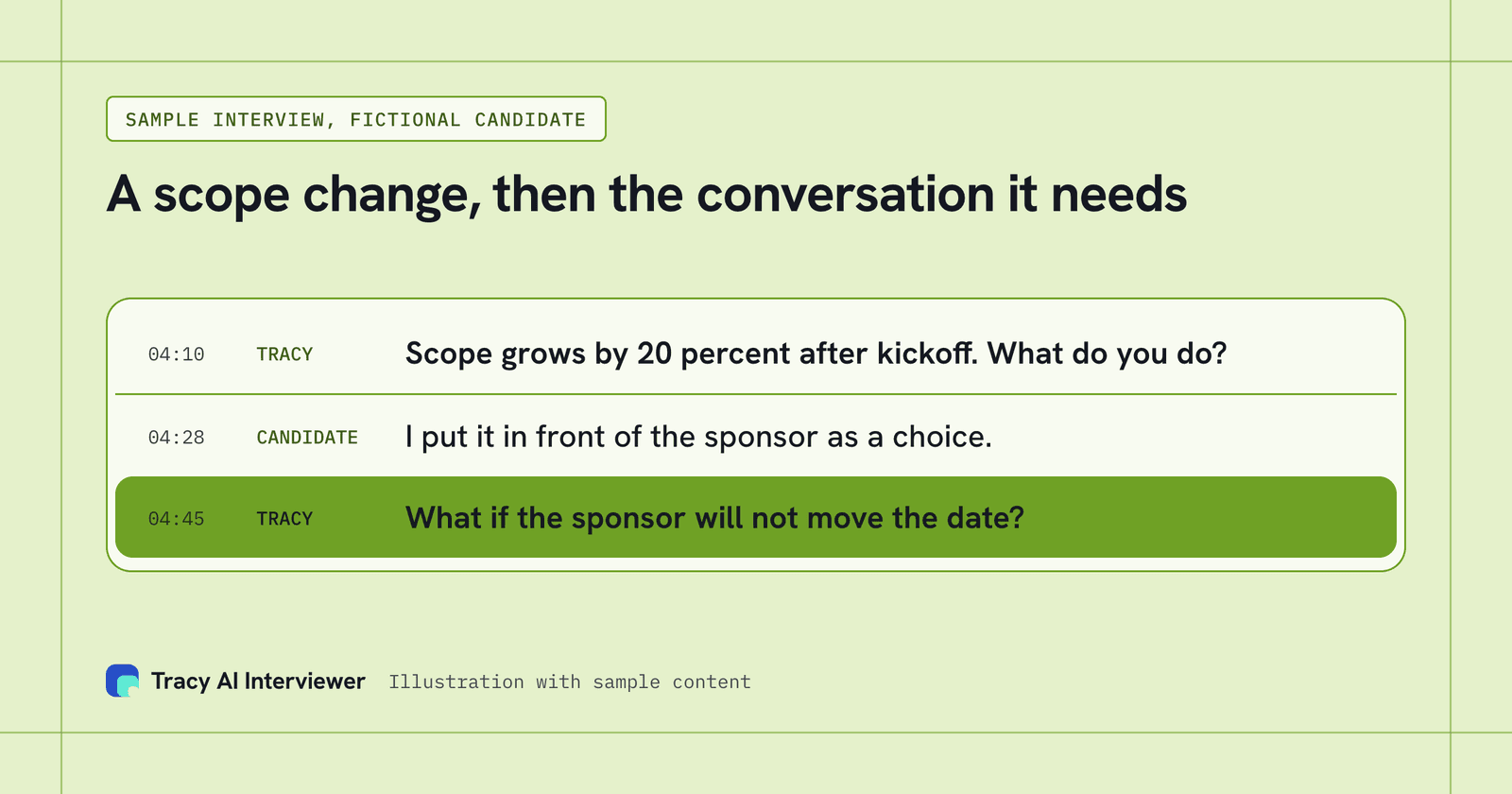
One more question shows whether the project manager has run that conversation before.
What Tracy adds to project manager screening
01
Reach every applicant
Each applicant can start on click, at any hour, with no scheduling and no recruiter on the call. Every applicant gets the same first conversation, whatever their schedule.
02
Ask the next question
Tracy asks in the person's own field, follows what they said, and waits for the answer. "I would tell the sponsor" becomes "tell me about the last time you did."
03
Keep the evidence
Every result includes a recording, a timestamped transcript, and a written assessment per question with its reasoning. Your hiring manager hears what the applicant did about a slip, in their own words.
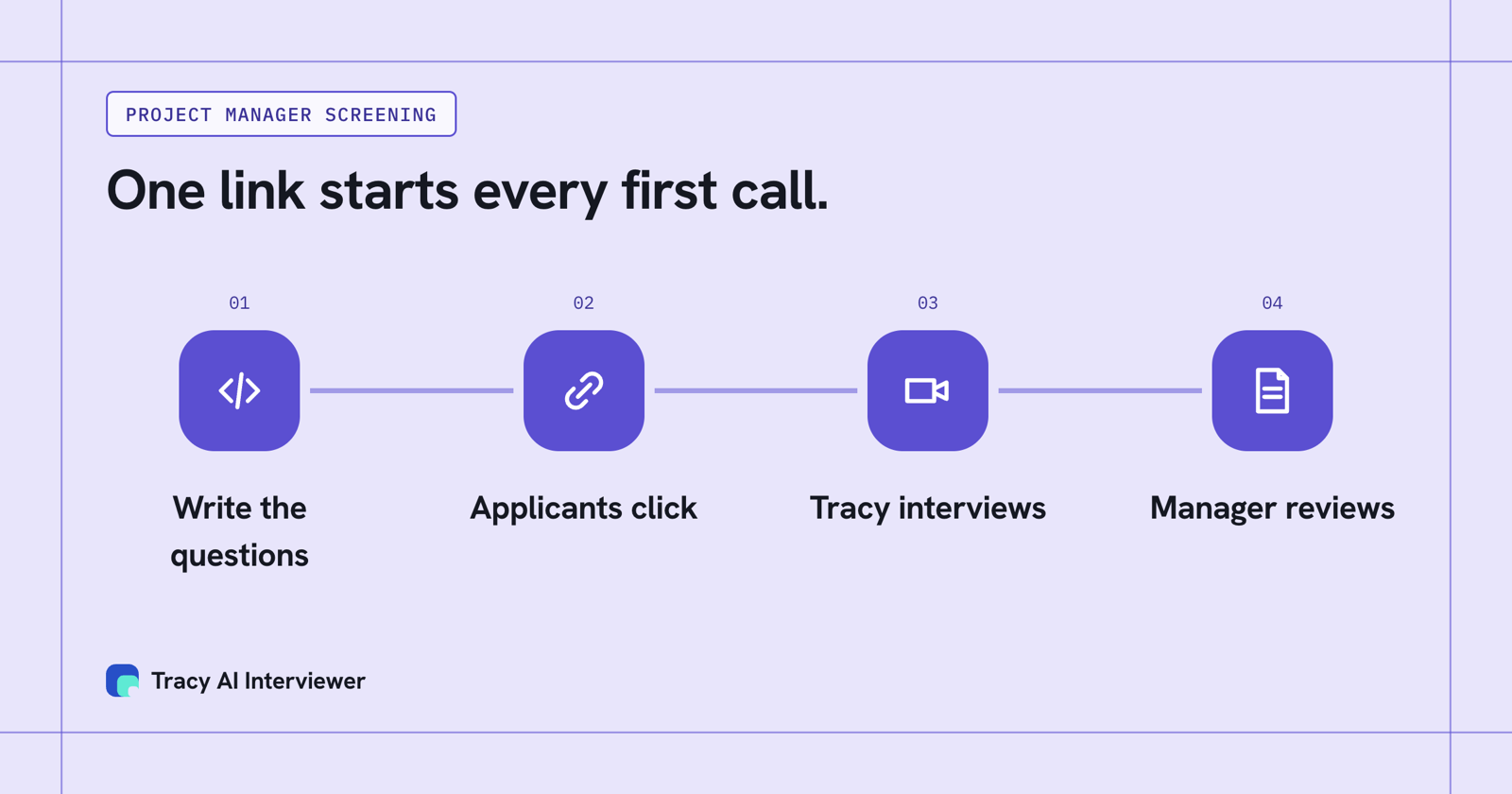
One link starts every first call.
What 150 first calls cost your team
At 30 minutes a call, 150 applicants is 75 hours of your team's time.
- Start from the job description: Tracy drafts the questions, and you edit them on the product page.
- Applicants need only a link and a browser: no account, no booking. Before they start, the screen tells them recording and transcription are on; what applicants see is on one page.
- Each result ties the recording and transcript to a note for your ATS, so a recruiter can listen to what the applicant did about a slip. See what a Tracy report shows.
- In a video interview, Tracy reports tab changes, face detection, gaze, fullscreen exits, delay before answers and external screens to a person, with the evidence for each, unless you turn them off. None is proof on its own; see how to spot a fake candidate.
Tracy has delivered 100K+ interviews, with a reported 99% completion rate. A result-producing interview costs $1 per started 20 minutes, and the first 3 results cost nothing; no card is needed. See pricing.
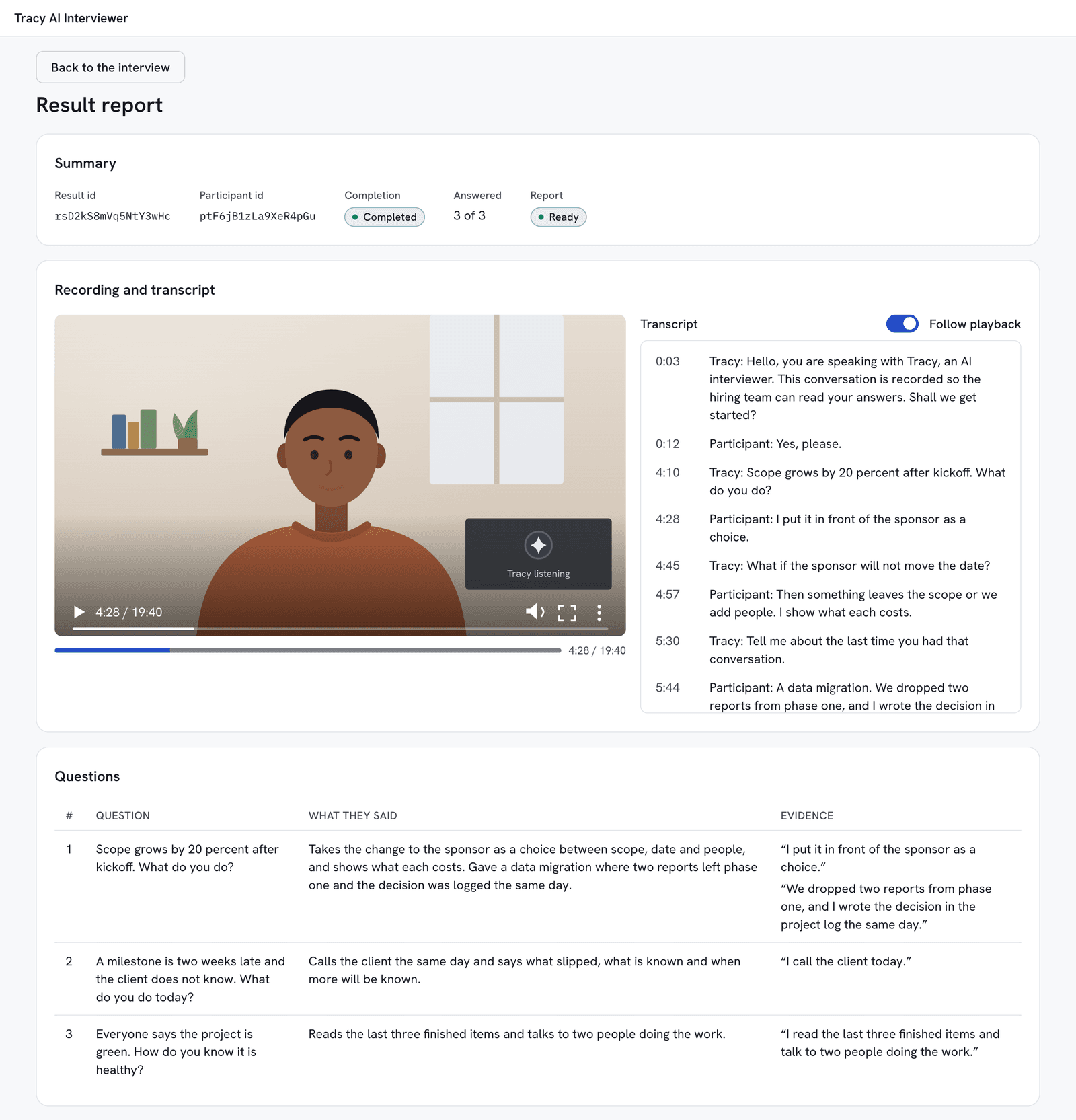
A recruiter opens one project manager's report and reads each answer next to the recording and transcript.
What your team still decides
- A hiring manager goes through each report and chooses who meets the team.
- Calibrate: ask one senior project manager to read five transcripts cold. If their reading departs from the report, the question needs revising before another hundred applicants arrive.
- The plan review: a sample plan, a presentation or a reference call is yours to run.
For two hires, a call with a senior project manager is the easier route, and AI interview vs human interview lays out the trade. With 150 applicants, competency-based interviews run at volume need more hours than a team has.
Common questions
What are good project manager interview questions?
What project manager interview questions suit experienced candidates?
What project manager interview questions should I ask the employer?
How should I prepare for project manager interview questions?
Can Tracy interview project managers?
Does Tracy choose the project manager?
Send one link to every project manager
Add the questions you picked, send the link and read what each applicant said. The first 3 results are free.
Try it free (opens in a new tab) Book a demo (opens in a new tab)
Your first 3 results are free. No card needed.
Sources
- Tracy AI Interviewer home page, retrieved 14 Nov 2026.
- Tracy AI Interviewer pricing, retrieved 14 Nov 2026.
- Tracy AI Interviewer Connect page, retrieved 14 Nov 2026.