
In short
Ask every finalist the same ten questions, and follow each answer with a request for detail: the date, the person, the first step.
Tracy AI Interviewer runs them as a first interview for every finalist, asks the follow-ups, and gives the committee a recording, a timestamped transcript and a written summary of what was said per question.
Applicants rate Tracy 92 on NPS. The committee reads the evidence and decides; Tracy ranks no one.
Copy the questions and the committee sheet below, then run them.
A selection committee meets finalists whose records look alike. Good scholarship interview questions pull them apart by asking what each person did. The ten below cover motive, obstacles, initiative and plan, and each carries a follow-up and a note on what to listen for. If your programme interviews for places as well as money, the admissions interview questions page has a wider set.
Which scholarship interview questions should a committee ask?
Ask the same ten to every finalist, in the same order, and follow each with one request for detail. Write down what a strong answer contains before the first interview, so every panel member reads the evidence the same way. On a short slot, drop questions but keep the follow-ups, because the follow-up is where the real answer starts.
1. What are you working on right now that matters to you?
Follow up with: What did you do on it last week?
Listen for: A recent, specific action, not just a topic.
2. Why this scholarship, and not another route to the same goal?
Follow up with: What will you do if you do not receive it?
Listen for: A real plan B. It shows the goal does not depend on the award.
3. Tell me about something that got in the way of your studies. What did you do?
Follow up with: What did you try first that did not work?
Listen for: The choices the applicant made, not only the circumstances.
4. Describe something you started or organised without being asked.
Follow up with: Who else was involved, and what was their part?
Listen for: A clear line between what they did and what the group did.
5. Tell me about a decision you would make differently.
Follow up with: What told you it was the wrong call?
Listen for: Whether they can name the signal and the cost.
6. What will you do with this award in the first year?
Follow up with: What is the first step you take in the first month?
Listen for: A first step with a date or a name in it.
7. Who besides you benefits if this goes well?
Follow up with: How will you know it worked?
Listen for: A way of checking, even a rough one.
8. How do you spend a normal week outside class?
Follow up with: What did you give up last term to make that time?
Listen for: A trade-off they actually made.
9. Tell me about a time you disagreed with a teacher, coach or leader.
Follow up with: What did you say, and what happened next?
Listen for: Respect and a real position, in the same story.
10. What should we know that your application does not say?
Follow up with: Why did you leave it out?
Listen for: The answer the form had no box for.
The committee sheet to copy
Paste this table into a shared document. Each panel member fills the right-hand columns before the group talks, so the discussion starts from what was said and not from who spoke last.
| Criterion | A strong answer contains | Evidence (quote and time) | Panel note |
|---|---|---|---|
| Motive | A reason tied to something they have already done | ||
| Persistence | What they tried, and what they changed | ||
| Initiative | An action nobody asked for, with their own part clear | ||
| Plan for the award | A first step with a date or a name | ||
| Candour | A limit or a mistake, named without prompting |
Scroll the table sideways to see all 4 columns.
Set the criteria with the whole panel first, and use the same ones for every finalist. Keep eligibility, grades and financial need out of this sheet: they sit in the application and are checked there.
What does a filled-in example look like?
This is a sample result for an invented applicant, shown the way a committee member reads it: the question, what the applicant said, the follow-up and the time in the recording.
| Question | What the applicant said | Follow-up | Time |
|---|---|---|---|
| A challenge and what you did | Cared for a sibling while studying; set a fixed study block each evening and asked a teacher about flexible deadlines | What did the teacher say? | 02:40 |
| What you will do with the award | Study engineering, then start a tutoring group at home | Not asked | 05:30 |
Scroll the table sideways to see all 4 columns.
The first answer opens with circumstance. The follow-up turns it into a choice: the applicant went to the teacher and asked. That detail is what the panel can weigh. The second answer states a goal, and a question about the first month would test it.
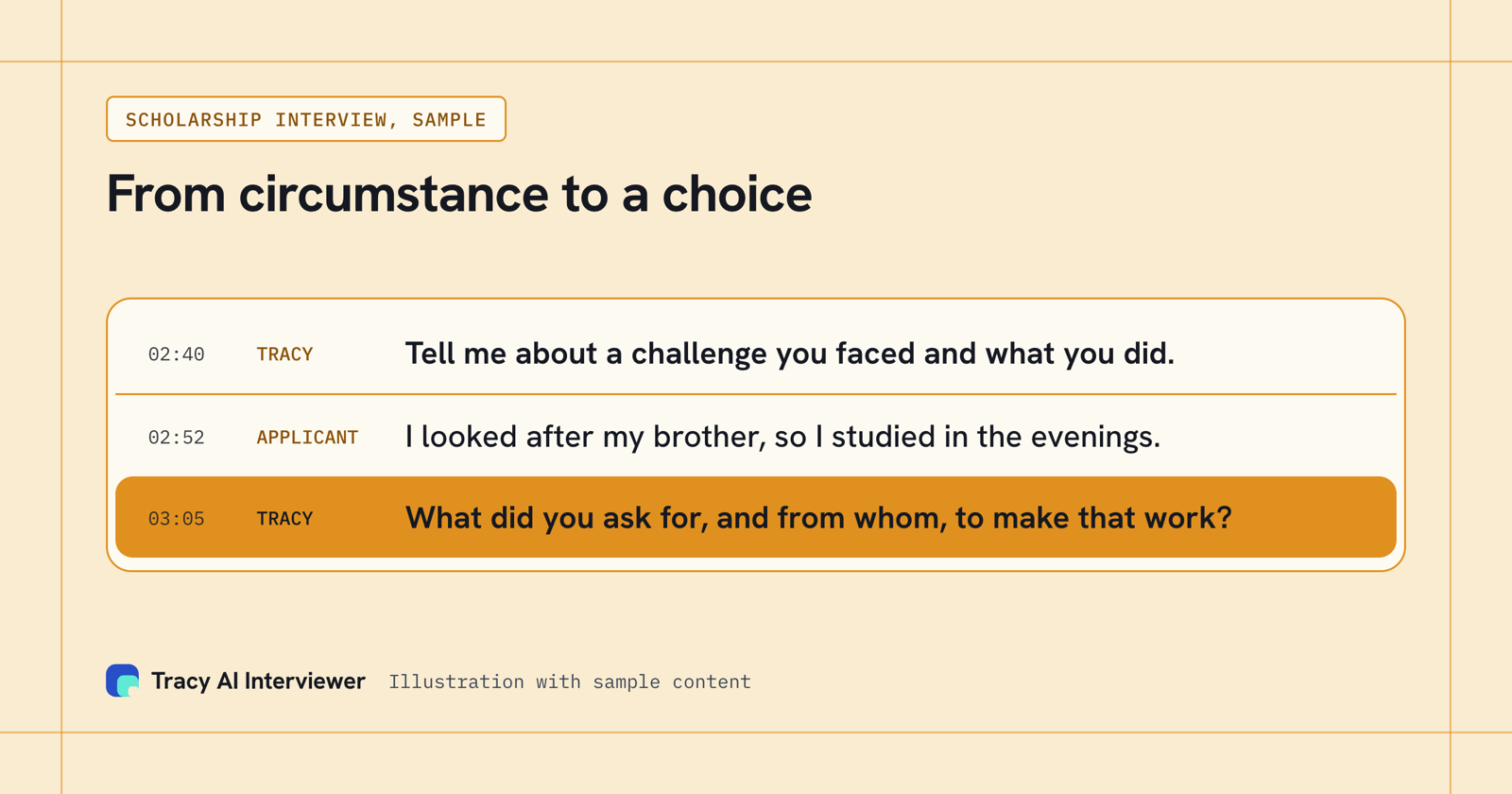
A follow-up turns a circumstance into a choice the committee can weigh.
How do you run these questions as a Tracy interview?
A committee with a long finalist list cannot hold a call with each. Tracy AI Interviewer can: describe the scholarship and Tracy drafts the questions, or paste the ten above and edit them freely. Each finalist gets a link, opens it in a browser, with no account and no calendar, and answers when they are ready, at any hour and in any time zone. Applicants are told on the join screen that the conversation is recorded and transcribed.
- Tracy asks the follow-up in the applicant's own story and waits for the end of the thought.
- The committee gets a recording of both sides, a timestamped transcript and a written summary of what each applicant said per question. See how an interview report reads.
- Pay-as-you-go costs $1 per credit, one credit per started 20 minutes of an interview that produced a result, with no seats.
Tracy reports what was said. It does not score, rank or reject anyone, and a person on the committee makes every decision.
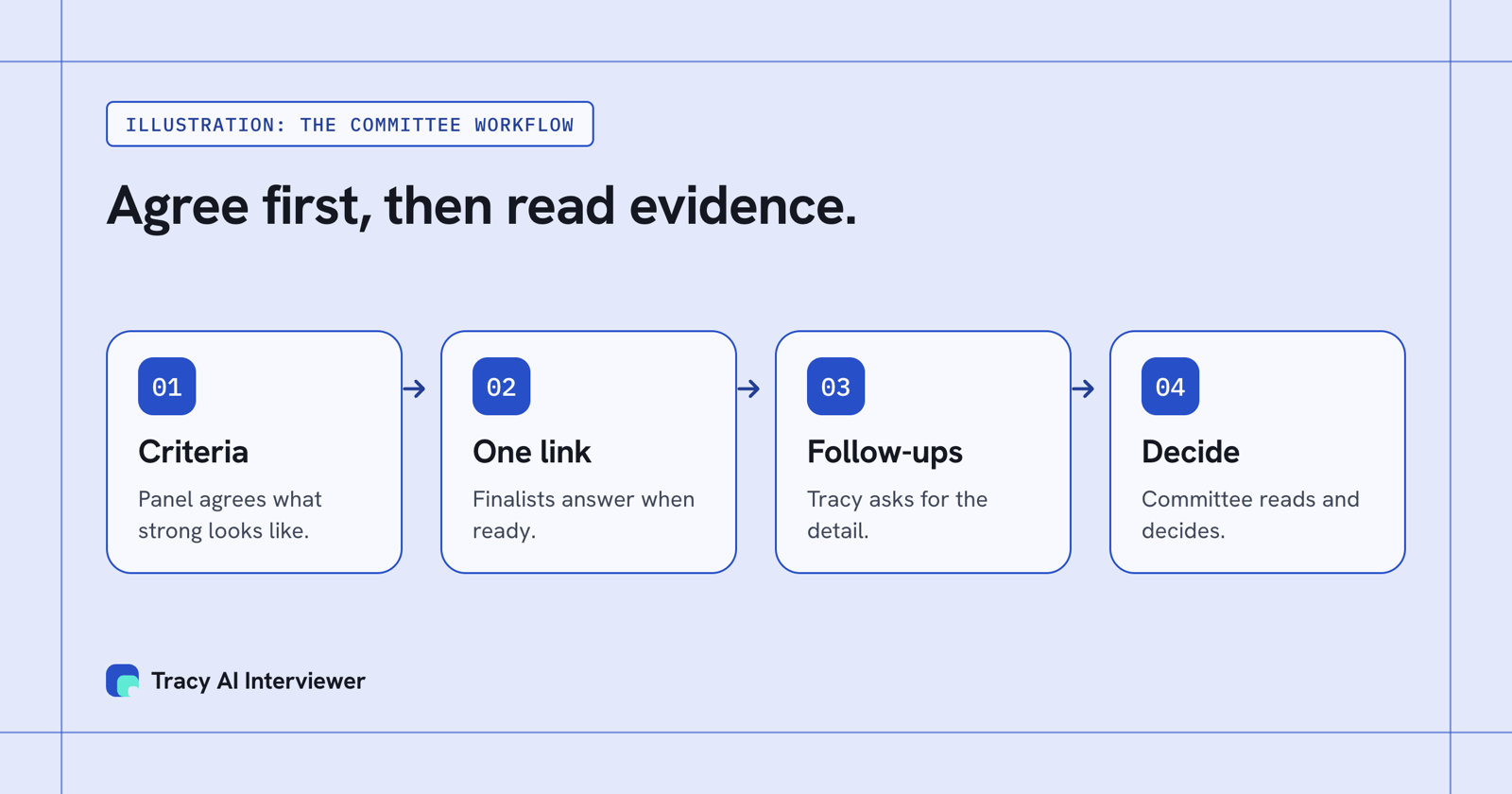
The committee agrees what strong looks like first, then reads evidence.
What can the interview not settle?
An interview collects what applicants say about themselves. It cannot check a transcript, confirm hardship or replace a referee. Keep those in your normal process. Run the interview before the committee meets, so the panel's hour goes on the difficult cases. For the method behind fixed questions and shared criteria, see how to conduct a structured interview.
Which path fits you
- Running a fellowship or accelerator intake: AI interview tools for accelerators.
- Reading many applications for a programme: the applications use case.
- Still writing your question set: the interview guide template.
Common questions
What are common scholarship interview questions?
What do good scholarship interview questions and answers sound like?
Is there a scholarship interview questions and answers sample?
How long should a scholarship interview last?
Should every finalist get the same questions?
Run these questions on every finalist
Paste the ten questions into a Tracy interview and send finalists one link. Your first 3 results are free.
Try it free (opens in a new tab) Book a demo (opens in a new tab)
Your first 3 results are free. No card needed.
Sources
- Tracy AI Interviewer pricing, retrieved 11 Nov 2026.
- Tracy AI Interviewer Connect page, retrieved 11 Nov 2026.