In short
A startup evaluation scorecard lists the criteria a panel rates every applicant on, with the evidence that counts for each. Copy the six below, with a filled example.
Applications give claims. In Tracy AI Interviewer every founder has a video conversation on your criteria, Tracy follows up on the claims that matter, and a recording, transcript and quoted answers sit behind each result.
Your reviewers rate and decide; Tracy does not score or rank. The first 3 results are free.
Why a panel needs the scorecard before the first application
Four partners read the same 400 applications. One counts traction, one trusts the team's story, one skips anything without a demo. At the panel the ratings cannot be compared, because nobody agreed what was being rated.
A startup evaluation scorecard settles that first. It names the criteria, the weight of each and the kind of evidence that earns a rating, so every applicant is held to the same bar. Below are the template, a filled example, and a way to get comparable evidence from every founder, including the ones a form would not have shown you. If you are still deciding who gets a conversation at all, start with how to meet every founder who applies.
How do you evaluate a startup?
Rate it on a short, fixed list of criteria, with one question and one kind of evidence for each, and rate every startup on the same list. Six criteria are enough for a first-round decision. More make the ratings harder to compare.
The six that follow suit an early-stage programme or fund: the founders, the problem and market, the product, traction, the business model and the plan for the cohort. Reorder or swap them to fit your thesis, but fix the list before you read the first application.
The startup evaluation scorecard template
Copy these tables into a document or a sheet. Agree Table 1 with your panel first, then give each reviewer a copy of Table 2 for every applicant.
Table 1: criteria and weights
| Criterion | Weight | What to establish | Evidence that counts |
|---|---|---|---|
| Founders | 30 | Do they know the customer and can they build? | Specific customer conversations, shipped work, who does what |
| Problem and market | 20 | Who has the problem, how often, how big? | A named customer type and what they pay or lose today |
| Product | 15 | What exists now and what comes next? | A demo, a release date, a user's words |
| Traction | 15 | What changed in the last 30 to 90 days? | Pilots, revenue or retention, with numbers and dates |
| Business model | 10 | How does it earn, and has the price been tested? | A price a customer paid or agreed to pay |
| Plan for the cohort | 10 | What will they do with the time and money? | The next six months, with a number attached |
Scroll the table sideways to see all 4 columns.
Table 2: score sheet, one per applicant
| Criterion | Rating, 1 to 5 | Evidence: quote and time | Question to raise |
|---|---|---|---|
| Founders | |||
| Problem and market | |||
| Product | |||
| Traction | |||
| Business model | |||
| Plan for the cohort |
Scroll the table sideways to see all 4 columns.
The weights add up to 100. Rate on this scale: 1 is no evidence given, 3 is stated with some support, 5 is specific, checkable and more than a form would show. To get a total out of 100, multiply each rating by its weight, add the results and divide by 5. Your reviewers work this out in the sheet; Tracy does not produce a total.
Rate the evidence a founder gives. One who sounds sure but gives no number is a 2.
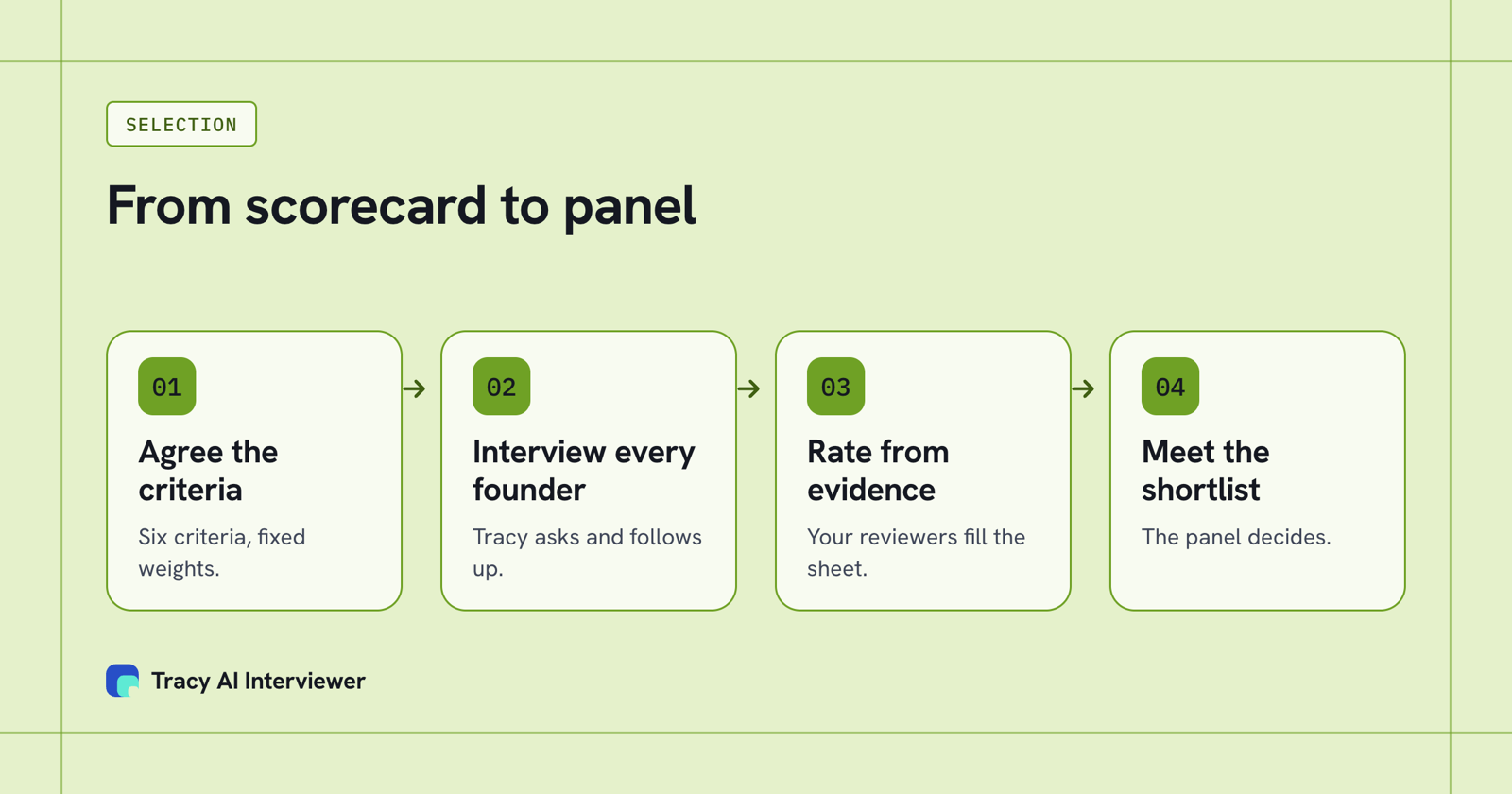
Fix the criteria first, hear every founder on them, rate from the evidence, then let the panel decide.
Is this the scorecard valuation method?
No. The scorecard valuation method prices a company before it has revenue. Bill Payne of Frontier Angels describes it in a version published through the Angel Capital Association in 2019: compare the company with typical angel-funded startups, then adjust the median pre-money valuation of recently funded regional companies using weighted factors. Payne's factors are management team (up to 30%), size of the opportunity (up to 25%), product and technology (up to 15%), competitive environment (up to 10%), marketing, sales channels and partnerships (up to 10%), need for additional investment (up to 5%) and other (up to 5%).
The scorecard on this page answers an earlier question: which applicants deserve a conversation, an interview or a place in the cohort. It borrows one idea from Payne, that the team carries the most weight, and does not try to set a valuation.
A filled example: a fictional cold-chain startup
An invented applicant. This is what the reviewer reads after the founder's interview, and the ratings a reviewer gave from it.
The first question was "What problem are you solving and who has it?" The founder said they were solving cold chain checks for small food distributors and had spoken to 30 of them before building. In their words, at 02:10: "I spoke to thirty distributors before I wrote any code." The follow-up built from that answer was "What did the first three say that surprised you?" The second question was "What have you done in the last month?" The founder said they signed two pilot customers and cut set-up time from a week to a day. In their words, at 05:30: "Two pilots signed. Set up went from a week to one day."
Table 3: the reviewer's ratings from that interview
| Criterion | Rating, 1 to 5 | Evidence: quote and time | Question to raise |
|---|---|---|---|
| Founders | 4 | Spoke to 30 distributors before building (02:10) | Who on the team has run cold chain operations? |
| Problem and market | 4 | Small food distributors with unchecked cold chains (02:10) | How many such distributors in the first region? |
| Product | 3 | Set-up cut from a week to one day (05:30) | What does a distributor see on day one? |
| Traction | 4 | Two pilots signed in the last month (05:30) | Are the pilots paid? |
| Business model | Not covered in this interview | Ask in round two | |
| Plan for the cohort | Not covered in this interview | Ask in round two |
Scroll the table sideways to see all 4 columns.
Four criteria are rated and two are open, so the panel can see what is still unknown. The follow-up carried the first row, because the claim of thirty conversations came with what the first three said.
Where the evidence comes from before the panel meets
A scorecard is only as good as what reviewers have to rate from. Y Combinator said it selected 260 companies from over 27,000 applications for Winter 2024, a rate below 1 percent. No panel can talk to 27,000 people, so most applicants are rated on what they wrote.
Tracy AI Interviewer gives the reviewer evidence per criterion, in three steps.
01 Set the questions from your criteria
Describe the programme and the six criteria and Tracy drafts the questions. Edit them or bring your own, so each row of Table 1 has a question behind it.
02 Hear every founder
A founder can begin the conversation the moment they click the link, at any hour, with no calendar to coordinate. The panel's ratings can then cover the whole pool.
03 Keep the evidence behind each rating
The result holds what the founder said to each question, a recording of both sides and a timestamped transcript. The quote and time in Table 2 come straight from it.
Tracy does not rate, rank or reject anyone. Your reviewers fill in Table 2 and the panel decides. To try it, enter the six criteria as the brief for one cohort and run three real founder interviews. For what each result contains, see what a Tracy result shows for each question.
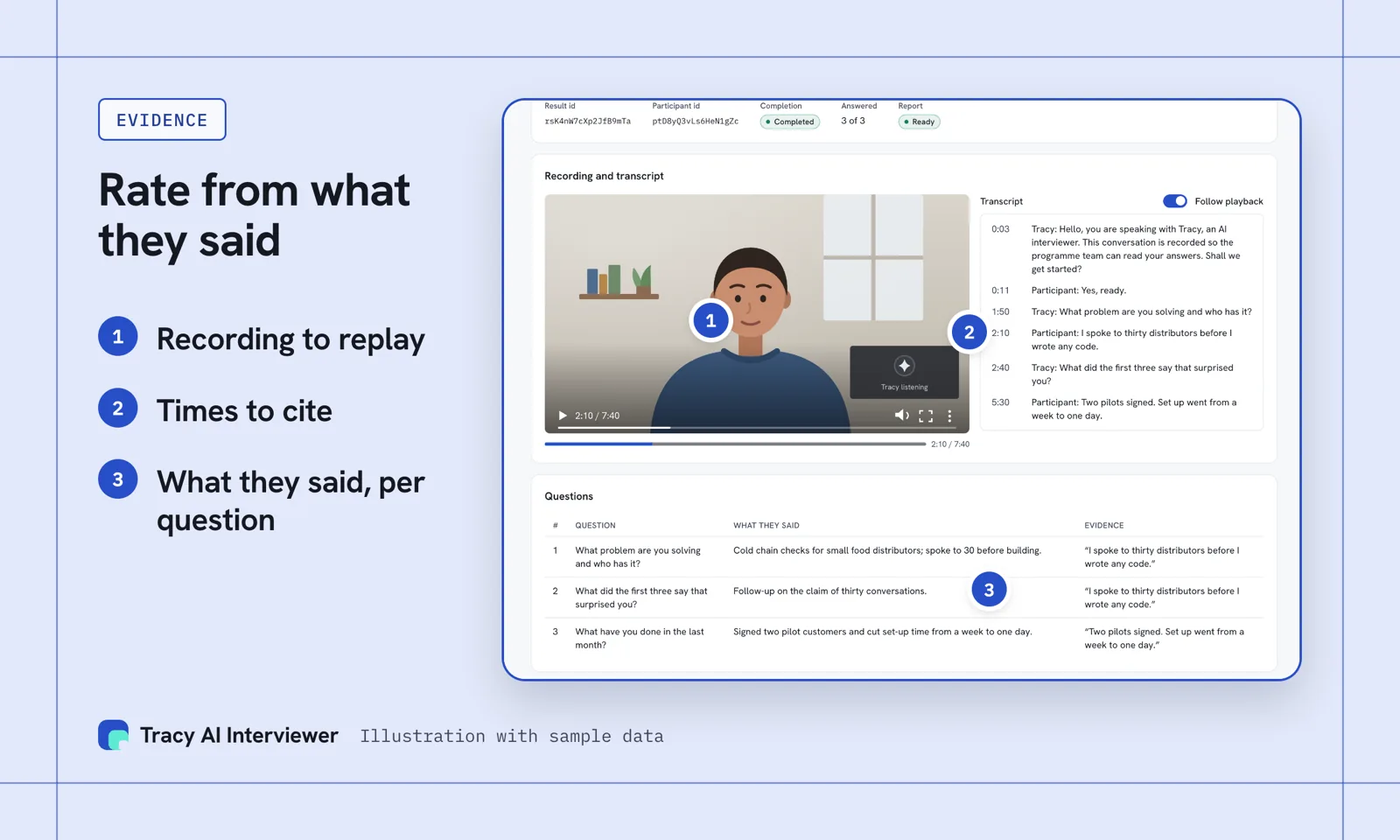
Each rating can point to the founder's words and the moment they said them.
Using the scorecard across a whole cohort
The same scorecard is only fair if it is used the same way every time.
- Fix the weights before the first application is read. Changing them after you have seen the pool defeats the point.
- Rate before the discussion. A reviewer who has heard the panel's view rates to match it.
- Use two reviewers per applicant and look at the rows where they differ by two points or more. Those rows are where the panel should spend its time.
- Calibrate on the first five. Have everyone rate the same five applicants, compare and agree what a 3 looks like.
- Leave a rating blank when nothing was said. The panel can ask in round two.
- Review the scorecard after the cohort. Compare the ratings with how the founders did, and change the next version.
Which path fits you
- Running selection for an accelerator: interview tools for accelerators.
- Investing or advising founders: AI interviews for founders.
- Hearing every applicant before a panel: how an accelerator interview works.
- Writing the questions behind each criterion: interview guide template.
Common questions
What is a startup evaluation scorecard?
How do you evaluate a startup?
What is the scorecard valuation method?
Is there a startup scorecard template?
Can Tracy fill in the scorecard?
Hear every founder, not only the shortlist
Tracy holds a first conversation with every applicant and asks the follow-up a partner would. Your first 3 results are free.
Try it free (opens in a new tab) Book a demo (opens in a new tab)
Your first 3 results are free. No card needed.
Sources
- Scorecard Valuation Methodology, rev. 2019, Bill Payne, Angel Capital Association, retrieved 22 Nov 2026.
- Meet the YC Winter 2024 Batch, Y Combinator, retrieved 18 Nov 2026.
- Tracy AI Interviewer Connect page, retrieved 11 Nov 2026.