
In short
Judge a pitch on a short fixed list: the problem, the customer and market, the solution, the business model and traction, the team, delivery and the Q&A. Copy the rubric below and score each pitch from 1 to 5.
A pitch is a short, rehearsed slot. Tracy AI Interviewer holds a first conversation with every applicant on your criteria and asks the follow-up a partner would, with a quote and a time behind each answer.
Your judges score and decide. Tracy does not score or rank. The first 3 results are free.
What criteria judge a pitch?
Judges look at seven things: the problem, the customer and market, the solution, the business model and traction, the team, delivery and the Q&A. University pitch rubrics group them in different ways, so the list below is a starting point to adapt to what your programme funds.
The University of Vermont's 2026 pitch judging criteria list five content criteria: unique value created; industry, target customer and competition; marketing, operation and management; financial and non-financial resource plan; and impact potential beyond the initial opportunity. It adds delivery, a Q&A criterion and an overall impression, each scored from 1 (very weak or missing) to 5 (great). NC State's design and pitch rubric uses two groups instead, one for evaluating the solution and one for preparation and presentation, with each row scored from 0 to 3. The rubric below keeps the 1 to 5 scale.
The pitch evaluation criteria template
Copy these tables into a document or a sheet. Agree Table 1 with your judges first, then give each judge a copy of Table 2 for every pitch.
Table 1: criteria and what a score means
| Criterion | What the judge asks | A 5 looks like | A 1 looks like |
|---|---|---|---|
| Problem | Is it real, frequent and costly for a named person? | A named customer, a number and the cost | A general trend, no named person |
| Customer and market | Who pays, how many, and who serves them today? | A customer type, a size estimate, the current alternative | "Everyone" is the customer |
| Solution | What exists now, and why will it work? | A demo or build, and why it beats the workaround | An idea with no build and no reason it works |
| Business model and traction | How does it earn, and what changed lately? | A price, a paying or pilot customer, a recent number | No price, no sign of demand |
| Team | Can these people build and sell it? | Relevant work shown, clear roles, one gap named | Unclear roles, no relevant work |
| Delivery | Was it clear and inside the time? | A clear order, on time, the whole team involved | No clear order, over time |
| Q&A | Did the answers hold up? | Direct answers with evidence | Dodges the question or repeats the pitch |
Scroll the table sideways to see all 4 columns.
Suggested weights, to change for your programme: business model and traction 20; problem, customer and market, solution and team 15 each; delivery and Q&A 10 each.
Table 2: score sheet, one per pitch
| Criterion | Score (1 to 5) | Evidence: a quote or a number | Weight |
|---|---|---|---|
| Problem | 15 | ||
| Customer and market | 15 | ||
| Solution | 15 | ||
| Business model and traction | 20 | ||
| Team | 15 | ||
| Delivery | 10 | ||
| Q&A | 10 |
Scroll the table sideways to see all 4 columns.
How do you score a startup pitch?
Give every judge the same sheet, take notes in the evidence column while the founder speaks, and score before the room talks. Judges score; you add the weighted total last.
- Hand out Table 2 and the weights before the first pitch starts.
- Write a quote or a number in the evidence column as it is said.
- Score before any discussion, so the loudest judge does not set the room.
- Use the Q&A to fill the rows that stayed blank, such as the team or the price.
- Add the weighted totals, then discuss only where two judges are furthest apart.
If you are rating written applications across a whole pool instead of a live pitch, see the startup evaluation scorecard.
A filled example: a fictional founder
An invented founder pitches software for dental clinics. This is a judge's sheet after the pitch and Q&A, and the scores are the judge's.
| Criterion | Score | Evidence |
|---|---|---|
| Problem | Not covered; ask in Q&A | |
| Customer and market | 4 | Clinics with 3 to 10 chairs paying about 200 a month; "They pay about two hundred a month for software that skips insurance checks." (02:20) |
| Business model and traction | 3 | Target of 40 paying clinics in six months; no current count given (06:00) |
A judge who scores the problem from a general impression cannot compare it with the next pitch, so a blank row tells the panel what to ask.
How can you hear every founder before pitch day?
A pitch shows a short, rehearsed slot to the few who get one. Tracy AI Interviewer can hold the first conversation with every applicant before it. Describe the programme and the criteria above, and Tracy drafts the questions, which you edit or replace. Founders start from a link, on video, when it suits them, at any hour. Tracy asks the follow-up a partner would, such as how they learned a number.
Your judges read what each founder said to each question, with a quote, a time and a recording behind it, and score with Table 1. Tracy does not score or rank anyone, and you decide which criteria the interview covers.
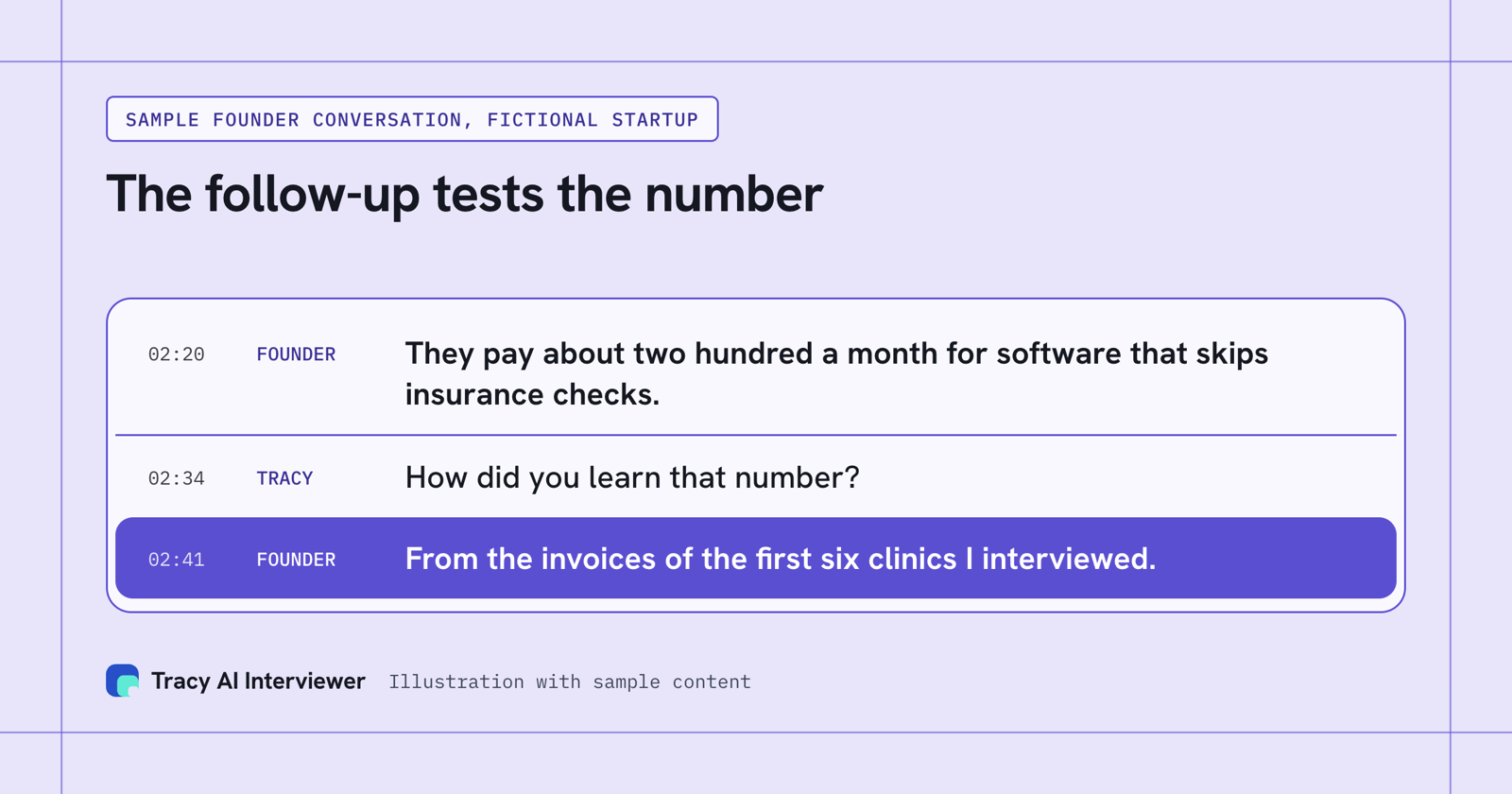
A follow-up on a founder's own number gives the judge evidence for the traction row.
Six questions Tracy can ask from this rubric
Use these as the interview built from the template, or paste them in as your own questions.
1. What problem are you solving, and who has it?
Follow up with: What did the first customers you spoke to say that surprised you?
Listen for: A named customer type and a detail only someone who has spoken to them would know.
2. Who is the customer, and what do they pay for today?
Follow up with: How did you learn that number?
Listen for: The alternative the customer uses now and what it costs.
3. What have you built, and what comes next?
Follow up with: What would you cut if you had half the time?
Listen for: What exists today, kept apart from what is planned.
4. How will it earn money?
Follow up with: Who has paid, or agreed to pay?
Listen for: A price, a pilot or a figure with a date.
5. Why this team?
Follow up with: Who does what, and what is missing?
Listen for: Relevant work and a gap named without prompting.
6. What would change your mind about this plan?
Follow up with: What happened the last time you were wrong?
Listen for: How the founder handles a challenge.
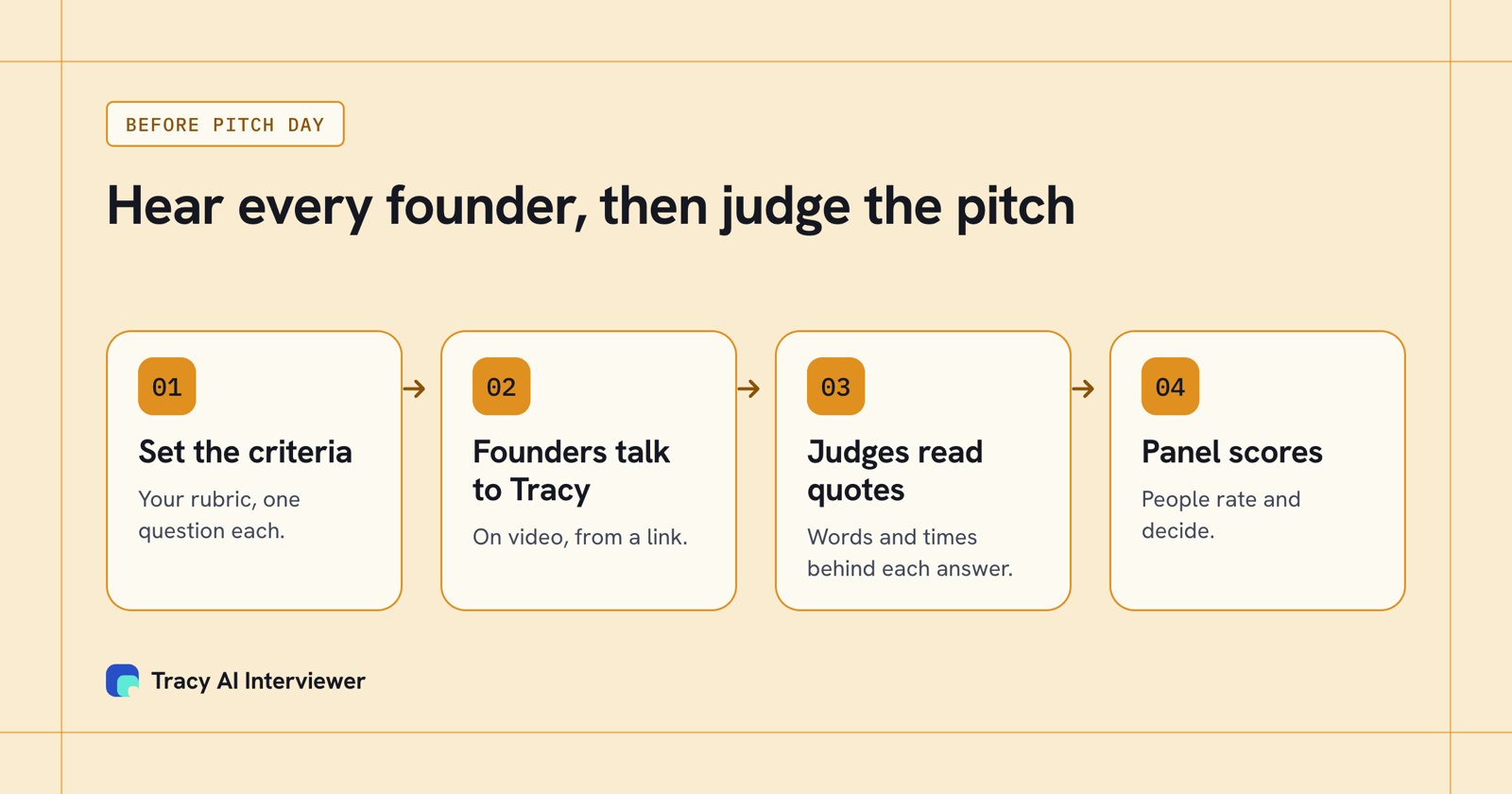
Every founder is heard before pitch day, and the panel scores from quotes.
Which path fits you
- Rating written applications across a pool: startup evaluation scorecard.
- Hearing every applicant before a panel: how to meet every founder.
- Choosing interview software for a programme: AI interview tools for accelerators.
- Investors weighing first meetings: AI interviews for founders.
Common questions
What criteria judge a pitch?
What are the five evaluation criteria?
How do you score a startup pitch?
Is there a pitch judging rubric template?
Hear every founder, not only the shortlist
Create one programme as an interview and read what each founder said, with quotes and times. Your first 3 results are free.
Try it free (opens in a new tab) Book a demo (opens in a new tab)
Your first 3 results are free. No card needed.
Sources
- University of Vermont: Pitch Judging Criteria 2026, retrieved 23 Nov 2026.
- NC State College of Design: Generic Pitch Judging Rubric, retrieved 23 Nov 2026.