In short
Tracy AI Interviewer gives every applicant a first interview, starting on click at any hour, and follows up on what each person says, so no application is judged on a form alone.
Use the 15 admissions interview questions below, written for programme teams, each with a follow-up and what to listen for.
Every result keeps a recording, a timestamped transcript and a written assessment per question; your team decides.
Next step: create one interview for your next intake.
An accelerator, fellowship or scholarship opens applications and 800 arrive for 30 places. The form says what people chose to write. It does not say who can explain a decision under a follow-up. Admissions interview questions have to find that, and to ask each applicant questions that test the same criteria.
These 15 admissions interview questions are written for programme and admissions teams selecting people for accelerators, fellowships and scholarships. Applicants and parents also search for this; the questions below show what an interviewer is looking for, so they work as preparation too. Each has a follow-up and a note on what a strong answer contains.
Tracy AI Interviewer gives every applicant a first interview. She asks each person, follows up on what they said and waits for the answer. See the applications use case and accelerator interviews for the wider process.
Fifteen admissions interview questions, grouped by what they test
Pick one or two from each group. Ask the follow-up only after the first answer, write down your criteria before the first applicant joins, and ask every applicant the same core questions, then follow up on what each one says.
Group 1: what they have done
1. Tell me about something you built or organised that you are proud of.
- Follow up with
- What did you change after the first month, and why?
- Listen for
- A specific project, their own part, a change they made on evidence.
2. Describe a time something you tried did not work.
- Follow up with
- What did you do the next day?
- Listen for
- Names the failure without blaming. A concrete next step.
3. What is the hardest thing you have taught yourself?
- Follow up with
- How did you know you had learned it?
- Listen for
- A method, a test of their own, not just time spent.
Group 2: how they think
4. Pick a problem you care about. Why does it exist?
- Follow up with
- What would change your mind about that?
- Listen for
- A cause beyond the obvious. Open to evidence that would change the view.
5. What is a belief you held a year ago and have since dropped?
- Follow up with
- What changed it?
- Listen for
- A real reversal and the reason for it.
6. You have two weeks and no budget. What do you do first?
- Follow up with
- What do you leave out?
- Listen for
- Picks one thing, gives a reason, accepts the cost of leaving things out.
Group 3: motivation and fit
7. Why this programme, and why now?
- Follow up with
- What would you do if you were not accepted?
- Listen for
- Specific to the programme. A plan that does not depend on it.
8. What do you want to be different in a year?
- Follow up with
- What are you doing about it this month?
- Listen for
- A goal with an action beside it.
9. Which of your answers on the form would you change now?
- Follow up with
- Why?
- Listen for
- Reflects honestly. Corrects or sharpens, does not defend.
Group 4: working with others
10. Tell me about a team you were part of that struggled.
- Follow up with
- What was your part in it?
- Listen for
- Owns a share. Describes the fix, not only the problem.
11. Describe a time you disagreed with someone and turned out to be wrong.
- Follow up with
- How did you find out?
- Listen for
- Says it plainly. What they do now.
12. Who has helped you most, and what did they do?
- Follow up with
- What did you do for them?
- Listen for
- Specific help. Gives back.
Group 5: judgement and evidence
13. Tell me about a decision you made with too little information.
- Follow up with
- What would you want to know next time?
- Listen for
- Names the gap and how they acted anyway.
14. How would you tell whether your idea is worth another year?
- Follow up with
- What result would make you stop?
- Listen for
- A stop rule stated before the work.
15. What question do you wish we had asked?
- Follow up with
- Why that one?
- Listen for
- Shows what they think matters. Useful for the next round.
A strong answer shows a choice, and a weak one shows an outcome
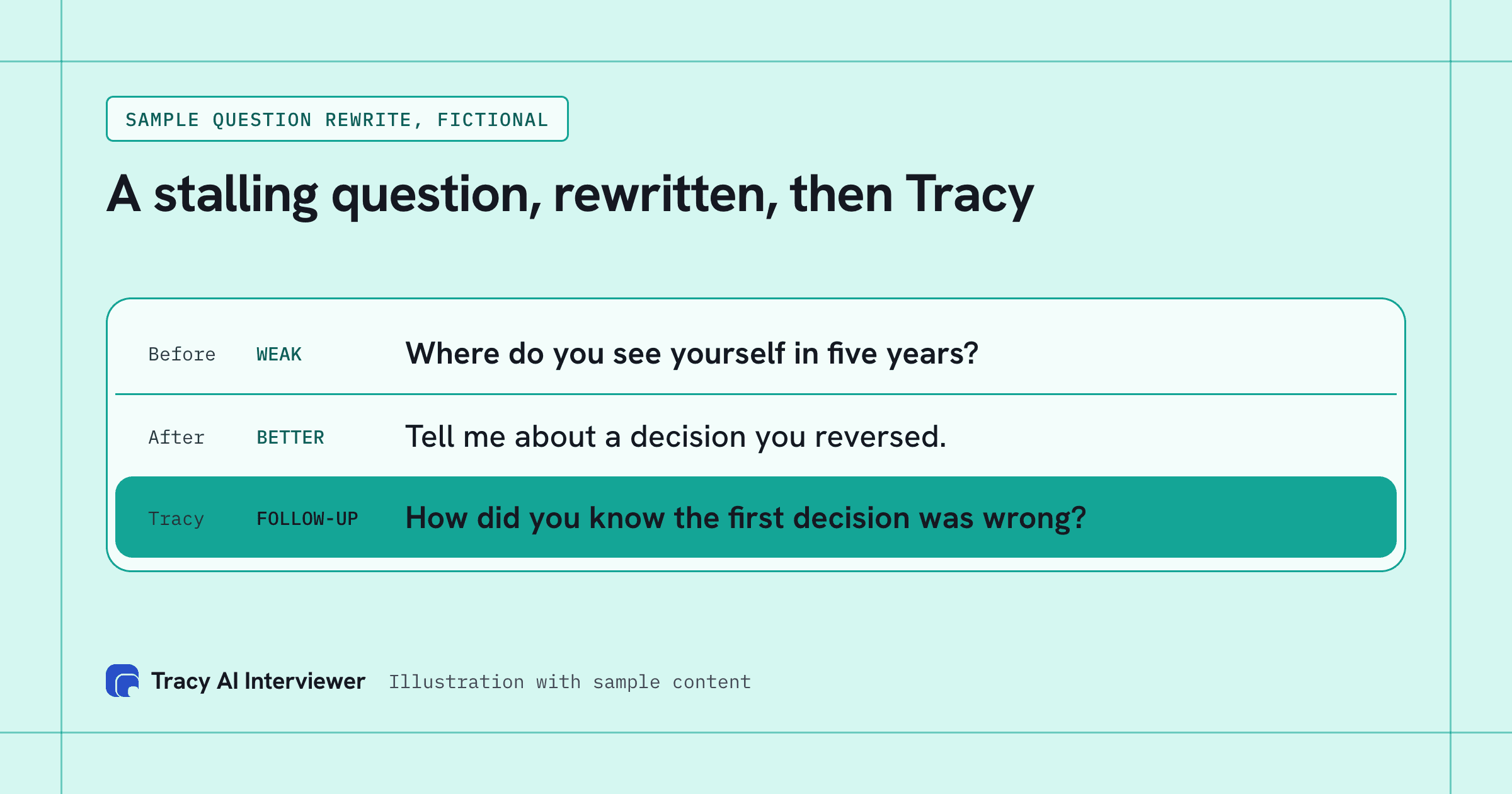
The difference shows up in the second answer. These pairs are written by us to show how it sounds; they are not quotes from real applicants.
| Weak answer | Strong answer | |
|---|---|---|
| Question 1, the project | "It went really well and the group grew." | "After a month I saw quiet students never spoke, so I moved to small groups. Attendance held and more of them answered." |
| Question 2, what did not work | "Nothing has really gone wrong for me." | "I sent a survey nobody answered. The next day I asked five people in person, and that told me what to change." |
| Question 9, the changed answer | "I would not change anything." | "I wrote that I wanted to build an app. Having thought about it, the real goal is the problem, and an app may not be the answer." |
Listen for choices. An applicant who explains why they changed something has shown how they think; one who lists results has shown what happened.
One follow-up chain shows where the real answer starts
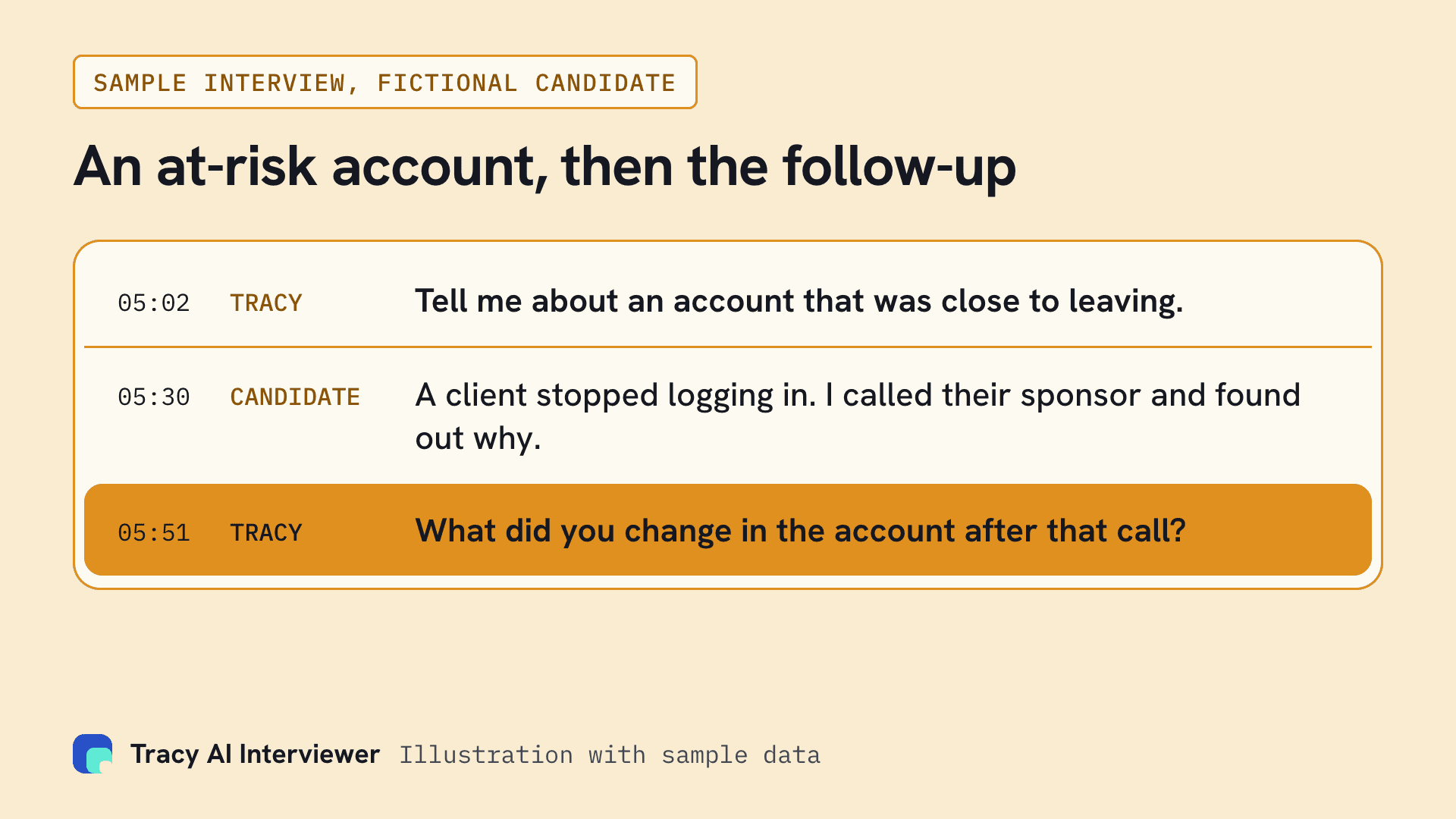
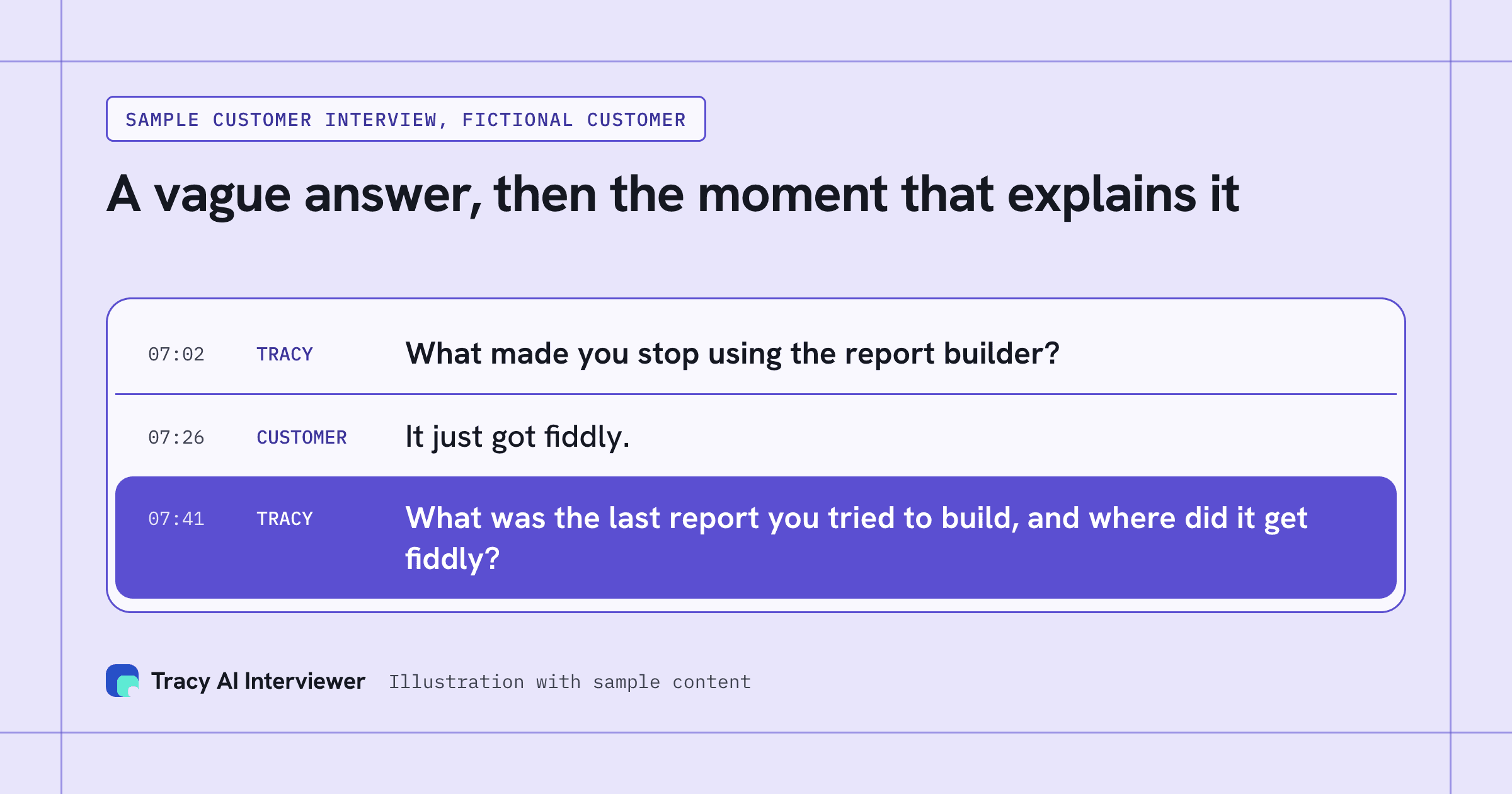
This is an illustration with sample data, not a real interview. The applicant is fictional. It shows the shape of what Tracy runs: an opening question from your list, the answer, and a follow-up built on it. The first chain starts from question 1; two shorter ones follow.
Tracy: Tell me about something you built or organised that you are proud of.
Applicant (fictional): I ran a weekly tutoring group for eleven students.
Tracy: What did you change after the first month, and why?
Applicant: I moved it to small groups, because quiet students never spoke.
Tracy: How did you know the change worked?
Applicant: More of them answered questions, and two started to help the others.
The first answer could be on any form. By the third, you can hear whether the applicant ran it.
Question 4, why a problem exists:
Tracy: Pick a problem you care about. Why does it exist?
Applicant (fictional): Students skip the library because the opening hours do not fit their classes.
Tracy: What would change your mind about that?
Applicant: If most of them told me hours were fine and the real issue was the noise.
Question 10, a team that struggled:
Tracy: Tell me about a team you were part of that struggled.
Applicant (fictional): Our robotics team missed two deadlines in a row.
Tracy: What was your part in it?
Applicant: I kept the schedule and did not flag the slip until it was too late.
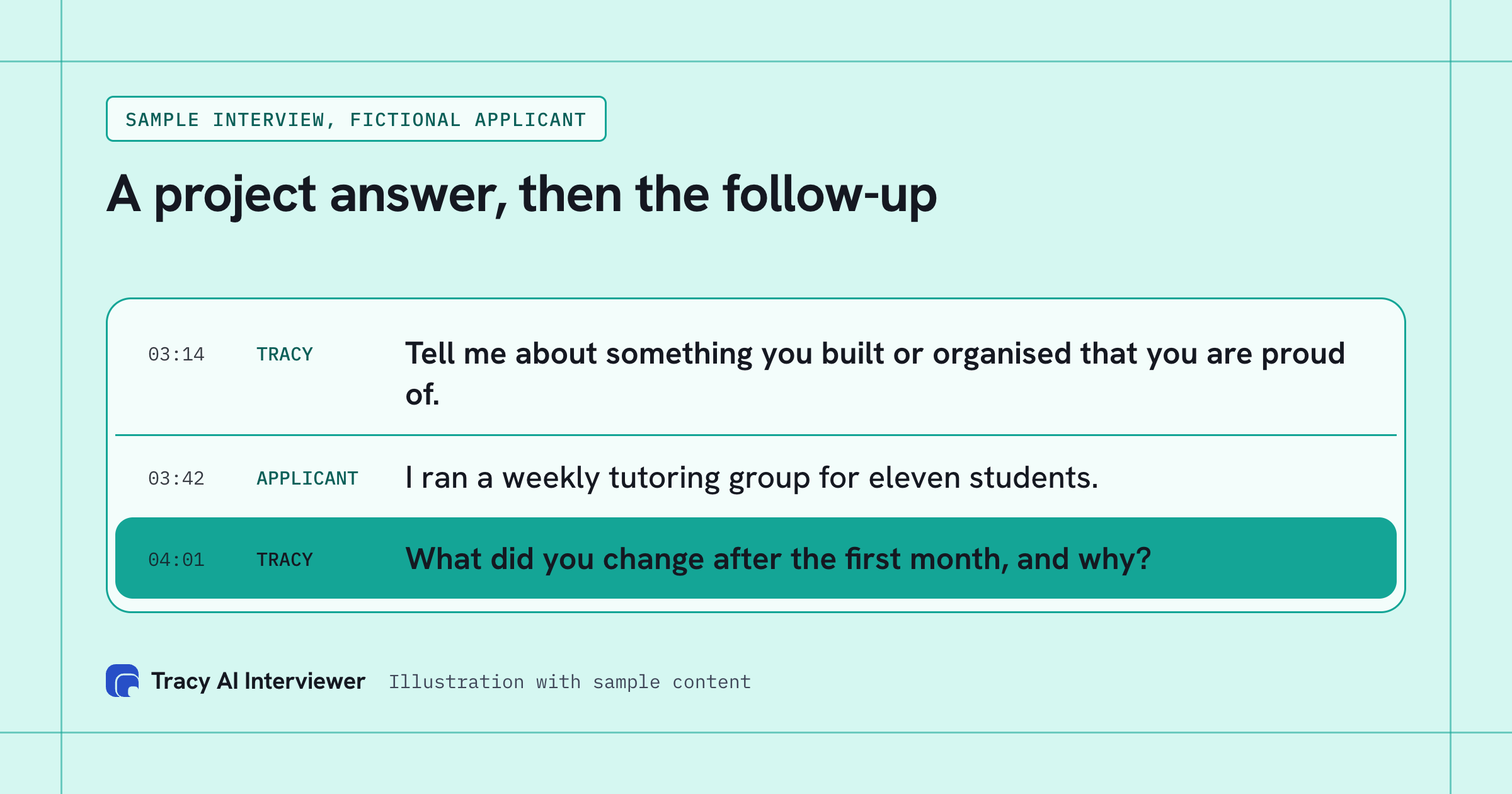
A follow-up on the applicant's own answer shows what they changed and why.
Give every applicant a first interview
You cannot hold 800 calls. Here is what Tracy does instead.
- Every applicant starts on click. Each person opens a link in a browser, with no account and no scheduling, at any hour, with no one from your team present. They are told on the join screen that the conversation is recorded and transcribed. See the participant experience.
- Follow-ups on what they say. Tracy reads the CV when the CV check is on, asks in the applicant's own field and follows up on the answer.
- A dropped applicant can rejoin. Within 10 minutes by default, set per customer. A reminder goes out after a day.
- A result you can share. A recording and a timestamped transcript sit behind every result, with a written assessment per question, so a borderline applicant can be discussed with the team. See AI interview reports.
- Your questions. Define what you want to assess before launch, then edit the draft questions Tracy makes from your brief.
On screening time, a Director at a top-tier early-stage VC describes it: "I was effectively spending around six hours a day on screening. With Tracy, I can now review and assess those candidates in approximately 1.5 hours."
It is $1 per credit, one credit per started 20 minutes of an interview that produced a result. The first 3 results are free with no card, and there are no seats. See pricing.
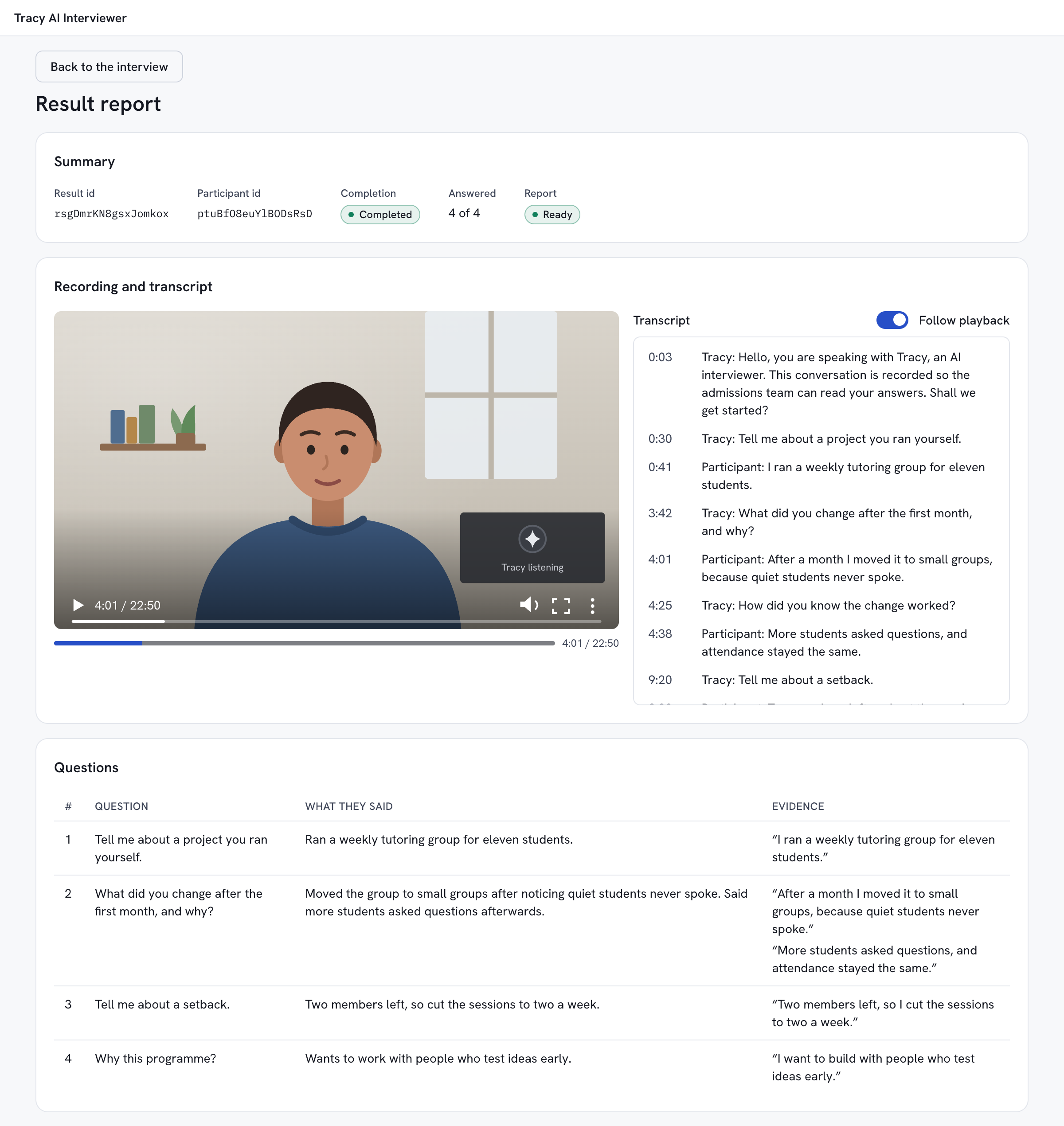
Your team can open the recording and the transcript behind each answer, and share the page for a borderline applicant.
Keep three decisions with your team
- Your criteria. Write down what a strong answer contains before the first applicant joins, and use the same criteria for everyone; opening questions can differ with the CV.
- The decision. A person on your team reads the evidence and decides who goes to the next round. Tracy publishes no bias audit, so your selection criteria and review stay yours.
- The final round. A conversation with the people who will work with the cohort stays live.
For 20 applicants, you can interview all of them yourself. The case for Tracy starts when applications outnumber your hours; see AI interview tools for accelerators. Pilot on one intake: 30 applicants, six opening questions, one reviewer.
Common questions
What are good admissions interview questions?
What admission interview questions suit students?
What are common college interview questions?
Can Tracy interview every applicant to a programme?
Does Tracy decide who is admitted?
Try Tracy on your next role
Tracy interviews every applicant, asks follow-up questions and sends you a ranked shortlist.
Try it free (opens in a new tab) Book a demo (opens in a new tab)
Your first 3 results are free. No card needed.
Sources
- Tracy AI Interviewer home page, retrieved 9 Nov 2026.
- Tracy AI Interviewer pricing, retrieved 9 Nov 2026.
- Tracy AI Interviewer Connect page, retrieved 9 Nov 2026.