In short
Interview scheduling goes faster when candidates pick from open slots in one link, panels are booked from shared calendars, and live time is kept for rounds that need a person.
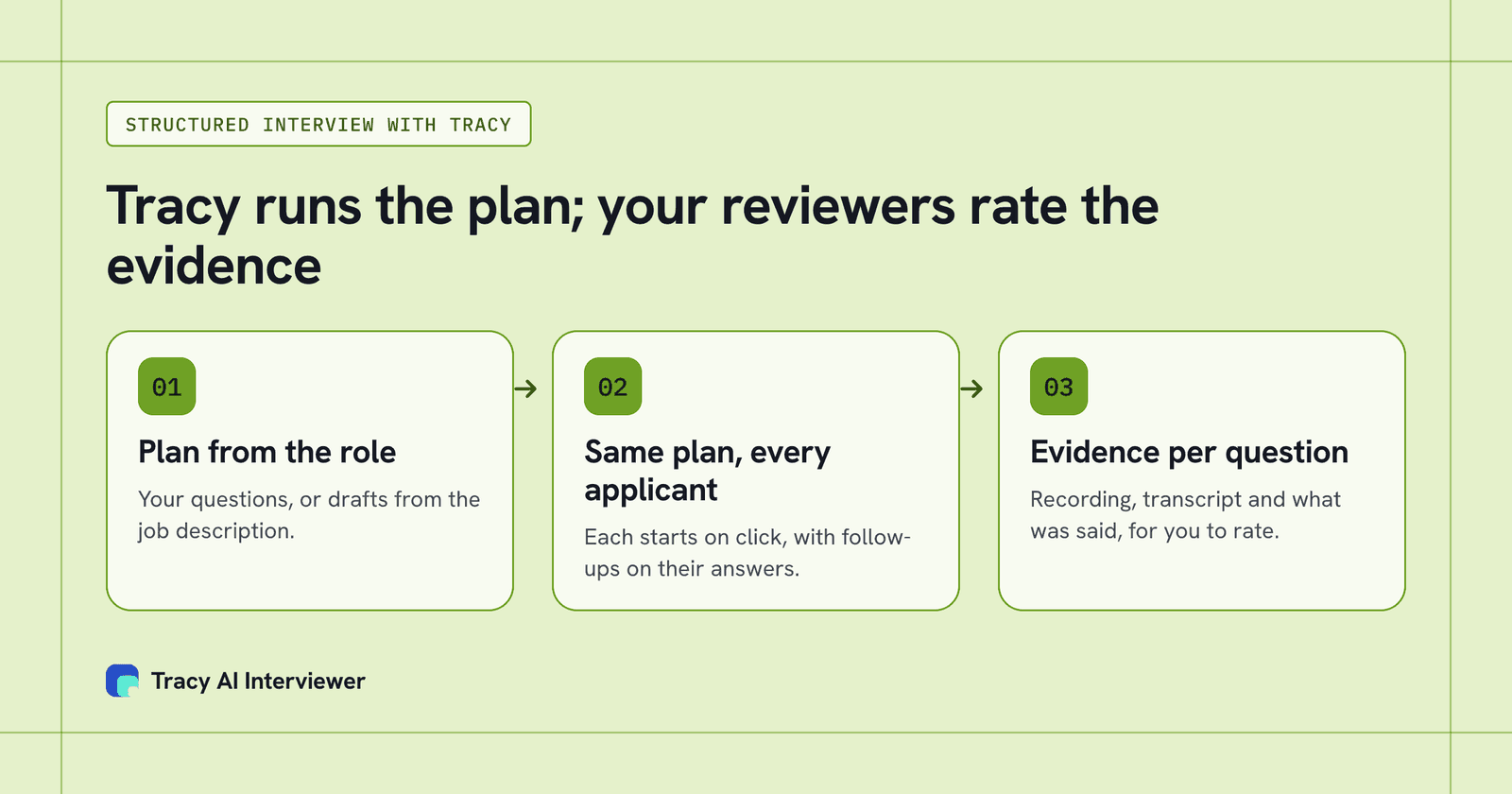
Tracy AI Interviewer takes the first round off the calendar: each applicant starts when they click the link, Tracy follows up on each answer, and your team gets a recording, a transcript and what they said to each question.
Each interview is ready in under 10 seconds when the applicant clicks the link. Send one link for one open role and book live rounds only for the applicants your reviewer moves forward.
How do you schedule interviews efficiently?
Book only the rounds that need a person, hand candidates every open slot in one link instead of proposing times one email at a time, and move any conversation a person does not have to run onto a link the candidate starts when ready.
In practice that is six steps:
- Fix the stages, the interviewers and the length of each stage before the role opens.
- Keep interviewers' availability current in their calendars, with buffers between calls.
- Send each candidate a self-scheduling link that shows real open slots in their time zone.
- Book a panel in one step from shared calendars, so five people are not matched by email.
- Send a confirmation and a reminder, each carrying the same link for rescheduling.
- Decide which stage can run without a live interviewer and take it off the calendar. Recruitment automation covers the other steps.
How do you avoid scheduling back-and-forth?
Show the slots up front. Every email that proposes three times and waits for a reply adds a round trip, and a booking link or automated scheduling removes it. Ashby's 2026 recruiting operations report, drawn from its customer data for January 2021 through March 2026, says teams using its Auto Schedule confirm interviews 26% faster than manual scheduling, with a median of 3.7 hours against 5 hours.
Gem's 2025 benchmarks, from customer data for 2021 to 2024, show recruiter numbers down 20% while application volume rose 117%. That leaves fewer recruiters booking more screens.
What is an interview schedule?
An interview schedule is the plan for one hire: which stages there are, who runs each, how long it lasts and in what order. The table shows an invented schedule where the first stage needs no live interviewer.
Table: A sample schedule for one hire.
| Stage | Who runs it | Length | Needs a live person |
|---|---|---|---|
| First-round interview | Tracy, started by the applicant | 20 minutes | No |
| Hiring manager call | Hiring manager | 30 minutes | Yes |
| Team panel | Three interviewers | 60 minutes | Yes |
| Offer call | Hiring manager | 20 minutes | Yes |
Scroll the table sideways to see all 4 columns.
Three stages need booking, and the first call for every applicant does not.
Where does the calendar still slow you down?
The first round hurts most. Say 120 applicants each get a 20-minute screen: that is 40 hours of calls, plus 120 booking threads before the first call happens, and every no-show needs a second slot. A booking tool shortens each thread, but the 40 hours of calls are still there.
The first round is also the stage a link can replace, because it is a conversation with one person and a set of questions. What a first-round interview is and high-volume recruitment cover that stage in more depth.
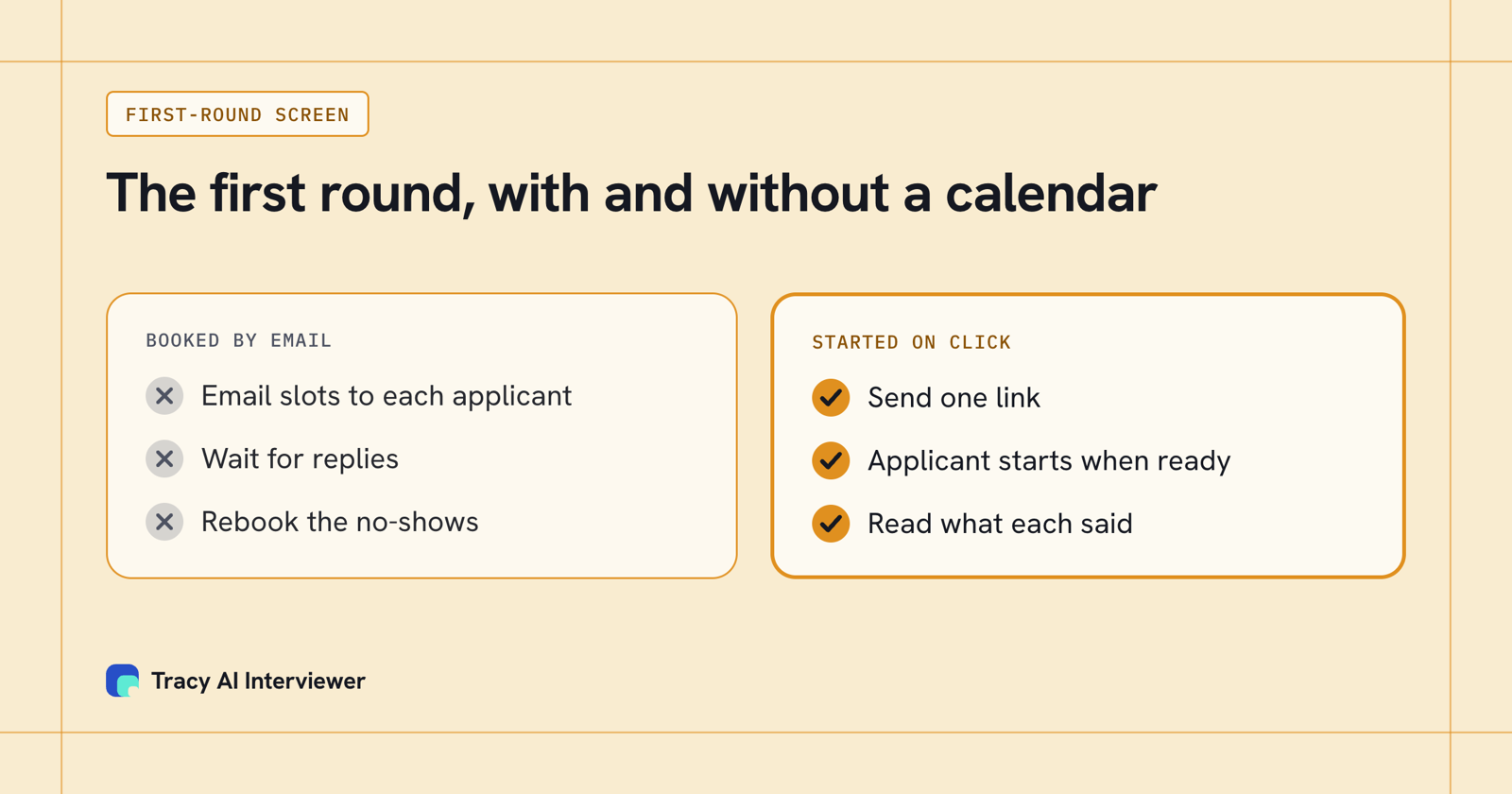
A first round started on click needs no booking, no wait for replies and no rebooking.
How does Tracy take the first round off the calendar?
Add the link to the application confirmation or to your reply to each applicant. The applicant opens it in the browser whenever they are free, and nobody from your team has to be on the call. If the connection drops, they can rejoin within 10 minutes, and a reminder goes out after a day. Tracy puts questions from the applicant's own field, lets each answer finish, then asks about one detail the applicant just gave (how to write questions an AI can follow up on).
Because nobody joins live, your team reads afterwards: the recording, the transcript with timestamps, and a summary of what the applicant said to each question. This excerpt for a hospitality role is invented:
Question 1. Tell me about a busy service you handled.
What they said. Worked a 150-cover Saturday as a server, kept a running list of tables and asked a colleague to cover two.
Quote at 01:30. "I kept a list of every table and asked a colleague to cover two."
Follow-up. How did you decide which tables came first?
Question 2. What days could you start?
Quote at 03:00. "From Monday, not Wednesdays."
Field, start date. Next Monday (evidence: question 2, 03:00).
Tracy does not book your live rounds. Keep a scheduling tool for the hiring manager call and the panel, and use it only for the applicants your reviewer moves forward.
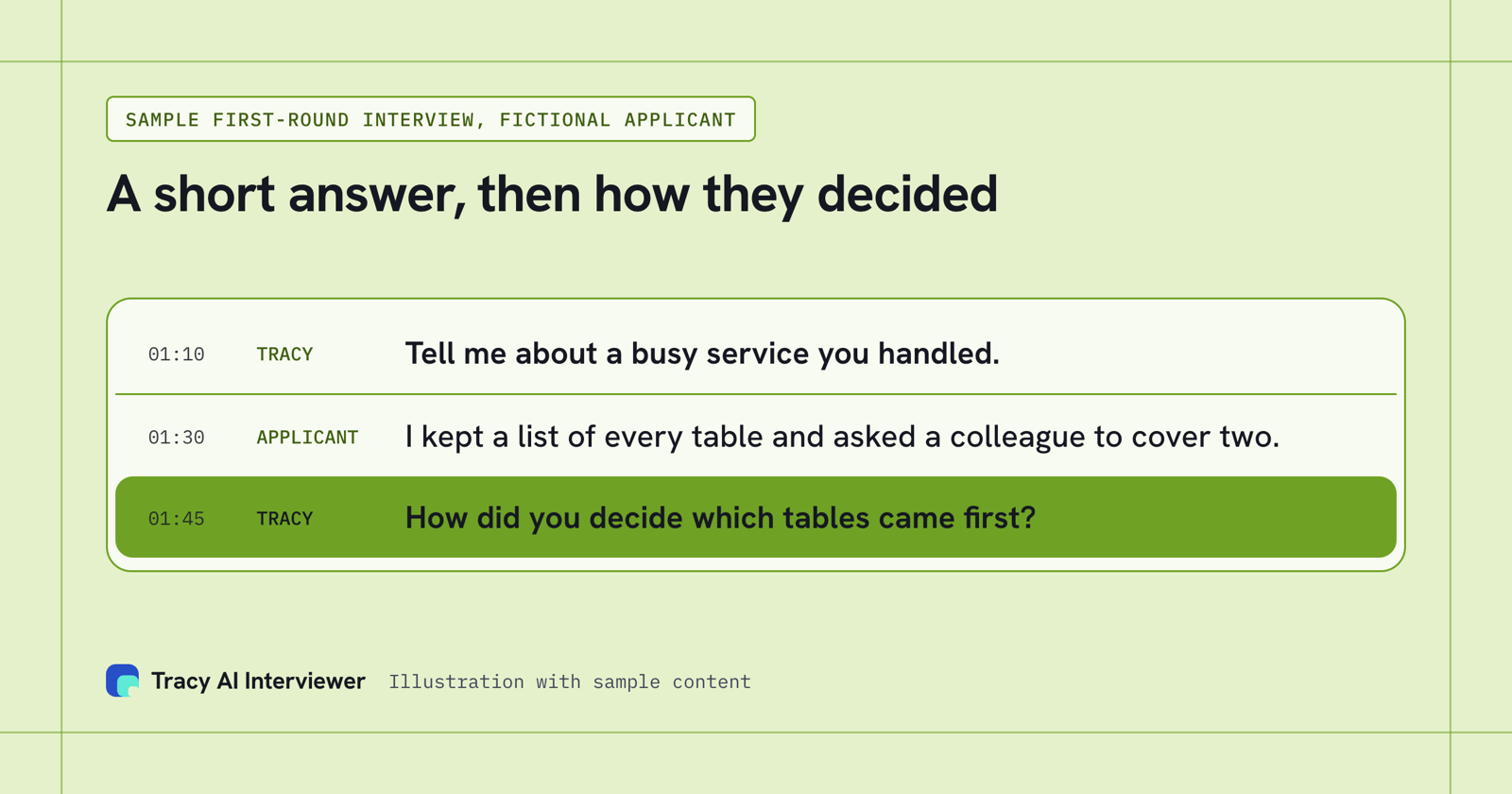
The follow-up asks how the applicant chose between tables, and the answer lands in the report with its timestamp.
What would 120 first rounds cost without booking any of them?
One credit covers each started 20 minutes of an interview that produced a result, at $1 a credit. 120 interviews of 20 minutes is 120 credits, $120 before the first 3 free results. See Tracy's pricing for the unit. Send the link for one open role and read the first five results before you book a live call.
What mistakes slow interview scheduling?
- Proposing times one email at a time instead of showing every open slot.
- Booking panel members separately, so five calendars are matched by hand.
- Ignoring time zones and buffers, which produces rescheduling.
- Booking a live screen for every applicant when a link could run it.
- Sending no reminder and no easy way to reschedule.
Which path fits you
- Automating more of recruiting: recruitment automation.
- Screening large applicant pools: mass hiring process and hiring at volume.
- Shortening the whole timeline: time to hire benchmark.
- Picking tools stage by stage: the best hiring tools.
Common questions
How to schedule interviews efficiently?
How to avoid scheduling back-and-forth?
What is an interview schedule?
Does Tracy schedule interviews?
Take the first round off your calendar
Send one link for an open role and read what each applicant said to each question. First 3 results free.
Try it free (opens in a new tab) Book a demo (opens in a new tab)
Your first 3 results are free. No card needed.
Sources
- Ashby, Recruiting Operations Benchmarks, 2026 Talent Trends Report (7 May 2026), retrieved 22 Nov 2026.
- Gem, 2025 Recruiting Benchmarks Report, retrieved 18 Nov 2026.
- Tracy AI Interviewer: Hiring at volume, retrieved 5 Nov 2026.
- Tracy AI Interviewer: Pricing, retrieved 11 Nov 2026.