In short
Interviewer training holds when it covers a fixed question set, one rating scale and a calibration session on real answers. A one-hour talk on interview tips covers none of these.
Tracy AI Interviewer runs the first round with the same questions for every applicant and a follow-up on each thin answer, so managers practise on real records and keep their hours for the later rounds.
Training effects fade, so refresh before each hiring round. Managers rate and decide; Tracy does not score.
How do you train hiring managers to interview?
Train them on three things: the questions every candidate gets, the scale everyone rates on, and a calibration session where they rate the same real answers and compare. Give each manager a one-page guide, and let them practise on a pilot role before their first live round.
Two managers hear the same candidate. One writes "strong communicator" and the other writes "rambled", because nobody told them what to listen for. Structure closes that gap. In Sackett and colleagues' 2022 re-analysis of selection research, structured interviews had a mean validity of .42 against job performance and unstructured interviews .19. Validity here is a correlation between the interview rating and later performance ratings, not a hiring success rate.
What should interviewer training cover?
Five things, in this order:
- The role. Write the three or four things a person must show to do the job well before any interview is booked.
- The fixed questions. Every candidate gets the same list. A manager's favourite extra question goes into the follow-up, not into the list.
- The follow-up. Ask for the detail behind a claim, wait for the end of the answer, then ask once more.
- The rating scale. Describe what each point looks like with an example, rate alone before any discussion, and write the evidence next to each rating.
- Notes and limits. Quote what was said, leave out guesses about the person, and drop any question your HR or legal team has ruled out.
For the structure behind points 2 and 4, see what a structured interview is and how to conduct a structured interview.
Calibrate on real answers, not slides
A 2026 systematic review of 19 studies concluded that structured scoring rubrics and group calibration are essential, and that refresher training can improve the interview process. The review is qualitative, and it notes that training effects may be short-term. It also reports one cited study in which trained interviewers were more prone to bias than untrained ones, so rely on fixed questions and rating before discussion, and treat the course as support.
A 90-minute session you can adapt to your team:
| Minutes | What happens | What you leave with |
|---|---|---|
| 0 to 10 | Read the role and the three or four things to look for | An agreed list |
| 10 to 30 | Each manager rates the same three interview records alone | Ratings with evidence |
| 30 to 60 | Compare, starting with the rows where two managers are furthest apart | Reworded scale points |
| 60 to 80 | Pairs practise a follow-up on one real answer | Three follow-ups to reuse |
| 80 to 90 | Agree how notes are written and the date of the next session | A calendar entry |
The interview records can come from your own past interviews, with names removed, or from a pilot round.
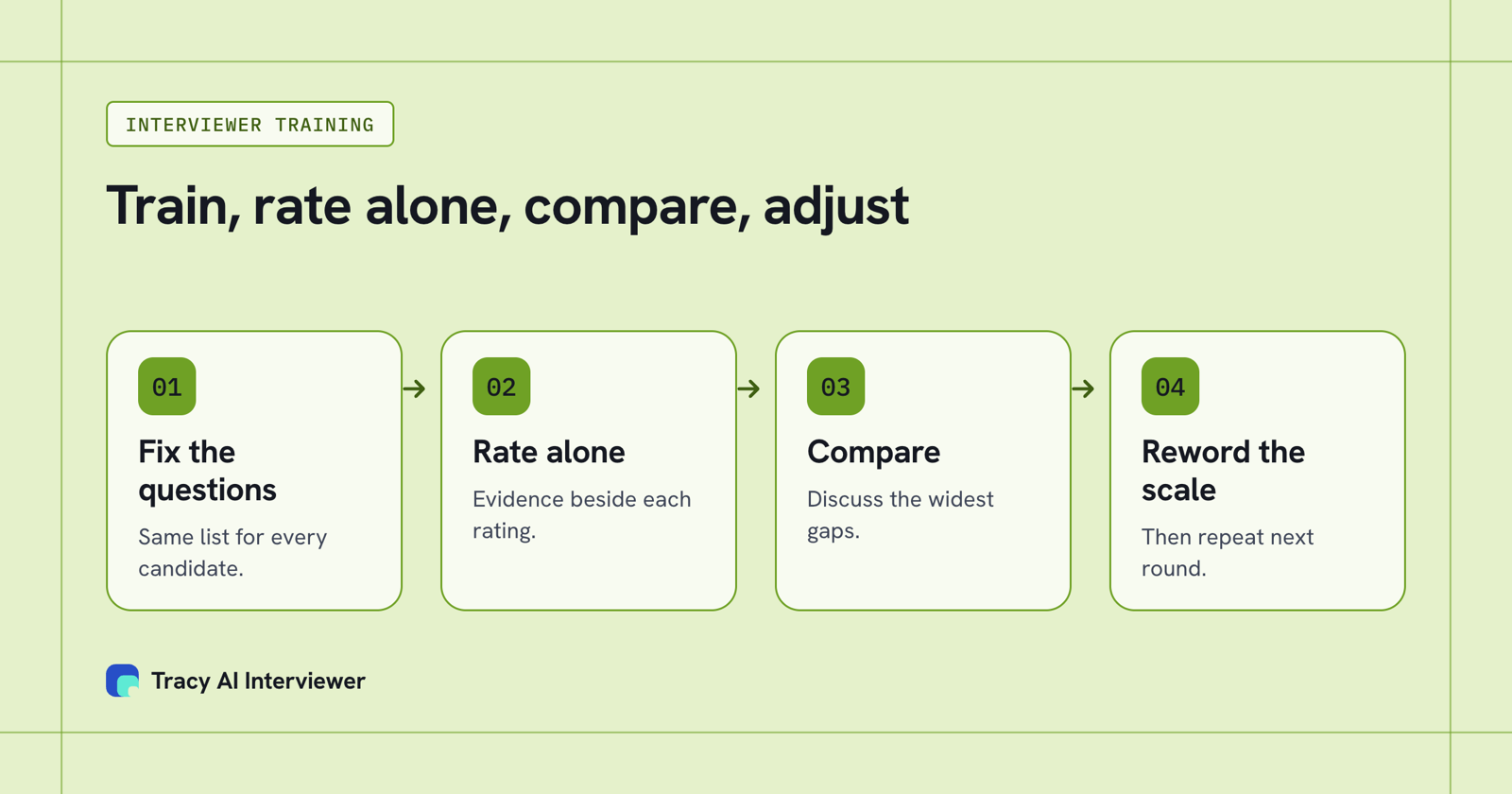
Each calibration round ends with a clearer scale, which the next round tests again.
Where does Tracy AI Interviewer fit in interviewer training?
Tracy takes the first round, so the managers' hours go to training, calibration and the later rounds. Describe the role and Tracy drafts the questions from it; you edit them or bring your own. Every applicant gets those questions, with a follow-up where an answer is thin, and starts on click at any hour with no scheduling.
The result also gives you training material. Each record holds what the person said to each question, with a timestamped transcript and a recording behind it. Give three records to every new interviewer, have them rate alone, then compare in the session above. Tracy does not score, rank or reject anyone. Managers rate, and managers decide.
One customer cut its average time to hire from 44 days to 7, and Tracy did the work of 53 full-time recruiters in one month. To get training material for your own team, run one role through Tracy and read three records together; the first 3 results are free. For the hiring-volume case, see high-volume recruitment.
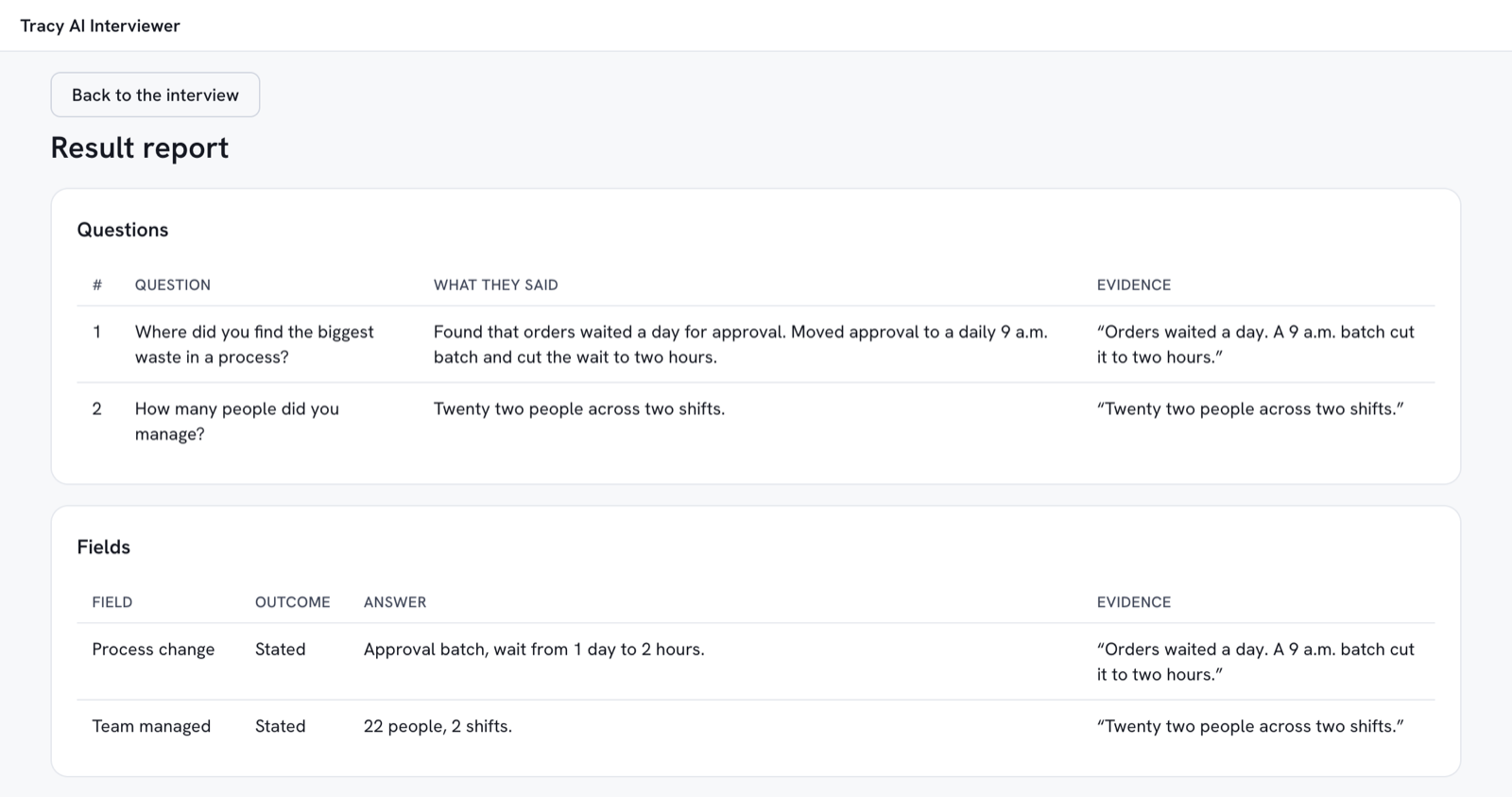
Every manager reads the same quotes, so ratings can be compared and the scale reworded.
Leave the judgement calls with people
Managers keep the questions for later rounds, the ratings, the debrief and the decision. They also keep the calls no record settles, such as a nervous candidate with strong detail, or a gap that matters more for this team than for another. Tracy reports what was said and what supports it. For the debrief that follows, see interview debrief template.
Pilot it with one team for four weeks
Pick one role family and one named owner, usually the head of talent. Decide the stop condition before week 1.
- Week 1: write the three or four things to look for and the fixed questions for the role.
- Week 2: run the first calibration session on three records and reword the scale.
- Week 3: managers run their live rounds from the guide, and the owner reads two sets of notes per manager.
- Week 4: run a second session on new records and compare the ratings.
A stop condition we would use: if two managers still differ by two points or more on a third of the rows, rewrite the scale before adding another team.
Which numbers show the training is working?
- Share of interviews that used the fixed questions.
- Agreement between two managers rating the same record, counted when they are within one point.
- Share of ratings with a quote beside them.
- Days from application to first interview.
- Manager hours per hire spent on first-round calls.
- Drop-off between the invitation and a finished interview.
Hours of training delivered and course completion are the vanity figures here, and they say little about how the interviews went.
Which path fits you
- Spotting weak habits in interviews you already run: signs of a bad interviewer.
- Tired interviewers late in the day: interviewer fatigue.
- Building the rating sheet: interview scorecard template.
- Hiring many people at once: Tracy for hiring at volume.
Common questions
What should interviewer training cover?
How often should interviewers be retrained?
How long does interviewer training take?
Does training remove bias?
Interview every applicant, not just a few
Create one role as an interview and read three records with your managers. Your first 3 results are free.
Try it free (opens in a new tab) Book a demo (opens in a new tab)
Your first 3 results are free. No card needed.
Sources
- Sackett, Zhang, Berry and Lievens (2022), Journal of Applied Psychology 107(11), retrieved 9 Nov 2026.
- Morales and Lopez (2026), The Interview Trap, F1000Research, retrieved 23 Nov 2026.