In short
Interviewer fatigue is the attention and consistency lost as one person runs interview after interview, and it can show up as lower ratings later in the day.
Tracy AI Interviewer takes the first round. Every applicant starts on click at any hour, gets the same questions with follow-ups, and leaves a record for a reviewer to read when fresh.
Cap the daily load, rate straight after each interview and read records in short batches. Reviewers still tire, and a person decides.
What is interviewer fatigue?
Interviewer fatigue is the drop in attention, memory and judgement that builds as one person runs interview after interview. It shows up as skipped questions, thinner notes and ratings that follow the hour of the day more than the candidate. The research below does not isolate fatigue from other causes, so read it as one likely contributor.
One seven-year record from a single academic centre, Columbia University Irving Medical Center, covers 387 ophthalmology residency candidates, 4,562 evaluations and 40 interviewers. Morning candidates averaged 52.75 on a percentile scale and afternoon candidates 49.28. Early morning averaged 54.47 and late afternoon 46.74. Breaks, interview day and gender had no significant effect. The authors suggest interviewer and decision fatigue, and note that a check for candidate fatigue found nothing. The data is retrospective and from one site, and the mechanism is left open.
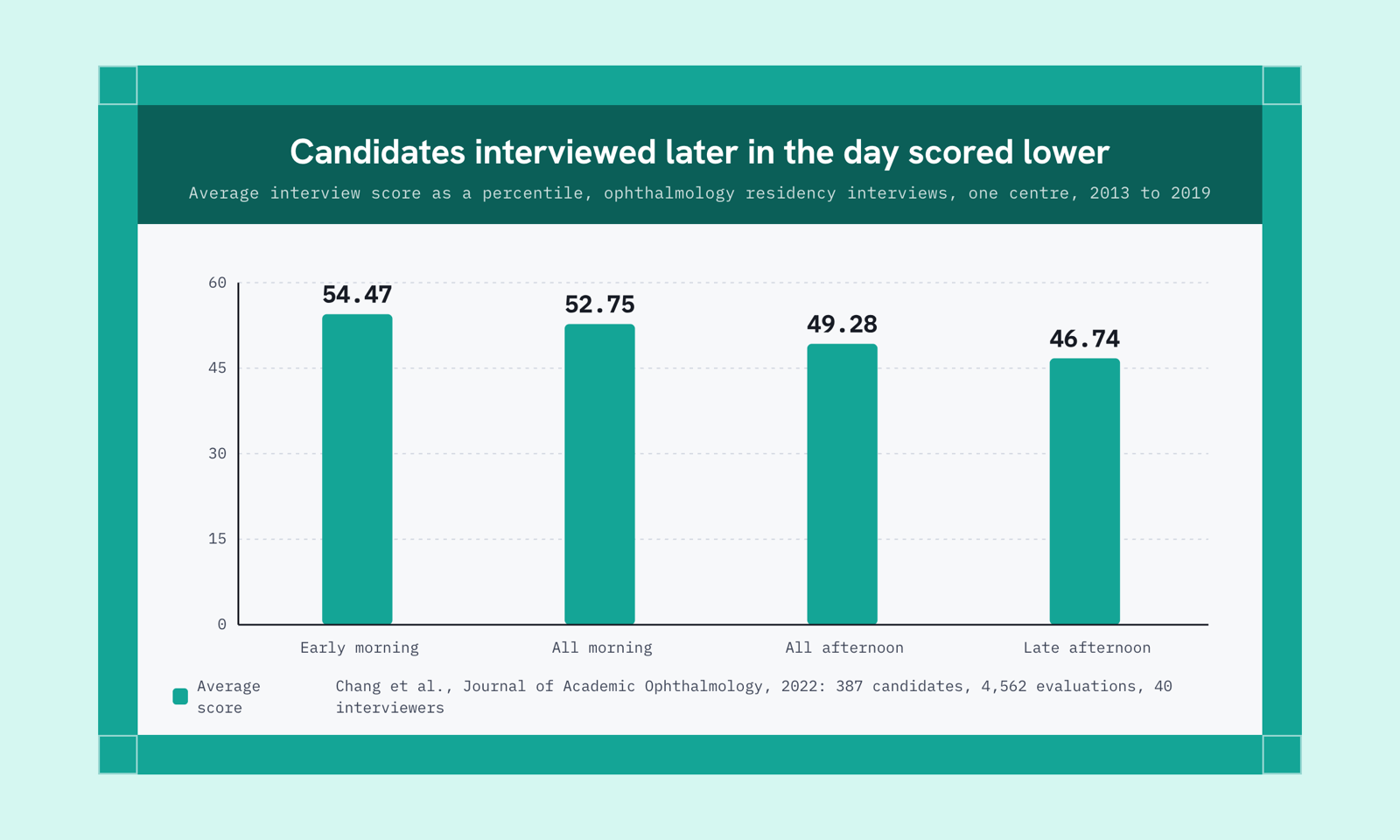
Scores in one residency programme fell from early morning to late afternoon.
Is fatigue the only reason late interviews score lower?
No. A study of more than 9,000 MBA admission interviews by 31 interviewers found that an applicant interviewed after strong candidates scored lower than they otherwise would, and one interviewed after weaker candidates scored higher. The authors call it narrow bracketing: a day's few people are judged against each other instead of against the full pool. That is a comparison effect, not tiredness, and a written scale is the usual answer to it.
How many interviews are too many in a day?
The studies above set no limit, so the number has to come from your own data. A starting cap we would try is four first-round interviews per interviewer per day, with a break between pairs. Then compare ratings and note length by hour for a month and move the cap.
These are the checks to run on your own records. None comes from the studies.
| Where | What to compare |
|---|---|
| Ratings | Average rating by start hour and by position in the day |
| Notes | Quotes or words per note, by position in the day |
| Questions | Share of interviews where the fixed list was finished |
| Follow-ups | Share of answers that got a follow-up note |
| Delay | Time between the end of an interview and the rating entered |
What would the check show? A hypothetical day
Say one interviewer runs six first-round calls between 9 and 4, and you pull the notes. The first two hold about 120 words each and three quotes. By the fifth, the note is 40 words and has no quote, and the fixed list was cut from eight questions to five. The calendar asked one person to do the same careful job six times, and the notes got thinner each time.
For that day, cap the count, move two of the calls to another interviewer, and let the notes template carry the memory. This example is invented to show what to look for; your own numbers will differ.
How do you reduce interviewer fatigue?
Take load off the person before asking them to try harder.
- Cap the day. Agree a number per interviewer with the managers, and keep it when a role gets urgent.
- Rate right after each interview and against the written scale, not against the person before.
- Spread candidates across the day, so one group does not always get the late slots.
- Hand the interviewer a fixed question list and a notes template, so a tired person has less to remember.
- Move the first round off human calendars when volume is the cause.
For how to teach the scale and the fixed list, see interviewer training. For the structure itself, see how to conduct a structured interview.
What should you tell the interviewers?
Tell them the cap protects the quality of the interviews and says nothing about effort. Say that ratings are compared by hour, and that nobody is judged on a single day's numbers. Ask them to tell you when a day runs over, so the schedule changes instead of the notes thinning out. A cap that people hide from you is worse than no cap, because the data you need to adjust it stops arriving.
Where does Tracy AI Interviewer fit?
When volume is the cause, the first round is the load. Gem's 2025 benchmarks, drawn from its customer data for January 2021 to December 2024, put the average recruiter at 14 open requisitions at once, 56% more than in 2021.
Tracy runs that first round. Describe the role and Tracy drafts the questions, which you edit or replace. Each applicant starts on click, at any hour, with no calendar to coordinate, so nobody is booked into a late slot. Tracy asks a follow-up where an answer is thin. Your team gets what each person said to each question, a recording, a timestamped transcript and a note for the ATS. In one customer's case Tracy did the work of 53 full-time recruiters in one month.
Reviewers still tire. Read records in short batches in the hours you are sharpest, and keep the decision with a person: Tracy does not score, rank or reject anyone. To try it on one role, create the interview and read the first results yourself; the first 3 are free. For the wider volume problem, see high-volume recruitment.
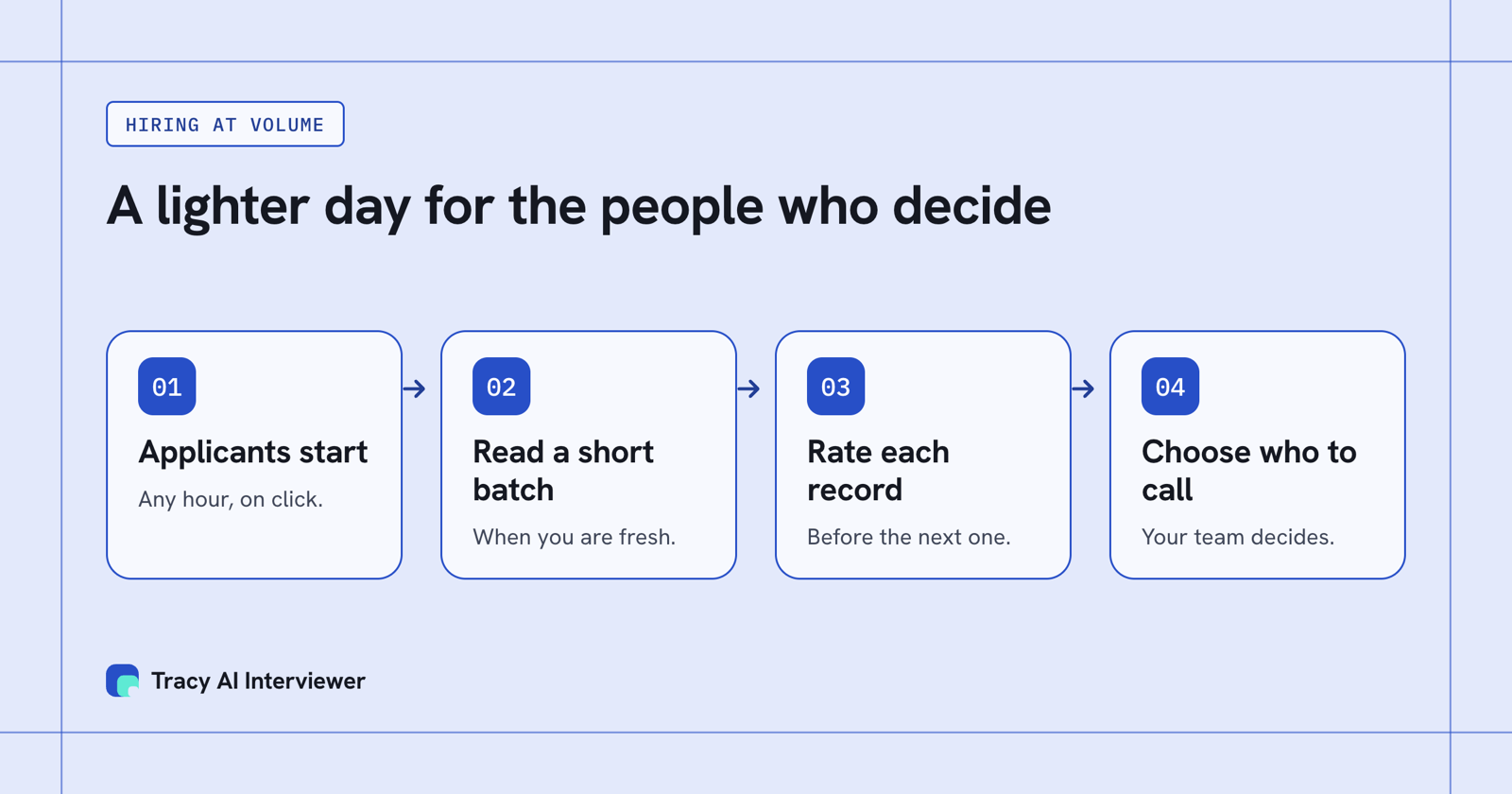
The first round moves off interviewer calendars, and the deciding people read records in batches.
Is interviewer fatigue the same as interview fatigue?
No. Interview fatigue usually means candidates worn out by round after round, while interviewer fatigue is the same strain on the other side of the table. Fewer, shorter and better-scheduled rounds help both.
Which path fits you
- Interviewers who need a shared scale: interviewer training.
- Spotting habits that cost you candidates: signs of a bad interviewer.
- Too many applicants for the calendar: how to screen hundreds of applicants.
- Running the first round at scale: Tracy for hiring at volume.
Common questions
What is interviewer fatigue?
How many interviews are too many?
How do you reduce interviewer fatigue?
Does time of day change interview scores?
Interview every applicant, not just a few
Create one role as an interview and let applicants start at any hour. Your first 3 results are free.
Try it free (opens in a new tab) Book a demo (opens in a new tab)
Your first 3 results are free. No card needed.
Sources
- Chang et al. (2022), Exploring potential schedule-related and gender biases in ophthalmology residency interview scores, retrieved 23 Nov 2026.
- Knowledge at Wharton (13 Feb 2013) on Simonsohn and Gino, Psychological Science, retrieved 23 Nov 2026.
- Gem, 2025 Recruiting Benchmarks Report, retrieved 18 Nov 2026.