In short
Tracy AI Interviewer interviews every customer success applicant on a real account story and follows up on what they actually did, so you hear judgement, not rehearsed answers.
Use the 15 customer success manager interview questions below, written for the interviewer, each with a follow-up and what to listen for.
Every result keeps a recording, a timestamped transcript and a written assessment per question; you decide.
Next step: create an interview from your job description.
You post a customer success role and a hundred people apply, most with the same phrases: relationship building, retention, stakeholder management. The CV does not say who has saved an account and who sat near one. Customer success manager interview questions have to ask for the account story and then ask what the person did next.
These 15 customer success manager interview questions are written for the interviewer: a head of customer success, a hiring manager or a recruiter screening for the role. Each has a follow-up and a note on what a strong answer contains. They suit a first conversation of 20 to 30 minutes; a role play with your own team belongs in a later round.
Tracy AI Interviewer runs that first conversation at volume. She asks each candidate in their own field, follows up on what they said and waits for the end of the thought. See volume hiring for the wider process and how to screen candidates for the steps before it.
Fifteen customer success manager interview questions, grouped by what they test
Pick one or two from each group. Ask the follow-up only after the first answer. Choose your opening questions for the role and write down what a strong answer contains before the first candidate joins.
Group 1: retention and risk
1. Tell me about an account that was close to leaving.
- Follow up with
- What did you change in the account after that?
- Listen for
- A named account, a cause found by asking, a change that followed, the outcome.
2. How do you know an account is at risk before the customer says so?
- Follow up with
- Which signal has been wrong?
- Listen for
- Usage, support tickets, a changed sponsor. Admits a false alarm.
3. Describe a customer you lost.
- Follow up with
- What would you do differently now?
- Listen for
- Owns part of it. A lesson that shows in how they work today.
Group 2: onboarding and adoption
4. How do you run the first 30 days with a new customer?
- Follow up with
- Where do new customers most often stall?
- Listen for
- A plan with milestones. A real stall point and what they did about it.
5. A customer bought the product but nobody uses it. What do you do?
- Follow up with
- Who do you speak to first?
- Listen for
- Finds the cause before offering training. Reaches users, not only the buyer.
6. How do you decide which customers get your time?
- Follow up with
- Tell me about one you deprioritised.
- Listen for
- A rule they can state. Comfortable with a trade-off.
Group 3: difficult conversations
7. A customer asks for a feature you will not build. What do you say?
- Follow up with
- How did that customer react?
- Listen for
- Honest no, the reason, an alternative. Keeps the relationship.
8. Tell me about a conversation with an angry customer.
- Follow up with
- What did you say first?
- Listen for
- Listens before explaining. A concrete opening line.
9. How do you handle a request from sales that conflicts with what the customer needs?
- Follow up with
- What did you give up?
- Listen for
- Names both sides and a decision. Does not blame.
Group 4: commercial sense
10. How do you prepare for a renewal?
- Follow up with
- When do you start, and why then?
- Listen for
- Starts early, ties value to what the customer said they wanted at signing.
11. Tell me about an expansion you helped create.
- Follow up with
- How did you know the customer was ready?
- Listen for
- Need first, offer second. No pressure story.
12. How do you show a customer the value they have received?
- Follow up with
- What if the numbers are not good?
- Listen for
- Uses the customer's own measures. Does not hide a weak quarter.
Group 5: working inside the company
13. How do you pass a customer problem to product or engineering?
- Follow up with
- Tell me about one that got fixed.
- Listen for
- A clear write-up, evidence, follow-through.
14. How do you keep notes so a colleague could take over tomorrow?
- Follow up with
- What do you always write down?
- Listen for
- History, decisions, owners, next dates.
15. What does a good week look like for you in this role?
- Follow up with
- What do you drop when it goes badly?
- Listen for
- Realistic, customer-led, knows what to cut.
A strong answer tells you what changed, and a weak one stays general
What matters comes in the second answer. We wrote these pairs to show how it sounds; none is a quote from a real candidate.
Table 6: Weak and strong answers to the same questions, written as examples.
| Weak answer | Strong answer | |
|---|---|---|
| Question 1, the account near leaving | "I built a strong relationship with them." | "Usage dropped, so I called their sponsor. The team had never been trained. I ran two sessions and they renewed." |
| Question 7, the feature request | "I'd tell them we'd pass it to product." | "I'd say we are not building it this year, explain why, and show them the closest thing that works today." |
| Question 10, the renewal | "I'd send a reminder 60 days out." | "I'd start at signing: what did they say they would measure? At renewal I show that number, good or bad." |
Listen for what changed. A story that ends with a customer's feeling tells you less than one that ends with a decision.
One follow-up chain shows where the real answer starts
This is an illustration with sample data, not a real interview. The candidate is fictional. It shows the shape of what Tracy runs: an opening question from your list, the answer, and a follow-up built on it. It starts from question 1.
Tracy: Tell me about an account that was close to leaving.
Candidate (fictional): A client stopped logging in. I called their sponsor and found out why.
Tracy: What did you change in the account after that call?
Candidate: Their team had never been trained. I ran two short sessions and set a monthly check on usage.
Tracy: How did you know it had worked?
Candidate: Logins doubled within six weeks, and they renewed for a second year.
The first answer is the one every candidate prepares. By the third you know whether the account was theirs.
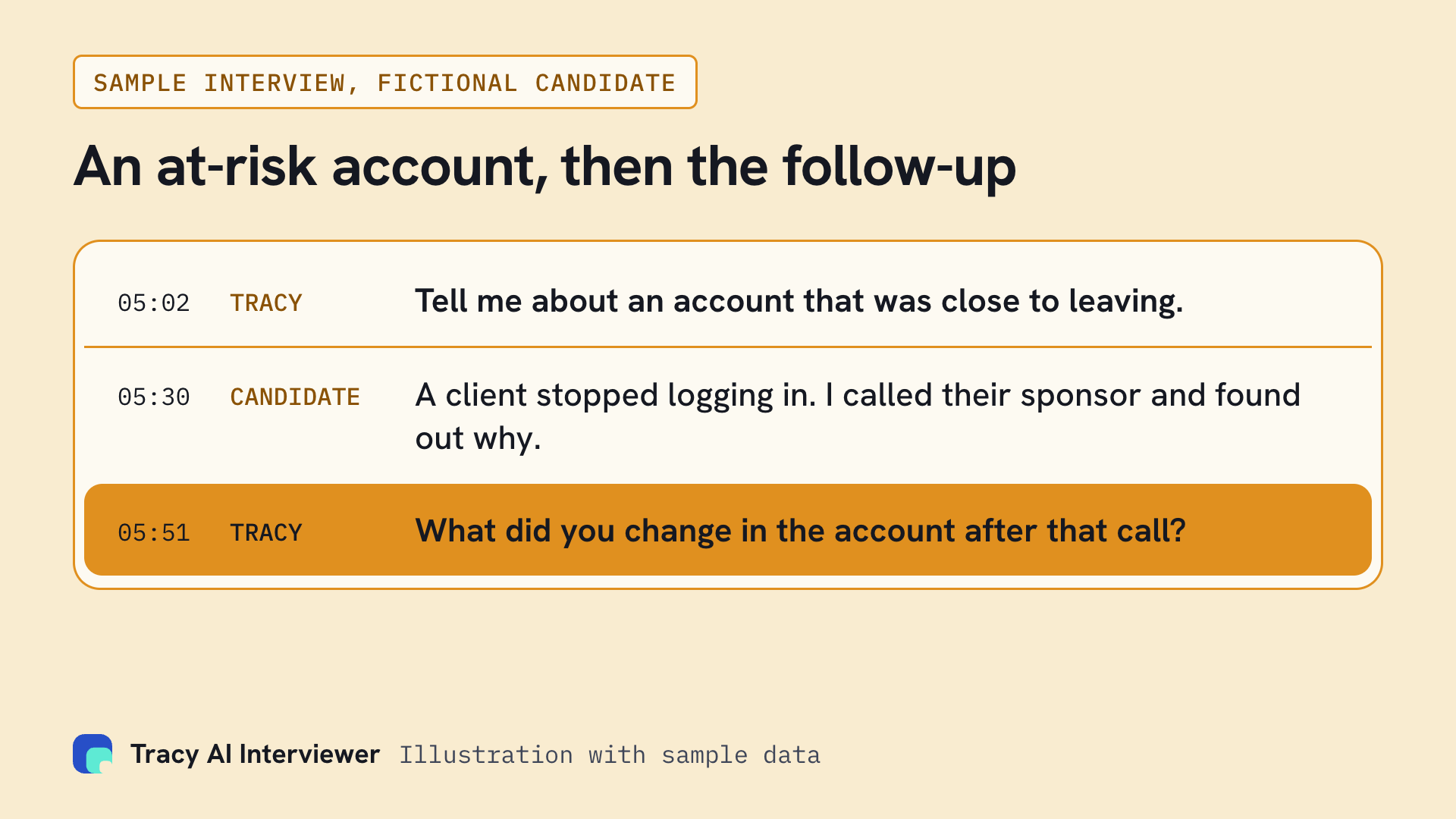
A follow-up on a real account story shows what the candidate changed, not only how they felt.
Run the interview for every applicant without losing the follow-up
A live call for every applicant does not survive a hundred applications.
- Set up from a job description. Tracy drafts the questions from the JD, which you edit, or you paste your own, from quick to deep and behavioural to technical. See the product page.
- Follow-ups on the story. If the candidate names an account, Tracy asks what they changed and how they knew it worked.
- Start on click. Each candidate opens a link in a browser, with no account and no calendar, at any hour, and is told on the join screen that the conversation is recorded and transcribed. See the participant experience.
- A result you can check. A recording and a timestamped transcript sit behind every result, with a written assessment per question. See AI interview reports.
It is $1 per credit, one credit per started 20 minutes of an interview that produced a result. The first 3 results are free with no card, and there are no seats. See pricing.
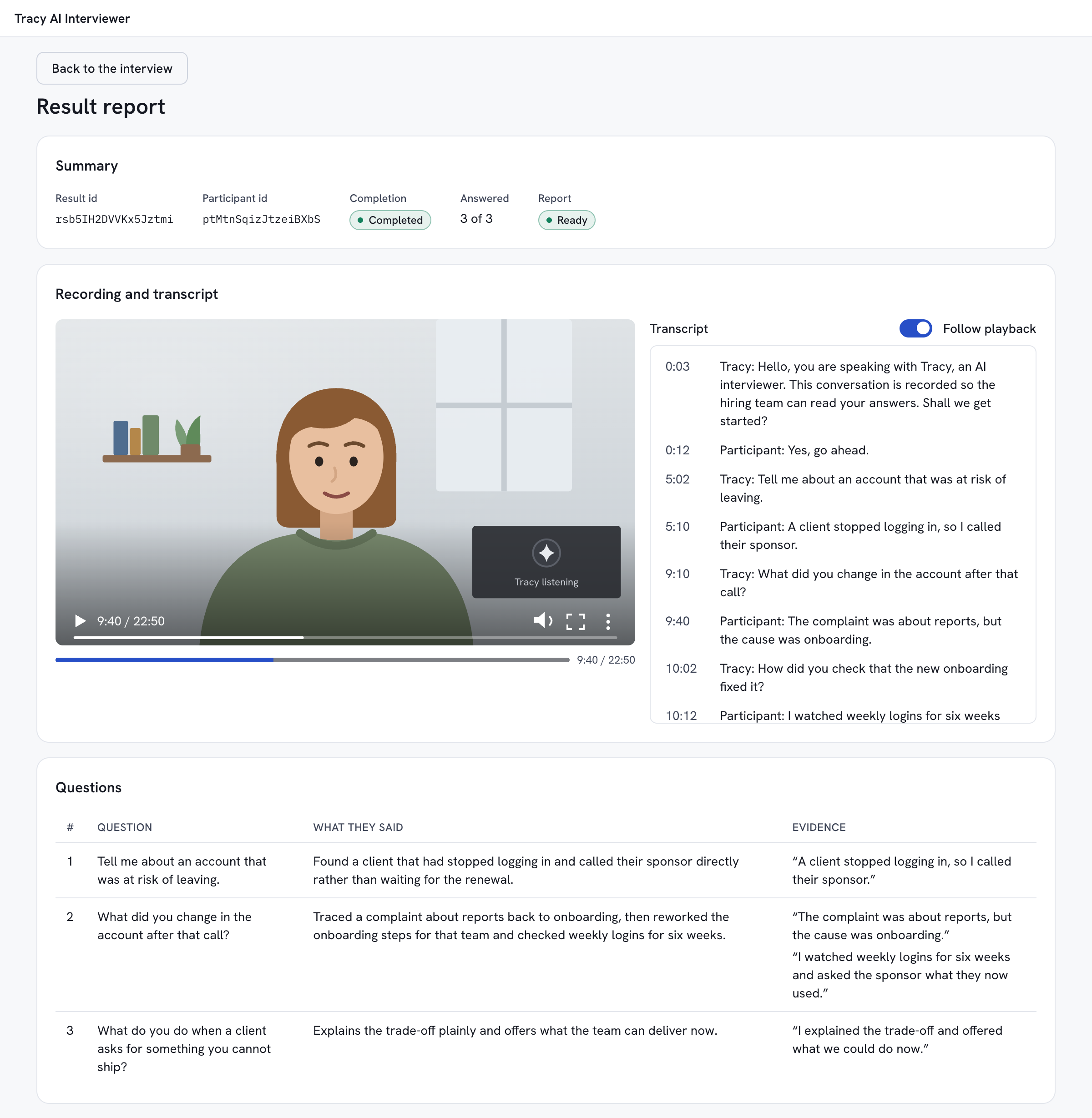
The hiring manager can read what the candidate said to each question, with the recording and transcript beside it.
Keep three decisions with people
- Who moves forward. The hiring manager reads the report and decides. A recruiter decides: they can move a candidate forward or invite them to interview again, and the history stays on the record.
- The calibration. Have one customer success lead read five transcripts blind. If they disagree with the written assessments, change the questions first.
- The live round. A role play on a hard customer call, and a conversation about team fit, stay with your people.
For two or three hires a year, a call with the hiring manager is simpler; see AI interview vs human interview. The case for Tracy starts when applicants outnumber the hours you have. To try it, build an interview from one job description, send it to your next applicants and read the first reports before you decide how far to go.
Common questions
What are good customer success manager interview questions?
What customer success manager interview questions suit someone senior?
How do client success manager interview questions differ?
Can Tracy interview customer success applicants?
Does Tracy decide who to hire?
Try Tracy on your next role
Tracy interviews every applicant, asks follow-up questions and sends you a ranked shortlist.
Try it free (opens in a new tab) Book a demo (opens in a new tab)
Your first 3 results are free. No card needed.
Sources
- Tracy AI Interviewer home page, retrieved 9 Nov 2026.
- Tracy AI Interviewer pricing, retrieved 9 Nov 2026.
- Tracy AI Interviewer Connect page, retrieved 9 Nov 2026.