What Is an AI Interviewer? How It Works and What to Check
 An AI interviewer is software that runs part of an interview. It asks a candidate questions, receives answers by voice, video or text, and produces a recording, transcript, summary or evaluation for a person to review.
That definition excludes tools that only schedule an interview or rank a CV. It also covers more than the familiar one-way recording. Some AI interviewers hold a two-way spoken conversation and ask a follow-up based on the answer they just heard.
The three common AI interview formats
1. One-way recorded interview
The candidate sees or hears a preset question, gets preparation time, then records an answer. The next prompt is already chosen. Spark Hire's documentation describes this flow, including optional time limits, think time and retakes.
One-way video is useful when a team wants the same short prompts from every candidate. It is asynchronous, so nobody has to match calendars. The trade-off is fixed depth: if an answer is vague, the system cannot ask what the candidate personally did.
2. Text or chat interview
The candidate answers in writing. A chat interviewer may ask a fixed sequence or generate a follow-up. Text can work for eligibility, availability and short structured questions. It is less suitable when spoken communication or explaining a decision aloud is part of the role.
3. Two-way spoken AI interview
The candidate speaks with an AI interviewer by video or audio. The system listens to an answer and can choose a follow-up before moving on. Tracy AI Interviewer, HireVue, Alex and HeyMilo each describe a conversational interview product, though their scope, channels and reports differ.
This format matters when the hiring signal sits one question deeper. "I led the migration" can become "Which part did you own?" A system design answer can become "What fails first at ten times the traffic?"
How does an AI interviewer work?
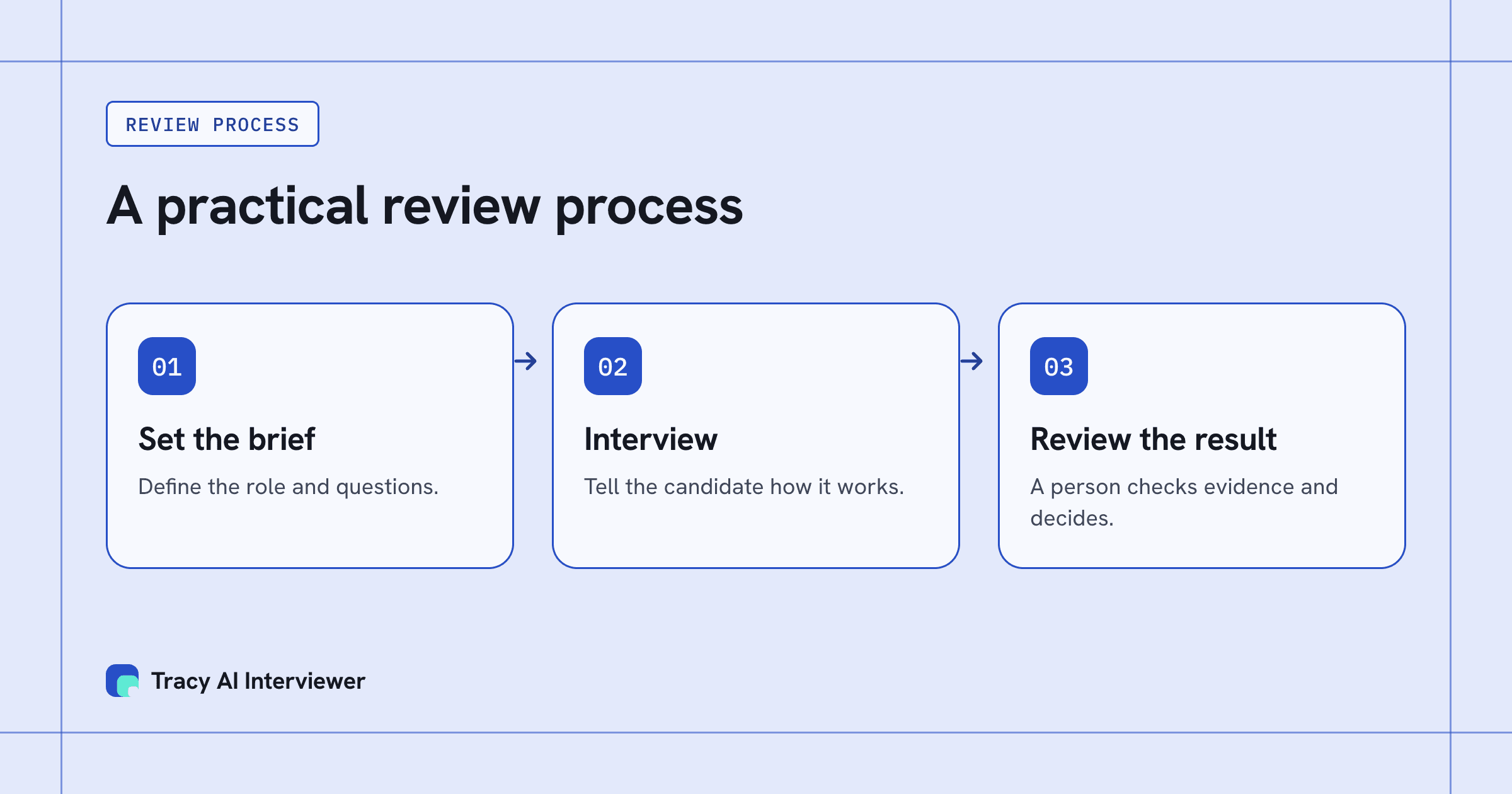
The exact system varies, but a responsible workflow has seven visible steps.
- The team defines the job of the interview. A first round might check relevant experience, a technical task, availability and motivation. The interview should not collect information nobody will use.
- The team reviews the questions and rubric. The product may draft questions, but a person should check wording, relevance and the standard for a strong answer.
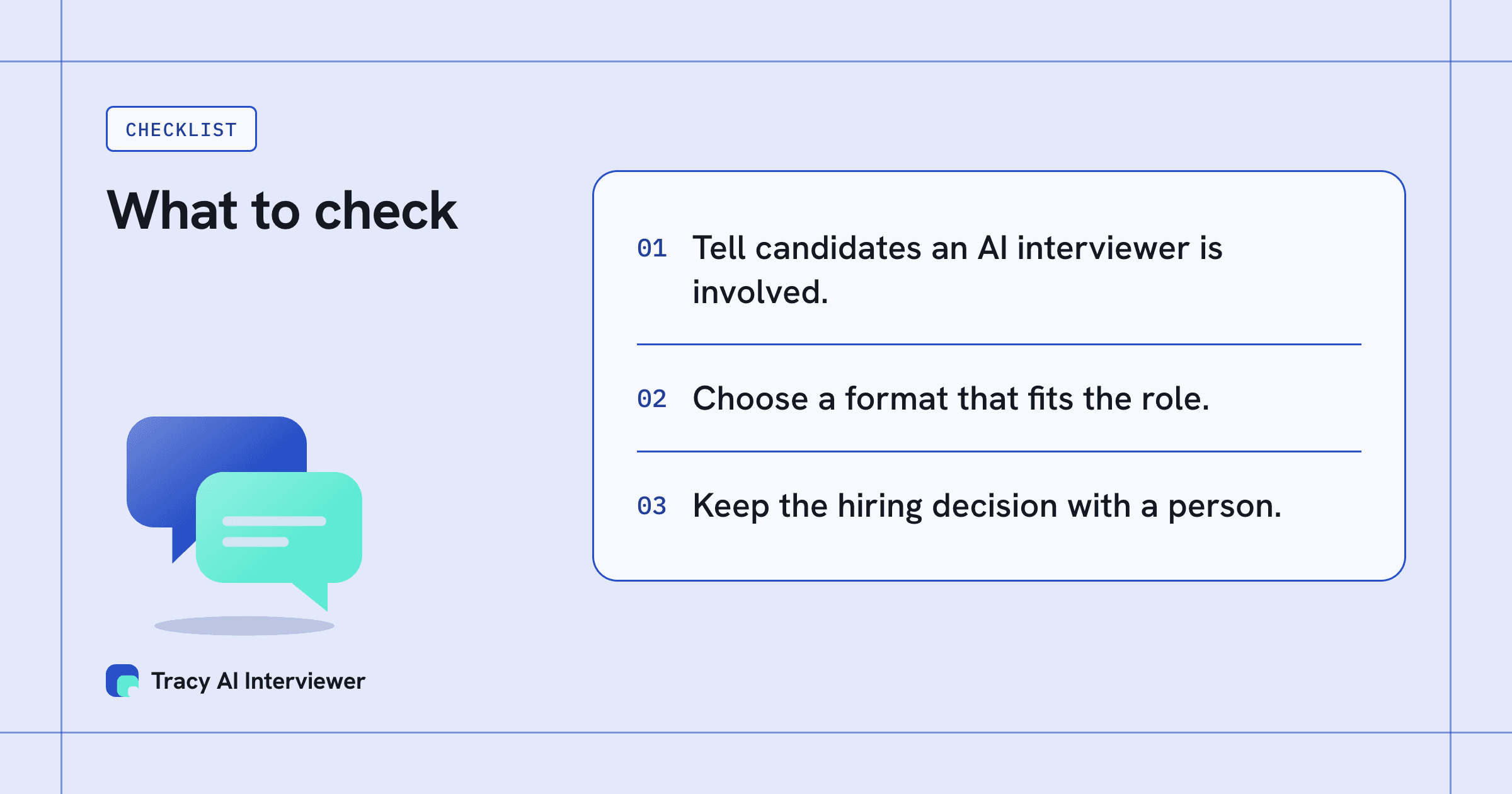
- The candidate receives a clear invitation. It should say an AI interviewer is involved, whether the session uses video or audio, what is recorded, and who reviews the result.
- The candidate joins and answers. Some tools require an account or app. Tracy's current product page says participants can join from a browser link without signing up.
- The interviewer follows its question plan. In a one-way system, that means the next preset prompt. In a conversational system, the next question may depend on the answer.
- The system builds a result. Depending on the product, this may include a transcript, recording, structured fields, quotes, scores, rationales and integrity signals.
- A person reviews and decides. The recruiter or hiring manager checks the evidence, resolves uncertain flags and chooses the next step.
Step 7 keeps the decision with a person. Greenhouse's 2026 candidate research found 38% of US candidates wanted confirmation that a person reviews AI output before a decision. In Pew's older survey, fielded in December 2022, 71% of US adults opposed AI making the final hiring decision.
What can an AI interviewer ask?
The useful range is wider than basic screening, but the questions still need to match the role.
- Experience: "Tell me about the last billing system you migrated."
- Behaviour: "Tell me about a decision your team disagreed with."
- Technical reasoning: "How would you make that service tolerate a regional outage?"
- Work sample: "Walk me through this code and identify the bug."
- Eligibility: "When could you start?"
- Role constraints: "Are you available for the stated shift pattern?"
For a spoken interview, the follow-up is often more revealing than the opening prompt. A candidate can prepare a broad success story. It is harder to prepare every detail about the constraint, mistake, measurement and personal contribution.
Our software engineer interview questions turn that principle into 25 question-and-follow-up pairs.
What should the report contain?
A useful report lets the reviewer move from a conclusion back to the answer that supports it. Look for:
- the questions asked and the candidate's full transcript;
- the recording, when the candidate agreed to video or audio;
- structured fields tied to the team's brief;
- direct quotes or timestamps behind each summary point;
- the reason for any score, not only the number;
- clear separation between observed evidence and generated interpretation;
- integrity signals presented for human review;
- a record of who made the hiring decision.
Tracy's current product page describes structured results backed by the participant's words, with direct quotes, video or audio and adaptive follow-ups. This description comes from Tracy's own page.
See what an AI interview report should contain for a field-by-field checklist.
What are AI interviewers good at?
Giving every applicant the same first opportunity
An asynchronous link can stay open across time zones, and a core question set can remain consistent. This helps when applicant volume exceeds recruiter hours.
Consistency does not guarantee fairness. A consistently irrelevant question is still irrelevant. The team must review the brief, accommodations and outcomes.
Asking for specifics at scale
A conversational interviewer can challenge a vague claim with a neutral follow-up. This is useful in technical, expert and behavioural screens where the evidence appears in the second answer.
Turning a conversation into reviewable evidence
A structured report can save the hiring manager from replaying every minute. The saving is real only when the summary is traceable. Reviewers should be able to check a quote, transcript or recording when something looks strong, weak or inconsistent.
What are the limits?
You still have to define the job
Generic questions create generic evidence. The team needs to name the decisions, skills and constraints that matter.
Generated scores can be wrong
A polished explanation is not proof that a score is correct. Keep the underlying answer, show the rationale and make uncertain or consequential decisions reviewable.
Candidate access differs
Video, speech recognition, bandwidth, disability and language can affect the experience. Offer clear technical requirements, practice, accommodations and another route when needed.
Monitoring can damage trust
Greenhouse found 26% of US candidates named monitoring during an AI interview as a reason they would withdraw. Collect only what is needed, disclose it before the session and treat a signal as a prompt to inspect, not a verdict.
Automation can make a bad process faster
Greenhouse reported 51% of surveyed US candidates who completed an AI interview never heard back. An interview tool should connect to an outcome and a response, not become a holding pen.
AI interviewer buyer checklist
Ask a vendor to show the candidate journey and the reviewer journey in the same demo.
| Area | Question to ask |
|---|---|
| Format | Is it one-way, chat or a live spoken exchange? |
| Follow-ups | Can it ask about the candidate's actual answer? |
| Evidence | Can a reviewer trace each conclusion to a quote, transcript or recording? |
| Decision | Does a person approve every progression or rejection? |
| Disclosure | What does the invitation tell the candidate before they begin? |
| Access | What alternatives and accommodations are available? |
| Data | What is recorded, where is it stored and when is it deleted? |
| Integrity | Which signals are collected, and can a person review the underlying moment? |
| Cost | Is pricing per result, interview, seat, role, month or hire? |
| Workflow | How does the result reach the ATS and hiring manager? |
Run the same sample brief through two products. Answer once with a clear example and once vaguely. Then compare the follow-up, the report and the evidence behind any score. A feature list cannot show those differences.
For the financial comparison, see AI interview cost. For format trade-offs, see one-way vs two-way video interviews.
Questions
What is an AI interviewer? An AI interviewer runs part of an interview by asking questions, receiving spoken, video or text answers, and producing a record or structured report for a person to review.
Is an AI interview the same as a one-way video interview? No. A one-way interview presents preset prompts and records answers. A two-way AI interviewer can ask a follow-up based on what the candidate just said.
Does an AI interviewer make the hiring decision? It should not. A responsible workflow uses the tool to collect and organise evidence while a recruiter or hiring manager reviews it and decides.
What does a candidate experience in an AI interview? The candidate receives an invitation, learns the format and data use, joins by link, answers questions, and may receive follow-ups. The exact experience varies by vendor.
What should I ask an AI interview vendor? Ask about disclosure, follow-up behaviour, report evidence, accessibility, retention, security, integrations, pricing, integrity signals and where human review occurs.
See how Tracy works as a two-way video or audio interviewer with adaptive follow-ups.
Sources
All sources retrieved 2 Nov 2026.
- Tracy AI Interviewer, product page: two-way video and audio, browser access, adaptive follow-ups, technical tasks, structured results and human decision.
- HireVue, AI Interviewer: two-way voice interview, follow-up questions and recruiter review.
- Alex, AI Interviewer: video, phone and chat formats, scheduling and follow-up positioning.
- HeyMilo, product page: voice, video, SMS and form channels, scoring and multilingual scope.
- Spark Hire, one-way video overview: fixed one-way format, think time, retakes and review.
- Greenhouse, 2026 Candidate AI Interview Report release: candidate disclosure, monitoring, human review and outcome findings.
- Pew Research Center, AI in hiring and evaluating workers: US public attitudes measured in December 2022.