
In short
A debrief goes well when the first questions ask what the candidate said. The tables below give interview debrief questions in four stages: evidence, disagreement, decision and process.
Tracy AI Interviewer gives the whole panel one record of each interview: a recording, a timestamped transcript and a written summary of what was said per question, from an interview that followed up on thin answers.
Tracy does not rate or rank anyone. The panel debriefs, and a person decides.
Panels often open a debrief with "so, what did everyone think?" and the most confident voice sets the answer. Good interview debrief questions start from the interview itself. Copy the four tables below into a shared document, ask them in order, and the discussion has something to point at. The meeting format, with its agenda and disagreement log, is in the interview debrief template; this page is the questions.
What questions should you ask in an interview debrief?
Ask what was said first, where interviewers differ second, what decides the question third, and what to improve last. Each stage has a few questions you can use word for word.
Stage 1: Evidence
| Question | Why it helps |
|---|---|
| What did the candidate say on this criterion, in their words? | Starts from a quote, not a mood |
| Which answer needed a follow-up, and what did it give you? | Shows how deep the interview went |
| What did you not get to ask? | Marks gaps before anyone votes |
Stage 2: Disagreement
| Question | Why it helps |
|---|---|
| Where did your ratings differ by two points or more? | Spends time where it is needed |
| What did you hear at the moment you rated it that way? | Moves the argument to evidence |
| Would the other answer change your mind if you read it again? | Tests whether the view can move |
Stage 3: Decision
| Question | Why it helps |
|---|---|
| Which criterion matters most for this role, and does the candidate meet it? | Keeps the bar fixed |
| What would change your vote? | Names the open point |
| What is the one question the next round must answer? | Hands over a clear task |
Stage 4: Process
| Question | Why it helps |
|---|---|
| Did every criterion get evidence? Which got the least? | Finds weak questions |
| Did anything we asked make a candidate's answer harder to give? | Catches unfair or unclear questions |
| What do we change before the next candidate? | Closes the loop |
How do you run an interview debrief?
Run it in the same order as the tables, with a few ground rules.
- Everyone submits their ratings and evidence before the meeting, and nobody reads anyone else's first.
- Whoever runs the meeting puts the stage 1 questions to the quietest person first.
- The panel settles one criterion at a time, from the record, before moving on.
- The meeting ends with a decision and the reason, written down.
Thirty minutes is our rule of thumb for one candidate and four criteria. The interview feedback form template covers what each interviewer writes before the meeting, and how to conduct a structured interview explains why every candidate gets the same questions.
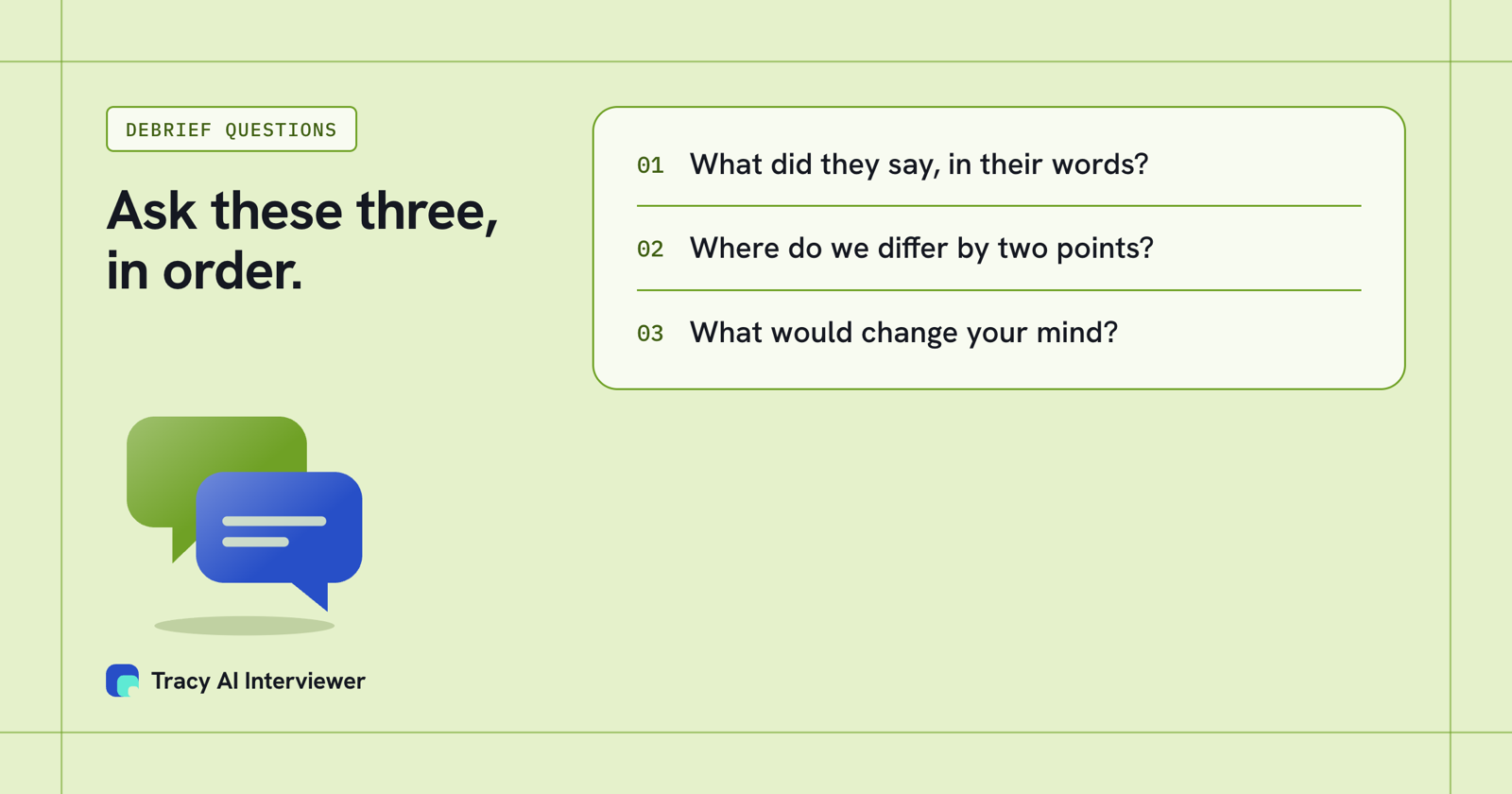
Three questions, in order, keep the debrief on evidence.
Hiring debrief or UX research debrief: what changes?
Both ask what a person said and what the team learned, and they end differently. A hiring debrief ends with a decision about one candidate against fixed criteria. A research debrief ends with what the team will change before the next session.
The US government's digital.gov guide to debriefing after user interviews gives three sets of starter questions: a warm-up ("What stood out about this interview?"), questions for a concept test or demo, and a retrospective that asks how the interview guide should change. It suggests about five minutes per section, then a group discussion. For customer interviews, the customer development interviews page has the questions to ask in the session itself.
What does a filled example look like?
A sample result for an invented candidate in a first-round interview. The panel opens on the evidence for one criterion, process improvement.
| Question | What the candidate said | Follow-up | Time |
|---|---|---|---|
| What would you change about how your team ships? | A short checklist before each release, to catch missing migrations | Who would own the checklist? | 02:20 |
| How long have you used that process? | Two years in the current team | Not asked | 04:10 |
Scroll the table sideways to see all 4 columns.
Stage 1 question: what did the candidate say, in their words? "A short checklist before each release would catch migrations." Stage 2: one interviewer rated the criterion a 4, another a 3. The follow-up asked who would own the checklist, so the panel replays 02:20 and settles whether the answer named a person.
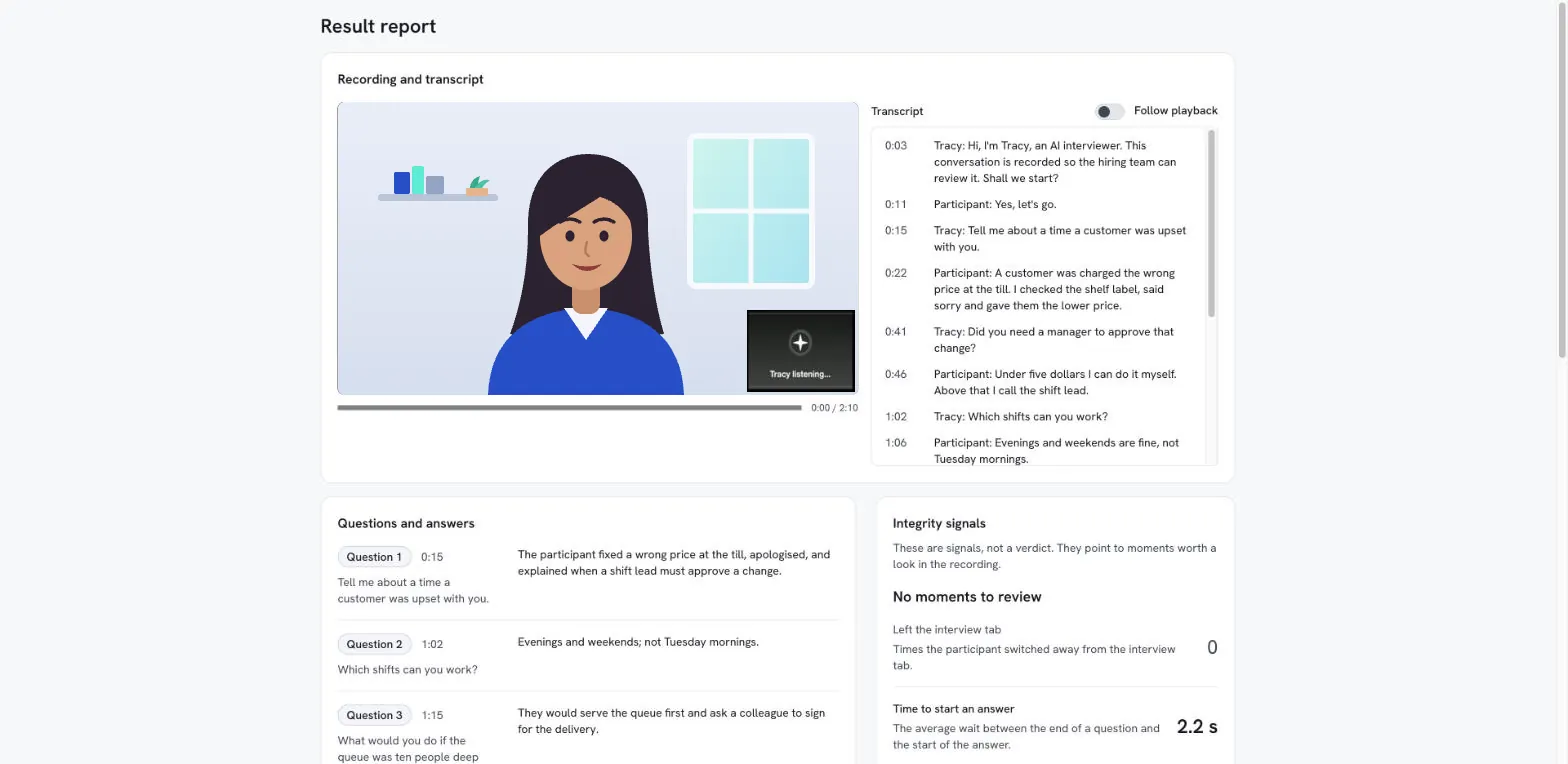
The whole panel can open the same recording and transcript at the same time.
How do you debrief from one shared record?
The stage 1 and stage 2 questions need something to point at. With Tracy AI Interviewer, each applicant takes the interview on a link, in a browser, at any hour. Tracy asks the follow-up when an answer is thin, and every panel member then opens the same result: a recording of both sides, a timestamped transcript and a written summary of what was said per question. See what an AI interview report contains.
Setup starts from the job description: Tracy drafts questions from it, and you edit them or bring your own. Pay-as-you-go is $1 per credit, one credit per started 20 minutes of an interview that produced a result, with no seats. Tracy does not rate, rank or reject candidates. The panel debriefs and a person decides.
Which path fits you
- Writing feedback after a single interview: the candidate interview summary template.
- Asking ChatGPT to tidy panel notes: ChatGPT for candidate feedback.
- Debriefing many first rounds for one role: the hiring at volume page.
Common questions
What questions should you ask in an interview debrief?
How do you run an interview debrief?
What is the difference between a hiring debrief and a UX research debrief?
What interview feedback questions should hiring managers answer?
Who should attend a debrief?
Give the debrief one shared record
Run one role as a Tracy interview, then open the debrief from its record. Your first 3 results are free.
Try it free (opens in a new tab) Book a demo (opens in a new tab)
Your first 3 results are free. No card needed.
Sources
- digital.gov, How to conduct an interview debrief (GSA), retrieved 23 Nov 2026.
- Tracy AI Interviewer pricing, retrieved 11 Nov 2026.