
In short
Recruitment ROI is the value of your hires minus what recruiting cost, divided by that cost, times 100. Below: the formula, a table to copy into a sheet and a worked example at 10, 50 and 200 hires a year.
At volume the first-round screen is the cost you can change fastest. Tracy AI Interviewer interviews every applicant on a link, sets up from your job description and follows up on each answer, at $1 per credit.
On the example inputs, swapping 40-minute phone screens for Tracy interviews cuts the screen line at 200 hires from about $80,000 to about $13,000.
Next step: put your own numbers in the table, then run one role as an interview.
A recruitment ROI calculator comes down to one formula and three inputs: what hiring cost you, what the hires are worth and how many hires you made. Most calculator tools take numbers in a form and return a percentage. This page gives you the formula, a table to copy into a sheet and a worked example at three volumes, so you can see which input moves the result. It sits next to the cost per hire guide, which covers the cost side alone.
What is ROI in recruitment?
Recruitment ROI is the return on what you spend to hire: the value the hires bring, set against the total cost of finding and hiring them. A result of 100% means the hires returned their cost and the same amount again. AIHR calls a percentage like 50%, and particularly 100%, indicative of a favorable hiring ROI.
It differs from cost per hire, which counts cost only, and from the other recruiting KPIs such as time to hire. Only ROI sets cost against value.
How is recruitment ROI calculated?
Recruitment ROI in percent is the total value of hires minus the total cost of recruitment, divided by the total cost of recruitment, times 100. Three steps get you there:
- Add up the cost for one period. Internal cost is the recruiting team's pay, tools and training. External cost is agency fees, job ad spend, assessments, background checks and ATS fees. Leave out what you spend after the hire starts, such as onboarding.
- Put one value on a hire. Choose a single measure and use it for every role in the period: first-year output minus pay, revenue per head, or the cost of the empty seat per month.
- Apply the formula. Cost per hire is total cost divided by hires, and it falls out of the same table.
That covers the usual ways to calculate ROI: the percentage, the cost per hire and the net return in dollars. Use all three, because a high percentage on a tiny budget says less than the dollars it returned.
The recruitment ROI calculator table
Copy the table into a sheet. Column B holds your entries and formulas, rows 2 to 10.
Table 1: recruitment ROI calculator
| Row | Cell | Entry or formula |
|---|---|---|
| Hires made in the period | B2 | Your number |
| Internal cost | B3 | Your number |
| External cost | B4 | Your number |
| Total cost of recruitment | B5 | =B3+B4 |
| Value per hire | B6 | Your number |
| Total value of hires | B7 | =B2*B6 |
| Net return | B8 | =B7-B5 |
| ROI in percent | B9 | =B8/B5*100 |
| Cost per hire | B10 | =B5/B2 |
Use the same period for every row, and set the value per hire before you see the cost, so the number is not bent to fit the answer.
A worked example at three volumes
The inputs below are an example, not a benchmark. Fixed cost is $40,000 a year (a share of recruiter pay, the ATS and tools). Variable cost is $1,500 per hire: about $400 of recruiter phone screens (15 screens per hire at about $27 each) and $1,100 of job ads, assessments and fees. Value per hire is $12,000 of first-year net output.
Table 2: worked example (example inputs)
| Hires a year | Total cost | Cost per hire | Total value | ROI |
|---|---|---|---|---|
| 10 | $55,000 | $5,500 | $120,000 | 118% |
| 50 | $115,000 | $2,300 | $600,000 | 422% |
| 200 | $340,000 | $1,700 | $2,400,000 | 606% |
Scroll the table sideways to see all 5 columns.
ROI climbs with volume because the fixed cost is spread over more hires. The variable cost still grows with every hire, and a large share of it is the first look at each applicant. Greenhouse reports that in the US, through August 2026, 1,000 applications produced 75 screened, 32 interviewed and 5 hired: about 194 applications per hire. Each hire sits behind many first looks, which is why the screen line matters at high volume.
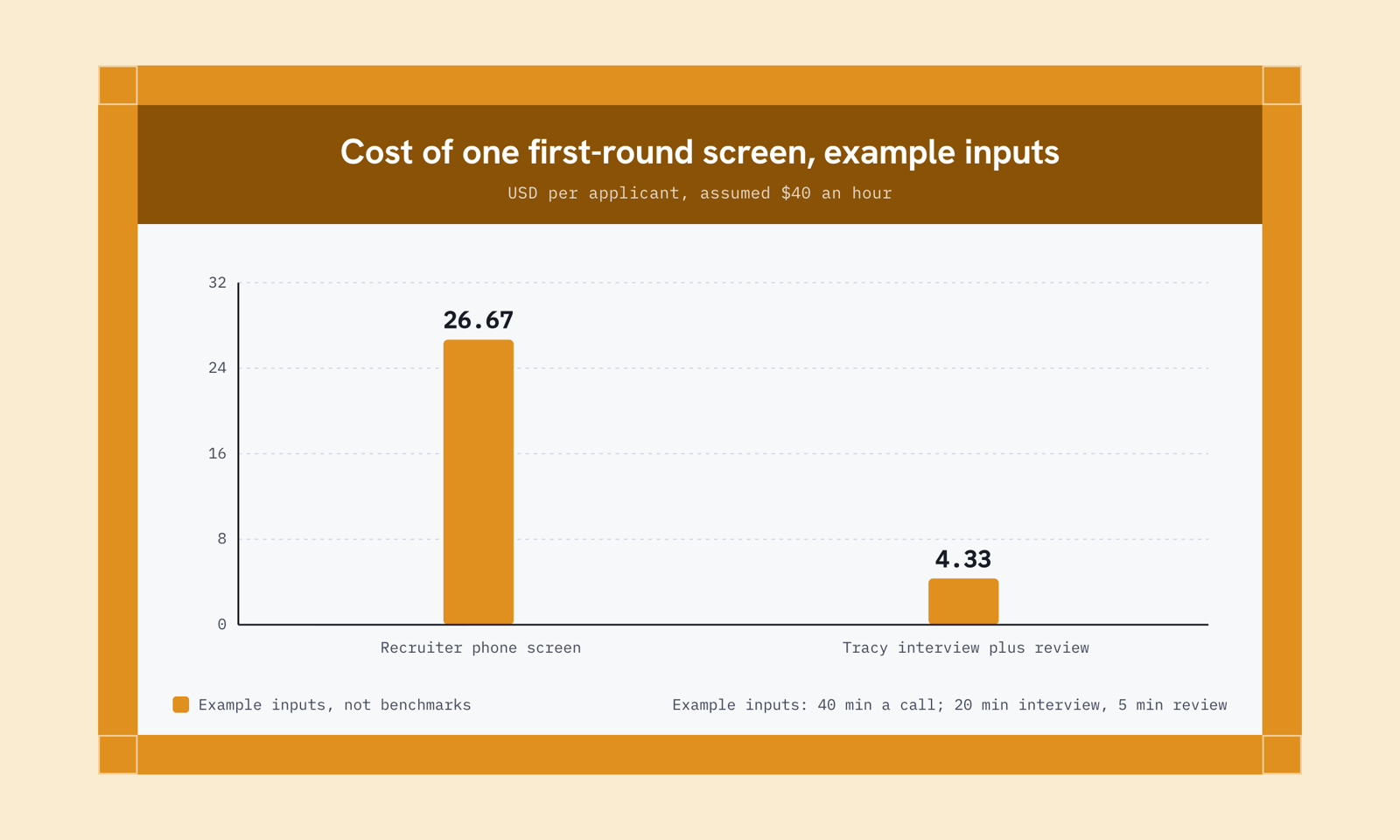
On the example inputs, one first-round screen costs about $27 by phone and about $4 as a reviewed Tracy interview.
What the screen line does to ROI
Replace the phone screens in the example with Tracy interviews. Each screen then costs $4.33 instead of $26.67: the $1 credit plus 5 minutes of reviewer time at $40 an hour. At 15 screens per hire that is about $65 a hire instead of about $400.
Table 3: the same example with Tracy as the first-round screen
| Hires a year | Phone screens | Tracy interviews | ROI before | ROI after |
|---|---|---|---|---|
| 10 | $4,000 | $650 | 118% | 132% |
| 50 | $20,000 | $3,250 | 422% | 511% |
| 200 | $80,000 | $13,000 | 606% | 779% |
Scroll the table sideways to see all 5 columns.
The gain holds only if the recruiter hours are saved or moved to work that returns more. If the same salary keeps paying for the same idle hours, the saving is smaller. Run one real role and count the hours before you trust the percentage. It uses the self-serve rate of $1 per credit, one credit per started 20 minutes.
How to run the example with Tracy
Tracy AI Interviewer starts each applicant's interview when they click a link, at any hour, in under 10 seconds. You describe the role and Tracy drafts the questions from the job description, or you bring your own. During the interview she follows up in the applicant's own field, and what the reviewer receives is a recording of both sides, a timestamped transcript and a written summary of each answer with the evidence behind it. A person reviews and decides. See the hiring at volume use case and how AI phone screening compares with a call.
Pricing follows the table: $1 per credit, no seats, no upfront cost, a session with no answers is never charged, and the first 3 results are free. One customer cut its average time to hire from 44 days to 7. If you value a hire by how soon the seat starts producing, a shorter time to hire raises the value line in Table 1.
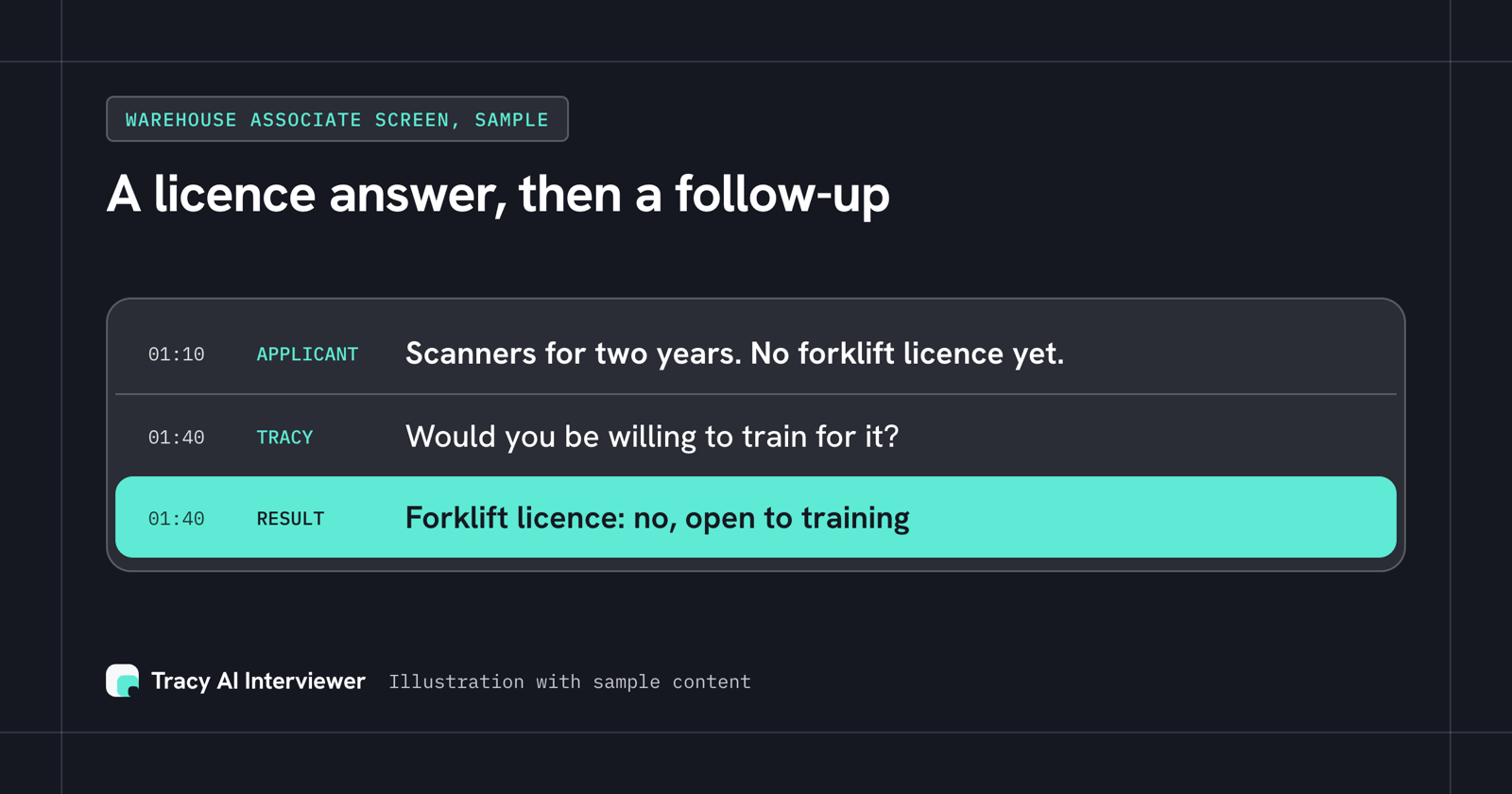
The reviewer sees what the applicant said, the follow-up Tracy asked and the field it filled, each with its place in the recording.
Which path fits you
- Many applicants for the same role: volume hiring.
- Working out the cost side first: cost per hire.
- Choosing which numbers to track: recruiting KPIs.
- Checking how long hiring takes: time to hire statistics.
- Working out what a credit costs for your volume: pricing.
Common questions
How to calculate recruitment ROI?
What is ROI in recruitment?
What is a good recruiting ROI?
What counts as recruitment cost?
Can I calculate recruitment ROI in a spreadsheet?
Interview every applicant, not just a few
Tracy runs a first-round interview the moment someone applies and follows up on each answer. Your first 3 results are free.
Try it free (opens in a new tab) Book a demo (opens in a new tab)
Your first 3 results are free. No card needed.
Sources
- AIHR, Recruitment ROI explained, retrieved 23 Nov 2026.
- Greenhouse, US recruiting benchmarks (through August 2026), retrieved 23 Nov 2026.
- Tracy AI Interviewer pricing, retrieved 23 Nov 2026.