In short
Surfshark's tracker records an estimated $3.91 billion in deepfake fraud losses from January 2020 to September 2026, and 809 incidents in the first three quarters of 2026, up 24% on 2025. Trackers count reported incidents, not deepfakes.
In hiring, 38% of US managers in Checkr's September 2026 survey reported AI-generated or deepfake interview content.
For expert vetting, Tracy AI Interviewer runs the video interview with follow-ups in the person's field and shows a reviewer integrity signals beside the recording. A person decides.
Next step: run one expert interview and read the signals yourself.
Deepfake statistics come from trackers that log incidents reported in the media or to authorities, so no figure measures how many deepfakes exist. Each number below comes with its source, its period and what was counted. Figures on fake candidates specifically are on candidate fraud statistics, and what a deepfake candidate is defines the term.
Deepfake statistics for 2026: how many incidents, how much money?
Surfshark's research, published on 10 November 2026, estimates deepfake-enabled fraud at $3.91 billion in losses across 51 countries between January 2020 and September 2026, with about 98% of that falling from 2024 onward. Incidents are rising too: 809 were recorded from January to September 2026, against 651 in the same months of 2025. Growth is slowing, though: each 2026 quarter beat its 2025 counterpart by 47% in Q1, 23% in Q2 and only 3% in Q3. The table gives the main figures and what each counts.
What the 2026 deepfake counts include
All rows are from one tracker and one dataset, January 2020 to September 2026. Source: Surfshark research, 10 November 2026.
| Measure | Number | What was counted |
|---|---|---|
| Recorded losses, 2020 to Q3 2026 | $3.91 billion | Fraud incidents with synthetic video, images or audio, verified by media reports |
| Losses, 2026 so far | $972 million | First three quarters of 2026 |
| Losses, 2020 to 2023 | $83 million | The same dataset, four years combined |
| Incidents, 2020 to Q3 2026 | 2,430 | All incident types in the dataset, not only fraud |
| Incidents, Q1 to Q3 2026 | 809 | Up 24% on 651 in Q1 to Q3 2025; 970 in all of 2025 |
| United States | 787 incidents | Most of any country; $705 million in losses |
How many deepfakes are there?
No source here counts deepfakes themselves. Surfshark's dataset draws on the AI Incident Database, Resemble AI and the OECD, and includes an incident only when media reports verify it. Losses from an incident that spans several countries are split equally between those countries in the location breakdowns, and non-dollar losses are converted to dollars. A tracker built this way tells you what got reported, so a different tracker can give a different total.
By country, the United States has the most incidents (787, against 246 in India and 141 in the United Kingdom) and the highest losses at $705 million, followed by Indonesia ($615 million) and Malaysia ($513 million).
What do deepfake fraud statistics say about the kinds of fraud?
Investment scams account for the largest share of recorded losses: $1.75 billion, 45% of the total, across 254 incidents. Finance and banking fraud follows at $1.14 billion (29%), then corporate fraud at $545 million (14%) from 56 incidents. Product promotion scams ($277 million) and romance scams ($179 million) are smaller. These shares are of the 768 fraud-related incidents in the dataset, not of all deepfakes.
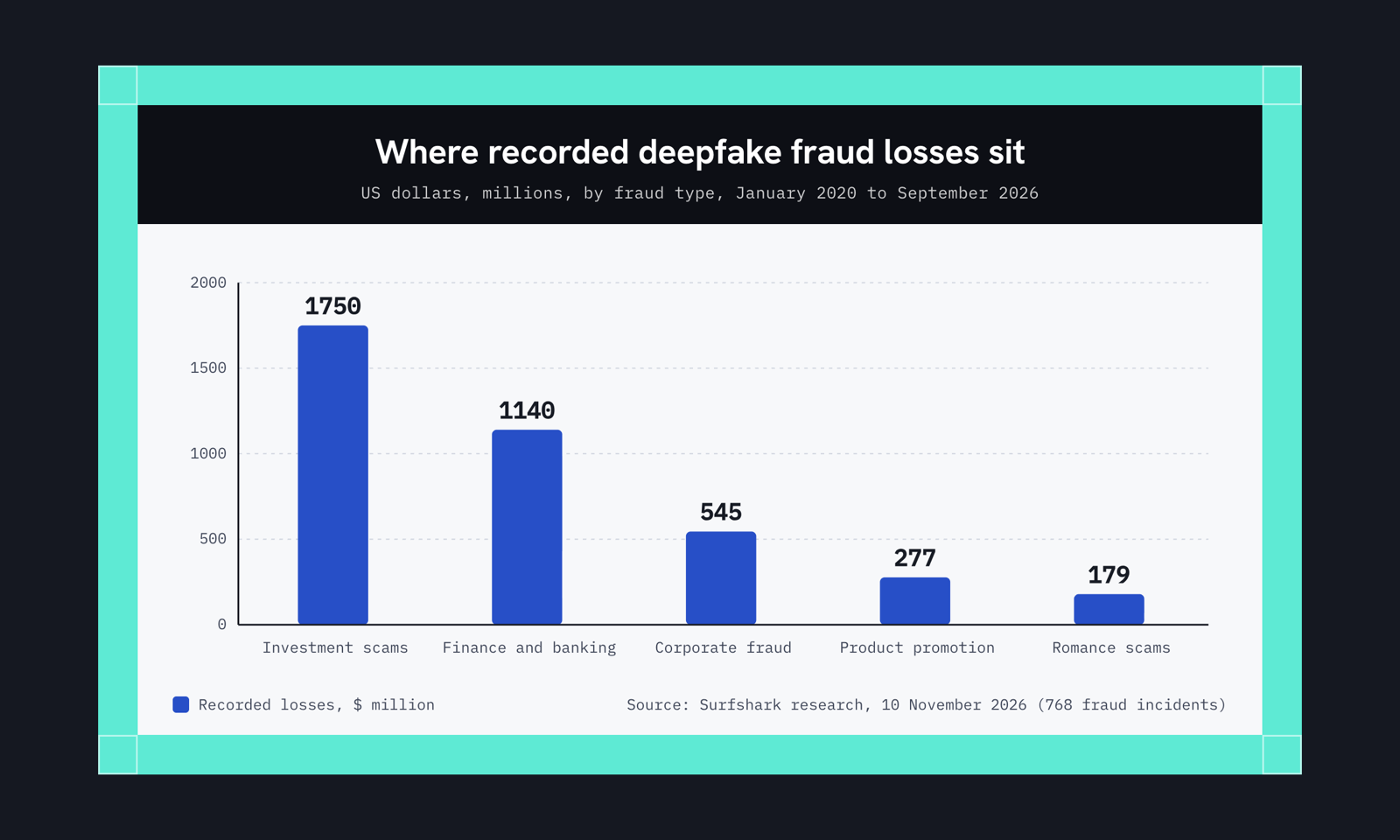
Investment scams and finance fraud make up almost three quarters of recorded deepfake fraud losses.
How common are deepfakes in job interviews?
The hiring figures come from managers and agencies, not from a count of interviews. Checkr's survey of 3,000 US managers involved in hiring, fielded 11 to 16 September 2026, found 38% reported AI-generated or deepfake interview content. Resume Genius, in a survey of US hiring managers launched in June 2026, reported 17% had encountered deepfake technology in video interviews. Gartner predicts that by 2028 one in four candidate profiles worldwide will be fake, which is a forecast and not a measurement. The FBI's Internet Crime Complaint Center warned in June 2022 of complaints about voice spoofing, possibly voice deepfakes, in online interviews for remote jobs, and gave no count.
The four come from different kinds of source, a manager survey, a vendor survey, an analyst forecast and an agency warning, so they are not added together. Checkr also found that only 29% of companies verify identity as soon as someone applies, and 49% wait until after at least one live interview.
What does this mean for vetting experts?
A platform that vets experts it has never met relies on a CV and a call, which is where a stand-in or a synthetic face would pass unseen. Tracy AI Interviewer runs the video interview itself. Each expert gets questions in their own field and a follow-up on what they just said, so a thin or rehearsed answer is asked for the detail behind it. Unless integrity signals are turned off, Tracy shows a reviewer when the participant switched tabs, looked away from the camera or waited long before answering, next to the recording and the transcript. Participants are told about the recording, a signal is never proof, and a person makes the decision.
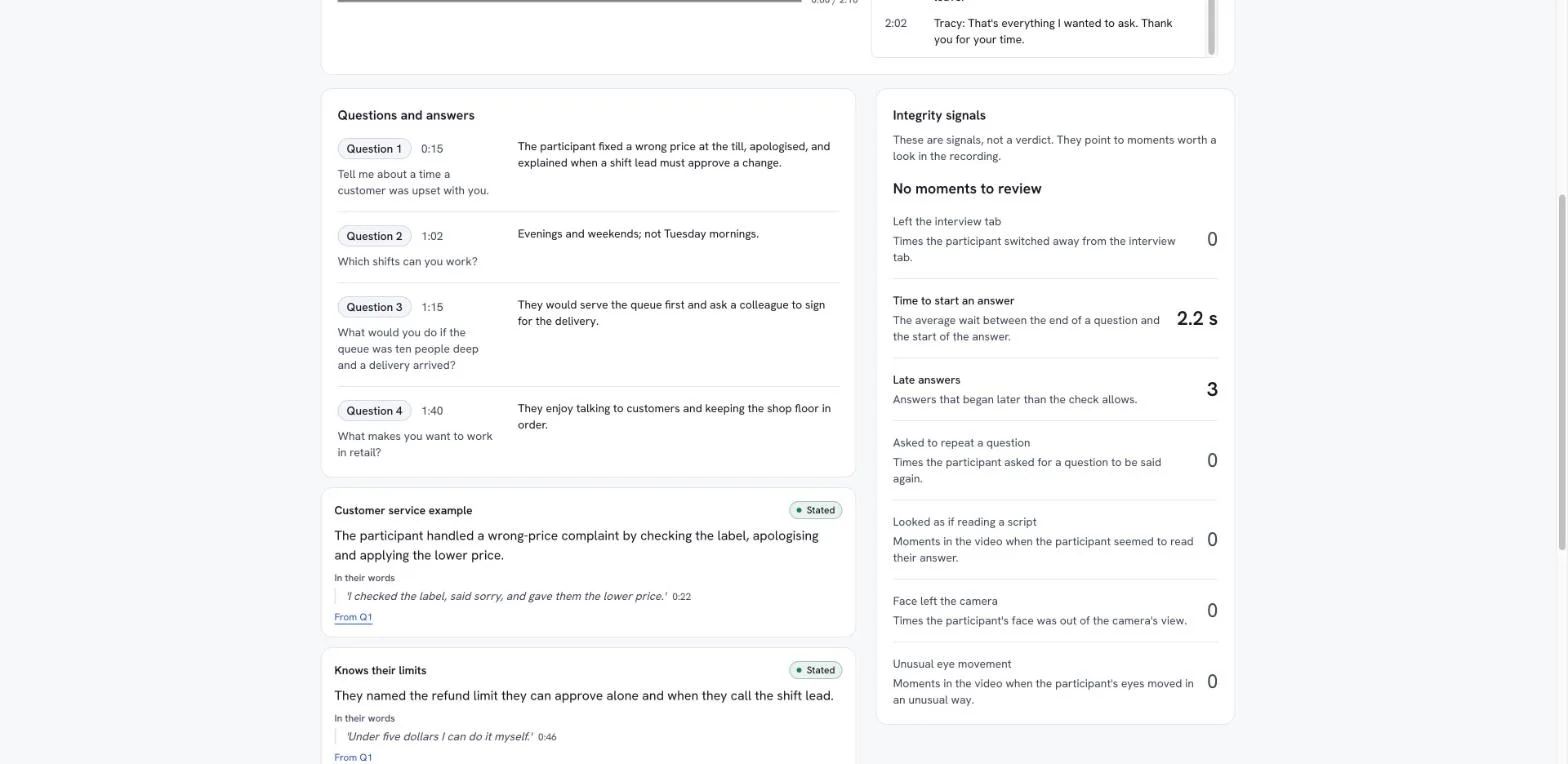
The reviewer reads each answer next to the signals, which are labelled as signals and not a verdict.
Which path fits you?
- Telling real from staged: how to spot a fake candidate.
- A stand-in on the call: proxy interviews.
- Reading signals responsibly: how integrity signals work in AI interviews.
- Fake candidates in numbers: candidate fraud statistics.
- Choosing a tool: tools for vetting experts compared.
Expert vetting with Tracy traces one expert from link to report.
Common questions
What are the deepfake statistics for 2026?
How many deepfakes are there?
What are the main deepfake fraud statistics?
How common are deepfakes in video interviews?
Can an interview tool show whether a face or voice is real?
Read the signals beside the interview
Run one expert interview and read the integrity signals next to the recording and transcript. The first 3 results are free.
Try it free (opens in a new tab) Book a demo (opens in a new tab)
Your first 3 results are free. No card needed.
Sources
- Surfshark: Deepfake fraud statistics, retrieved 23 Nov 2026.
- Checkr: The Hiring Hoax 2026, retrieved 22 Nov 2026.
- Resume Genius: AI's Impact on Hiring in 2026, retrieved 18 Nov 2026.
- Gartner: Survey shows just 26% of job applicants trust AI will fairly evaluate them, retrieved 19 Nov 2026.
- FBI IC3: Deepfakes and Stolen PII Utilized to Apply for Remote Work Positions, retrieved 18 Nov 2026.