In short
An expert network interview runs in five stages: a client brief, expert screening, compliance approval, the call and a recorded transcript.
Tracy AI Interviewer runs that interview, probing each answer in the expert's own field while a person reviews what was said. Integrity signals sit beside the answers as evidence and never as proof.
When a project lands and you run out of experts to interview, send one link instead of booking calls.
The SOC 2 Type II attestation report is available on request at hello@tracyinterview.ai.
How does an expert network call work?
An expert network connects a client who needs a specialist's view with an expert who has it, for a paid conversation. The steps below come from the networks' own compliance pages and from Umbrex's guide for experts.
- The client sends a brief. The network's associate checks whether the expert's experience matches the request, looking at relevance, recency, perspective, availability and rate.
- The expert is screened. Umbrex lists the questions an expert may meet: whether they are currently employed, what they owe a former employer and whether they hold material nonpublic information.
- Compliance clears the call. Experts complete consulting agreements and a pre-qualification questionnaire at AlphaSense. At GLG they answer profile questions about conflicts, and respond to any screen the client adds before a consultation.
- The call runs. The expert usually gets a topic summary and not a full agenda. GLG reminds experts of their limits at the start, and an expert must end a project that drifts into topics they cannot discuss.
- The call is recorded and reviewed. AlphaSense requires consent to record and transcribe, and compliance reviewers listen to the recording and read the transcript before anything enters its library.
Being contacted does not mean a call is booked. Umbrex warns that a delayed compliance confirmation can get an expert removed from the project.
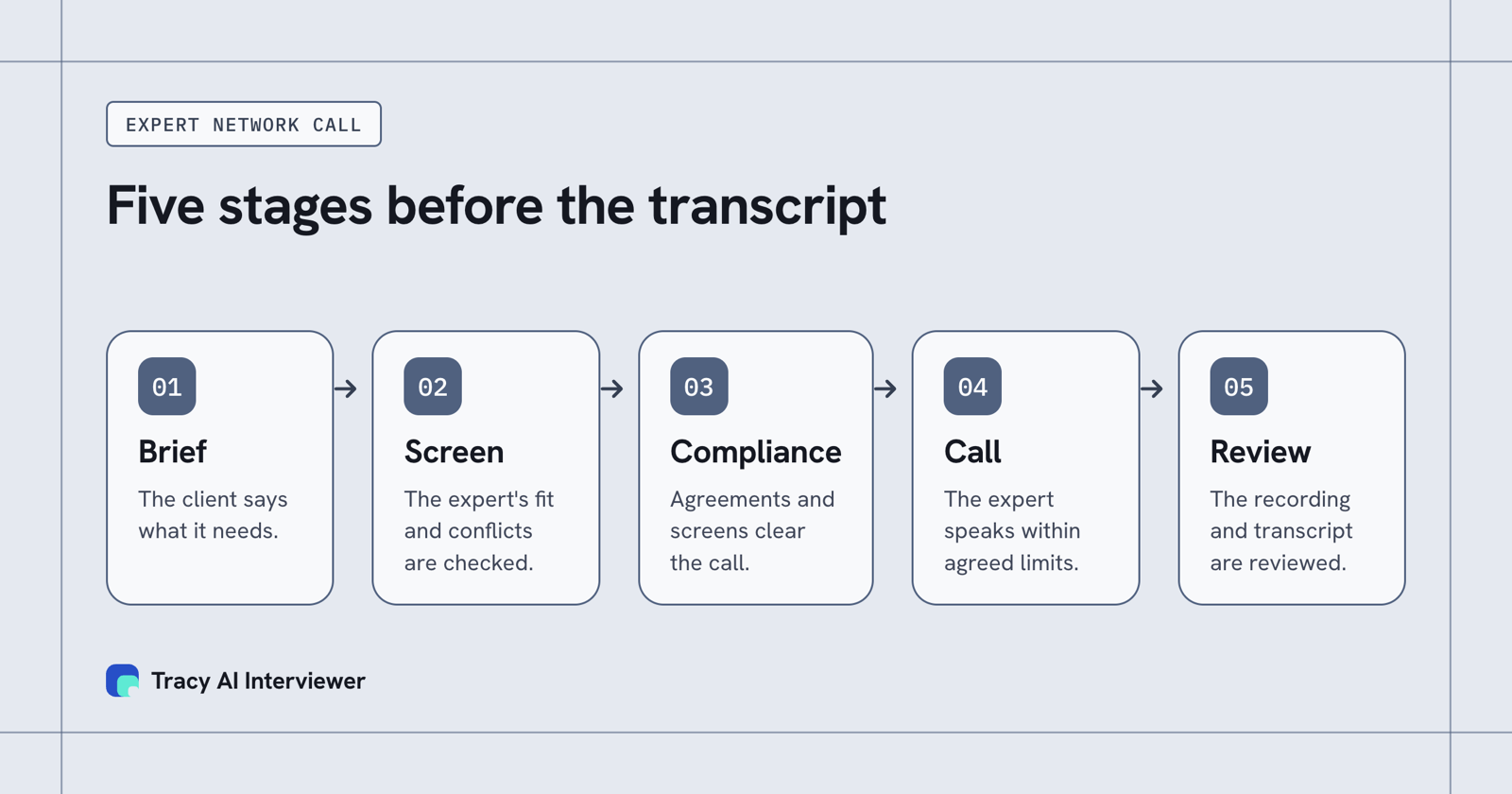
Five stages sit between a client's brief and a recorded call, and the screening step is where the expert's depth is judged.
Are expert network calls legal?
The calls are a normal paid service, and the legal risk sits in what is said. Umbrex describes the network's concern as whether an expert can take part "without violating confidentiality, securities rules", which is why experts are asked about material nonpublic information. Under GLG's terms, each expert promises not to give clients confidential or material non-public information.
Whether a particular call is lawful depends on the topic and on who the expert works for, so the agreements, screens and call limits above exist to keep restricted information out. This page explains the process and is not legal advice. Take your own programme to your counsel.
How do you prepare for an expert call?
For the expert, Umbrex advises deciding in advance which topics you can discuss and which you must avoid, because the topic summary is rarely a full agenda. Confirm the time zone, and answer compliance requests quickly.
For the person buying the call, the preparation happens earlier, in the choice of expert. A good brief names the decision the client is making, the experience that would help and the kind of person to avoid. Then check that the expert can speak to the detail, which a profile does not show.
What does the interview before the call have to find out?
The profile says the expert held a role. The interview shows whether they can speak to the detail, which decisions were theirs and what they cannot discuss. Four questions cover it. They are a starting set to edit for your field, and the full list for subject matter experts goes further.
1. Describe your last role and what you could speak about.
Follow up with: Which decisions did you personally make?
Listen for: a named responsibility with a time frame, not a list of topics.
2. Walk me through a recent problem in your field and how it was solved.
Follow up with: What was the alternative you rejected, and why?
Listen for: the reasoning and the trade-off in the expert's own terms.
3. Is there anything you cannot discuss?
Follow up with: Does that cover your current employer?
Listen for: clear limits stated without prompting.
4. What would a client most often get wrong about this topic?
Follow up with: How would you tell if a company had made that mistake?
Listen for: a specific example from experience.
How does Tracy run the expert interview?
Describe the project or bring your own questions; Tracy drafts the interview and you edit it. With the CV check on, Tracy can read the CV first. Send one link. Each expert opens it in the browser when it suits them, at any hour, and is told on the join screen that the conversation is recorded and transcribed. Tracy lets the expert finish, then asks about whatever the answer left out, in the expert's own field.
An expert who recites a polished profile is asked about the decision behind it. Integrity signals, such as a full-screen window left or a face leaving the frame, go to the reviewer with their evidence. A person looks at them, and they never count as proof. The expert is told they are recorded, a person reviews, and nothing is decided in the interview.
The expert and the exchange below are invented.
What does the reviewer read?
Question 1. Describe your last role and what you could speak about.
What they said. The expert was head of procurement for a mid-size food manufacturer for six years and can speak on supplier contracts and ingredient pricing.
Quote at 01:40. "I can speak on supplier contracts and ingredient pricing."
Follow-up. Which decisions did you personally make?
Question 2. Is there anything you cannot discuss?
Quote at 04:00. "Nothing from my current employer. I left the last role a year ago."
Field, most recent relevant role. Head of procurement, 6 years (evidence: question 1, 01:40).
Field, confidentiality limits. Current employer excluded (evidence: question 2, 04:00).
The reviewer approves or declines with the recording behind every line. The report gives what the expert said to each question, with its time, and Tracy does not score or rank anyone. The real report screen below shows the recording beside the transcript.
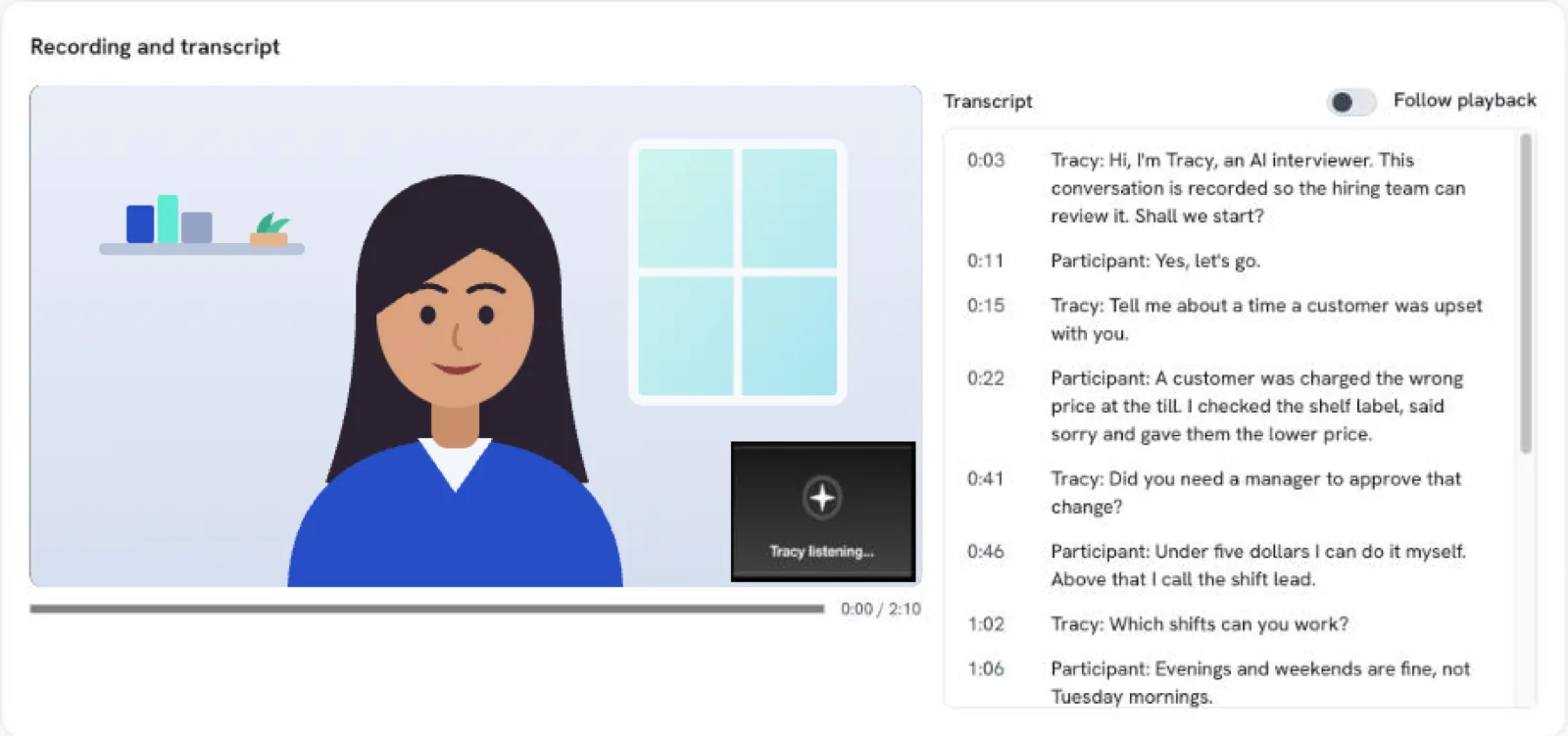
The recording sits beside a timestamped transcript, so a reviewer can check any answer at the moment it was said.
What does it cost to vet a pool of experts?
A hundred interviews of 20 minutes are 100 credits, so $100 at $1 per credit, one credit per started 20 minutes. The first 3 results are free and a session with no answers is never charged. The expert vetting page shows the flow, and the best AI interview tools for expert vetting compares seven options.
Which path fits you?
- Choosing an expert network for client calls: best expert network software.
- Writing questions for a finance specialist: finance expert interview questions.
- Worried about invented credentials: what interview fraud looks like.
- Vetting your own pool before a project lands: expert vetting.
Common questions
How does an expert network call work?
Are expert network calls legal?
How to prepare for an expert call?
What is an expert network interview?
Can Tracy replace the expert call?
See which experts know the field
Tracy asks follow-ups in the expert's own field and shows integrity signals to a reviewer. First 3 results free.
Try it free (opens in a new tab) Book a demo (opens in a new tab)
Your first 3 results are free. No card needed.
Sources
- Umbrex, Screening Calls and Compliance Checks (Paid for Your Perspective, chapter 14), retrieved 23 Nov 2026.
- GLG, Compliance, retrieved 23 Nov 2026.
- Tracy AI Interviewer: Pricing, retrieved 11 Nov 2026.