In short
Verify candidate identity in layers: a recorded interview a person reviews, your own document or live check before access or an offer, and in person where you can.
Tracy AI Interviewer runs the video interview with follow-ups in the person's field, and shows a reviewer leaving full screen and the face leaving the frame beside the recording and transcript.
Signals are never proof, and the identity check itself stays your own step.
Next step: run one expert screen and read what the reviewer sees. The first 3 results are free.
Candidate identity verification fails in a few predictable ways, and each has a fix. This guide is for a head of expert supply or talent operations who has to be sure the person who passed the screen is the person who shows up for the work. It is general information, not legal advice. For US employment verification, the official source is USCIS's Form I-9 page, and the FBI alerts cited below are the source for the fraud patterns. Numbers on how common the problem is are in candidate fraud statistics.
Why does candidate identity verification fail?
Four causes recur.
- A stand-in takes the interview. Checkr's September 2026 survey of 3,000 US managers found 40% had personally interviewed a candidate later revealed to be using a fake identity. Proxy interviews explains how it works.
- The documents are forged. The FBI's alert of 13 October 2026 says remote IT workers forge verification documents for stolen identities when applying.
- The face or voice is altered. The FBI's alert of 23 January 2025 says workers have used AI and face-swapping technology during video job interviews. See what a deepfake candidate is.
- The check comes too late. Checkr found only 29% of companies verify identity as soon as someone applies, 49% wait until after at least one live interview and 18% wait until the final interview or later.
How to verify candidate identity
The FBI's guidance points to layers, which it calls identity in depth: layered detections, access controls and continuous identity verification throughout employment. In practice:
- Interview on video and keep a recording. The recording is the reference for every later step.
- Have a person review the interview, including any integrity signals, before anyone is cleared.
- Check documents or run a live identity check at the stage that fits your risk, before access or an offer. In the US, an employer completing Form I-9 must examine the documents an employee presents to determine whether they reasonably appear to be genuine.
- Compare the person across rounds. The face and voice at the live round should match the recording.
- Complete as much of hiring and onboarding in person as you can, as the FBI advises, and keep verifying through employment.
The FBI also warns that relying solely on ban lists or filtering out associated names can be unreliable and can block qualified applicants, so a name filter alone will not solve the problem.
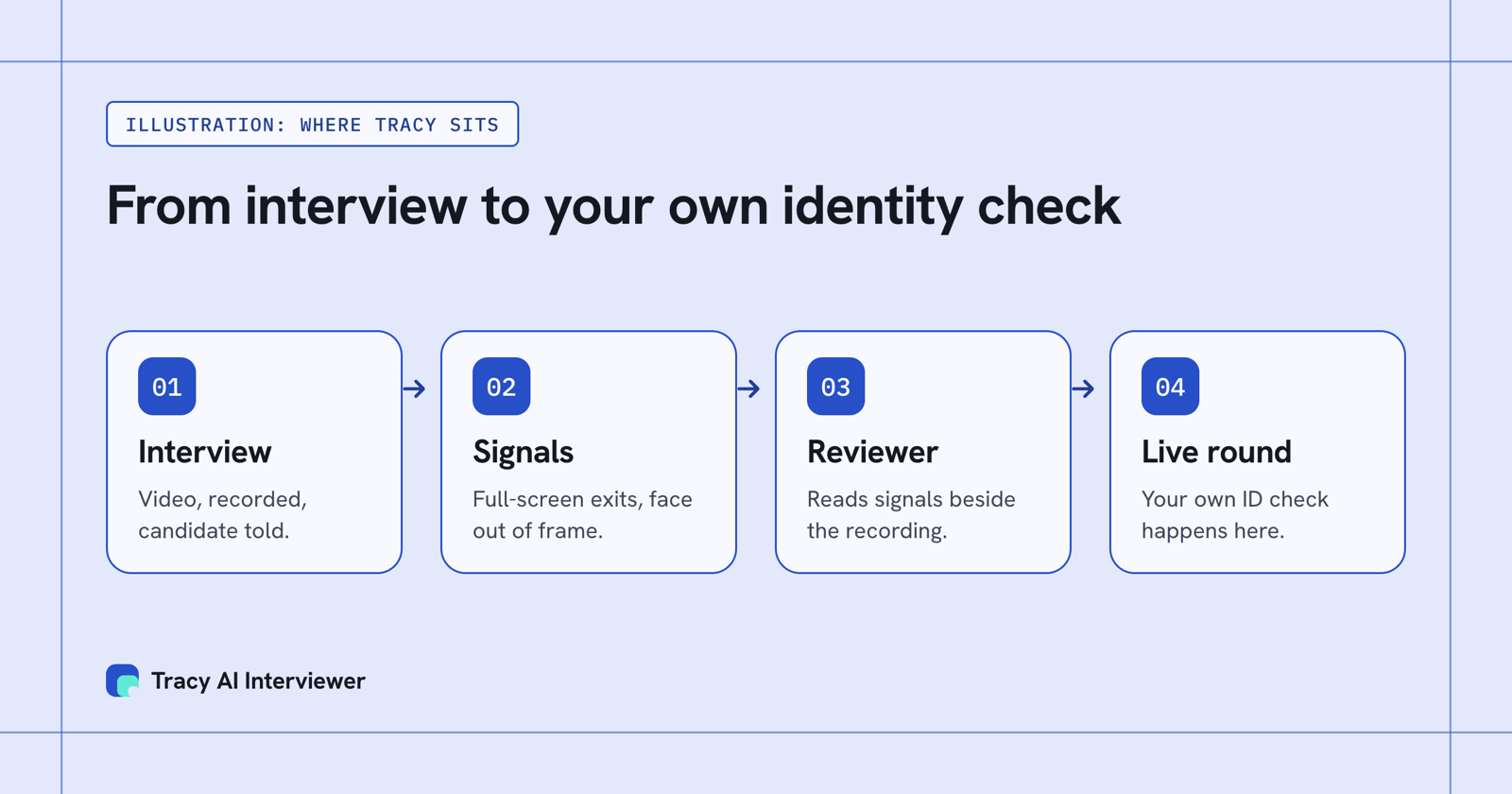
Tracy gives the reviewer a recording and signals before the live round, where your own identity check happens.
When should you verify candidate identity?
Before anyone gets access to work, systems or an offer, and in a light form earlier. The FBI's January 2025 alert advises identity-verification processes during interviewing, onboarding and throughout the employment of any remote worker. The Checkr figures above show most companies run their first check after a live interview, which is the point where a stand-in has already passed one round.
A sensible order for an expert platform is the recorded interview first, a person's review second, and the document or live check for the shortlist. That keeps the heavier step for the people who earned it. Whatever the order, write it down per role, so a hire made in a hurry does not skip a layer, and record who checked what and when.
Does identity verification hurt candidate drop-off?
It can, when people are not told why. Greenhouse's 2026 Candidate AI Interview Report says the top reasons U.S. candidates gave for abandoning a process were a pre-recorded, AI-scored video interview with no human present (33%), undisclosed AI use (27%) and AI monitoring (26%). The report does not state the exact question, and it does not measure ID checks, so read it as a warning about surprise and silence.
Say what is recorded and why. A Tracy interview tells the candidate on the join screen that the conversation is recorded and transcribed, and a person reviews the result. Put the heavier document check after a candidate has shown interest and tell them what it is for.
What Tracy adds before the identity check
Tracy asks follow-ups in the candidate's own field and waits for the answer, so a stand-in has to carry the detail: a thin answer about a project gets a question about the first problem the person hit. The reviewer then sees the signals next to the recording. Video interviews run integrity signals unless they are turned off: leaving full screen and the face leaving the frame are shown to the reviewer. Applicants are told the conversation is recorded, a signal is never proof, and a person decides.
The screen below is a real Tracy report. The panel on the right reads "These are signals, not a verdict. They point to moments worth a look in the recording."
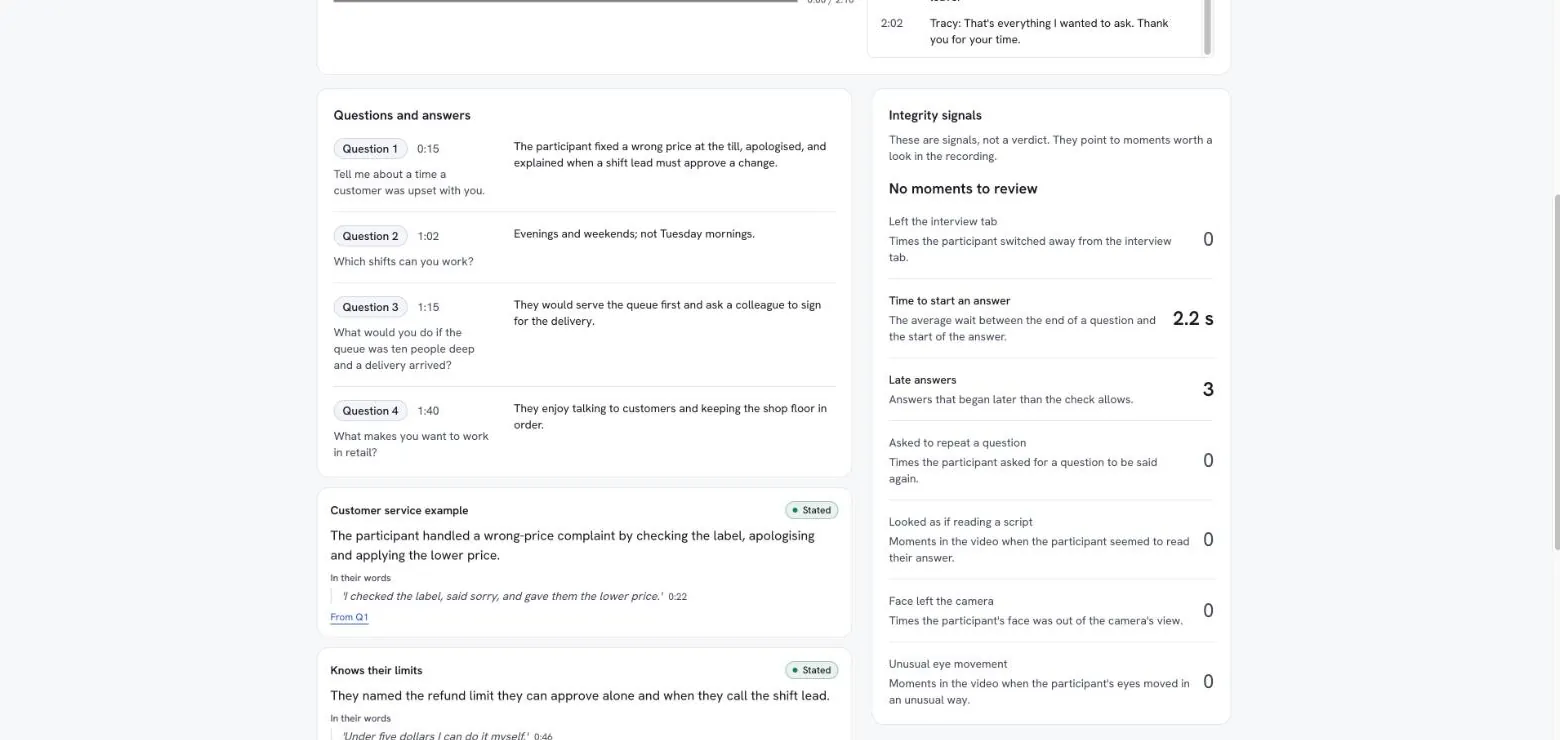
Integrity signals sit beside the questions and answers, labelled as signals and not a verdict.
In a sample expert-network screen, the candidate says, "I can speak on supplier contracts and ingredient pricing." Tracy asks, "Which decisions did you personally make?" and the report records the role, head of procurement for six years, with the time of the answer, 01:40. A second field notes a confidentiality limit: nothing from the current employer. Beside it the reviewer sees tab switches 0 and face out of frame 0. The sample uses invented data.
The identity check stays with you, at your document check and your live round.
Which path fits you?
- Spotting the patterns before the call: candidate fraud detection.
- The definition and the types: what interview fraud is.
- Vetting experts for a platform: AI interview tools for expert vetting and expert vetting.
Common questions
How do you verify candidate identity?
When should you verify identity?
Does verification hurt candidate drop-off?
Do integrity signals prove a candidate is not who they say?
Give reviewers evidence before the live round
Tracy shows a reviewer the recording, the answers and the integrity signals for each interview. Your first 3 results are free.
Try it free (opens in a new tab) Book a demo (opens in a new tab)
Your first 3 results are free. No card needed.
Sources
- FBI IC3 alert I-101326-PSA (13 October 2026), retrieved 23 Nov 2026.
- FBI IC3 alert I-012325-PSA (23 January 2025), retrieved 23 Nov 2026.
- USCIS: Form I-9, retrieved 23 Nov 2026.
- Checkr: The Hiring Hoax 2026, retrieved 22 Nov 2026.
- Greenhouse: 2026 Candidate AI Interview Report (press release, 1 May 2026), retrieved 18 Nov 2026.