In short
Claude Code suits the file work around hiring: merging candidate exports, drafting outreach in bulk and writing small scripts. It is a coding tool that runs in a terminal, so it fits a recruiter who is comfortable there or has an engineer beside them.
Add Tracy AI Interviewer with one command and the same session can set up an interview from a job description, with follow-ups in each person's own field.
The results come back into the session: what each person said to each question, the result fields and a note for your applicant tracking system.
Try the prompt below on a copy of an export, then connect Tracy.
How can recruiters use Claude Code?
Claude Code for recruiting is a narrower idea than it sounds. Anthropic describes the tool as an agentic coding tool that reads your files, edits them and runs commands, available in a terminal, an IDE, a desktop app and a browser. Most surfaces need a Claude subscription or an Anthropic Console account. Where a chat window answers questions, Claude Code can open a folder of exports, write a script, run it and change the files, which makes it most useful for the file work around hiring.
If you want drafting help in a chat instead, Claude for recruiting covers prompts. If you want folder work without a terminal, see Claude Cowork for recruiters.
Five file jobs a recruiter can hand to Claude Code, and the check to run on each. Examples written for this guide.
| Job | What you ask | Check before use |
|---|---|---|
| Merge exports | Combine four ATS exports into one file, newest row per email | Compare row counts with the sources |
| Find duplicates | List people who appear under two spellings of a name | Review the list yourself; delete nothing from it |
| Outreach drafts | Write a first line per row from the role and company columns | Read every draft before anything is sent |
| Client format | Reshape the list into the client's template columns | Open five rows next to the original |
| Interview topics | Turn a job description into ten topics to ask about | Edit them; the role knowledge is yours |
A prompt to copy
Start Claude Code in a folder that holds copies of your exports, then paste:
Read the four CSV files in this folder. Merge them into candidates.csv with one row per email address, keeping the newest row when an email appears twice. Do not change the original files. Then print the number of rows in each source file and in candidates.csv so I can check the totals.
The last sentence gives you counts to check the result against. Anthropic's overview says you can describe what you want in plain language, but read what Claude Code proposes to run before you approve it, and work on copies, never on the live system.
Is Claude Code safe to use with candidate data?
Safety depends mostly on your habits. Anthropic's MCP documentation says to verify you trust each server before connecting it, and warns that servers which fetch external content can expose you to prompt injection. A CV is text written by someone else, so treat a script that reads many of them the same way.
- Check your company's data policy before candidate files go into any AI tool.
- Remove the columns the task does not need before you start.
- Keep decisions about people with a person; use the output to prepare, not to reject.
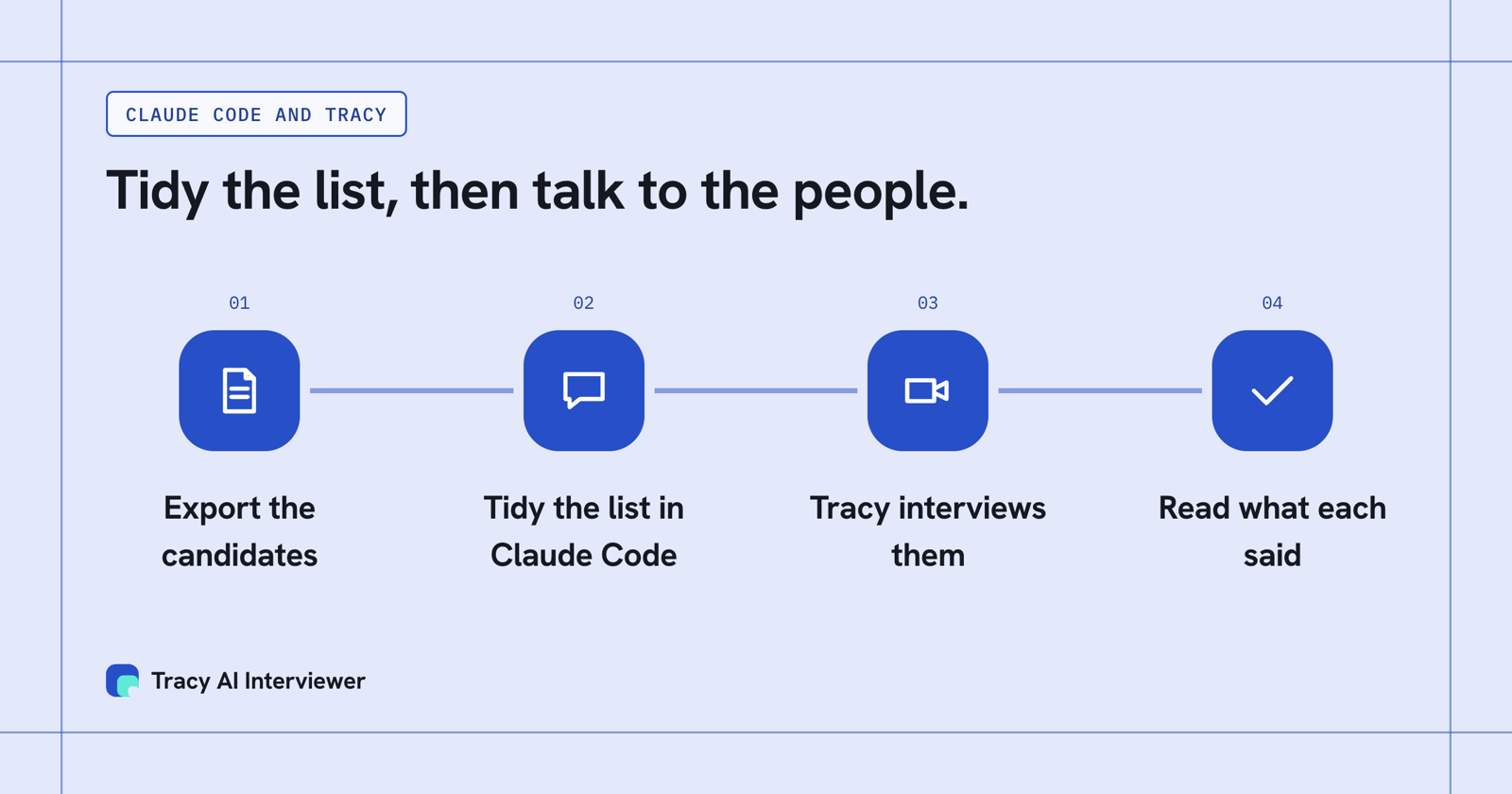
Claude Code tidies the list; Tracy talks to the people on it.
Claude Code for candidate sourcing?
Claude Code can write a script that cleans a sourced list, and it can draft the search strings you paste into a platform yourself (the ChatGPT Boolean search guide shows the method). It should not be pointed at LinkedIn to collect profiles. LinkedIn's help page says it does not permit third-party bots, plug-ins or extensions that scrape or automate activity on its site.
From a clean list to a first interview
A tidy list still has to be screened. Tracy AI Interviewer has a remote MCP server, and Claude Code adds it with one command in the terminal:
claude mcp add --transport http tracy https://tracyinterview.ai/mcp
Then type /mcp inside Claude Code and sign in through the browser. Anthropic's docs describe three scopes for a server: local, the default, which is yours in the current project; project, shared through a .mcp.json file; and user, yours across every project. Tracy's own guide suggests the user scope if you want it everywhere.
Now ask Claude Code to use Tracy AI Interviewer to set up an interview for the role and paste the job description. Tracy drafts the questions and the result fields, and nothing is created until you approve a preview. For technical roles, an interview can include a coding task (live coding, SQL, debugging or multiple choice) with follow-ups on approach and trade-offs. A new interview starts with its public link on, for anyone with the link, up to 20 people for 14 days, and nobody invited; you can turn the link off or invite people by email after a preview.
Each person interviews on video in the browser. Video interviews run integrity signals unless turned off: a full-screen window, the face on camera and a pop-up if the face leaves the frame. They go to a person to review and prove nothing. When you ask for results, Claude Code shows what each person said to each question, the result fields and a note for your ATS, and you can have it save them into a file beside your shortlist. Tracy does not score, rank or reject anyone. Tracy's own figure is 100K+ interviews completed.
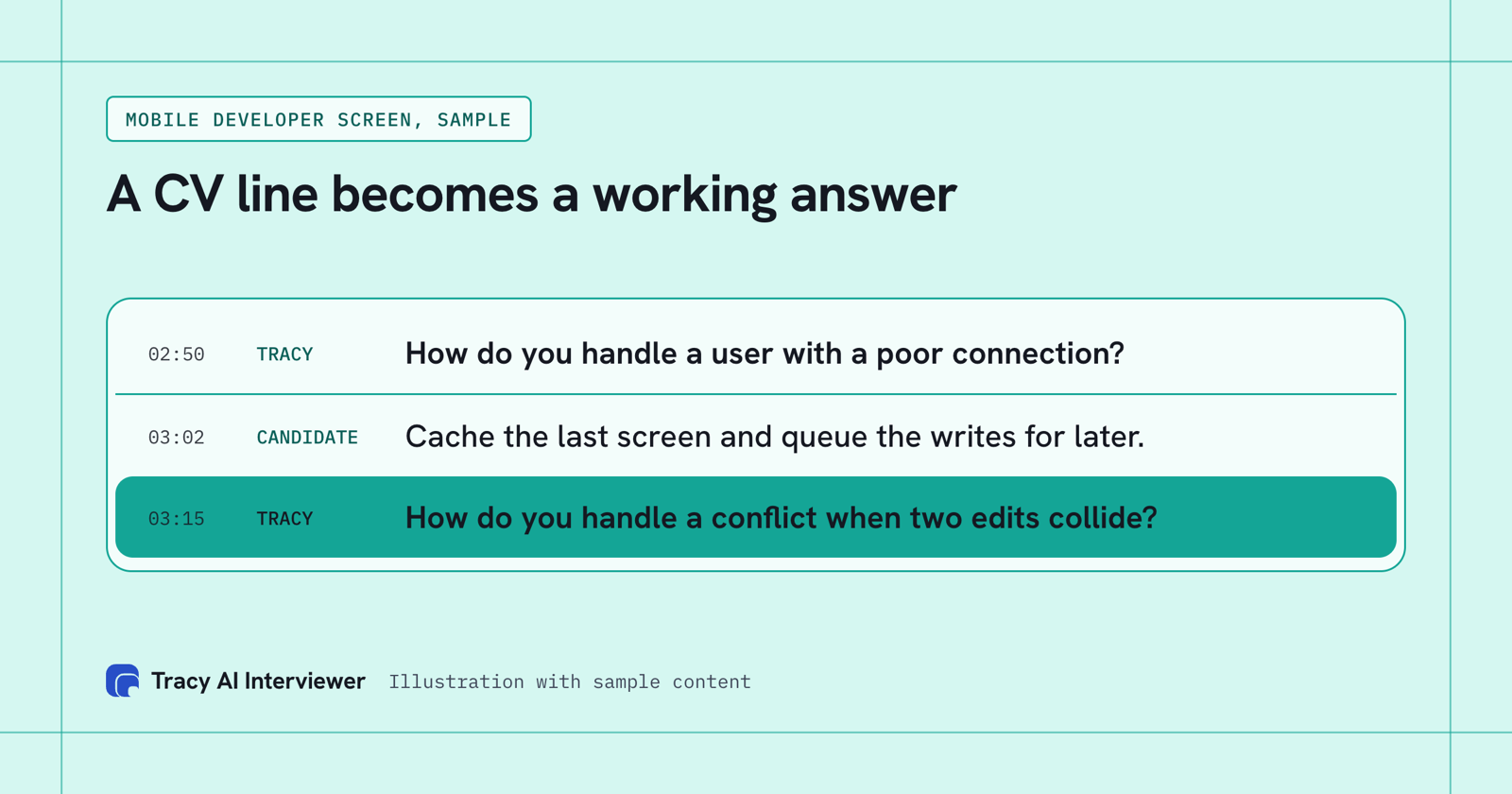
The follow-up tests the detail a CV line cannot show.
Which path fits you?
- Hiring engineers: AI interviews for software engineers shows what a first technical interview asks.
- Reusing prompts across the team: Claude skills for recruiting packages them.
- Connecting Tracy to the Claude app instead: how to add MCP to Claude lists the steps.
Common questions
Do I need to know how to code to use Claude Code?
Can Claude Code source candidates?
Which Claude plan do I need?
What recruiting workflows suit Claude Code best?
Can Claude Code run the interviews?
Add Tracy to Claude Code
Run one command, sign in and ask for an interview from a job description. First 3 results free.
Try it free (opens in a new tab) Book a demo (opens in a new tab)
Your first 3 results are free. No card needed.
Sources
- Anthropic, Claude Code overview, retrieved 23 Nov 2026.
- Anthropic, Connect Claude Code to tools via MCP, retrieved 23 Nov 2026.
- LinkedIn Help, Prohibited software and extensions, retrieved 14 Nov 2026.
- Tracy AI Interviewer, Claude guide, retrieved 14 Nov 2026.
- Tracy AI Interviewer, Connect, retrieved 23 Nov 2026.