In short
A virtual job tryout is an online assessment that puts a candidate through tasks from the job instead of asking about them. It is HireVue's registered name for its version; the method is a job preview plus job-related tasks.
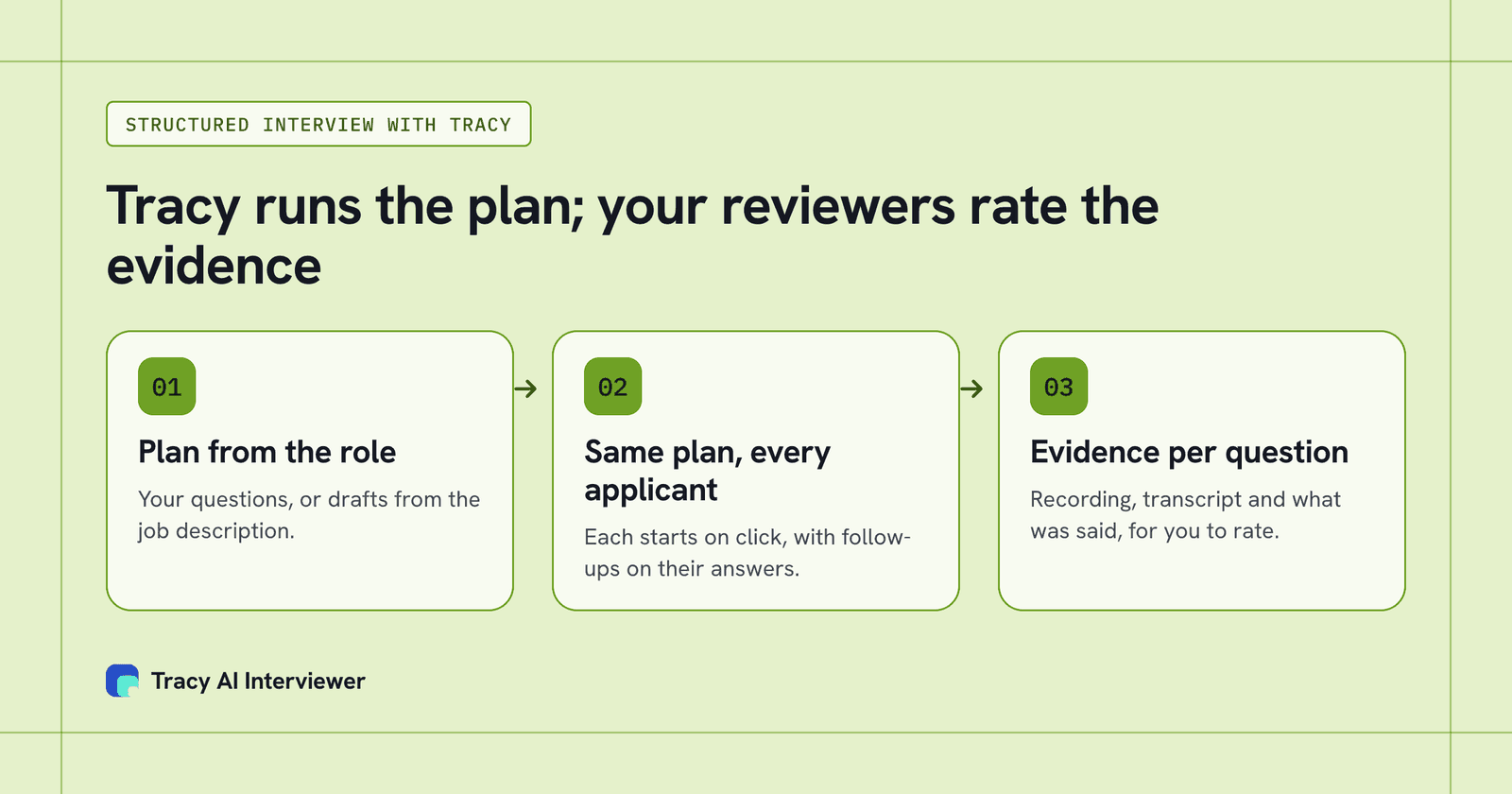
In Tracy AI Interviewer every applicant is interviewed on video about real situations from the role, and each answer gets a follow-up. Your reviewer gets a recording, transcript and quoted answers.
Candidates rate Tracy 92 on NPS. Your reviewers decide, and the first 3 results are free.
What is a virtual job tryout?
A virtual job tryout, often shortened to VJT, is an online assessment where a candidate works through tasks taken from the job. HireVue describes its Virtual Job Tryout as an assessment that immerses candidates in job-related tasks. Candidates complete it on their own time on any device with an internet connection, and hiring teams receive a candidate fit profile that rates the candidate in the competencies important to the job. HireVue also says its realistic job previews let candidates self-select out if the job is not for them.
Virtual Job Tryout is a registered name HireVue uses for its assessment, but the idea is older and wider. It shows the candidate a slice of the job, asks them to do or decide something from it, and lets you compare what you see. Search for it and most of what you find is written for candidates. This guide is for the person who runs hiring, so it covers what a tryout tells you, how to build one, and what a tryout cannot tell you.
What a job tryout can and cannot tell you
A tryout is a good test of how someone handles a situation from the job. A candidate for a contact centre role who is given an upset customer shows how they would respond. That is more direct evidence than a CV line saying they have customer experience.
What a fixed task leaves open is the reasoning. Two candidates can give the same answer for different reasons, and a fixed task does not ask a follow-up. A second conversation is where you find out whether the answer came from experience or from a lucky guess, and that is the part Tracy AI Interviewer is built for.
How to prepare for a virtual job tryout
If you hire, send this list to candidates before you send the link. Prepared candidates give you a fairer read.
- Read the job post again and note the three tasks it names most often.
- Think of one real example for each task: what happened, what you did, what changed.
- Do a practice run on the same device, and ask a friend to play the interviewer.
- Find a quiet place with steady light and a working internet connection, and charge or plug in your device.
- Set aside more time than you think you need. HireVue's candidate guide to its video assessments (a different product from the tryout) says most include between 5 and 8 questions and suggests setting aside 45 minutes.
- Answer in your own words rather than from a script.
Tell candidates who sees the result, how long it takes and whether it is recorded.
How to build a job tryout of your own
You can build a basic job tryout without buying a platform. Start from the work, not from a test template.
- Pick three situations from the first 90 days of the role. Ask the best person already in it what went wrong last month.
- Write each as a short scenario with one decision in it.
- Before anyone applies, write what a strong answer includes and what a weak one misses.
- Add one follow-up per scenario, to ask whoever answers.
- Decide who reads the results and how they decide.
- Try it on three colleagues and fix any scenario that confuses them.
Here is a worksheet for a fictional contact centre role. Copy it and replace the rows.
| Situation | What it tests | A strong answer includes | Follow-up |
|---|---|---|---|
| A customer was charged twice and is angry | Calm and ownership | Acknowledges the error, names the next step | What would you do if it takes three days? |
| Two urgent tickets arrive together | Prioritising | A reason for the order | What would you tell the second customer? |
| A policy blocks what the customer asks | Judgment | Explains the limit, offers what is possible | When would you escalate? |
Scroll the table sideways to see all 4 columns.
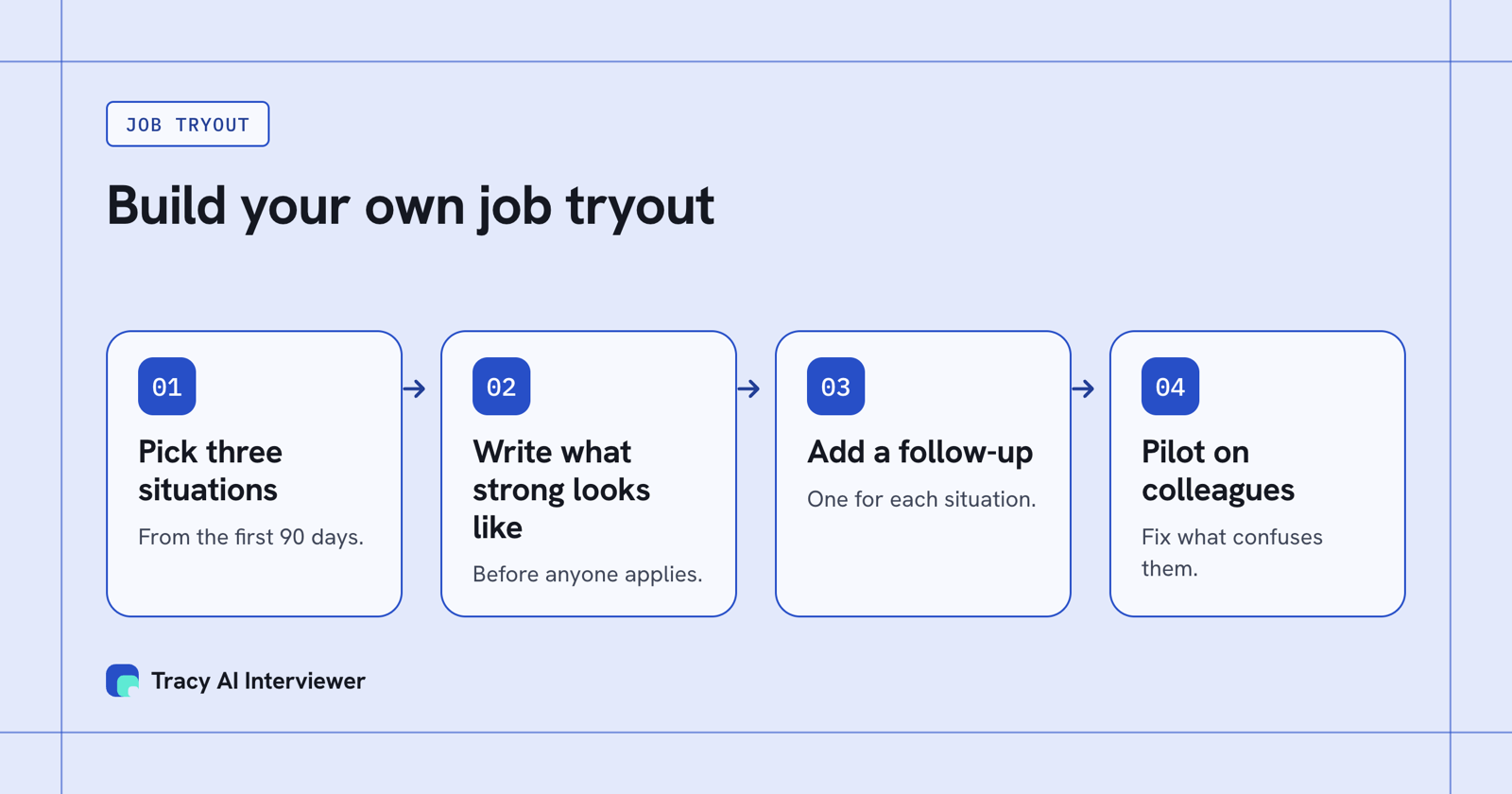
A tryout built from real situations, with a follow-up on each, shows how someone thinks as well as what they do.
Where Tracy asks the next question
Tracy AI Interviewer runs the same idea as a conversation. You describe the role and Tracy drafts questions built on real situations from it; edit them or bring your own.
01 Every applicant gets one
An applicant opens the link whenever it suits them, with no recruiter present and no slot to book. The whole pool gets the situations, not only the shortlist.
02 The follow-up
When an answer stops short, Tracy lets the candidate finish and then asks for the missing detail. A sample, with invented data: the question was "Tell me about a time a plan changed at short notice." The summary: a supplier dropped out two days before an event, and the candidate found a replacement and updated the guests. In their words, at 02:20: "I called three suppliers the same afternoon and found one." Tracy's follow-up, built from that answer: "How did you tell the guests?"
03 Evidence a person can check
The reviewer receives the recording of the whole conversation, a transcript with times and a summary of the answers to each question, each backed by the candidate's own words. Tracy leaves the rating and the decision with your reviewer. HireVue's realistic job previews let candidates see the work first, as described above, and its page describes a fit profile that rates candidates. With Tracy the reviewer reads what was said and does the rating. For everything a result contains, see the contents of a Tracy result, question by question.
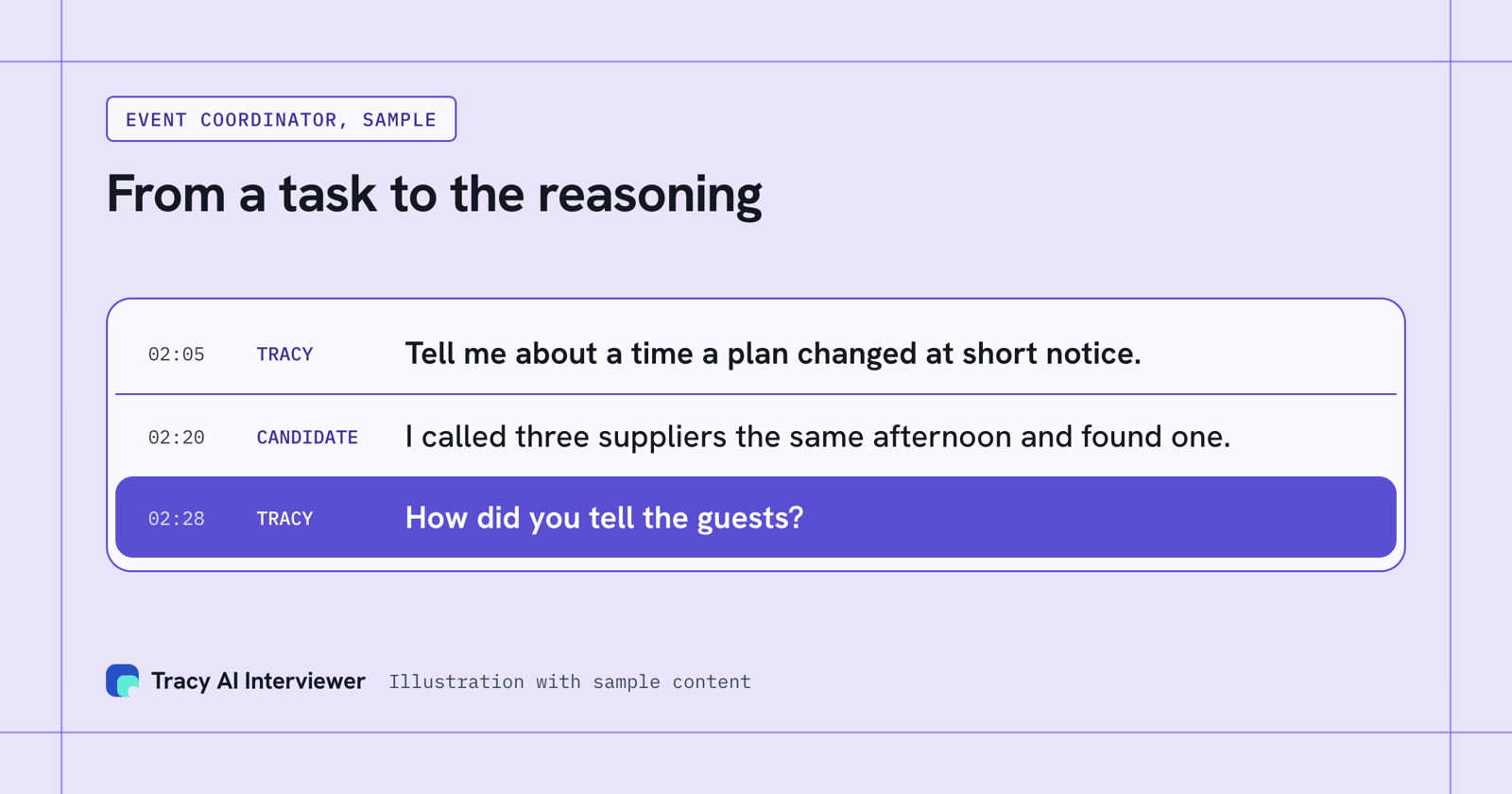
A follow-up turns a one-line answer into evidence about how the candidate acted.
How do candidates find a conversation instead of a task?
One non-STEM candidate said: "Even though it was AI, it gave me enough time to think about my responses and did not interrupt." Candidates are told on the join screen that the conversation is recorded and transcribed, and they join from a browser link with no account.
Mistakes that spoil a job tryout
- Scenarios that do not match the job. If the task is not something the role does, the result predicts nothing.
- No notice. Tell candidates what is recorded, who sees it and how long it takes.
- Letting one number decide. A tryout result is one input for a person to weigh with the rest.
- Running it for everyone before the basics are checked. Keep it short enough that a candidate would do it for a role they only half want.
- Skipping the pilot. Run it on colleagues first and rewrite whatever they stumble on.
Which path fits you
- Replacing the first call with a conversation: what a first-round interview is.
- Weighing one-way against two-way video: one-way vs two-way video interviews.
- Filling many places in one role: volume interviewing for a single role and a 30-day pilot for a mass hiring process.
- Writing the situations: first-round interview questions.
Common questions
What is a virtual job tryout?
How to prepare for a VJT?
Can I run a job tryout without a platform?
Does Tracy run a virtual job tryout?
Talk to every applicant
Every applicant gets interviewed through a link, whenever they choose, and every answer gets a follow-up. The first 3 results cost nothing.
Try it free (opens in a new tab) Book a demo (opens in a new tab)
Your first 3 results are free. No card needed.
Sources
- Virtual Job Tryout, HireVue, retrieved 22 Nov 2026.
- Tracy AI Interviewer Connect page, retrieved 11 Nov 2026.