
In short
The four Van Westendorp questions ask a customer at what price a product feels too cheap to trust, like a bargain, starting to feel expensive and too expensive. Plot the answers from many people and the crossing points give an acceptable price range.
You can ask the same four questions in an interview. Tracy AI Interviewer asks them on video, follows up on each number and reports what each person said, so you hear why a price feels high.
The method gives a range and not a demand forecast, and direct price questions tend to run low, so test the result against a real purchase.
Write the four questions for your product, then run one round.
Van Westendorp pricing questions are the four prompts of the Price Sensitivity Meter, a method Wikipedia credits to the Dutch economist Peter van Westendorp in 1976. They suit a product or pricing lead who has a product to describe and no idea yet where the price should sit. The questions are short, the wording below comes from Qualtrics, and the analysis is a set of curves you can draw in a spreadsheet. The numbers leave out why people feel the way they do about a price, and an interview can fill that gap.
What are the four Van Westendorp questions?
Each question asks for one price, and together they mark where a product turns from suspiciously cheap to too costly. Qualtrics words them as follows, and you can replace "the product" with your product's name.
- "At what price do you think the product is priced so low that it makes you question its quality?"
- "At what price do you think the product is a bargain?"
- "At what price do you think the product begins to seem expensive?"
- "At what price do you think the product is too expensive?"
Describe the product first, in a few plain sentences, so everyone prices the same thing. Sawtooth Software notes that its template lets you reverse the order of the questions, so order is a setting you can choose and record.
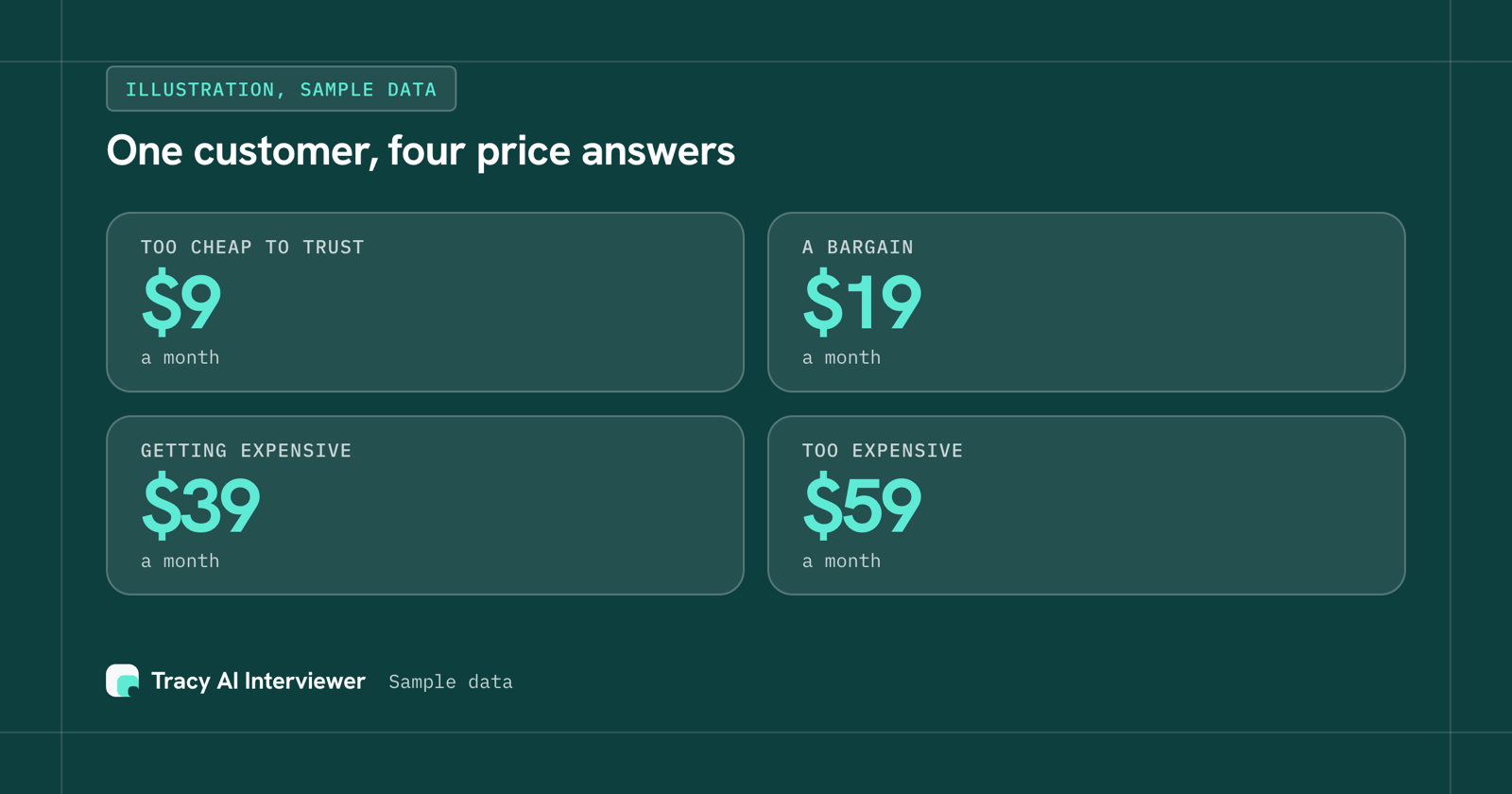
One customer's four answers form an ordered ladder of prices.
How do you turn the answers into a price range?
Plot the share of respondents who named each price, as a running total, for each of the four questions. The "too cheap" and "bargain" curves are inverted so that the lines can cross, which the Wikipedia article calls conventional practice. The four crossing points give you the range.
The four price points
Source: Wikipedia, Van Westendorp's Price Sensitivity Meter, read 23 Nov 2026. PMC is the point of marginal cheapness, PME marginal expensiveness, IPP indifference price and OPP optimal price.
| Point | Where the curves cross | What it marks |
|---|---|---|
| PMC | Too cheap meets expensive. | Lower bound of the acceptable range. |
| PME | Too expensive meets cheap. | Upper bound of the acceptable range. |
| IPP | Expensive meets cheap. | Equal numbers call it cheap or expensive. |
| OPP | Too cheap meets too expensive. | Equal numbers find it beyond their limits. |
How many responses do you need for Van Westendorp?
Qualtrics, Wikipedia and Sawtooth Software state no minimum. Qualtrics says to "get a large enough panel for your study to even out any anomalous or outlying answers", because the questions are subjective and people answer very differently. Treat the curves as a job for a large survey, and treat a small interview round as the way to learn what the numbers mean. If you run both, the interviews tell you what to write into the survey's product description.
Can you run Van Westendorp in an interview instead of a survey?
Yes, with one trade. The four questions work the same way spoken aloud, and a person on video can say why a price feels wrong, which a survey box rarely captures. What an interview round cannot do at small scale is draw reliable curves. So use it to hear the reasons, and use a bigger sample when you want the range.
A survey takes the number and moves on. An interview can ask what made that price feel too high, what the person compares it with and what they pay today for something similar. Those answers are the reason behind the number, and they tell you whether the price or the product description needs work.
How do you ask each question in an interview?
Ask the four in order, then follow up on the answer just given. Edit the wording for your product.
1. At what price is it so low that you would question its quality?
Follow up with: What makes you doubt it at that price?
Listen for: what the person treats as a sign of quality, such as support, security or a brand they know.
2. At what price is it a bargain?
Follow up with: What would you compare it with?
Listen for: a named alternative or the amount they pay today.
3. At what price does it begin to seem expensive?
Follow up with: What would you want to see before paying that?
Listen for: the feature or proof that would justify the higher price.
4. At what price is it too expensive?
Follow up with: What makes that price too much for you?
Listen for: a budget limit, an approver or a cheaper habit they would keep.
How does Tracy run the four price questions?
Describe the product and what you want to learn, and Tracy drafts the guide for you to edit, or you paste the four questions above. Send one link. Each customer opens it in a browser when it suits them, with no account, and answers the four questions on video. A vague number such as "around fifty" gets a follow-up about what makes it feel high. Recruiting stays your job: Tracy interviews the people you send the link to.
Each interview comes back as a note with the recording and a timestamped transcript behind it. Tracy reports what each person said and does not draw the price curves, so you take the four numbers from the words and plot them yourself. This excerpt is invented, from a cancelled-customer interview where a price answer led to a follow-up:
Question: What led you to cancel?
Summary: The customer's team shrank from 12 to 4 and they no longer needed the larger plan.
Quote, 01:30: "We went from twelve people to four."
Tracy's follow-up: Did you look at a smaller plan?
Field: Aware of smaller plan: No. Evidence: Q1 follow-up, at 02:10.
Eight interviews of 20 minutes are 8 credits, so $8 at $1 per credit, one credit per started 20 minutes, and the first 3 results are free. The customer research page shows the flow.
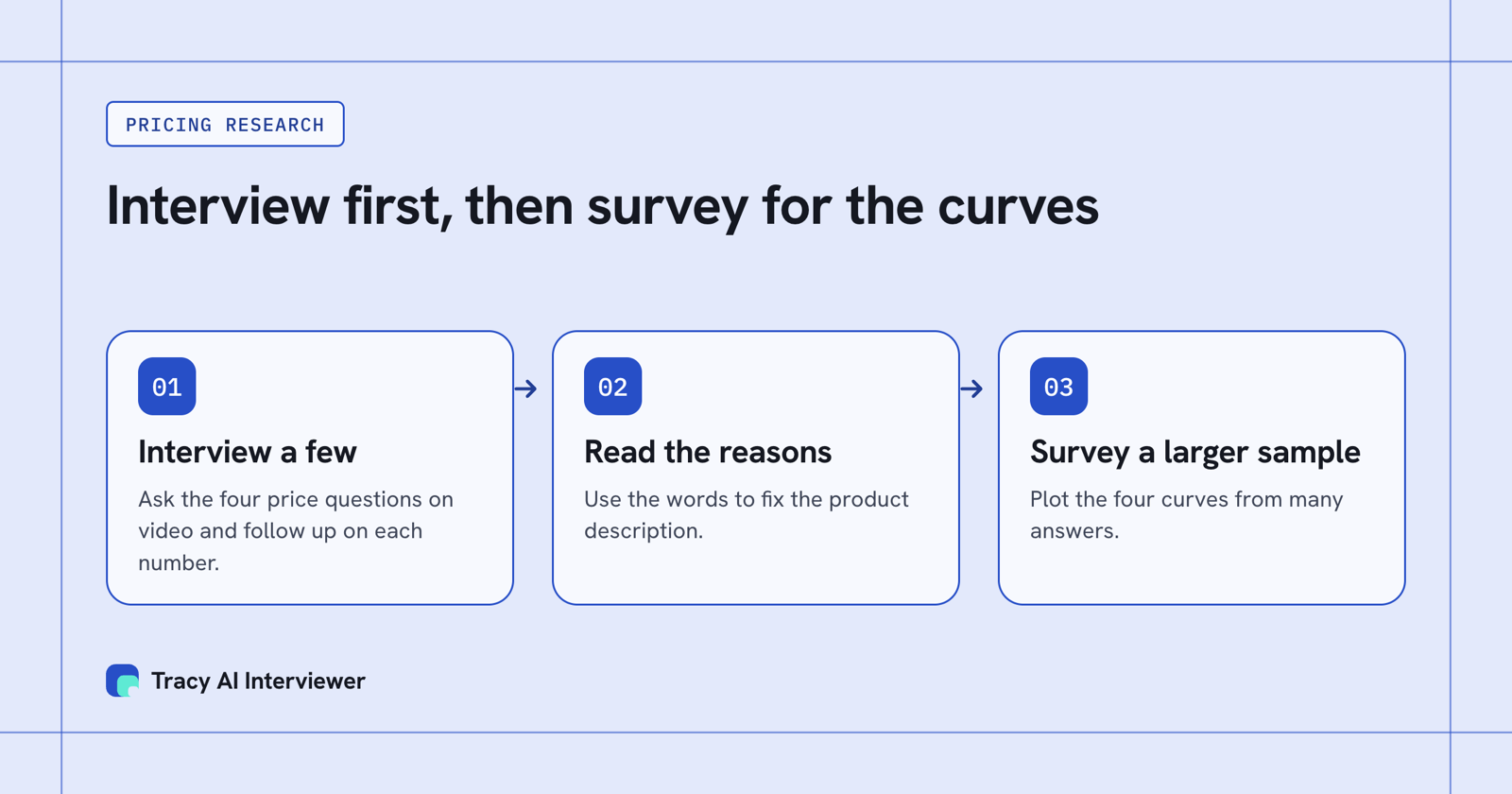
An interview round supplies the reasons, and a larger survey supplies the curves.
What mistakes spoil a Van Westendorp study?
- Skipping the product description. People price different things when each imagines their own version.
- Reading the range as a demand forecast. The method gives acceptable prices, and the Wikipedia article says van Westendorp did not try to estimate demand.
- Trusting direct price answers at face value. Qualtrics warns they tend to be far lower than people are truly willing to pay, and recommends validation testing in a real purchase situation.
- Asking people who would never buy. Ask customers or prospects who fit the product.
- Using it when you need a trade-off between features and price. Sawtooth Software names choice-based conjoint as the preferred technique for measuring price sensitivity, and the Price Sensitivity Meter as the simpler option.
For the interview side of the work, see customer development interviews and customer discovery interview questions.
Which path fits you?
- Setting up the interviews end to end: how to run customer interviews.
- Comparing tools for the interviews: customer interview software compared.
- Wondering whether a model can stand in for customers: what synthetic users can and cannot replace.
- Weighing a group session instead: alternatives to focus groups.
- Running research as a team: AI customer interviews.
Common questions
What are the four Van Westendorp questions?
How many responses do you need for Van Westendorp?
Can you run Van Westendorp in an interview instead of a survey?
Is Van Westendorp the same as conjoint analysis?
Does Tracy set the price for me?
Hear why a price feels too high
Tracy asks the four price questions on video and follows up on each answer, so you hear the reason. Your first 3 results are free.
Try it free (opens in a new tab) Book a demo (opens in a new tab)
Your first 3 results are free. No card needed.
Sources
- Qualtrics, Van Westendorp pricing studies explained, retrieved 23 Nov 2026.
- Wikipedia, Van Westendorp's Price Sensitivity Meter, retrieved 23 Nov 2026.
- Sawtooth Software, Van Westendorp question library, retrieved 23 Nov 2026.
- Tracy AI Interviewer, Pricing, retrieved 11 Nov 2026.