In short
The closest replacement for a focus group is a set of one-on-one interviews: each person answers alone, so nobody can dominate the room, and you hear the reason behind each answer.
Tracy AI Interviewer runs those interviews from one link. Customers answer when it suits them, Tracy asks about the detail a short answer left out, and each finding links to the person's words and the moment in the recording.
Keep a focus group when you need to watch people react to each other. No one-on-one format shows that.
Write the one question the group was meant to answer, then send the link to five or six customers.
What can replace focus groups?
One-on-one interviews replace a focus group best when you want to know why each person chose what they chose. Each person talks alone, so the quiet customer gets the same airtime as the confident one.
Four other formats cover other jobs. The table shows what each one answers and what it gives up, so you can pick by the question you have instead of by the habit of booking a room.
Which format answers which question?
Five formats that can stand in for a focus group, and what each one gives up.
| Format | Best for | What it gives up |
|---|---|---|
| One-on-one interviews | The reason behind each person's choice | Watching people react to each other |
| Diary or mobile study | What people do in their own setting over several days | A follow-up in the moment; it comes after the entry |
| Online community | An ongoing group conversation without a booked room | A few voices can still lead the thread |
| Survey | How many people chose each option | The reason, and answers outside your options |
| Usability test | Whether a person can finish a task | Whether anyone wants the product |
Why do teams look for something other than a focus group?
The room causes most of the trouble. A research methods text puts it plainly: "one or two participants might dominate the group, silencing other participants." A dscout article on alternatives (a vendor blog, 2020) calls the biases of the group format "invisible" and "insight limiting", and says show rates stay "notoriously tenuous" even with incentives.
Book a set hour for eight people and you inherit all of it: the no-shows, the loud voice and the answers shaped by whoever spoke first.
The same text lists what a focus group does well. You can watch participants react to one another, and one-on-one interviews cannot capture that. If your question is how a group reacts to an advert or a product name, keep the focus group.
Are online focus groups an alternative?
An online focus group puts the room on a video call and keeps the group, so one or two people can still dominate it, and you still have to find an hour that suits everyone. Use one when you need the group reaction and cannot meet in person. It does not replace one-on-one interviews when you want the reason behind each person's answer.
Are AI-moderated interviews an alternative?
Yes, for the one-on-one job. An AI-moderated interview is still an interview held with each person alone, so the group effects go away. What changes is how many people you can reach and when. Nobody has to find a shared hour.
Tracy starts from what you want to learn. She drafts the interview guide, or you paste your own questions and edit them. You send one link, and each customer opens it in the browser when it suits them, with no calendar. Tracy waits until the customer has finished, then asks about the part the answer skipped. All customers meet the same guide, which lets you read their answers in a row. Recruiting stays your job: Tracy interviews the people you send the link to.
The consumer and the exchange below are invented. The interviewer asks the same question a moderator would, and the follow-up goes after the exception the shopper mentions.
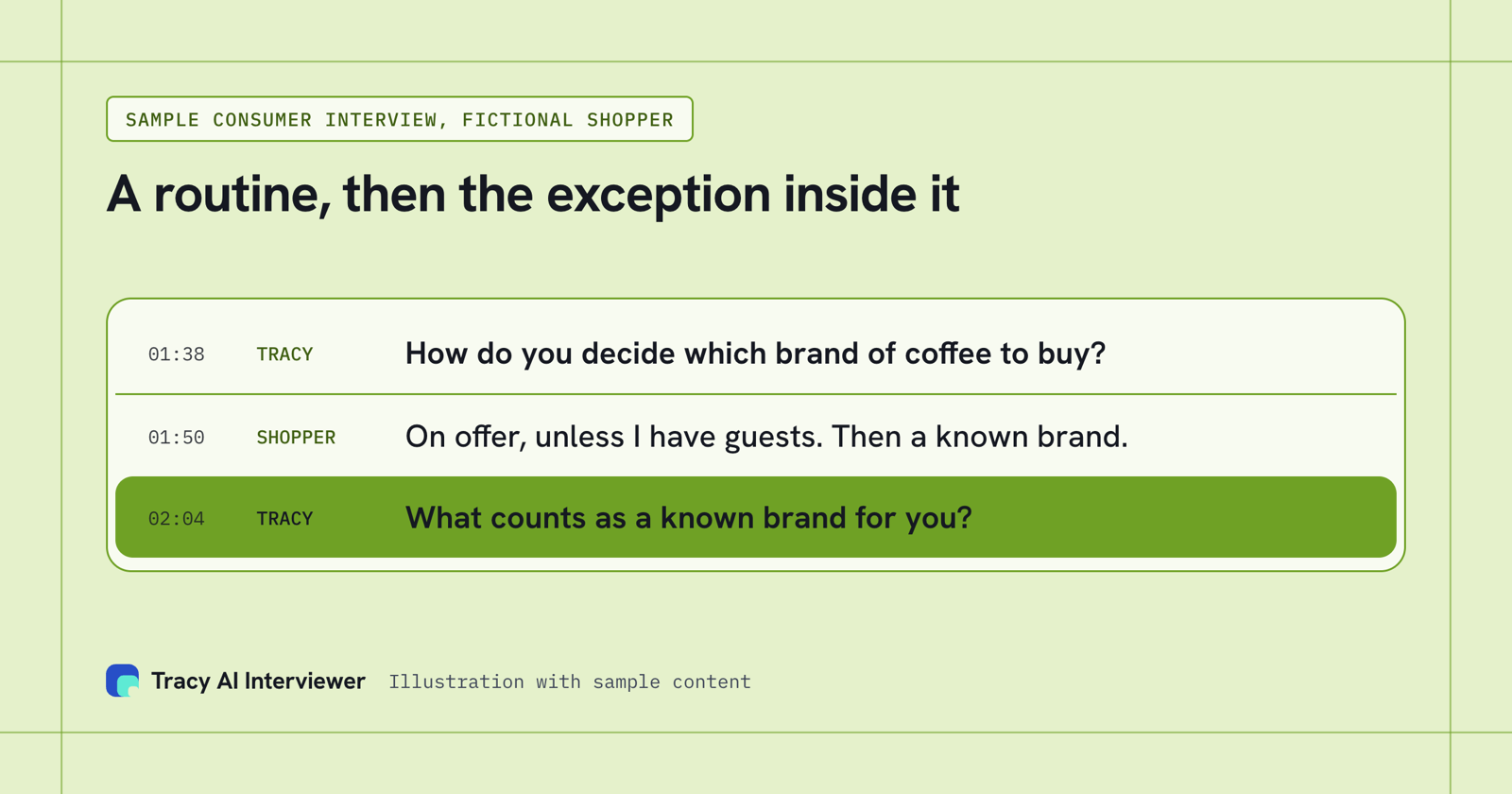
A shopper's routine turns into a rule once Tracy asks what counts as a known brand.
What do you get back from each interview?
The research team reads a short note from the same interview. This excerpt is also invented:
Question 1. How do you decide which brand of coffee to buy?
What they said. The participant buys the brand on offer unless guests are coming, then buys a known brand.
Quote at 01:50. "On offer, unless I have guests. Then a known brand."
Follow-up. What counts as a known brand for you?
Field, purchase driver. Promotion; known brand for guests (evidence: question 1, 01:50).
Every interview comes back with the recording, a timestamped transcript and what the person said to each question, as the real report screen below shows. You read across people and decide. Tracy does not rank or score anyone's answers.
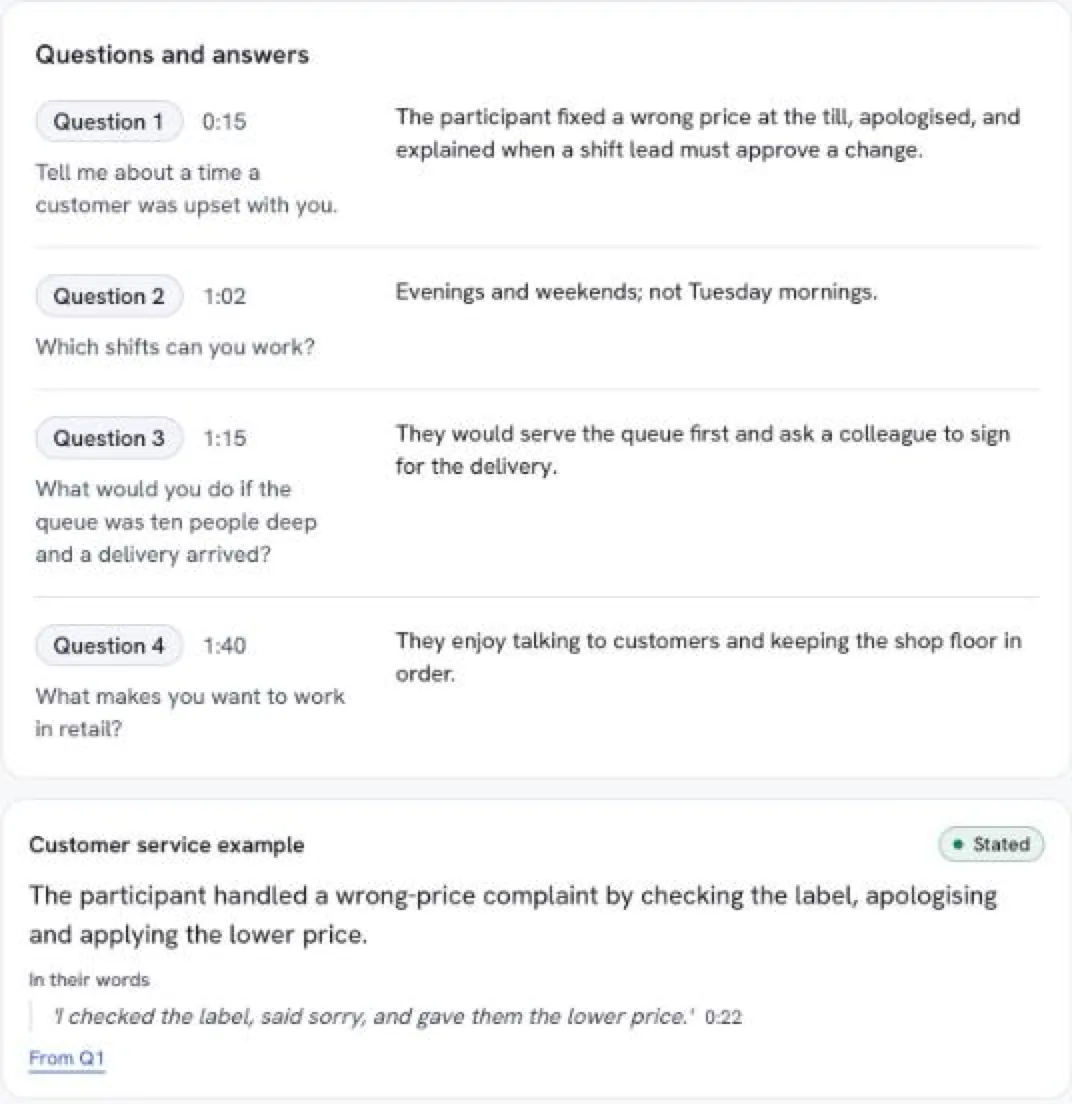
Each question comes back with a summary of the answer, the time it was asked and the customer's own words.
Which replacement fits which question?
- Why did customers pick this over the alternative? Run one-on-one interviews, by hand or from one link.
- What do people do across a week? A diary or mobile study.
- How many chose A over B? A survey.
- Can they finish the task? A usability test.
- How does a group react to this advert? Keep the focus group.
If you are starting with interviews, how to run customer interviews covers the guide and the follow-ups, and ten discovery questions with follow-ups gives you the first questions to ask. Teams that wonder whether a model can stand in for the customers themselves can read what synthetic users can and cannot replace.
How do you swap the room for interviews?
- Write the one question the group was meant to answer, such as why customers switched.
- Draft six to eight open questions about the last time it happened, or let Tracy draft them from that sentence.
- Send one link to five or six customers and read each interview as it finishes.
- Compare what people said to each question, and note the reasons that repeat.
- Hold a short group session only for the one question that needs a group reaction.
Six interviews of 20 minutes are 6 credits, so $6 at $1 per credit, one credit per started 20 minutes. The first 3 results are free. The customer research page shows the flow, and the customer interview software list compares the tools that run it.
What mistakes spoil the swap?
- Replacing the room with a survey and losing the reason behind each answer.
- Reading one interview and calling it a finding. Read the round, then adjust.
- Describing your idea before you ask. People react to the idea instead of telling you what happened.
- Keeping the group's habits, such as asking everyone the same closed question and counting hands.
A fuller list is in how teams run customer development rounds.
Common questions
What can replace focus groups?
Are online focus groups an alternative?
Are AI-moderated interviews an alternative?
When should you keep a focus group?
How many interviews replace one focus group?
Replace the room with one link
Tracy interviews each customer alone, when it suits them, and links every finding to their words. First 3 results free.
Try it free (opens in a new tab) Book a demo (opens in a new tab)
Your first 3 results are free. No card needed.
Sources
- 12.1 Focus Groups, Principles of Sociological Inquiry (Saylor Academy), retrieved 23 Nov 2026.
- Ben Wiedmaier, 3 Focus Group Alternatives To Garner Rich, Qual Insights, dscout (2 Sep 2020), retrieved 23 Nov 2026.
- Tracy AI Interviewer: Customer research, retrieved 9 Nov 2026.
- Tracy AI Interviewer: Pricing, retrieved 11 Nov 2026.