
In short
Cost per hire is the internal and external cost of recruiting in a period, divided by the hires made in that period. It is only comparable once you state which costs you counted.
Tracy AI Interviewer interviews every applicant on click, asks follow-ups in the applicant's own field and gives a reviewer the recording, transcript and a written summary of what each person said, per question, so the first round needs no recruiter on each call.
UK median cost per hire is £2,000 for most employees and £3,500 for senior managers (CIPD, 2026).
Next: calculate your own number, then price your first round.
A recruiting lead is asked for one number: what does a hire cost us, and is that normal? A cost per hire that counts agency fees and recruiter pay is a different figure from one that counts job ads only, yet both get quoted as if they were the same.
This guide gives the cost per hire formula, the benchmarks we can cite with their scope, and the stage of hiring where a team can change the cost most directly: the first round. For a company that interviews many applicants per role, that is where high-volume recruitment spends its hours.
The cost per hire formula
Cost per hire is total recruiting cost in a period divided by the number of hires in that period. The period is usually a month, a quarter or a year. Workable describes the total as every internal and external recruiting expense, and leaves out costs that arise after the hire, such as training.
Cost per hire = (internal recruiting costs + external recruiting costs) / hires in the period
Internal costs are the pay and overhead of the recruiting function, for example in-house talent acquisition salaries. External costs are what you pay outside people and tools: agency fees, job board postings, assessments, background checks, employer branding, relocation and ATS fees.
Here is a worked example with invented figures for one quarter.
| Cost line | Amount | Type |
|---|---|---|
| Recruiting team pay | $36,000 | Internal |
| Job boards | $8,400 | External |
| Agency fees | $15,000 | External |
| Assessments and background checks | $3,600 | External |
| ATS subscription | $3,000 | External |
The total is $66,000. With 12 hires in the quarter, cost per hire is $5,500. Change one input and the answer moves: counting hiring managers' interview time would raise it, and leaving out the agency would cut it by more than a fifth.
Example figures are invented for illustration. The method follows Workable's description of cost per hire.
What is a normal cost per hire?
There is no single normal figure. The studies we can cite measure different things in different countries, so read each one with its scope.
- CIPD, UK, 2026: the median cost of recruiting was £2,000 for employees below senior level and £3,500 for senior managers and directors. CIPD's survey covered 1,014 UK HR professionals between 2 April and 2 May 2026, and the medians come from those able to estimate within plus or minus 20 percent (223 and 263 respondents). In its 2022 survey the figure for other employees was £1,500.
- Appcast, US, 2024: advertising cost per hire reached $851 by the end of 2024, from more than 1,300 US employers using Appcast. It counts job ad spend only, so it is a floor, not a full cost per hire.
- SHRM, US, 2025: executive cost per hire is up 113 percent from 2017 and 21 percent from 2022 (medians), and nonexecutive cost per hire has decreased. SHRM reads the executive rise as organisations possibly paying more to hire faster.
If your figure sits above the CIPD median, check what you counted before you decide you overspend. The cost lines you include matter more than the benchmark you pick.
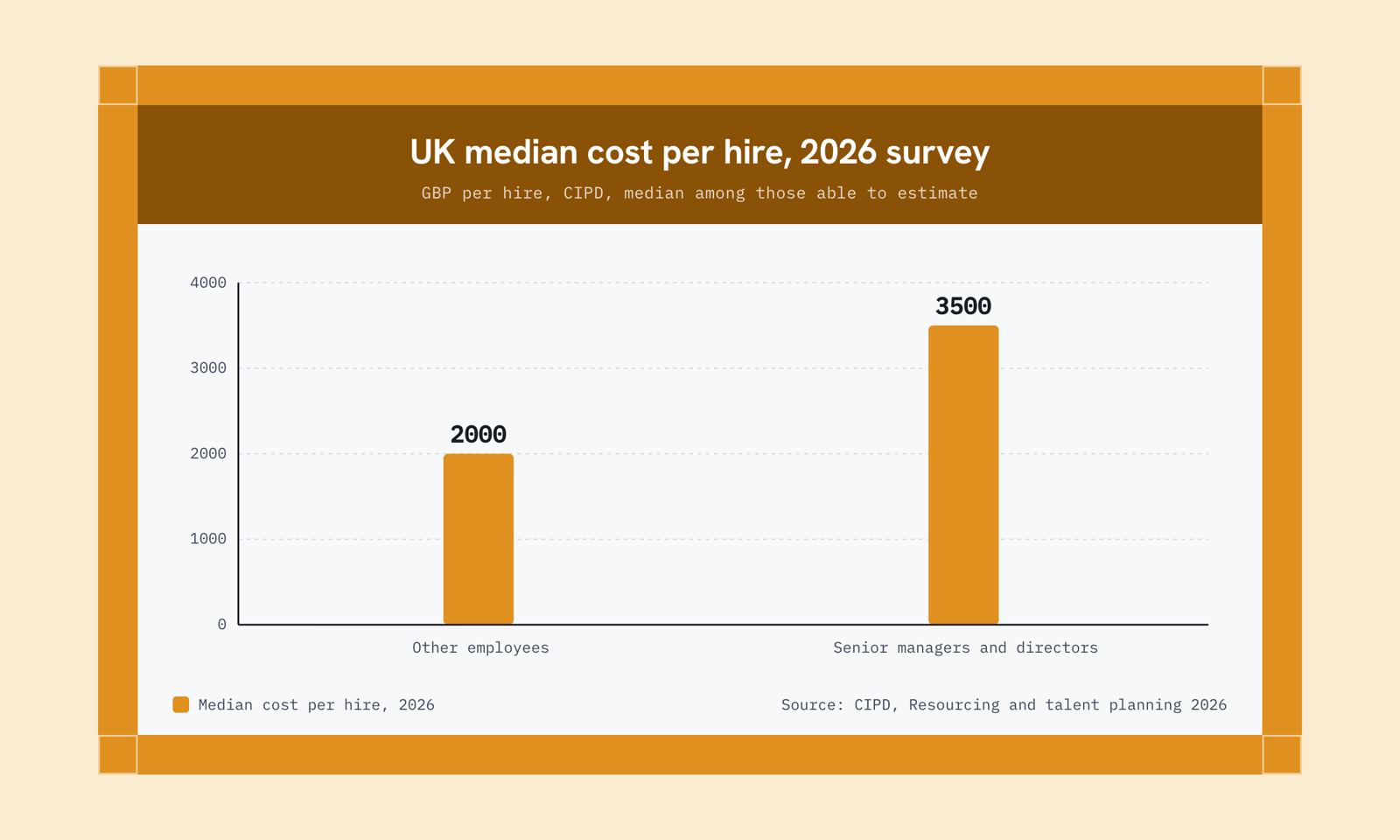
UK median cost per hire in 2026 is £2,000 for most employees and £3,500 for senior managers and directors.
Why two cost per hire figures rarely match
Before you put a benchmark next to your own number, check four things.
- Which costs are in: job ads only, or recruiter pay, agency fees and tools too.
- Which hires are counted: all hires, or one role family. Executive and other roles differ, as the SHRM and CIPD splits show.
- Which period: a seasonal push moves a quarter. Appcast's 2024 figure rose towards the end of the year.
- Mean or median: a few agency placements pull a mean up. CIPD and SHRM report medians.
If a source does not say, treat its number as colour. Your own figure, defined the same way each quarter, is the benchmark that tells you something.
Where the first round adds cost
Most of the cost sits before the offer. Greenhouse's US data for the year to August 2026 shows 194 applications per hire, and of every 1,000 applications only 32 reach a first interview. Gem's customer data shows teams running 20 interviews per hire in 2024, up from 14 in 2021. Each interview is recruiter or hiring manager time, and that time is cost.
Here is the arithmetic for one role, with invented assumptions: 400 applicants, a 15 minute phone screen each, and a loaded cost of $40 an hour for the person screening.
| Line | Phone screens by a recruiter | First round in Tracy |
|---|---|---|
| Applicants screened | 400 | 400 |
| Time per applicant | 15 minutes | Up to 20 minutes, applicant alone |
| Recruiter hours | 100 | Reading reports |
| Cost of the round | $4,000 | Up to $400 |
The first column is invented. The second follows Tracy's pricing: $1 per credit, one credit per started 20 minutes, no seats, a session with no answers never charged. A person still reads the reports and decides, so recruiter time does not fall to zero, and a longer interview costs more credits. What changes is that the cost no longer grows with a recruiter's calendar. With each applicant starting on click, the first round also has no interview scheduling to arrange.
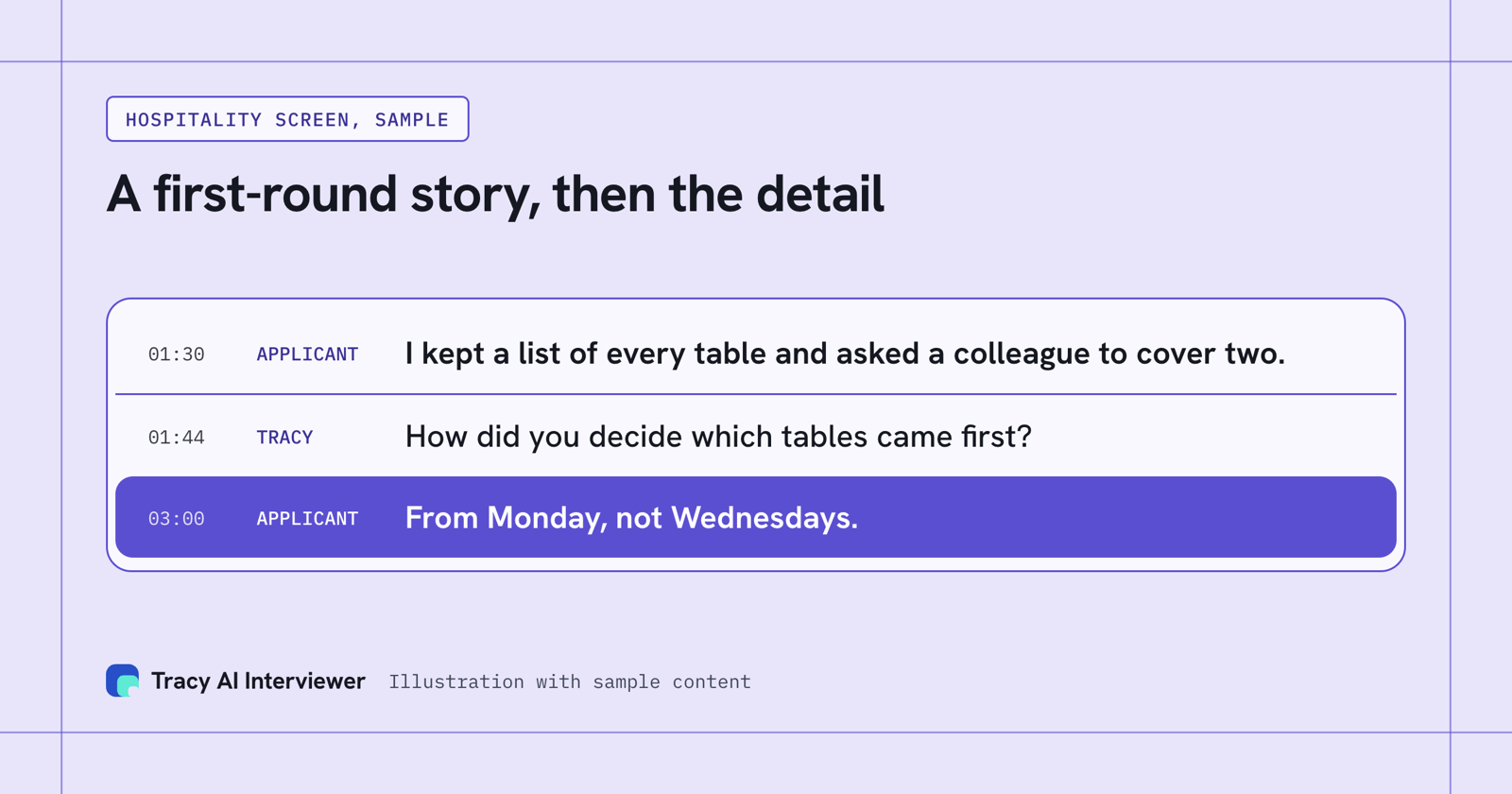
One follow-up turns a thin availability answer into a detail a reviewer can read, with its time in the recording.
How to lower cost per hire
Work on the lines that are large and under your control.
- Cut agency use where volume is steady. Agency fees were the biggest external line in the example above.
- Track source quality. Spend on a job board that sends applicants nobody hires is a cost with no hire attached. The KPIs guide shows how to count it.
- Shorten the funnel before the interview. Fewer wasted recruiter hours lowers the internal line. How many applicants per job shows the load.
- Interview every applicant in the first round, not a shortlist. Tracy reads each applicant's answers and follows up, so a person decides from evidence instead of from a CV and a 15 minute call.
- Watch the other side of the ledger. A cheap hire who leaves costs more later; the cost of a bad hire covers that, and time to hire covers speed.
One customer cut its average time to hire from 44 days to 7, and Tracy did the work of 53 full-time recruiters in one month. That result covers time and workload. Cost per hire still needs your own cost lines.
Try the first round on one role
Pick one open role with many applicants. Record your cost per hire for the last quarter with the formula above, then run the next requisition's first round in Tracy. Load your own questions or let Tracy draft them from the job description. A recruiter or hiring manager reads the reports and decides.
To turn the result into a business case, use the recruitment ROI calculator. Prices are on the pricing page.
Which path fits you:
- Many applicants per role: hiring at volume.
- Interested in the time side: time to hire statistics.
Common questions
What is the cost per hire formula?
How do you do a cost per hire calculation?
What is a good cost per hire benchmark?
What does cost per hire mean in recruitment?
See the method in one interview
See the method applied in one real interview. The first 3 results are free.
Try it free (opens in a new tab) Book a demo (opens in a new tab)
Your first 3 results are free. No card needed.
Sources
- Workable, Cost per hire, retrieved 23 Nov 2026.
- CIPD with Omni RMS, Resourcing and talent planning report 2026, retrieved 18 Nov 2026.
- Appcast, 2025 Recruitment Marketing Benchmark Report, retrieved 18 Nov 2026.
- SHRM, 2025 Recruiting Executives Benchmarking data brief, retrieved 9 Nov 2026.
- Greenhouse, US recruiting benchmarks, year to August 2026, retrieved 23 Nov 2026.
- Gem, 2025 Recruiting Benchmarks Report, retrieved 18 Nov 2026.
- Tracy AI Interviewer pricing, retrieved 11 Nov 2026.