TLDR Tracy AI Interviewer interviews every product manager applicant from your job description and follows up on what each person says, so you see how they decide, not only what they have shipped.
Use the 15 product manager interview questions below, grouped by what they test, each with a follow-up and what to listen for.
Every result keeps a recording, a timestamped transcript and a written assessment per question for a person to review.
Next step: paste these questions into a Tracy interview for one open role.
We make Tracy AI Interviewer.
A product role opens and 300 people apply. Every CV says "owned the roadmap" and "drove adoption". None says whether the person ever decided what not to build. Product manager interview questions for a first round have to find that out, and a single answer rarely does.
These are written for the person asking the questions. Candidates preparing for an interview will find them useful too, but the notes on what to listen for are for the interviewer. Each question has a follow-up and a note on what a strong answer contains.
Tracy AI Interviewer runs the part that does not scale. She asks each applicant questions drawn from your job description, follows up on what they just said and waits for the end of the thought. A recording, a timestamped transcript and a written assessment per question go to you, and you decide. For engineering roles, see software engineer interview questions, and for the wider workflow, hiring at volume.
Fifteen product manager interview questions, grouped by what they test
Group 1: product sense and prioritisation
| Ask | Follow up with | Listen for |
|---|---|---|
| 1. Pick a product you use every day. What would you change first, and for whom? | Who would be unhappy with that change? | Names a user and a problem before a feature. Accepts that the change costs someone something. |
| 2. You can fund one of three projects: a retention fix, an enterprise feature a big customer asked for, or a platform cleanup. How do you choose? | What would you want to learn before Friday? | States criteria before the choice. Names the cheapest evidence. Says what waits. |
| 3. Tell me about something you decided not to build. | Who pushed back, and what happened? | A real case, a named stakeholder, an outcome someone could check. |
Group 2: metrics and evidence
| Ask | Follow up with | Listen for |
|---|---|---|
| 4. A feature you launched has 20 percent adoption. Is that good? | What would you compare it with? | Asks for the target and who the 20 percent are. Counts the users it was built for. |
| 5. Weekly active users rose and revenue is flat. What do you check? | Which explanation would change the roadmap? | Segments, pricing, mix. Ties the answer to a decision, not a dashboard. |
| 6. Tell me about a metric you chose and later stopped trusting. | What replaced it? | A real case, how they noticed, what they do differently now. |
Group 3: engineering and design
| Ask | Follow up with | Listen for |
|---|---|---|
| 7. An engineer says your date cannot be met. What do you do? | When do you cut scope and when do you move the date? | Asks what drives the estimate. Trades scope in the open. Does not escalate first. |
| 8. How do you write a requirement so two engineers build the same thing? | Read me one sentence from a spec you wrote. | Observable acceptance criteria, edge cases, stated non-goals. |
| 9. Describe a disagreement with a designer. | What did each of you give up? | The argument is about the user, not taste. Names what moved. |
Group 4: customers and discovery
| Ask | Follow up with | Listen for |
|---|---|---|
| 10. Tell me about the last customer conversation that changed your plan. | What did you ask that got that answer? | Specific and recent. Open questions. Separates what customers say from what they do. |
| 11. Ten customers ask for the same feature. Do you build it? | What would make you say no? | Asks about the problem behind the request, who asked and how much they use or pay. |
| 12. How do you find out why people stop using something? | What would you do with only five conversations? | Mixes usage data and interviews. Honest about small samples. |
Group 5: ownership and stakeholders
| Ask | Follow up with | Listen for |
|---|---|---|
| 13. Tell me about a launch that missed. | What did you tell the company, and when? | Owns it, gives a timeline, names a process change. |
| 14. A senior leader asks for a feature you think is wrong. What happens? | What would change your mind? | Disagrees with evidence, commits once it is decided, says what would move them. |
| 15. What did you do last quarter that nobody asked you to do? | What did it cost you? | A concrete action with an owner and an honest cost. |
Table 1. The 15 questions, each with a follow-up and what to listen for (written by us).
A strong answer names a decision, and a weak one names a framework
The difference shows up in the second answer. These pairs are written by us as examples of how it sounds, not quotes from real candidates.
| Weak answer | Strong answer | |
|---|---|---|
| Question 2, one of three projects | "I would use RICE and take the highest score." | "Retention first, because the enterprise request is one account. I'd tell sales it waits a quarter and say why." |
| Question 4, 20 percent adoption | "It is okay for a new feature." | "Of whom? If it was built for admins, I'd count admins only, then compare with the last feature we shipped to them." |
| Question 13, a launch that missed | "The market was not ready." | "I wrote the requirement badly. I told the company that week, and now every spec names what we won't do." |
Table 2. Example weak and strong answers (illustrative, not from real candidates).
Listen for ownership. A framework name tells you what someone has read. "I decided this, and this is what happened" tells you what they did.
One follow-up chain shows where the real answer starts
This is an illustration with sample data, not a real interview. The candidate is fictional. It shows the shape of what Tracy runs: an opening question from your list, an answer, and a follow-up built on it. It starts from question 4.
Tracy: A feature you launched has 20 percent adoption. Is that good?
Candidate (fictional): It depends on the target. For a niche feature, maybe.
Tracy: What would you compare it with?
Candidate: Adoption among the users it was built for. If it was for admins, I would count only admins.
Tracy: Tell me about a time you made that correction.
Candidate: We shipped bulk export and saw 6 percent. Counting only accounts above 50 seats it was 31 percent, so we stopped calling it a failure and moved the entry point.
The first answer is the safe one. The third shows whether it ever happened. Roy Junyoung Jang, Director, Residency & Investment at Antler Korea, says Tracy "sometimes brings up exactly those questions I might have forgotten to ask, which has been a pleasant surprise."
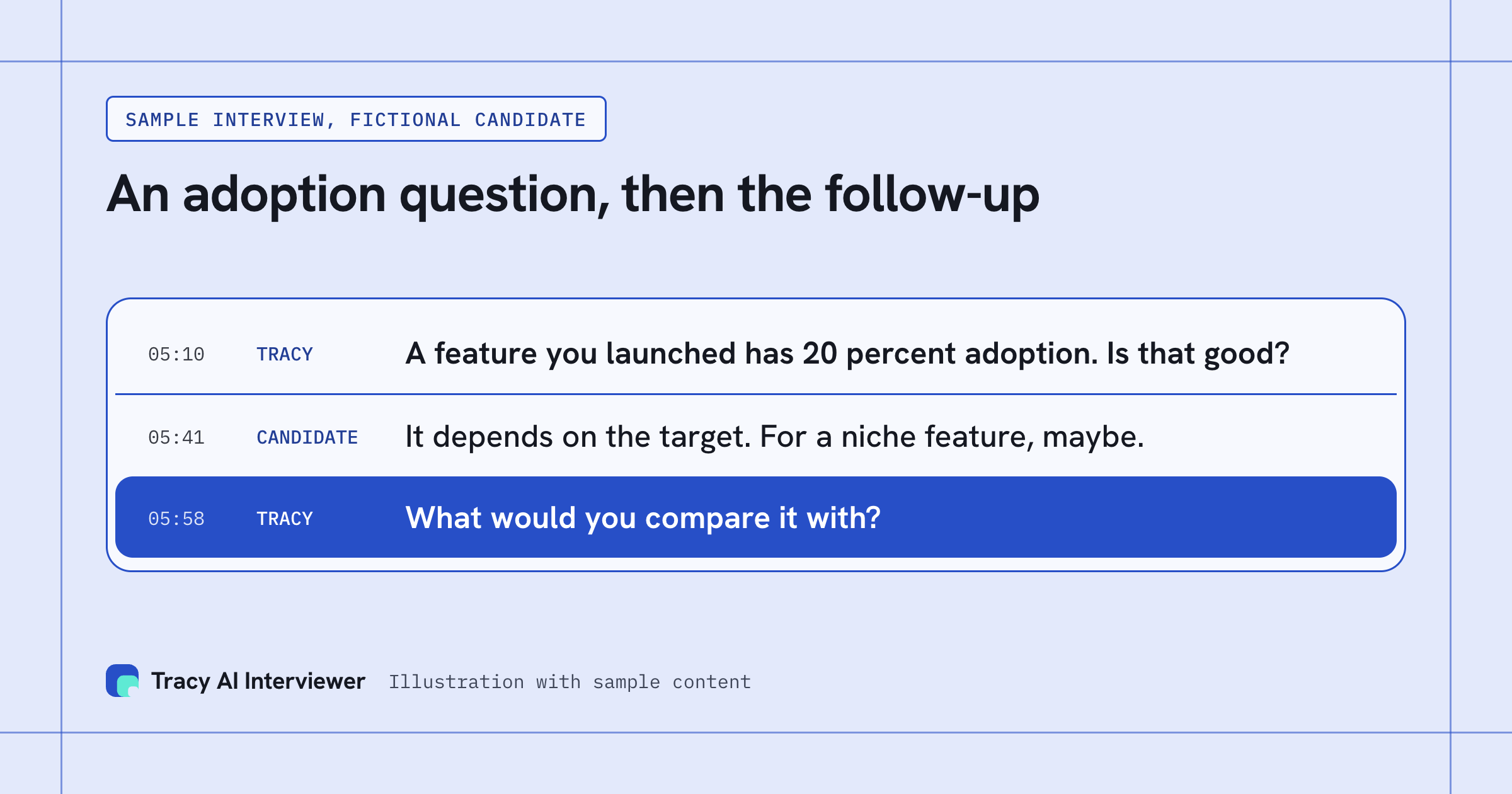
A follow-up built on the candidate's own answer shows whether they have done the work.
Run the interview for every applicant without losing the follow-up
A live call for every applicant stops working once a product role draws a few hundred.
- Questions from your job description. Paste it and Tracy drafts questions you can edit, from quick to deep and from technical to behavioural, or use your own. See the product page.
- CV check, as a setting. With it on, Tracy can read the CV and ask about what it claims, so "led the roadmap" becomes a question about one decision.
- Start on click. Each applicant opens a link in a browser, with no account and no calendar, at any hour, and is told on the join screen that the conversation is recorded and transcribed. See the participant experience.
- A result you can check. A recording, a timestamped transcript and a written assessment per question sit behind every result.
It is $1 per credit, one credit per started 20 minutes of an interview that produced a result, so a 34-minute interview costs $2. The first 3 results are free with no card, there are no seats, and a session with no answers is never charged. See pricing. Customisation takes days: send us one role and we will build the interview plan.
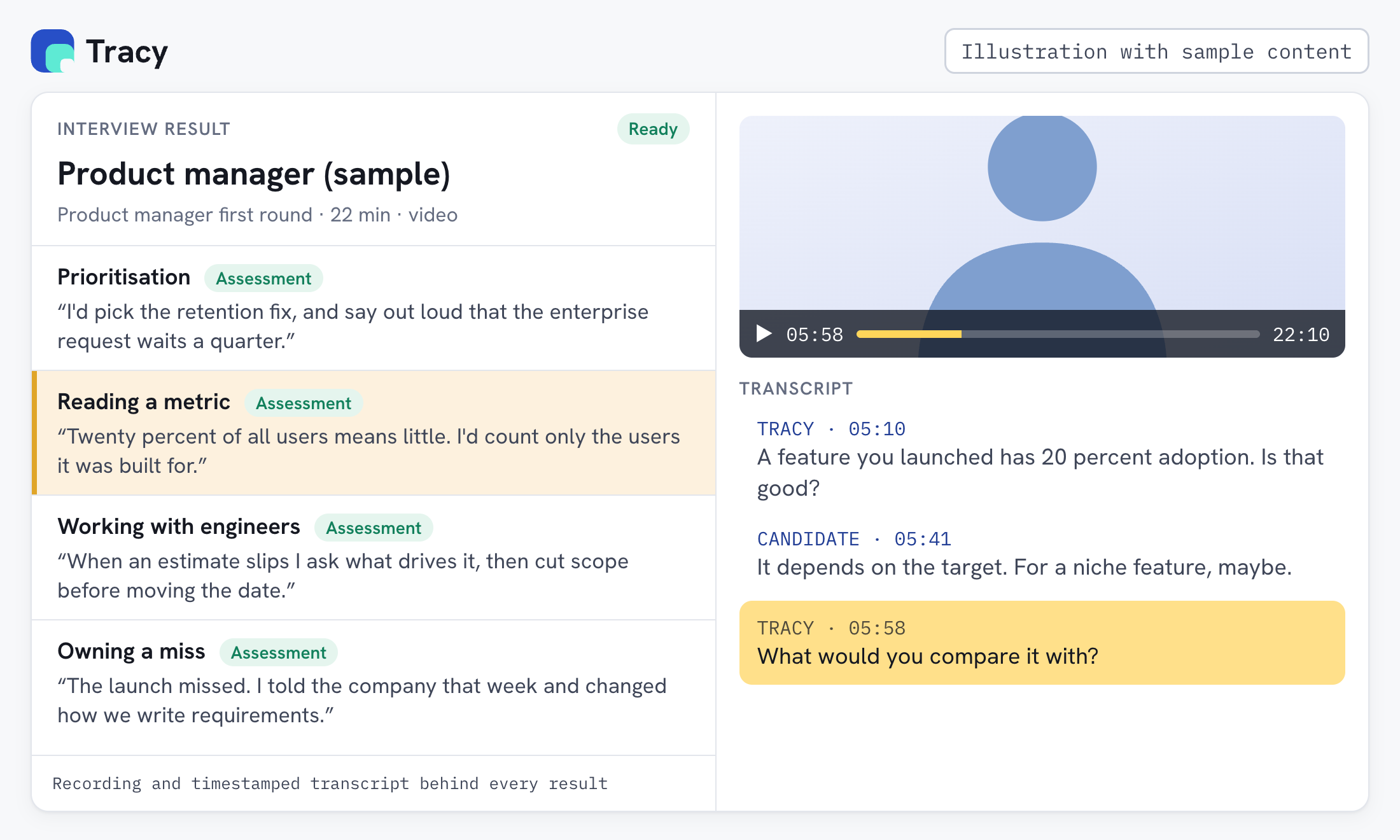
A reviewer can open the recording and transcript behind each assessment.
Keep three checks with people
- A product leader reads five or six transcripts blind. If they disagree with the written assessments, fix the questions before you invite the next hundred.
- A work sample for finalists. Interview evidence shows how someone reasons. It does not replace a case or a portfolio review.
- The decision. A person reads the evidence and decides.
For five applicants a month, a call with the hiring manager is a reasonable choice; see AI interview vs human interview. The case for Tracy starts when applicants outnumber the hours your product leaders have. Pilot on one role: 20 applicants, one reader. Track completion, hours from application to result and how often the reader disagrees with an assessment. See AI interview reports.
Questions
What are good product manager interview questions?
What are good product manager interview questions for experienced candidates?
How do you judge answers to product manager interview questions?
Can an AI interviewer interview product managers?
Create a Tracy interview for this exact role from these questions, then read the recording and report. Or send us one role and we will build the interview plan, with a recording and report you can check. Try it free · Book a demo
Sources
- Tracy AI Interviewer home page, retrieved 9 Nov 2026.
- Tracy AI Interviewer pricing, retrieved 9 Nov 2026.
- Tracy AI Interviewer Connect page, retrieved 9 Nov 2026.