
TLDR Tracy AI Interviewer runs a competency-based first round for every applicant: you set the skills and their weights per role, and she asks about each skill and follows up on the answer.
A competency-based interview asks for evidence of the skills a role needs and scores every answer against the same criteria.
Each result keeps a recording and timestamped transcript, plus a written assessment per question.
Next step: send us one role and we build the interview plan.
We make Tracy AI Interviewer.
What is a competency-based interview?
A competency-based interview asks each candidate for evidence of the specific skills and behaviours a role needs, then scores every answer against the same criteria. What does that look like in practice? The interviewer picks a handful of competencies from the job, asks for a real example of each, and rates the example instead of the impression the person made.
A competency is a skill or behaviour you can observe and measure. The UK Civil Service uses the word behaviours for the same idea and describes them as "the actions and activities that people do which result in effective performance in a job". It adds that behaviours "can be observed and measured". That is the whole approach in one line: you look for evidence of named competencies and not for a personality.
A competency-based interview is defined by named skills, real examples and shared scoring.
How a competency-based interview works
The scoring is decided before the first interview, and the order of the steps shows it.
- Choose the competencies. Take four to six from the job description, such as ownership, problem solving or working with others. Fewer and you miss parts of the job; more and each gets a thin question.
- Write the anchors. For each competency, write what a weak, adequate and strong answer contains.
- Ask for past behaviour. Questions that start with "tell me about a time you" begin from something the person did.
- Probe the example. The Civil Service guide to applying suggests the STAR method, which it describes as setting the scene, showing what and how you did, and the overall outcome. A good interviewer asks for whichever part is missing, usually the action and the result.
- Score each answer against its anchors, one competency at a time, and compare candidates on the same scale.
A competency-based interview example
Here is one role's worth of competencies. The questions are set per competency before the first interview. The follow-up depends on what the person says.
| Competency | Question | A strong answer has | Follow-up |
|---|---|---|---|
| Ownership | Tell me about a project that went wrong after you handed it over. | A named project, what the person did next and what changed afterwards | What would you have checked before the handover? |
| Problem solving | Describe a problem where your first fix did not work. | The first approach, why it failed and how the cause was found | What did you rule out, and how? |
| Working with others | Tell me about a disagreement with a colleague over how to do a task. | The disagreement in concrete terms, the person's own move and the outcome | What did the other person say when you proposed it? |
This table shows three competencies from a sample role: the question, the evidence a strong answer contains and one follow-up. It is sample content.
Each answer is scored on its own, against the anchors for that competency. The follow-up carries most of the weight. A rehearsed story survives the first question and rarely survives a request for the exact thing the person did, said or decided.
Competency-based, behavioural and structured interviews
The terms overlap and people use them loosely. In this guide, a behavioural question asks about something you did in the past. A competency-based interview organises the whole interview around a defined list of competencies. A structured interview asks every candidate the same questions and scores them against criteria set in advance. A competency-based interview is usually both behavioural and structured, but each word describes something different: the type of question, the content of the interview and the way it is scored. For the behavioural side, see our guide to AI behavioural interviews.
Where a competency-based interview falls short
The method measures what people say they did. A person can tell a vivid story about work someone else did, and a nervous person can tell a real one badly. Three habits limit the damage: ask for detail only the person who did the work would have, score the evidence in the answer and not the delivery, and keep a person in the decision.
The scores also depend on the competencies you chose. If the list does not match the job, a well-run interview measures the wrong things. And a rating from one interviewer on one day is still one rating, which is why the evidence behind each score should be easy to check.
Running a competency-based interview with Tracy
Tracy AI Interviewer applies the method to every applicant. You set the skills and their weights per role, and she generates the questions from your job description. You can edit them or use your own. She asks each applicant, in the applicant's own field, about each skill, follows up on what they said and waits for the answer. Nobody schedules anything: each person starts from a link when it suits them, which is what makes the method workable for hiring at volume.
Each result keeps a recording and a timestamped transcript, plus a written assessment per question with its reasoning, so a reviewer can check what the person said against the competency. A recruiter keeps the last word and can override a rejection or invite someone to interview again. Our guide to what an AI interview report shows covers where each piece of evidence sits.
Tracy also raises questions an interviewer may skip. Roy Junyoung Jang, Director, Residency & Investment at Antler Korea, says: "Tracy sometimes brings up exactly those questions I might have forgotten to ask, which has been a pleasant surprise." If you want to see a chain on your own role, send us the role and we build the interview plan. The first 3 results are free, with no card.
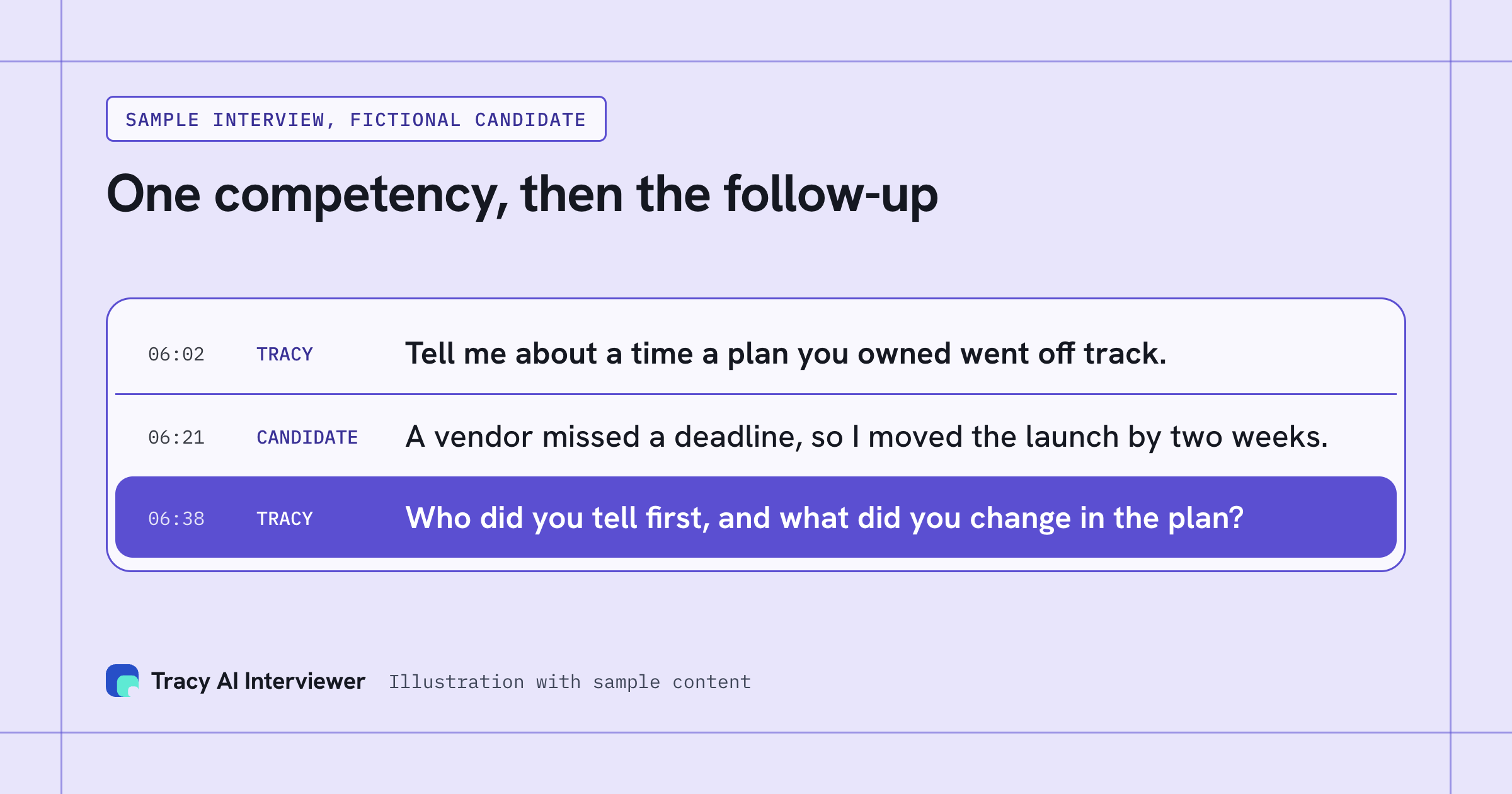
Tracy asks about one competency, then follows up on what the applicant said.
Related terms
- Behavioural interview: questions about past behaviour. See AI behavioural interviews.
- Anchor: a written description of what a weak, adequate or strong answer to a question looks like.
- Screening interview: the first-round conversation that decides who moves on. See AI screening interviews.
- STAR: situation, task, action, result, a frame for telling an example.
Questions
What is a competency-based interview?
What are competency-based interview questions?
What is the STAR method?
How many competencies should an interview cover?
Can an AI interviewer run a competency-based interview?
See the method applied in one real interview. Send us one role and we will build the interview plan in days, with a recording and report you can check. Try it free · Book a demo
Sources
- UK Cabinet Office, Success Profiles: Civil Service behaviours (updated 29 January 2025), retrieved 9 Nov 2026.
- UK Cabinet Office, Success Profiles: Candidate overview (STAR method), retrieved 9 Nov 2026.
- Tracy AI Interviewer home page, customer quotes, retrieved 9 Nov 2026.
- Tracy AI Interviewer pricing, retrieved 9 Nov 2026.