In short
Tracy AI Interviewer asks follow-ups inside the expert's own field, so a rehearsed answer on transformers or retrieval gets probed for the project behind it. A person reviews the evidence.
Below are 15 NLP engineer interview questions, each with a follow-up and the points a strong answer covers, for AI-lab and talent-platform teams vetting experts. Start with question 11: "Your classifier scores 95% and fails in production. Why?"
Describe the project and Tracy drafts the questions from it. You edit them or bring your own, and every result has a recording and a timestamped transcript behind it.
An NLP expert profile can list transformers, fine-tuning and retrieval, and so can a profile written the night before. For a lab or a talent platform, the cost of a weak expert shows up later, in a project that drifts. Good NLP engineer interview questions ask about the run that failed and what the person did next.
These 15 questions are for expert-supply and talent-operations teams vetting NLP engineers, and for hiring managers who need one. Aim for a first conversation of 20 to 30 minutes, and keep the deep technical review for your own scientists.
Tracy AI Interviewer can take on that opening conversation. She asks in the expert's own field and follows up on what they said, so a polished first answer meets a second question that depends on it. For the wider method, see how AI interviews vet experts. For the first conversation in a technical hiring process, see how Tracy runs technical interviews. For the neighbouring role, see machine learning engineer interview questions.
How do transformers work, and why open with it?
A transformer reads a whole sequence at once and uses attention to let each token weigh every other token, with positional information added so order still matters. Open with it because the textbook answer is easy to rehearse, and the follow-up about cost, long documents or failure shows who has used one.
Fifteen NLP engineer interview questions, grouped by what they test
Pick one or two questions per group, and hold the follow-up until the first answer is in. Write down what a good answer contains before the first interview.
Group 1: Language basics
Table 1: Language basics. Each question has a follow-up and the points a strong answer covers.
| Question | Follow-up | A strong answer covers |
|---|---|---|
| 1. What is tokenization, and how do lemmatization and stemming differ? | What goes wrong when a tokenizer meets text from another domain? | Subword tokenizers such as BPE or WordPiece split rare words. Lemmatization returns a dictionary form, stemming cuts suffixes by rule. Domain terms become many tokens, which costs quality and money. |
| 2. How did people represent text for a classifier before transformers, and why does it still matter? | When would TF-IDF with logistic regression beat a large model? | Bag of words and TF-IDF. A strong, cheap, explainable baseline. Small data, tight latency or a stable vocabulary. |
| 3. What is an embedding, and how do you check whether embeddings suit your data? | What do you do when the nearest neighbours look wrong? | Dense vectors from a model. Tests on a retrieval task with labelled queries. Looks at neighbours by hand. Checks domain mismatch, normalisation and chunk size. |
Group 2: Transformers
Table 2: Transformers. Each question has a follow-up and the points a strong answer covers.
| Question | Follow-up | A strong answer covers |
|---|---|---|
| 4. How do transformers work? | Why does the cost of attention grow with sequence length? | Self-attention lets each token weigh the others, through queries, keys and values, with positional information and several heads. Cost grows with the square of the length. |
| 5. What separates encoder-only, decoder-only and encoder-decoder models, and which fits classification, generation and translation? | What would you change for a very long document? | An encoder for classification and extraction, a decoder for generation, an encoder-decoder for translation or summarising. Chunking, long-context models or retrieval for the long document. |
| 6. How does a model generate text one token at a time, and what do temperature and top-p change? | When would you set temperature to zero, and what can still vary? | Sampling from the next-token distribution. Temperature reshapes it, top-p cuts its tail. Zero is close to greedy. Outputs can still differ between runs on some systems. |
Group 3: Adapting a model
Table 3: Adapting a model. Each question has a follow-up and the points a strong answer covers.
| Question | Follow-up | A strong answer covers |
|---|---|---|
| 7. When do you prompt, retrieve, fine-tune or train from scratch? | What evidence would move you from one to the next? | Starts cheap with a prompt. Retrieval for knowledge that changes. Fine-tuning for style, format or behaviour. Measures on a held-out set before each step. |
| 8. Describe a fine-tuning run that did not improve the model. | What did you check first? | Data quality, label noise, leakage between train and test, learning rate, a mismatch between the metric and the task. Says plainly what they got wrong. |
| 9. How do you build retrieval-augmented answers that stay grounded in the source? | How do you measure whether an answer used the retrieved text? | Chunking, hybrid search, reranking, citations. Evaluates retrieval apart from generation. Checks claims the sources do not support. |
Group 4: Evaluation and data
Table 4: Evaluation and data. Each question has a follow-up and the points a strong answer covers.
| Question | Follow-up | A strong answer covers |
|---|---|---|
| 10. How do you evaluate a summarisation or generation system? | What are the limits of BLEU and ROUGE? | Overlap metrics miss meaning. Human review on a sample, task-specific checks, and an LLM judge calibrated against people. |
| 11. Your classifier scores 95% and fails in production. Why? | How would you find out? | Class imbalance, leakage, distribution shift. A confusion matrix per class, a comparison of live and training data, error analysis on real misses. |
| 12. How do you get consistent labels from annotators? | What do you do when two annotators disagree? | Written guidelines, a pilot round, an agreement measure such as Cohen's kappa, adjudication, and a revised guideline. |
Group 5: Production
Table 5: Production. Each question has a follow-up and the points a strong answer covers.
| Question | Follow-up | A strong answer covers |
|---|---|---|
| 13. How do you run an NLP model in production? | What do you watch after release? | Latency, batching, caching, quantisation, versioning, a rollback path. Watches input drift, sampled output quality and cost. |
| 14. How do you reduce hallucinated or unsafe output? | When do you stop the model from answering? | Grounding, constrained output, validation, refusals, and human review for risky cases. Defines the unacceptable answer first. |
| 15. Explain a recent technique to a product manager, then to an engineer. | What would you test before adopting it? | Changes the level without changing the facts. Names the limits. Plans an ablation or a small trial. |
What are tokenization and lemmatization, in one good answer?
Tokenization splits text into the units a model reads: words, subwords or characters. Lemmatization reduces a word to its dictionary form, so "running" and "ran" both map to "run". Stemming gets to a stem by cutting endings by rule, so it is faster and cruder. A strong candidate adds when it matters: most modern models take subword tokens and need neither step, while classic pipelines, search and small-data work still use them.
Weak and strong replies to three of the questions
Each row gives a weak and a strong reply to one question.
Table 6: Sample weak and strong replies to three of the questions above, written as examples.
| Question | Weak reply | Strong reply |
|---|---|---|
| Question 11, 95% in test | "The model must be overfitting." | "I'd check for leakage first, then the per-class results, since 95% can hide a rare class at 40%. Then I'd compare live inputs with the test set." |
| Question 7, which approach | "Always fine-tune. It's the most accurate." | "I try a prompt, then add retrieval if the knowledge changes. I fine-tune when I need a fixed format or style and I have a clean set to test on." |
| Question 13, production | "We deployed it on a big GPU." | "We batched requests, quantised the model, cached repeat inputs and sampled outputs weekly for review, with the old version ready to roll back." |
A follow-up chain on the model that fails live
The card below is a made-up exchange with an invented candidate. It starts from a question like question 11, and the second question asks for the method behind the answer.
An expert who has fixed this describes the logging and the comparison.
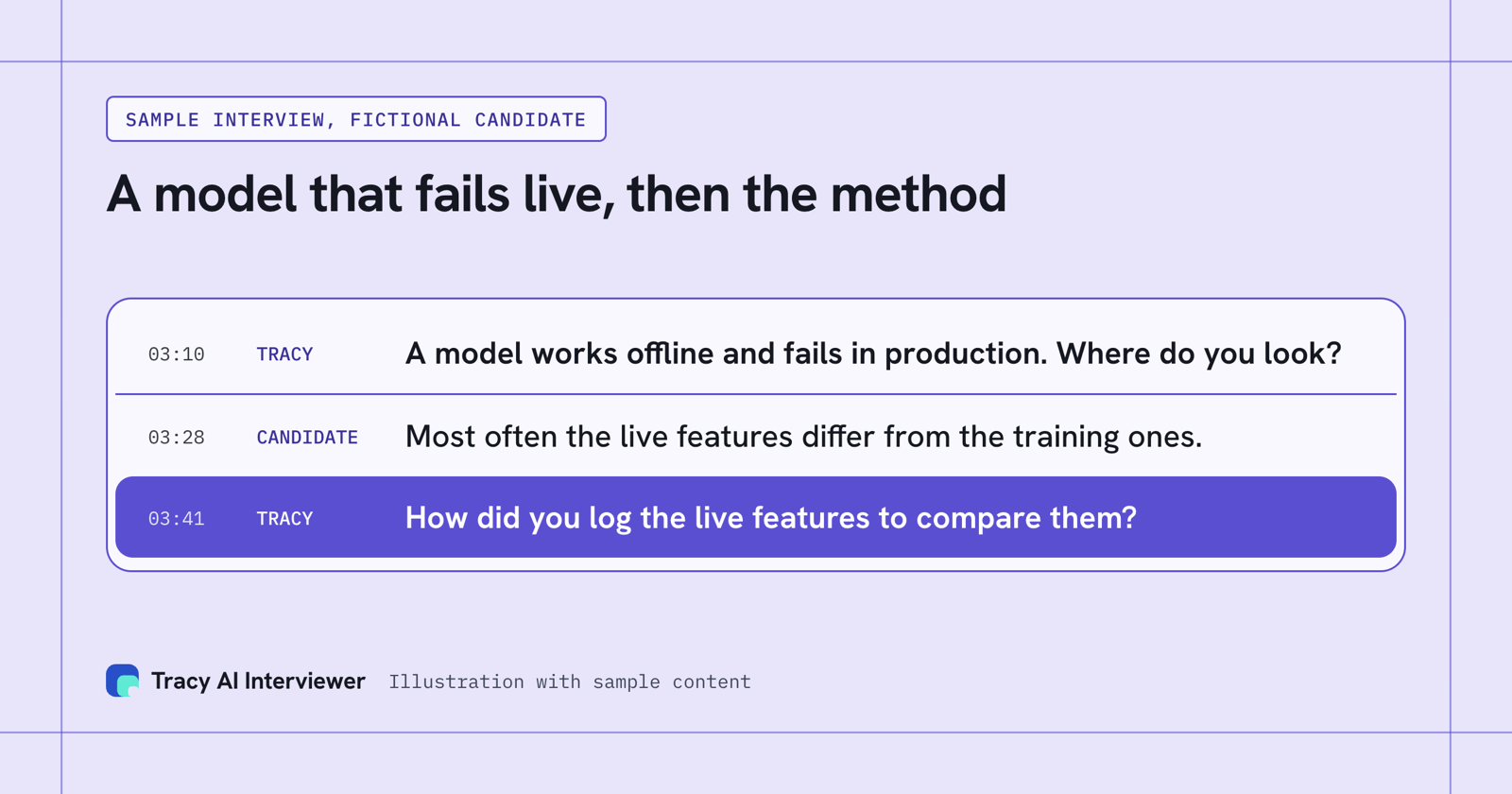
The follow-up asks for the method behind a confident answer, which a memorised rule cannot supply.
Vet NLP experts before a project lands
A new project needs experts in days, and a calendar of screening calls cannot keep pace. The same volume problem is covered in high-volume recruitment.
- Describe the project or the role and Tracy drafts questions from it. Choose the style from quick to deep and from technical to behavioural, then edit or replace the questions. See how the interview is set up.
- Each expert opens a link and starts when ready, at their own hour and in their own time zone. The join screen says the conversation is recorded and transcribed.
- Tracy asks follow-ups in the expert's field, such as the metric they used or how they found the cause, and waits for the end of the answer.
- Integrity signals come with video interviews and can be switched off: tab changes, face on camera and leaving fullscreen. The evidence goes to a person, and a signal is not proof. Candidates are told about the recording before it starts.
- Every result has a recording and a timestamped transcript behind what the expert said to each question. See what the report holds.
Pricing is $1 per credit, and an interview that returns a result uses one credit for every started 20 minutes. The first 3 results are free and need no card; the pricing page has the detail.
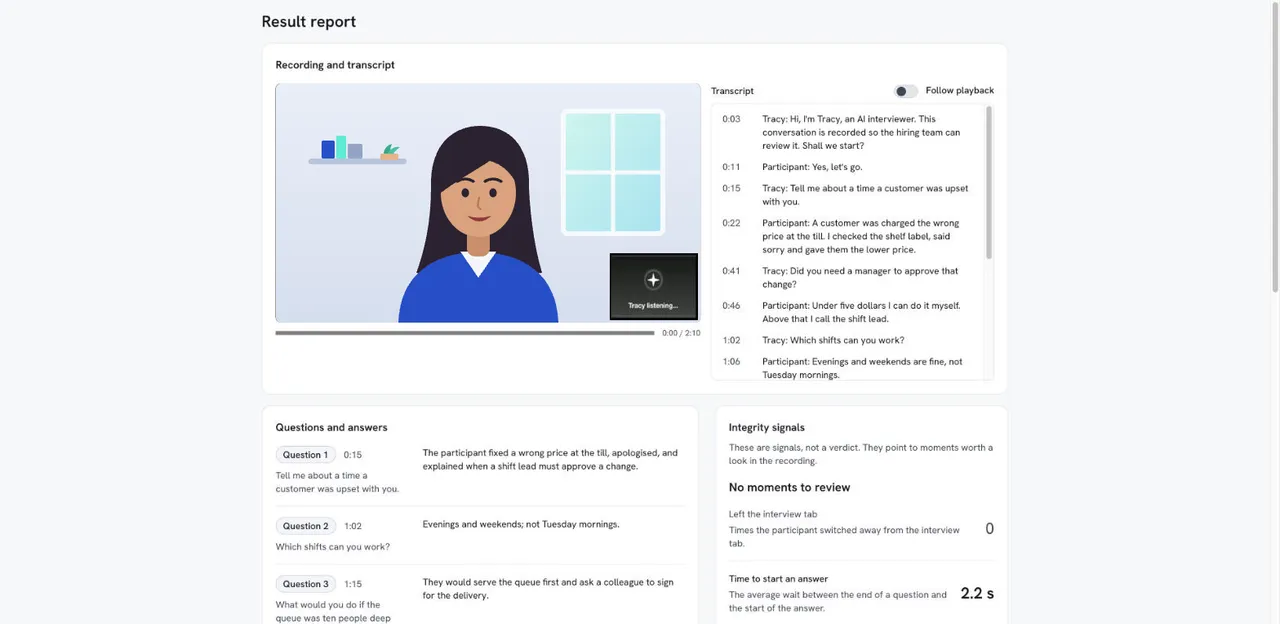
A reviewer can follow the transcript beside the recording and check what the expert said at its source.
What stays with your scientists
- Who is approved: a senior NLP engineer reads each report and decides. Tracy reports what was said, with quotes; the judgement is theirs.
- The field map: agree which subfields count for the project, such as retrieval, evaluation or multilingual work, and read each report against that list.
- The deep review: reading a candidate's code or paper stays with your team.
For a handful of experts a year, a call with your own scientist is simpler, as AI interview versus human interview sets out. Where a project needs dozens vetted quickly, an interview that starts on click helps. To test the approach, add three of these questions to a single open expert role and have a scientist read the first reports.
Common questions
What deep learning engineer interview questions go with these?
Can Tracy interview NLP experts in their own field?
Does Tracy decide who is approved?
Hear each expert answer in their field
Tracy asks follow-ups in the expert's own field and keeps integrity signals for a person to review. First 3 results free.
Try it free (opens in a new tab) Book a demo (opens in a new tab)
Your first 3 results are free. No card needed.
Sources
- Tracy AI Interviewer home page, retrieved 22 Nov 2026.
- Tracy AI Interviewer pricing, retrieved 22 Nov 2026.
- Tracy AI Interviewer Connect page, retrieved 22 Nov 2026.