In short
MCP server examples come in three groups: the seven reference servers that teach the protocol, vendor servers such as GitHub's, and servers you write yourself in Python, TypeScript, Java, Kotlin or C#.
Tracy AI Interviewer runs a remote MCP server from a different field. From a Claude or ChatGPT chat you draft an interview, invite people and read what each said to each question, and nothing is created until you approve a preview.
Read one reference server first to see the shape, then check what each tool can do before you connect it.
What are examples of MCP servers?
The best-known examples live in the modelcontextprotocol/servers repository, which lists seven reference servers. The maintainers call them reference implementations that demonstrate MCP features and SDK usage, and say they are not production-ready solutions. They are the quickest way to see what a server looks like.
| Server | What it lets the AI do |
|---|---|
| Filesystem | Secure file operations with configurable access controls |
| Fetch | Fetch web content and convert it for efficient LLM use |
| Git | Read, search and manipulate Git repositories |
| Memory | Keep a knowledge graph-based persistent memory |
| Time | Convert times and time zones |
| Sequential Thinking | Work through a problem in a sequence of reflective steps |
| Everything | A test server with prompts, resources and tools |
The seven current reference servers, as the repository's README describes them, read 23 Nov 2026.
Older examples such as GitHub, Google Drive, PostgreSQL and Slack have moved to an archive in that repository, and Slack is now maintained by Zencoder. GitHub now publishes its own server, covered below. For a longer directory, the MCP server list gives twelve to start from.
What does a vendor's own MCP server look like?
GitHub's server is the example most people search for. Its README says it connects AI tools directly to GitHub's platform, and lists use cases from repository management and issue and pull request automation to Actions runs, code security findings and discussions. GitHub hosts a remote version at api.githubcopilot.com/mcp, and groups of tools can be switched on or off, so a host exposes only what a task needs.
A small, named set of tools is easier to approve than a large one, so copy that habit in your own server. What is a remote MCP server explains why a hosted address changes the setup.
MCP server examples in Python, TypeScript and C#
The official quickstart builds a small weather server with two tools, get_alerts and get_forecast, and connects it to Claude for Desktop. It has tabs for Python, TypeScript, Java, Kotlin and C#. In Python the tool is a decorated function, and the docs say the type hints and docstring generate the tool definition:
from mcp.server import MCPServer

mcp = MCPServer("weather")

@mcp.tool()
async def get_alerts(state: str) -> str:
    """Get weather alerts for a US state.

    Args:
        state: Two-letter US state code (e.g. CA, NY)
    """
    ...
In TypeScript the same idea is a registerTool call on an McpServer. The C# tab follows the same pattern with its own SDK.
One rule applies in every language. A server that talks over STDIO must never write to standard output, because that corrupts the JSON-RPC messages. In Python, use the logging module, which writes to stderr, instead of print. In TypeScript, avoid console.log, and in C# avoid Console.WriteLine. A server reached over HTTP is not affected.
How do you build a simple MCP server?
Start from the quickstart and change one thing at a time.
- Pick a language and install its SDK.
- Write one tool as a function with typed arguments and a docstring that says what it does.
- Send logs to stderr if the server uses STDIO.
- Add the server to a host. For Claude for Desktop, servers go under the
mcpServerskey in its configuration file. - Ask the host to use the tool and read what it sends before you approve the call.
The MCP spec says a human should always be able to deny a tool invocation, so build with approval in mind. A tool that changes something should describe the change in plain words.
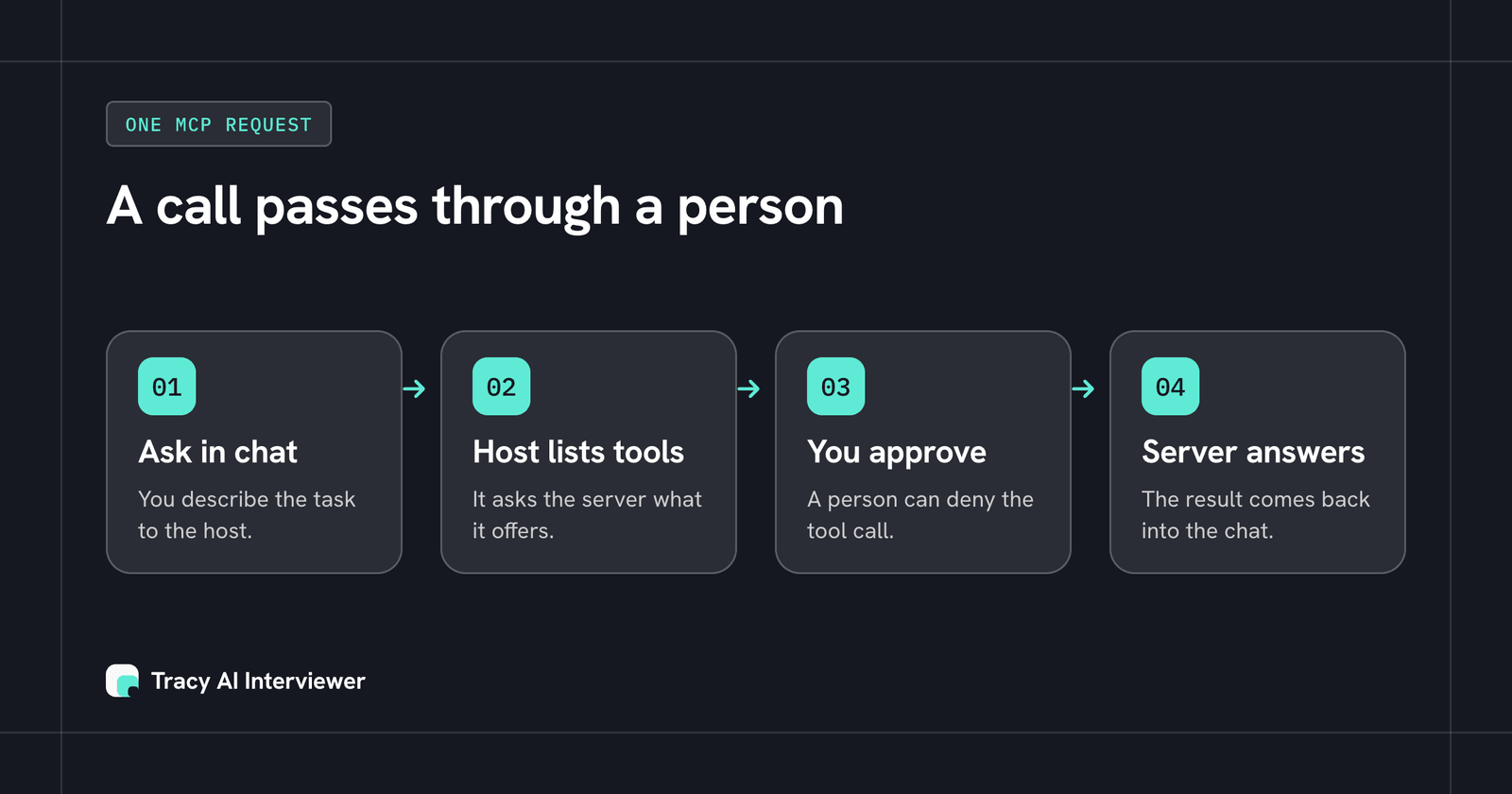
A server call passes through a person: the host lists the tools, and you approve before anything runs.
What is an MCP server example from outside developer tools?
Tracy AI Interviewer's server at tracyinterview.ai/mcp handles conversations with people, where most examples handle code or files. A host such as Claude or ChatGPT can suggest an interview, create and update it, invite participants by email, turn a public link on or off, get results, check the balance and create a top-up link. Creating an interview, inviting people and turning on the public link each show a preview first and wait for your approval. A new interview starts with its public link on, open to anyone with the link for up to 20 people over 14 days, and nobody is invited until you say so. You can turn the link off.
The interview itself runs on video or audio in a browser. The person needs no account and is told on the join screen that the conversation is recorded and transcribed. Tracy asks follow-ups in the person's own field. A sample, with an invented project manager, is below.
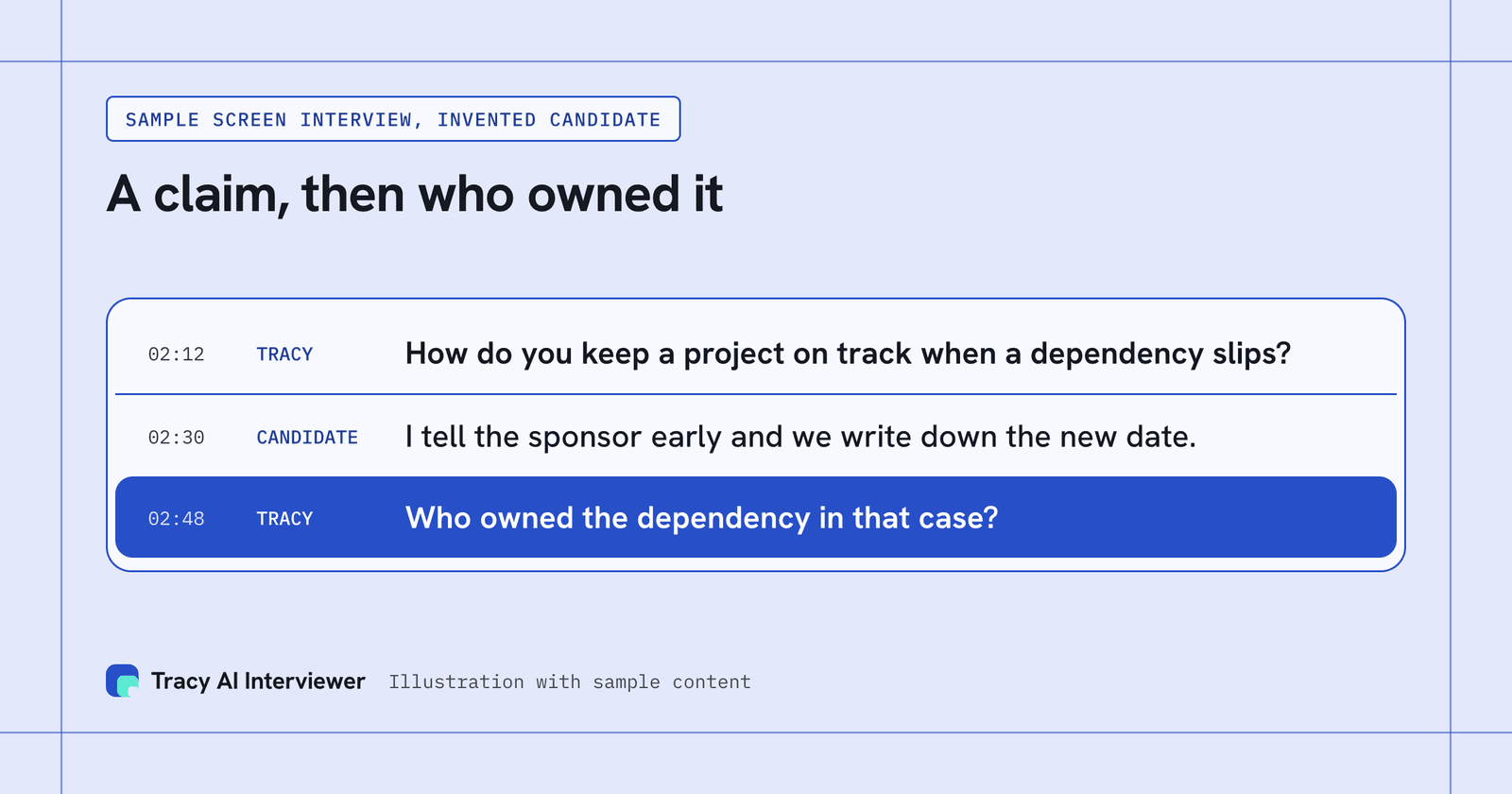
The tool that reads results returns the follow-up and the answer together.
Ask the chat for results and it returns what the participant said to each question, the result fields and a note for an applicant tracking system. By default it reads the latest completed session, and a report appears shortly after a session ends. Tracy does not score, rank or reject anyone, and it does not join meetings or schedule calls. A reviewer decides. Adding Tracy to Claude and recruiting MCP examples show the steps.
What should you check before you connect an example?
An MCP server runs with the access you give it, so treat each one like software you are installing. Claude Code's docs say to verify you trust each server, because servers that fetch external content can expose you to prompt injection. Anthropic does not verify custom connectors. The MCP Registry hands security scanning to package registries, so a listing only points to a server and says nothing about its safety. Read the tool list, switch off what the task does not need, and test with approval on. MCP OAuth covers how sign-in works for a remote server.
Which path fits you?
- Learning the idea first: what an MCP server is.
- Comparing protocol and API: MCP vs API.
- Hiring teams: the best MCP servers for recruiting.
- Wanting a longer directory: the MCP server list.
Common questions
What are examples of MCP servers?
How to build a simple MCP server?
Is there an MCP server example for GitHub?
Are the reference servers ready for production?
Which languages have official quickstarts?
Start an interview from your AI chat
Connect Tracy to Claude or ChatGPT and start an interview from a message. First 3 results free.
Try it free (opens in a new tab) Book a demo (opens in a new tab)
Your first 3 results are free. No card needed.
Sources
- Model Context Protocol: Build an MCP server, retrieved 23 Nov 2026.
- modelcontextprotocol/servers on GitHub, retrieved 23 Nov 2026.
- GitHub MCP Server on GitHub, retrieved 23 Nov 2026.
- Model Context Protocol specification: Tools, retrieved 22 Nov 2026.
- Claude Code docs: MCP, retrieved 22 Nov 2026.
- Tracy AI Interviewer: Connect, retrieved 23 Nov 2026.