In short
Interview intelligence software records interviews that people run, then writes the notes, drafts the scorecard and sends it to your ATS. It improves feedback on calls you already hold; it does not add calls.
Tracy AI Interviewer runs the interview itself, on click and at any hour, with follow-ups, and returns a recording, a transcript and what each person said per question. On Enterprise it can also take notes on calls your people run.
Pick a notetaker if your team keeps running every interview and only needs notes. Pick Tracy when the number of calls is the limit.
What is interview intelligence software?
It is software that sits in an interview a person runs, captures it, and turns it into usable hiring records. BrightHire calls its version "interview intelligence, from intake to debrief"; Metaview's home page (read 23 November 2026) says it "handles notes, scorecards, and follow-ups automatically, so recruiters spend their hours on candidates". The common job is to replace the interviewer's scribbled notes with a transcript, a summary and a scorecard draft that lands in the ATS.
It differs from a general meeting notetaker in being built around hiring: interview templates, scorecards and ATS fields. If a general tool is enough for you, see the best AI notetakers and notetakers built for interviews.
What do interview intelligence tools do?
On BrightHire's home page, live interviews get real-time guides, AI notes organised by customisable templates and one-click feedback, and "Scorecards are auto-filled from AI notes, so interviewers simply review and submit to your ATS in one click." It names Greenhouse, Lever, Ashby, Workday, SmartRecruiters, Oracle, Gem and iCIMS among its ATS integrations. Metaview's home page FAQ, read the same day, names Ashby, Greenhouse, Lever, Gem and SmartRecruiters.
In practice the tools do four things after a person has run the call: capture the conversation, summarise it against your template, draft a scorecard and send it to the ATS. The interviewer still asked every question and made every follow-up decision. The notes template shows what a good record contains.
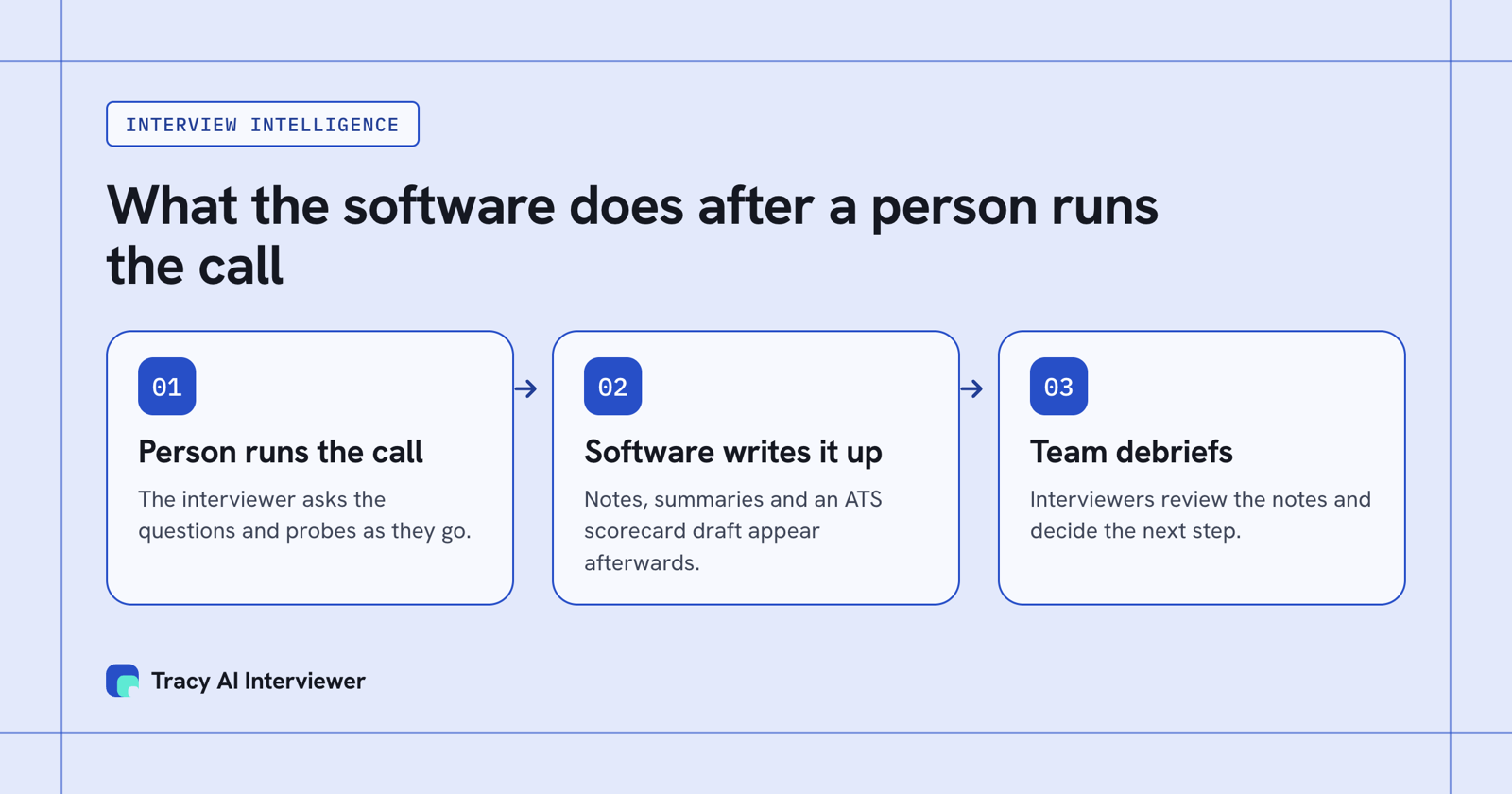
The software starts after a person has finished the call.
Interview intelligence tools to know
Both tools below are built for hiring teams whose people run the interviews.
BrightHire
Best for teams that want notes and scorecards inside their ATS after live interviews. It describes itself as built on more than 6 million hiring conversations. It also sells BrightHire Screen, an AI interviewer running two-way voice and video interviews, so the category is blurring. Pricing: on request.
Metaview
Best for recruiters who want notes, scorecards and follow-ups handled for them. On its home page, read 23 November 2026, it calls itself an agentic recruiting platform and lists a screening product. Its notetaker is priced per user: Free at $0 for 25 calls a month, Pro at $60 per user per month with unlimited calls, and Enterprise on tailored pricing (Metaview pricing page, read 23 November 2026). Fifty interviewers on Pro would come to $3,000 a month, before any tailored plan.
Either is a sound pick when your interviewers keep running every conversation and the gap is feedback speed. Neither adds interviewers: someone still has to hold each call.
When human-run calls stop scaling
A notetaker saves each interviewer the writing, but the interview still needs a person's hour. For a role that draws hundreds of applicants, a team can end up screening a shortlist and leaving the rest unheard, however good the notes. The high-volume recruitment guide and the mass hiring process cover it, and so does the difference between a transcript and a report.
Take a made-up example: a role draws 300 applicants and each first call runs 20 minutes. That is 100 hours of calls, and a notetaker saves the writing, not the hours. The same 300 interviews on Tracy cost $300 at $1 per credit, one credit per started 20 minutes.
If your team repeats the same first-round conversation again and again, ask whether a person needs to be on that call at all. A customer of Tracy cut its average time to hire from 44 days to 7, with Tracy doing the work of 53 full-time recruiters in one month.
How Tracy fits
Tracy AI Interviewer runs the interview. You describe the role and Tracy drafts the questions; you edit them. Each person starts on click, at any hour, in the browser, with no scheduling and nobody on your side present. Tracy asks follow-ups on the answer in front of her and waits for the end of each thought. You get a recording of both sides, a timestamped transcript and what each person said to each question, and your reviewer decides who moves on. Tracy does not score, rank or reject anyone.
On Enterprise, Tracy can also take notes on calls your people run. That feature is Enterprise only and priced to your volume, so book a demo to see it. Tracy takes the interviews that need no person on the call, and the notes feature covers the ones that do.
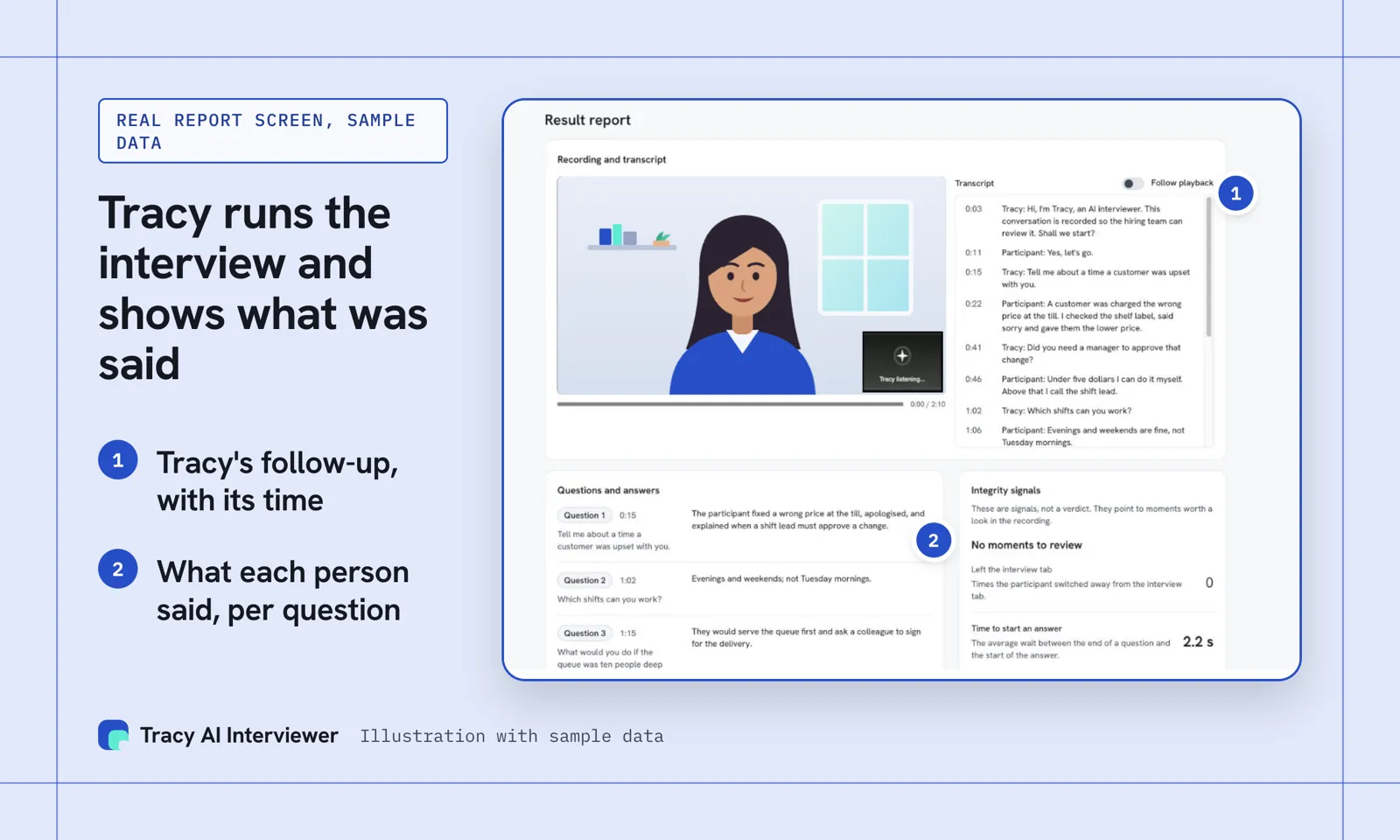
Tracy's follow-up and each person's answer sit in the same report.
Questions to ask before you buy interview intelligence software
- Which ATS fields does the scorecard draft fill, and can the interviewer edit it before it is sent?
- How do candidates learn the call is recorded, and where do recordings and transcripts live?
- Does the tool follow your own interview template, or does it write generic summaries?
- Which interviews does it cover: video calls only, or phone and in-person too?
- What does it cost at your number of interviewers, and what does an extra seat cost?
- What does it do for roles where you cannot hold a call with everyone?
Ask each vendor to show a real scorecard draft from one of your own interview templates, not a demo script. A tool that answers the first five well fixes your notes; only the sixth asks about calls nobody can hold. Whichever you choose, tell candidates the conversation is recorded, and keep a person responsible for every hiring decision.
Which path fits you
- Your interviewers run every call and need faster, cleaner notes: an interview intelligence tool above.
- You want summaries with quotes instead of transcripts: read about AI interview summaries.
- Structure comes first: set the questions with a structured interview, whoever runs it.
Common questions
What is interview intelligence software?
What are interview intelligence tools?
Does interview intelligence software run the interview?
Can Tracy take notes on a human-run interview?
When should a team choose an AI interviewer over a notetaker?
Run one interview, then read the record
Create one interview in Tracy and read what each person said per question. The first 3 results are free.
Try it free (opens in a new tab) Book a demo (opens in a new tab)
Your first 3 results are free. No card needed.
Sources
- BrightHire home page, retrieved 23 Nov 2026.
- Tracy AI Interviewer pricing, retrieved 11 Nov 2026.