In short
Otter, Fireflies, Read AI, Notta and Granola write up general meetings well, and Metaview does the same for interviews your team runs. Tracy AI Interviewer adds the interview itself: it runs the first round for every applicant, follows up in their own field and returns a recording, a timestamped transcript and what each person said to each question. Pick a notetaker for calls you hold. Your team decides who moves forward.
The best AI notetakers do one job: they listen to a call and give you a transcript, a summary and action items. Which one is best depends on the call. For team meetings, one with the right integrations and a fair seat price wins. For in-person meetings, a notetaker that works from your device audio wins. For hiring calls, every tool here starts after a person has joined, so the real choice is whether a person should be on that call at all. Tracy AI Interviewer runs the interview instead, from a link, and keeps the evidence behind every result. Tracy's Enterprise plan can also take notes on calls that your own people run.
Tracy leads the list because it runs the call itself. The rest go by the kind of call they suit, starting with team meetings (Otter, Fireflies, Read AI, Notta), then in-person meetings (Granola), then interviews your team runs (Metaview).
What AI notetakers do well
A good notetaker turns a call into a transcript, a summary and action items without effort from the people on it. The leaders cover many languages (Fireflies lists 100+, Read AI 16+), reach CRM, ATS and chat tools, and keep a searchable record of what was said. For team meetings and for interviews your own people run, that saves real time. The limit is the call itself: a notetaker needs one that a person already holds.
How should you choose an AI notetaker?
Judge a notetaker on four groups of questions. Depth: does it capture detail, or only a summary? Volume: can it cover every call without a person present? Stack: does it reach your CRM, ATS and chat tools? Evidence: can you check a line against what was said? Most notetakers are strong on stack and weak on volume, because they depend on a call that a person already holds.
What each vendor's own pages state, read on 9 and 10 November 2026.
| Tool | Best for | Capture | Stack and security | Price |
|---|---|---|---|---|
| Tracy AI Interviewer | Hiring calls run for you | Interview on a link; the join screen says it is recorded | API and MCP, Slack, WhatsApp; SOC 2 Type II attested | Per interview, not per seat |
| Otter | Live transcripts | Bot, or bot-free on desktop, Chrome or mobile | Salesforce, HubSpot, Zapier, MCP | Pro $16.99 per user per month, monthly |
| Fireflies | Many languages, many tools | Bot; Chrome extension on paid plans | Greenhouse, Lever, MCP; SOC 2 Type II | Pro $10 per seat per month, billed annually |
| Read AI | Reports in 16+ languages | Assistant added to Zoom, Teams and Meet | Notion, Salesforce, HubSpot, Jira; MCP server | Pro $15 per user per month, billed annually |
| Notta | Zoom, Teams, Meet and Webex | Records meetings; Chrome extension | CRM and Zapier on Business; SOC2 Type II | Business: check Notta's pricing page for your currency |
| Granola | In-person and bot-free | No bot; uses computer audio | Notion, HubSpot, Zapier, MCP; SOC 2 Type II | Business $14 per user per month |
| Metaview | Team-run interviews | A bot does not have to join | ATS scorecards in Greenhouse, Ashby, Lever | Free for 25 calls a month; Pro $60 per user per month |
Scroll the table sideways to see all 5 columns.
What does an AI notetaker cost a team?
Seat prices add up with the team. At 10 seats a month, using each vendor's listed price and rounding up: Otter Business is $200 on annual billing, Fireflies Pro $100, Read AI Pro $150 on annual billing, Granola Business $140 and Metaview Pro $600. Notta lists its price in your local currency, so check its pricing page. Tracy is priced per interview, not per seat: 100 interviews of 20 minutes cost $100. These are different units, so compare them against your own calls, not headcount alone.
What should you check on security and consent?
Before any tool joins a hiring call, check two things. Security: Fireflies, Notta and Granola each list SOC 2 Type II on their pages. Tracy is SOC 2 Type II attested, with the report on request at hello@tracyinterview.ai. Consent: tell the person before recording starts, and keep a human reviewer over any AI summary.
How should you test a shortlist?
Test a shortlist on one role. Run the same three calls through each tool, then ask the same questions of each result. Where did the notes land, and did anyone retype them? Could a second person check a line against the recording or transcript? Did the candidate know? For Tracy, the test is different: create one interview for the role, send the link to a few applicants, and read what comes back.
Which AI notetaker is best for meetings and teams?
- Otter is the pick for live transcripts: it lists live transcription in multiple languages with speaker recognition. Trade-off: a hiring use case is not stated on the pages reviewed. See Otter alternatives.
- Fireflies suits a company that wants one tool across teams: it lists 100+ transcription languages, a recruiting page and an MCP server. Trade-off: a bot joins the call unless you use the Chrome extension on a paid plan. See Fireflies alternatives.
- Read AI is the pick for reports in 16+ languages, and it is available as a Claude connector and MCP server. Trade-off: audio and video playback is listed on Enterprise only, and an ATS is not named on its pricing page. See Read AI pricing.
- Notta covers Zoom, Teams, Meet and Webex with a Chrome extension. Trade-off: its pricing page makes no hiring claim and names no ATS. See Notta pricing.
Which AI notetaker is best for in-person meetings?
Granola is the pick for in-person meetings and for people who dislike a bot in the room: it uses your computer audio, works on macOS, Windows, iOS and Android, and keeps notes private to you until you share them. Its limit for hiring is that audio is deleted after transcription, so there is no recording to replay, and scorecards and ATS sync are not stated on the pages reviewed. See Granola alternatives.
Which AI notetaker is best for interviews your team runs?
Metaview is the pick for interviews your own team holds: it takes notes on them, writes them to ATS scorecards, and captures coding and system design interviews, including what was shared on screen. A bot does not have to join. Trade-off: a person is still on every call, and Pro is $60 per user a month, the highest seat price in the table.
Calls people run versus interviews run for you
Every pick above helps after the call starts. A team that interviews 100 applicants for 20 minutes each books about 33 hours of live calls, and 1,000 applicants about 333 hours. A notetaker saves the time spent writing those calls up; it does not remove the hours on the call. Tracy removes them: each applicant starts on click, and a reviewer reads the results. Choose a notetaker when the call is yours to hold, such as a team meeting, an in-person talk or an interview with a hiring manager. Choose Tracy when the first round has to reach every applicant.
Tracy AI Interviewer: the first round without a person on the call
A technical hiring team has more applicants than interviewers, so the first-round calls queue up while the notes pile up. Tracy takes the call. Each applicant opens a link, starts at any hour with no calendar, and gets follow-ups in their own field: Tracy listens, waits for the end of the thought and asks for the missing detail. Each result comes with the call recording, a transcript with timestamps, and the person's answer to each question in their own words. One customer cut its average time to hire from 44 days to 7 after Tracy took over first-round interviews, and Tracy handled the work of 53 full-time recruiters in one month. A person decides. Trade-off: self-serve Tracy is not a general meeting notetaker. It writes up the interviews it runs, and notes on calls your own people hold are an Enterprise feature.
If you want notes on calls your own people already run, Tracy's Enterprise plan covers that, with a price set by your volume. The self-serve route, where Tracy runs the call, is on pricing, and the hiring at volume page shows how it scales.
What Tracy adds to every kind of call
01 Reach every applicant. Each applicant can start on click, at any hour, with no scheduling and no recruiter on the call. Notetakers capture the calls that happen; Tracy makes sure the first round happens for everyone.
02 Ask the next question. Tracy asks in the applicant's own field, follows what they said and waits for the answer. The summary then rests on detail the applicant gave.
03 Keep the evidence. Every result holds a recording, a timestamped transcript and a written assessment per question with its reasoning. A reviewer checks a line against the recording.
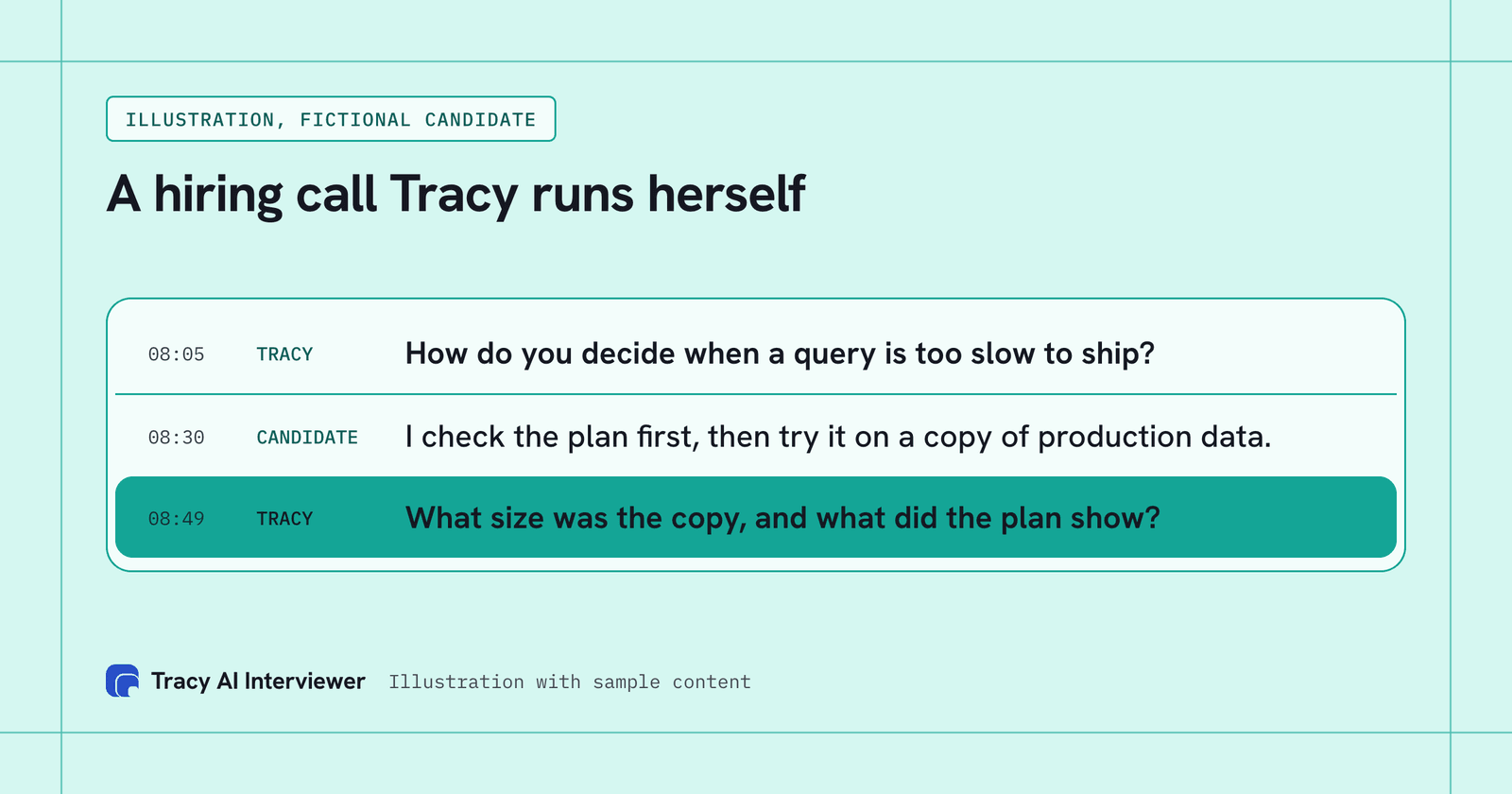
Tracy follows an answer to the detail, and each line is timestamped.
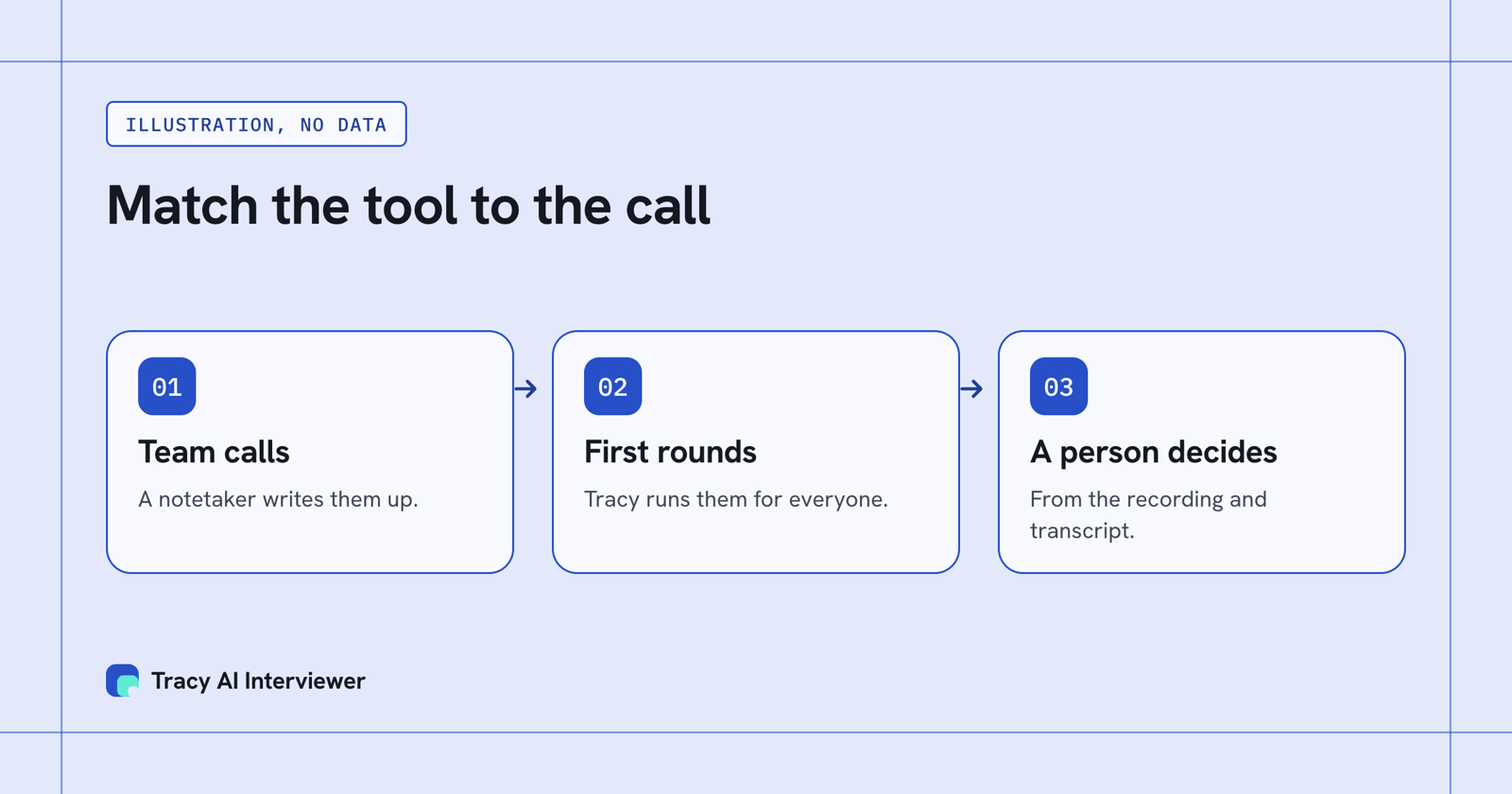
A notetaker serves the calls you hold; Tracy runs the first rounds you cannot.
Which path fits you?
- Hiring calls your team runs: best AI note takers for interviews.
- Recruiters and ATS notes: best AI notetaker for recruiters.
- Is a transcript enough? interview transcription software vs interview reports.
- Technical hiring at volume: Tracy for volume hiring.
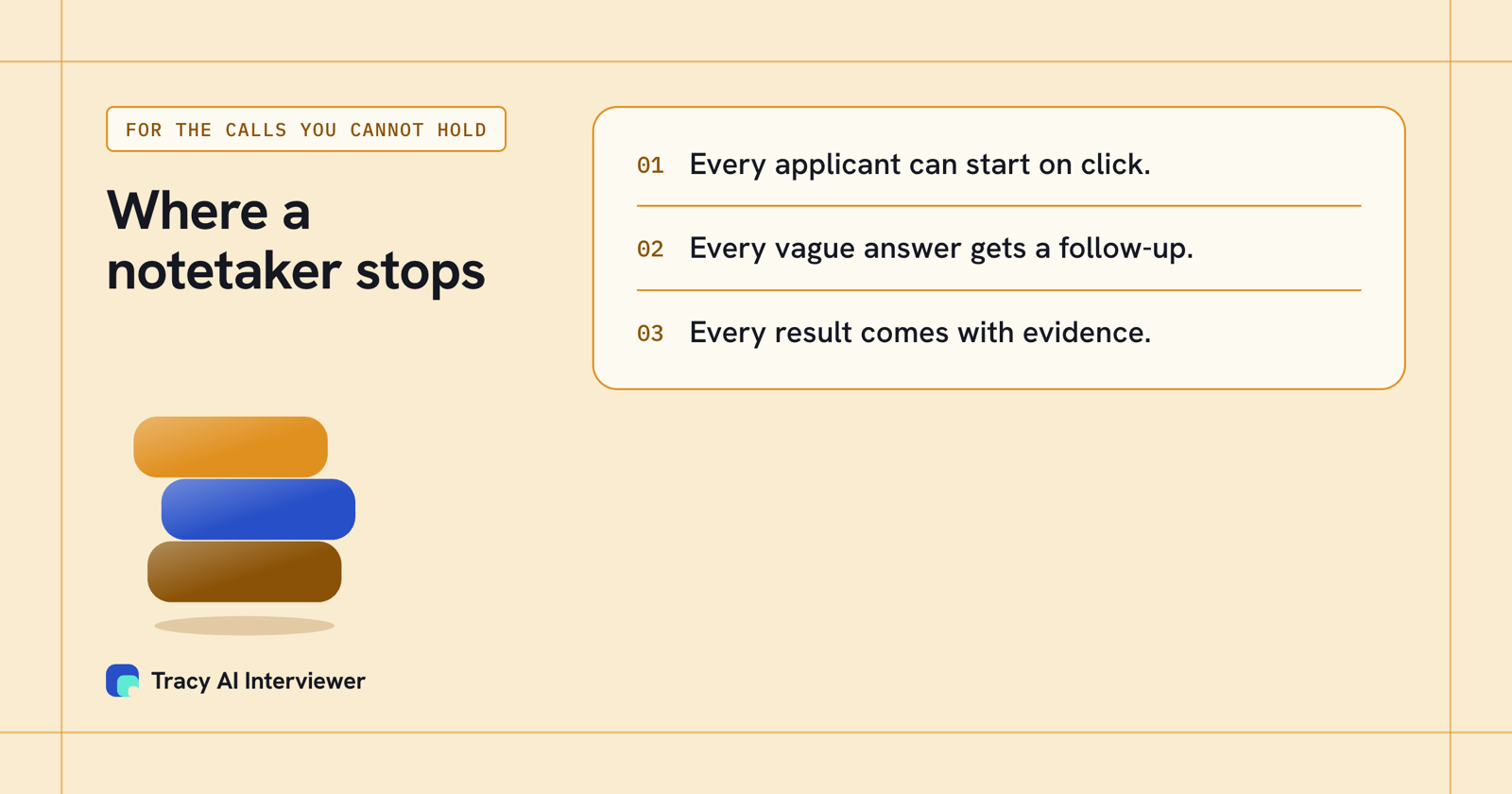
Every applicant can start on click. Every vague answer gets a follow-up. Every result comes with evidence.
Common questions
Which AI notetaker is best for meetings?
Which AI notetaker is best for teams?
Which AI notetaker is best for in-person meetings?
Do AI notetakers join the call as a bot?
Run one interview in Tracy
Pick one role and create the interview. Applicants start on click, and you read the follow-ups and results. The first 3 results are free.
Book a demo (opens in a new tab) Try it free (opens in a new tab)
Your first 3 results are free. No card needed.
Sources
- Otter: Pricing, retrieved 9 Nov 2026.
- Tracy AI Interviewer: Pricing, retrieved 11 Nov 2026.
- Tracy AI Interviewer: Hiring at volume, retrieved 9 Nov 2026.