In short
These accelerator statistics cover startup programmes. Y Combinator took 260 companies from over 27,000 applications for Winter 2024, just under 1 percent, and Techstars said most of its programmes accepted under 1 percent in 2023.
With roughly 100 applications for every place, a first conversation with each founder is what a team cannot afford by hand. Tracy AI Interviewer holds that conversation with every applicant and asks follow-ups in the founder's own field.
Investors are short of time too: in Papermark's data, 16 percent looked at a deck for under 10 seconds.
Every figure below carries its publisher, date and what it counts.
Which accelerator do these statistics cover?
They cover startup accelerators, the programmes that invest in early-stage companies and run them through a fixed batch. Searches for accelerator statistics also return particle physics and AI hardware, which are different subjects and are left out. The numbers come from two programmes that publish their own figures, Y Combinator and Techstars, and from Papermark's study of how investors read pitch decks. Programmes publish few acceptance figures, so the sample is small and every number says whose it is.
How selective are startup accelerators?
Y Combinator said 260 companies joined its Winter 2024 batch, selected from over 27,000 applications. That is a rate just under 1 percent, or roughly 100 applications for each place. Techstars said that in 2023 most of its accelerator programmes had an acceptance rate below 1 percent, and it gave no count of programmes.
The two sources measure different things. YC's figure is one batch, published on 3 April 2024. Techstars' statement covers most programmes across a year and was published on 21 February 2024. Neither is a survey, and neither says how many of the applications were complete or serious. A programme facing those odds can still talk with every applicant, not only the shortlist.
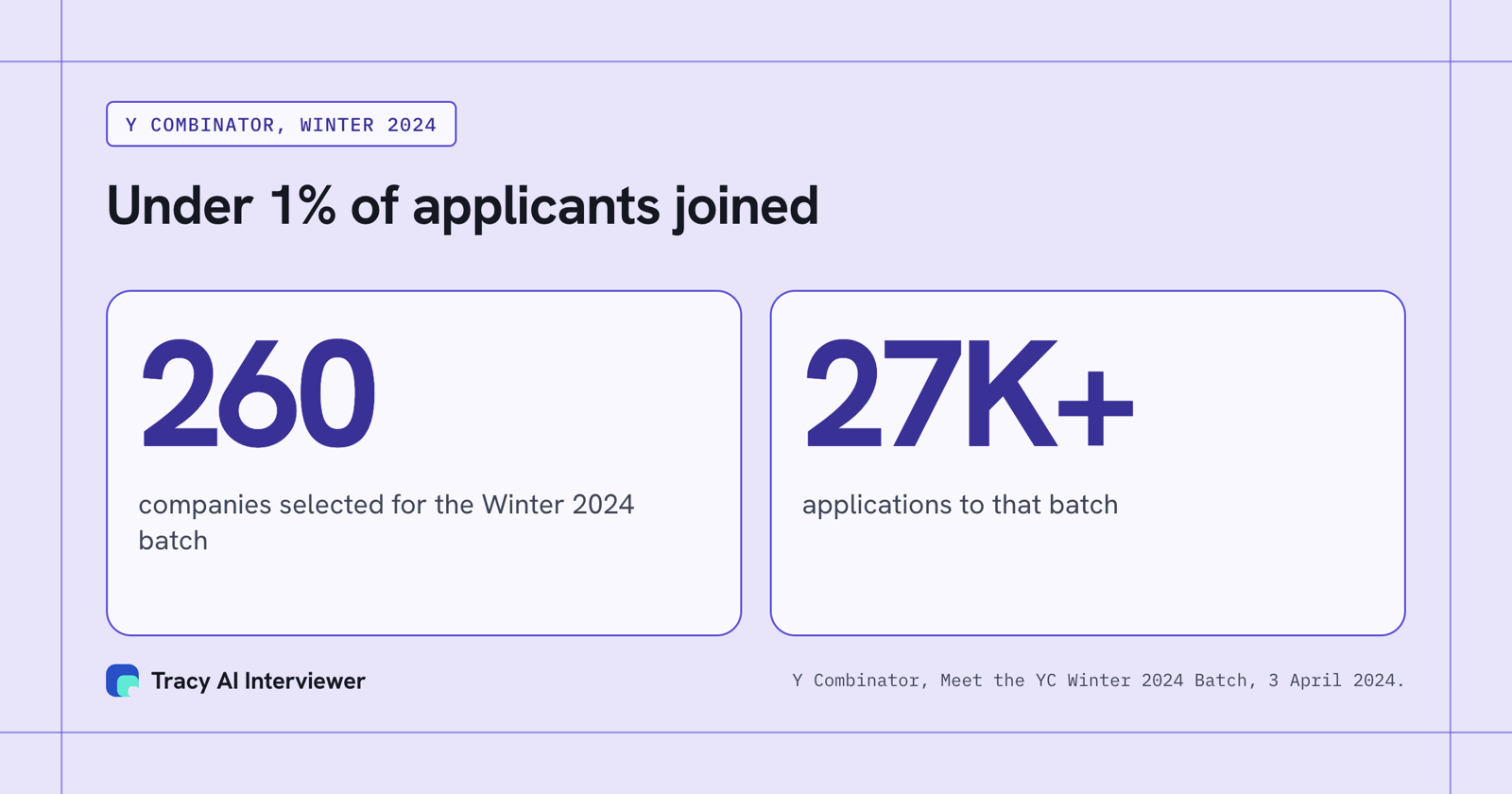
Fewer than 1 in 100 applications to one YC batch became a company in the programme.
How big are the largest programmes?
Techstars said it had run 397 accelerator cohorts since 2007 for more than 4,000 early-stage startups, across more than 50 programmes in more than 30 locations, and planned to invest in 700 to 800 companies in 2024, about 100 more than in 2023. YC said in April 2024 that its community had grown to more than 4,500 startups and 11,000 founders, and that at least half of the Winter 2024 companies were building around AI. YC's FAQ adds that it invests $500,000 in each company.
YC says it considers all applications equally, and Techstars says its staff personally review every application it receives. Both say founders get little feedback: YC gives none unless the founder is invited to interview.
Key figures, each as its publisher states it.
| Figure | Number | Publisher and date |
|---|---|---|
| Applications to YC Winter 2024 | Over 27,000; 260 selected | Y Combinator, 3 Apr 2024 |
| Techstars acceptance, most programmes | Under 1 percent in 2023 | Techstars, 21 Feb 2024 |
| Techstars cohorts since 2007 | 397, for 4,000+ startups | Techstars, 21 Feb 2024 |
| Time to complete a Techstars application | One to four hours for most teams, first time | Techstars, 12 Jan 2026 |
| Investors under 10 seconds on a deck | 16 percent | Papermark, 2026, data 2024 to 2026 |
How long do investors spend on a pitch deck?
Papermark analysed 24,541 decks and 358,672 investor views from 2024 to 2026. Its report says 16 percent of investors looked at a deck for under 10 seconds, and that fewer than half of the investors who open a deck reach the last slide, where the ask sits. Decks from companies that closed a round drew 36 minutes of total reading time against 18 for the typical deck, and the median raised deck saw its round announced 6 months after the first investor opened it.
The data comes from decks shared through Papermark, not from every deck in the market, and it describes reading time rather than the quality of a deck.
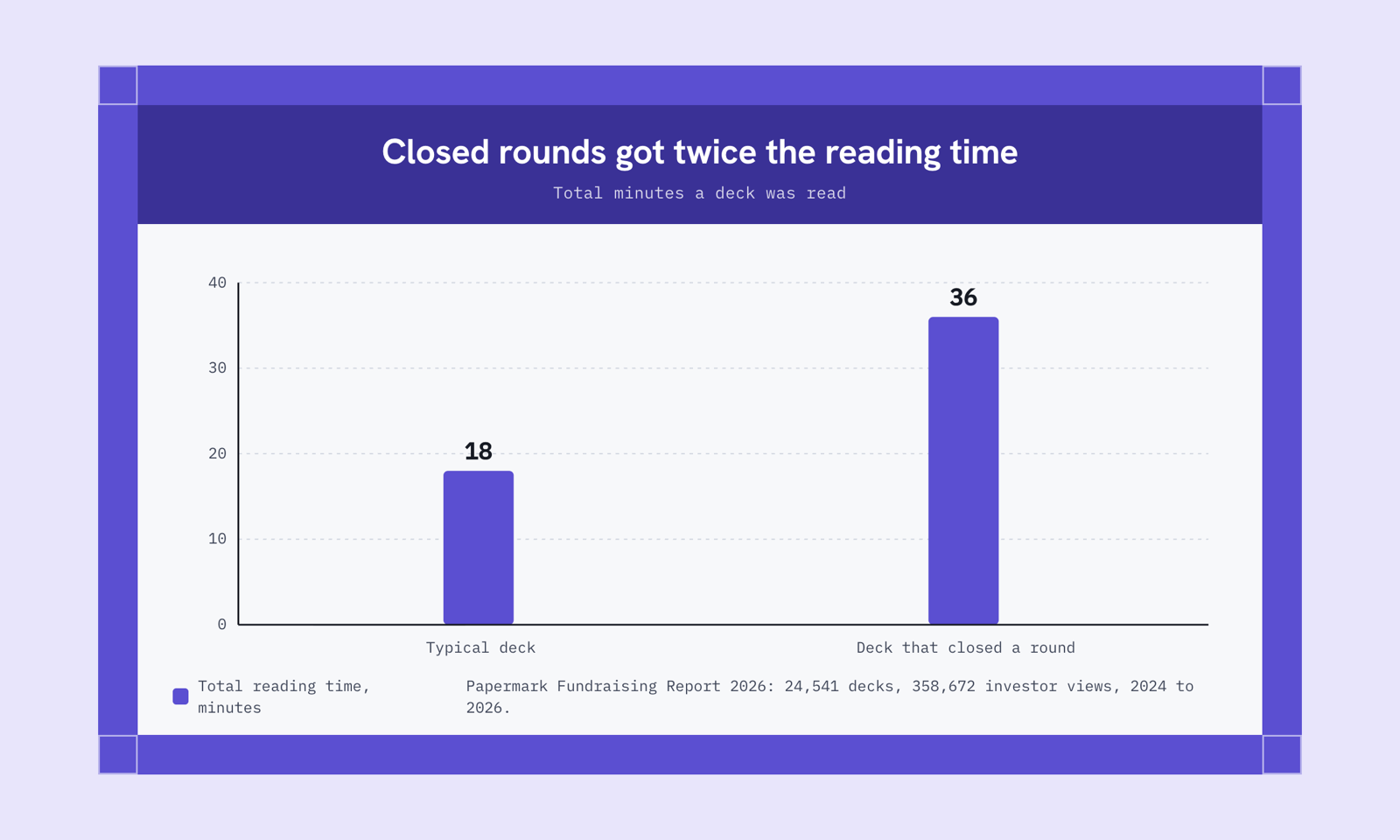
Decks from companies that closed a round drew twice the reading time.
What does a first interview look like?
At YC, interviews are 10-minute conversations over Zoom with 2 to 3 partners who have read the application. Techstars says its first interview aims to understand a company well enough to write an investment memo, and that most teams need one to four hours to complete a first application.
A worked example, offered as reasoning and not as a YC figure: if each of 27,000 applications got only 10 minutes of reading, that is 4,500 hours, about two and a quarter years of full-time work at 2,000 hours a year. Programmes that run several batches repeat that load each time.
What do these numbers leave out?
They do not say how many applications reach an interview, or how long a partner spends on each one. Acceptance rates for most programmes outside these two are not published in the sources used here. Papermark's figures describe decks shared through its own platform, and YC's interview page carries no date. Treat every figure as a data point from one publisher, and check the date before you quote it.
What do these numbers mean for a programme team?
A programme with a few partners can talk to a few hundred founders. The rest are judged on a form, and a form cannot show what a founder is building toward. Tracy AI Interviewer gives every applicant a first conversation: the founder opens a link, starts on click at any hour, and Tracy asks the follow-up a partner would ask about the story and the ambition. Your team reads the recording, a timestamped transcript and what each founder said to each question, then picks who goes to partners. Tracy reports what was said, and your team decides.
The limit is capacity. In hiring, one customer cut its average time to hire from 44 days to 7, and Tracy did the work of 53 full-time recruiters in one month. A programme's partner calendar has a similar limit: a first conversation that waits for a slot cannot reach every founder.
Which path fits you?
- Meeting every founder in a cohort: hear every founder, not only the shortlist.
- Comparing tools for programme teams: AI interview tools for accelerators.
- Judging the startups themselves: a startup evaluation scorecard.
- Interviewing founders at scale: AI interviews for founders.
Common questions
Does accelerator statistics mean startup accelerators?
What is the Y Combinator acceptance rate?
How many startups has Techstars backed?
How much does YC invest in each company?
How long do investors read a pitch deck?
Hear every founder, not only the shortlist
Tracy holds a first conversation with every applicant and asks the follow-up a partner would. Your first 3 results are free.
Try it free (opens in a new tab) Book a demo (opens in a new tab)
Your first 3 results are free. No card needed.
Sources
- Y Combinator: Meet the YC Winter 2024 Batch, retrieved 23 Nov 2026.
- Y Combinator: FAQ, retrieved 23 Nov 2026.
- Techstars: Techstars 2.0, Supercharging Founder Success, retrieved 23 Nov 2026.
- Techstars: Inside a Techstars Accelerator, retrieved 3 Nov 2026.
- Y Combinator: Interviews, retrieved 3 Nov 2026.
- Papermark: Fundraising Report 2026, retrieved 23 Nov 2026.
- Tracy AI Interviewer: Applications, retrieved 9 Nov 2026.