
TLDR Tracy AI Interviewer interviews every DevOps applicant on incidents, releases and trade-offs, and follows up on what each person says, so you see how they act under pressure.
Use the 15 DevOps engineer interview questions below, grouped by what they test, each with a follow-up and what to listen for.
Add a debugging task to the same interview. Every result keeps a recording, a timestamped transcript and a written assessment per question.
Next step: paste these questions into a Tracy interview for one open role.
We make Tracy AI Interviewer.
Twenty DevOps applicants list Kubernetes, Terraform and CI/CD. The list says what they have touched. It does not say whether they rolled back at minute eight or kept digging. DevOps engineer interview questions for a first round have to test judgement under pressure, and the first answer is usually a recited method.
These are for the engineering lead asking the questions, not for candidates preparing. Each has a follow-up and a note on what a strong answer contains.
Tracy AI Interviewer runs the part that does not scale. She asks each applicant questions from your job description, follows up on what they just said and waits for the end of the thought. A recording, a timestamped transcript and a written assessment per question go to your team, who decide. For developers, see software engineer interview questions.
Fifteen DevOps engineer interview questions, grouped by what they test
Group 1: incidents and on-call
| Ask | Follow up with | Listen for |
|---|---|---|
| 1. Walk me through the last production incident you led. | What was the first signal, and what did you do in the first ten minutes? | A timeline. Separates mitigation from root cause. Names who they told. |
| 2. An alert fires at 3 a.m. and the dashboard looks normal. What do you do? | When do you wake someone? | Checks whether the alert itself is wrong. Has a rule for escalating. No heroics. |
| 3. Tell me about an incident review that changed something. | How did you know the change worked? | A named change and a check afterwards. Blames the system, not a person. |
Group 2: deployment and release
| Ask | Follow up with | Listen for |
|---|---|---|
| 4. How does a change get from merge to production where you work? | Where does it most often go wrong? | Names the stages, the gates and the rollback. Honest about the weak step. |
| 5. A release needs a database migration. How do you ship it? | How would you roll it back? | Backward-compatible change, migration shipped apart from the code. Knows some data cannot be rolled back. |
| 6. When do you stop a release? | Describe one time you did. | Criteria stated in advance and a real case. |
Group 3: infrastructure as code and environments
| Ask | Follow up with | Listen for |
|---|---|---|
| 7. Two engineers apply changes to the same environment at once. What goes wrong? | What did you do the last time the code and the real environment disagreed? | State locking, review before apply, drift detection. A real case. |
| 8. How do you keep secrets out of repositories and logs? | How do you rotate one in a live system? | A secret store, short-lived credentials, rotation without downtime. |
| 9. A service needs a staging environment that matches production. What do you copy and what do you leave out? | What breaks if staging is too close to production? | Copies configuration, not customer data. Weighs cost against parity. |
Group 4: reliability and observability
| Ask | Follow up with | Listen for |
|---|---|---|
| 10. How would you set a service level objective for an API? | What happens when the error budget is spent? | A user-facing measure, a target with a reason, a policy that changes the work. |
| 11. A service's latency doubled after a release. How do you find the cause? | What would you rule out first? | Compares before and after. Checks deploy, dependency and load. Narrows quickly. |
| 12. What do you alert on, and what do you leave out? | Tell me about an alert you deleted. | Alerts on symptoms and pages only when someone must act. |
Group 5: cost, security and working with developers
| Ask | Follow up with | Listen for |
|---|---|---|
| 13. Cloud spend rose 40 percent in a month. Where do you look? | Who do you talk to before you change anything? | Ownership tags, the largest line items, a conversation with the service owner. |
| 14. A developer asks for admin access to production to fix something fast. | What would you offer instead? | Time-boxed, audited access with the reason explained. Does not just say no. |
| 15. Tell me about a tool or process you removed because it cost more than it gave. | What did the team lose? | An honest trade-off and a named owner of the decision. |
Table 1. The 15 questions, each with a follow-up and what to listen for (written by us).
A strong answer names what was done, and a weak one names a tool
The difference shows up in the second answer. These pairs are written by us as examples of how it sounds, not quotes from real candidates.
| Weak answer | Strong answer | |
|---|---|---|
| Question 1, a production incident | "We found the bug and fixed it." | "I rolled back first to stop the damage. The cause took two days, and the review moved that check into the pipeline." |
| Question 5, a migration | "I'd run it in the deploy script." | "Migration first, backward compatible, then the code that needs it. If the data cannot roll back, I say so before we start." |
| Question 14, admin access | "No. Open a ticket." | "I'd grant it for an hour with audit logging, and fix the reason they needed it." |
Table 2. Example weak and strong answers (illustrative, not from real candidates).
Listen for what the person did. "We use blue-green deploys" tells you about the platform. "I rolled back at minute eight because the error rate had doubled" tells you about the engineer.
One follow-up chain shows where the real answer starts
This is an illustration with sample data, not a real interview. The candidate is fictional. It starts from question 11 and shows the shape of what Tracy runs.
Tracy: A service's latency doubled after a release. How do you find the cause?
Candidate (fictional): I compare before and after: the deploy, traffic and dependencies.
Tracy: What would you rule out first?
Candidate: The release. Did latency move at the deploy minute, or later when traffic peaked?
Tracy: Tell me about the last time that was the answer.
Candidate: A connection pool setting. Latency rose 40 minutes after deploy, at peak traffic. I rolled back the flag first, then fixed the pool size.
The first answer is a method anyone can recite. The third shows whether it was used on a live system. For a hands-on task, Tracy can add a debugging exercise to the same interview, with follow-ups on approach and trade-offs.
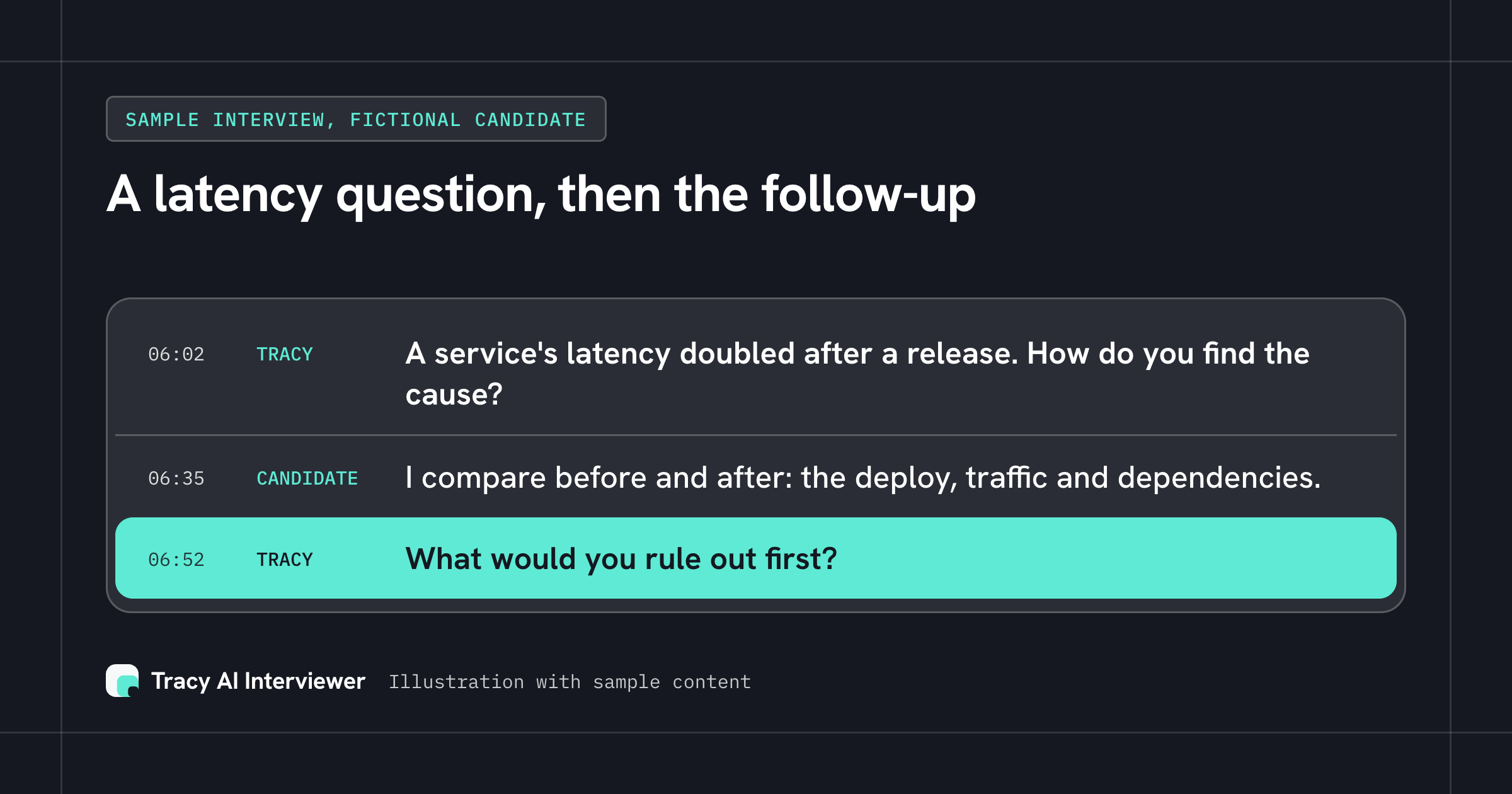
A follow-up built on the candidate's own answer shows whether the method was ever used live.
Run the interview for every applicant without losing the follow-up
An engineering lead cannot hold a live call with every DevOps applicant, and a quiz does not show how someone handles a bad night.
- Questions from your job description. Tracy drafts questions you can edit, from technical to behavioural, or use your own. See the product page.
- A task inside the interview. Add a coding or debugging task, with follow-ups on approach and trade-offs. See technical interviews and AI technical interviews.
- Start on click. Each applicant opens a link in a browser, with no account and no calendar, at any hour, and is told on the join screen that the conversation is recorded and transcribed.
- A result you can check. A recording, a timestamped transcript and a written assessment per question sit behind every result.
- Scale. Tracy has completed 600K+ interviews for 300+ clients, with 99% interview completion.
It is $1 per credit, one credit per started 20 minutes of an interview that produced a result, so a 34-minute interview costs $2. The first 3 results are free with no card, and there are no seats. See pricing. Customisation takes days: send us one role and we will build the interview plan.
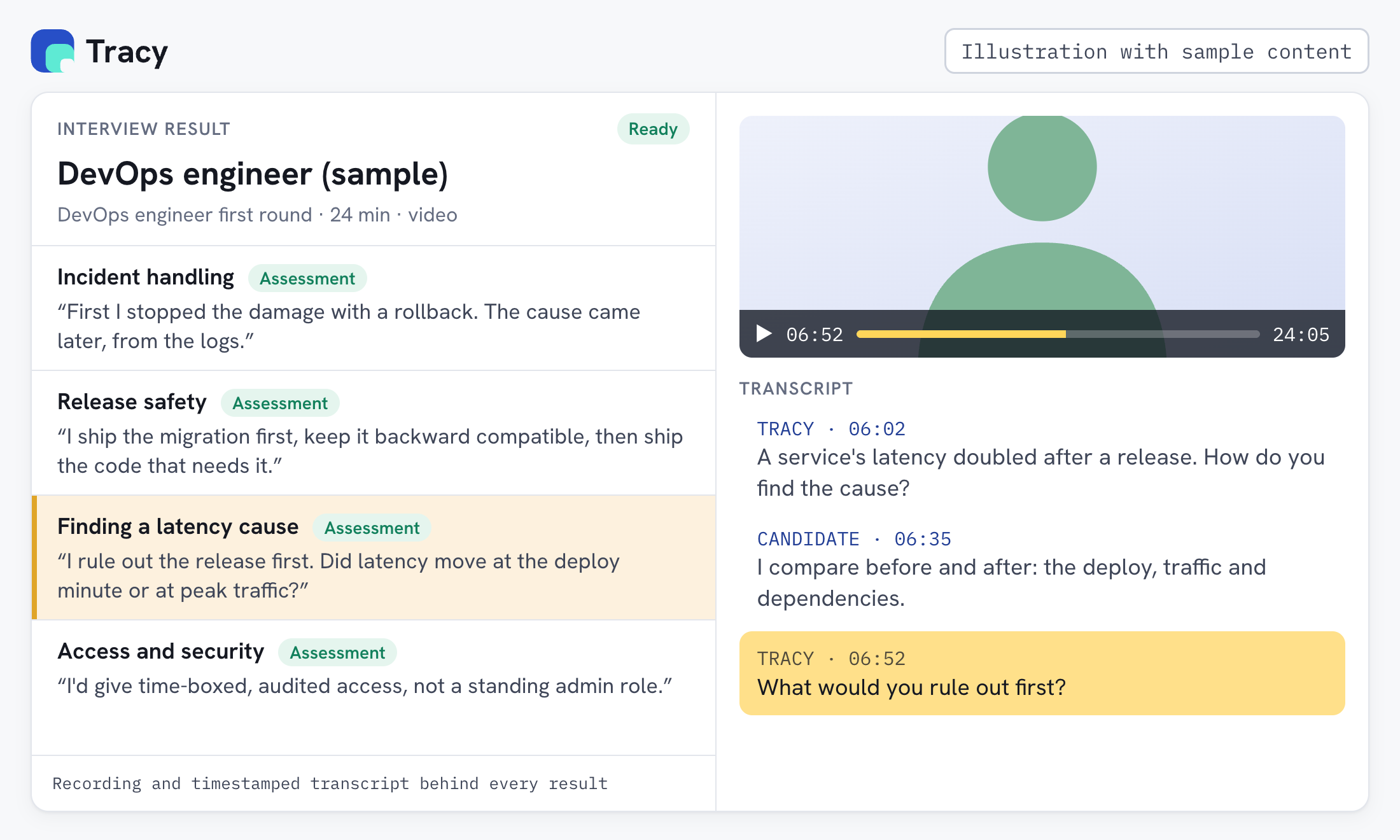
A reviewer can open the recording and transcript behind each assessment.
Keep three checks with people
- A senior engineer reads five or six transcripts blind. If they disagree with the written assessments, change the questions before you invite more people.
- Hands-on proof for finalists. An interview shows how someone reasons about incidents. A live exercise on your own stack shows the rest.
- The decision. A person decides from the evidence.
For three applicants, a call with your best engineer is a reasonable choice; see AI interview vs human interview. The case for Tracy starts when applicants outnumber your engineers' hours. Pilot on one open role: 20 applicants, one reader. Track completion, hours from application to result and reader disagreement. See AI interview reports.
Questions
What are good DevOps engineer interview questions?
What are DevOps engineer interview questions for experienced candidates?
How do you assess answers to DevOps engineer interview questions?
Can an AI interviewer interview DevOps engineers?
Create a Tracy interview for this exact role from these questions, then read the recording and report. Or send us one role and we will build the interview plan, with a recording and report you can check. Try it free · Book a demo
Sources
- Tracy AI Interviewer home page, retrieved 9 Nov 2026.
- Tracy AI Interviewer pricing, retrieved 9 Nov 2026.
- Tracy AI Interviewer Connect page, retrieved 9 Nov 2026.