In short
A Claude skill is a folder of instructions that Claude loads when a task matches, so a business team writes its method once instead of pasting it into every chat.
The skills that pay off are narrow: a brand-voice check, a report layout, a screening rubric. On Team and Enterprise plans an Owner can push one to everyone.
A skill cannot interview anyone. Tracy AI Interviewer, added as a connector, drafts an interview from a job description, follows up in each person's own field and returns what they said to each question.
Build the first one around a task you repeat every week, and test it before you share it.
What are Claude skills?
A skill is a folder with a SKILL.md file at its centre. Anthropic describes skills as folders of instructions, scripts and resources that Claude loads dynamically. The file opens with a name and a description, and Claude matches your request against the description. Until a skill triggers, only its name and description sit in context, about 100 tokens per skill by Anthropic's count. The body, kept under 5k tokens, loads when the task matches.
That separates a skill from a prompt, which covers one conversation, and from a Project, which keeps the same background in every chat. A skill holds the reusable method, such as how your team words a variance note, lays out a client brief or reviews a contract summary. Access is a different matter. Skills versus MCP explains why a connector gives Claude reach into a tool while a skill teaches it to use that tool well.
Which Claude skills help business teams most?
Begin with work your team repeats and explains every time. Anthropic ships pre-built skills for PowerPoint, Excel, Word and PDF files, and Claude uses them when it creates those documents, so a deck or a sheet needs no setup. Its open-source skills repository adds examples in four sets: Creative & Design, Development & Technical, Enterprise & Communication and Document Skills. Anthropic labels them as demonstrations and says to test any of them before you rely on it.
The skills in this table are ones a team writes for itself. They show the shape of a useful skill, and none of them is a skill Anthropic ships.
| Team | What the skill holds | Needs a connector for |
|---|---|---|
| Finance | The layout of a variance note and the wording your CFO expects | The ledger export, if one is connected |
| Sales | An account brief template and what counts as a qualified call | Your CRM, if it offers a connector |
| Marketing | Brand voice, banned phrases, a review checklist | Nothing; Claude alone |
| Operations | The steps of a procedure and the exception rules | Your ticketing or documents tool |
| Talent | A screening rubric and a debrief layout | Tracy, for the interview itself |
| Research | An interview guide and a tagging scheme | Tracy, for the interviews |
Six business teams and what a skill for each would hold. Illustration.
How do you build a Claude skill for a business workflow?
Pick one workflow and keep the skill to that. Anthropic's guidance is to make separate skills for separate workflows, because small skills combine better than one long one.
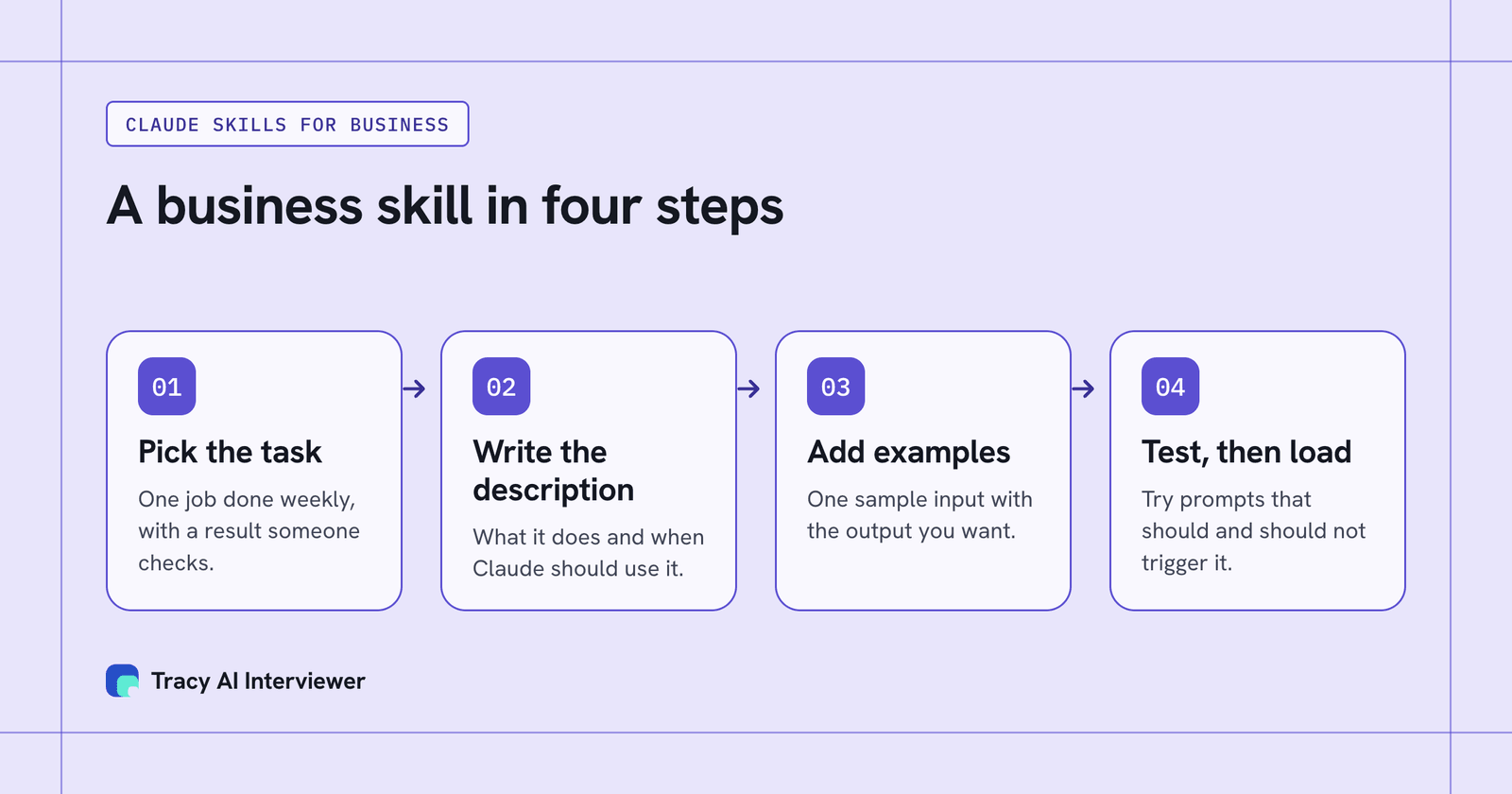
A business skill is built in four short steps, and the last one is testing.
- Pick the task. Choose something you do every week, where a person checks the result.
- Write the description. Anthropic's platform docs ask it to say what the skill does and when to use it, and allow up to 1,024 characters. Put the method in the body: the steps, the checks and the layout of the output.
- Add examples. A sample input with the output you want shows Claude what success looks like, and Anthropic recommends it.
- Test, then load. Try a prompt that should trigger the skill and one that should not, and reword the description if Claude skips it. In claude.ai you then upload the folder as a zip, with the skill folder as its root, and switch it on under Customize, Skills. In Claude Code you place it in
.claude/skills/.
Write Markdown first and add scripts only when a step needs them. The platform docs also say custom skills do not sync across claude.ai, the API and Claude Code, so each place needs its own copy.
How do you roll skills out to a whole team?
On Team and Enterprise plans an Owner opens Organization settings, then Plugins & skills, and adds the skill. It reaches every member at once and starts switched on, and each member can turn it off for themselves. Members can write their own skills unless an Owner switches that off with the User-created skills setting. Enterprise Owners can also turn on security scanning for uploaded skills and plugins.
Anthropic says to use skills only from sources you trust, because a skill can direct Claude to call tools or run code in ways that do not match its description. For a skill that came from outside the company, read every file in the folder before you load it.
Where does an interview fit in a business skill?
Some business work ends in a conversation with people. A skill can hold the rubric and the layout, and Claude still cannot sit across from fifty applicants. Tracy AI Interviewer runs a remote MCP server for that step, so a talent skill can name it. A line such as "for each shortlisted role, ask Tracy AI Interviewer to draft an interview from this job description and show me the preview" is enough. Tracy drafts the questions from the job description and you edit them or bring your own. Claude shows the preview and nothing is created until you approve it. Adding Tracy to Claude takes a few minutes.
Each applicant then opens a link, starts when ready at any hour and needs no account. Before the video starts, a screen tells them the conversation is recorded and transcribed. When an answer is thin, Tracy asks the follow-up in the person's own field. The sample below uses an invented business analyst.
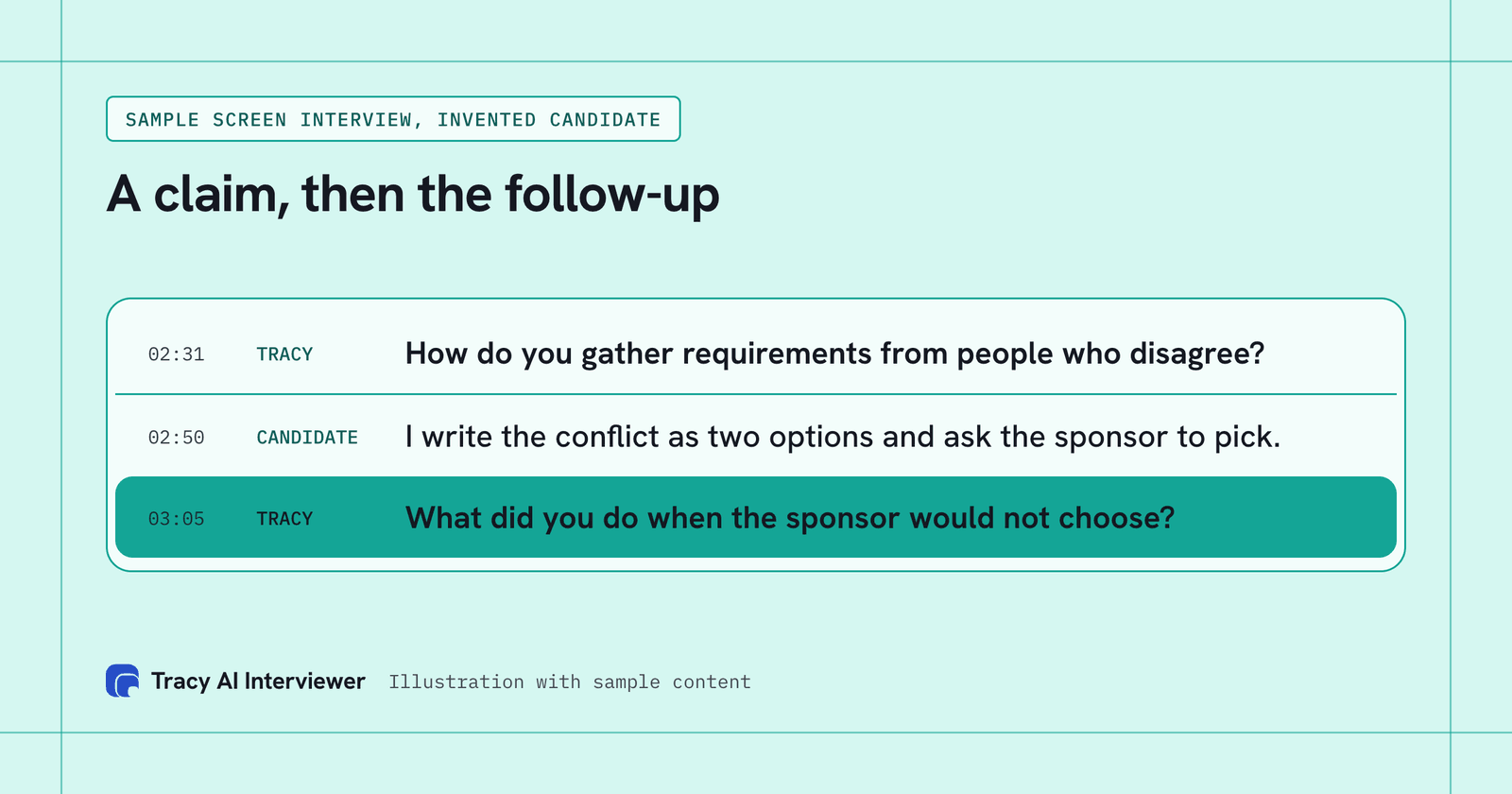
Tracy follows a claim about a stuck decision with the question a reviewer would ask.
Ask Claude for the results and it brings back, in the chat, what each person said to each question, the result fields and a note for an applicant tracking system. Your skill can set the layout of that summary. Tracy does not score, rank or reject anyone, and a reviewer makes the call. Candidates rate Tracy 92 on NPS.
Which path fits you?
- Recruiters writing their first skill: Claude skills for recruiting.
- People teams: Claude skills for HR covers policies, onboarding and reviews.
- Hiring managers: a hiring manager skill builds the scorecard and the interview from one chat.
- Teams that work in Anthropic's desktop agent: Claude Cowork for HR.
Common questions
What are Claude skills?
Best Claude skills for business teams?
How to build skills for business workflows?
Are Claude skills available on the free plan?
Can a Claude skill interview candidates?
Do skills replace connectors?
Start an interview from your AI chat
Add Tracy to Claude, then ask for an interview draft in plain words. You approve it before anything is created. First 3 results free.
Try it free (opens in a new tab) Book a demo (opens in a new tab)
Your first 3 results are free. No card needed.
Sources
- Anthropic help center: What are skills?, retrieved 23 Nov 2026.
- Anthropic help center: Provision and manage skills for your organization, retrieved 23 Nov 2026.
- Anthropic help center: How to create custom skills, retrieved 23 Nov 2026.
- Anthropic platform docs: Agent Skills, retrieved 23 Nov 2026.
- Anthropic skills repository on GitHub, retrieved 23 Nov 2026.
- Claude Code docs: Skills, retrieved 14 Nov 2026.
- Tracy AI Interviewer: Connect, retrieved 23 Nov 2026.