
In short
ChatGPT can plan a sourcing search, write the Boolean strings and draft the outreach. The searching itself happens in tools you are licensed to use. Tracy AI Interviewer picks up after the shortlist: ask ChatGPT to set up an interview, approve the preview, and every person you reach gets the same video interview on click, with follow-ups in their own field. Tracy does not look up emails or collect addresses; you bring the people you sourced elsewhere. Candidates rate Tracy 92 on NPS. Your reviewer reads a recording, a timestamped transcript and what each person said to each question, and decides.
ChatGPT is not a people database, so the names for a search have to come from a tool you are licensed to use. ChatGPT for sourcing candidates is useful at the front of the job: turning a role into a search plan, writing the strings, drafting the first message. This page is for recruiters and sourcers. It covers what ChatGPT can and cannot do, five prompts, and how to get the people you find into a first interview fast, using Tracy AI Interviewer from the same chat through an MCP connector.
Can ChatGPT find candidates?
Not on its own. Sourcing means finding people, and ChatGPT works from the web it can search and the text and files you give it. The places where professional profiles live also set rules. LinkedIn's User Agreement bars software, scripts and robots that scrape or copy profiles and other data, and its help pages say it does not permit third-party crawlers, bots, plug-ins or extensions that scrape or automate activity on the site. So the search runs in a tool you are licensed to use, such as your recruiter seat, your ATS or a people-data product you pay for, and ChatGPT works on either side of it.
What it does well:
- Turns a job description into a search plan: titles, adjacent titles, skills, employers, places.
- Writes and varies Boolean strings you paste into the tool.
- Drafts the first message and the follow-up, tuned to the role.
- Summarises a profile you paste in, if your company policy allows candidate data in a chat. Check the policy first.
Which ChatGPT prompts help with sourcing?
- Search plan from a job description: "From this job description, list the titles, adjacent titles, skills and employer types that fit a [role]. Mark which are must-have and which are nice to have." Check: cut anything you would not interview for.
- Boolean strings: "Write three Boolean strings for [role] in [location]: one tight, one wide, one built on adjacent titles. Explain what each excludes." Check: run each and read the first twenty results before you widen.
- Places you have not looked: "What other job titles, communities or open-source projects would a [role] be part of? List ten places to look." Check: verify each place exists before you spend time there.
- First message: "Write a four-sentence message to a [role] who has not applied. Name the problem the team is solving, one reason this person fits and one easy reply. No flattery." Check: send it to yourself and read it as a stranger.
- Follow-up: "Write a follow-up for five days later that adds one new fact about the role and does not repeat the first message." Check: it must add something.
For technical roles, give ChatGPT the stack and the problems the team works on. A message about the problem gets a different reply from a message about the title.
What happens after the shortlist?
Say a search returns fifty names. They match on keywords, and before a recruiter spends an hour on any of them, each one needs the same conversation. Tracy AI Interviewer runs that conversation from the same chat and gives the reviewer what each person said, so the recruiter chooses who moves on.
First add it to ChatGPT as a custom MCP server (setup is here). If you do not see the option to add a custom MCP server, check your plan and your ChatGPT settings for Developer mode. Then ask: "Use Tracy AI Interviewer to set up a screening interview for senior backend engineer candidates." ChatGPT shows the interview as a preview and nothing is created until you approve it. Approving creates the interview with nobody invited. Inviting is a second preview.
Then choose how people arrive:
- Invite by email the people whose addresses you already hold. Tracy does not look them up.
- Share the public link in your outreach reply. A new interview starts with the link on, so anyone with it can join, up to 20 people for 14 days. You can switch it off in the chat.
Our practice, not a rule: ask first, then send the link. A message that says "reply yes and I will send a 20-minute video interview you can take tonight" gets the person to opt in before you spend a link on them.
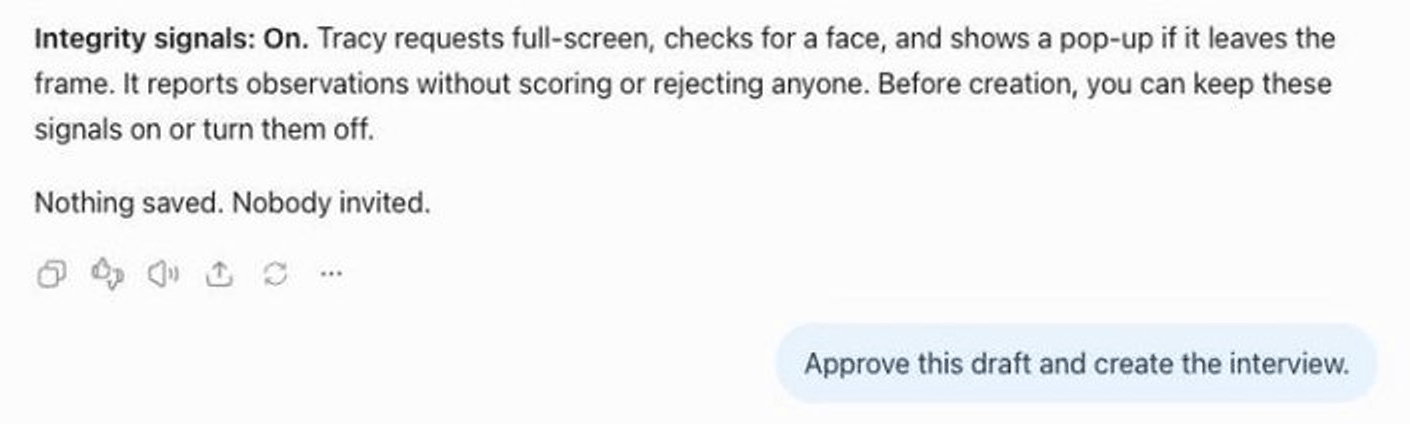
Nothing is saved and nobody is invited until you approve the draft.
What does a sourced candidate get?
A sourced candidate gets a link they open in a browser at any hour, with no account and no calendar, and the join screen tells them the conversation is recorded and transcribed. Tracy asks the questions you chose and follows up on what they say, in their own field: after a vague answer about a system they built, she asks what they changed and why. See what a candidate sees.
Asked in ChatGPT, the results come back as what each person said to each question, the result fields and a note for your ATS. In Tracy you also get, for each person, a recording of both sides, a timestamped transcript and a written assessment per question, with each finding linked to the moment. Tracy does not score, rank or reject anyone. A person reads and decides. Video interviews also show integrity signals, such as leaving full screen or the face leaving the frame, as evidence for the reviewer. They are never proof of anything, and the decision stays with you.
For a first batch, write your questions the way candidate screening questions suggests, with a follow-up for each, or see AI screening interviews for the format.
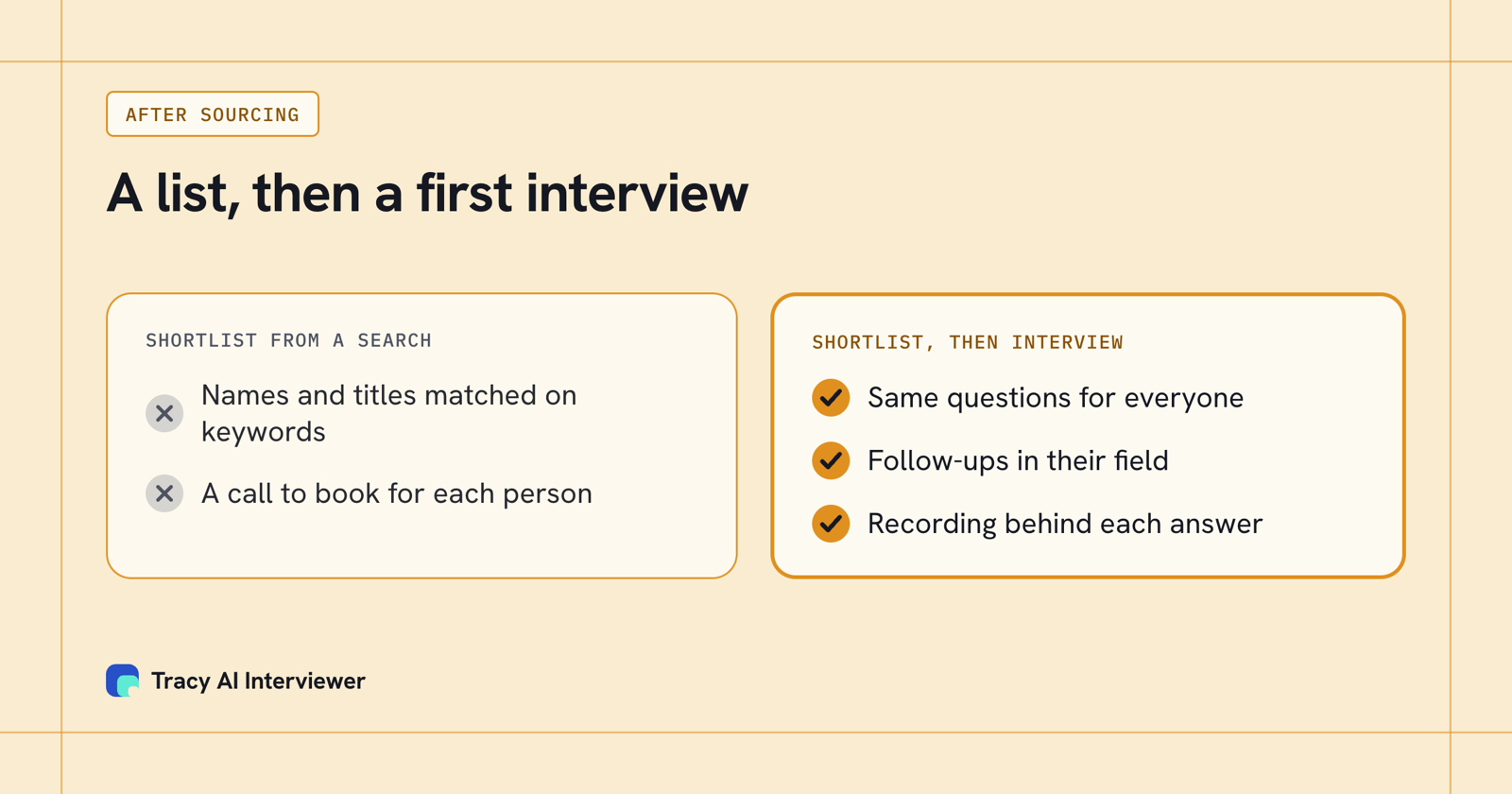
A search shortlist matches on keywords; an interviewed shortlist shows how each person answers.
What stays with you?
- Where you search stays in tools you are licensed to use. ChatGPT does not make that choice for you.
- Who you contact stays with you. Tracy invites only the addresses you supply. Follow your own outreach and consent rules.
- Which questions Tracy asks is your call: your questions, or a draft you edit, for the volume hiring or technical role you are filling.
- The decision stays with a person who reads the results and decides who moves on.
On cost, Pay as you go is $1 per credit, one credit per started 20 minutes, with the first 3 results free and no seats. A hundred 20-minute interviews is $100, which is on the pricing page.
Common questions
Can ChatGPT find candidates?
Is there a ChatGPT sourcing agent?
Can ChatGPT write Boolean searches?
Can I send sourced candidates a Tracy interview?
Does Tracy reject candidates?
Interview the people you shortlist
Connect Tracy to ChatGPT and approve one preview for your open role. Share the link and read the first interviews.
Try it free (opens in a new tab) Book a demo (opens in a new tab)
Your first 3 results are free. No card needed.
Sources
- LinkedIn User Agreement, section 8.2, retrieved 14 Nov 2026.
- LinkedIn Help: Prohibited software and extensions, retrieved 14 Nov 2026.
- OpenAI: Developer mode and custom MCP, retrieved 14 Nov 2026.
- Tracy AI Interviewer: ChatGPT guide, retrieved 14 Nov 2026.
- Tracy AI Interviewer: Pricing, retrieved 11 Nov 2026.