In short
A live call shows pauses, gaze and polished wording, and each has honest causes, so no single sign proves a candidate is reading ChatGPT answers. Tracy AI Interviewer asks every applicant a follow-up in their own field, waits for the answer and shows a reviewer integrity signals with their times, beside a recording and transcript. A signal is a reason to look, never proof, and a person decides.
Candidates using ChatGPT in interviews: what a live call can show
A live call does show things. A steady delay before answers, wording that sounds like documentation and a gaze that stays on one spot are the signs people mention for candidates using ChatGPT in interviews. Each has honest causes, so no single one proves anything; look for a few together. A follow-up about the answer the candidate just gave is a check you can run. The cheating detection guide covers what a signal can and cannot show.
Watching a call is a weak defence on its own. In an interviewing.io experiment of 32 mock coding interviews with senior candidates (the post is undated; read 14 Nov 2026), professional interviewers ran interviews with candidates who had been told to use ChatGPT. Not one interviewer raised cheating as a concern, and 81% of the candidates had no worry about being caught. The setup was audio only, so a video call gives you more to see. Even so, a feeling is not a check.
Hirers do suspect it. In Checkr's September 2026 survey of 3,000 US managers, 67% had suspected a candidate of using AI to misrepresent themselves. Checkr sells background checks, and these are managers' suspicions, not measured rates.
What a call cannot do is ask the second question of everyone. A signal tells you which minute to open; only a follow-up, asked of every candidate the same way, shows whether the person did the work.
Which signs suggest a candidate is reading ChatGPT answers?
These are signs people commonly mention, and the right-hand column shows why none is a test.
| Sign | What you see | Possible honest explanation |
|---|---|---|
| Delay before answers | A similar pause before every answer, whatever the question | Thinking time, a slow connection, a second language |
| Gaze | Eyes fixed on one spot off camera | Notes, a habit of looking away to think |
| Answer style | Tidy structure, formal links between points, no concrete detail | A prepared answer, a careful speaker |
| Echoed question | The question repeated back before each answer | Nerves, buying time |
| Thin second answer | A fluent first answer, then vague detail | Nerves, or the topic is not theirs |
| Window changes | Tab changes or leaving full screen | A note, a notification |
Six signs people commonly mention, with an honest explanation for each. Read each as a prompt to ask a question.
Leave accent, name, connection quality and camera angle out of it, because they say nothing about whether someone used a tool.
Why does a follow-up question work better than watching?
A pasted or memorised answer is built for the question as it was asked. The next question depends on details inside that answer, and the detail is harder to supply from a script. A candidate who did the work can go one level deeper. A candidate reading a screen may have to pause, ask again and read again, which a reviewer can see in the words as well as the timing.
In the written sample below, the first answer is smooth and says almost nothing. The follow-up asks for what the candidate saw, which only someone who did the work can describe. None of the 32 interviewers in the interviewing.io experiment raised cheating, so a call watched in real time left them with a feeling and no evidence. A follow-up chain leaves a transcript line to point at.
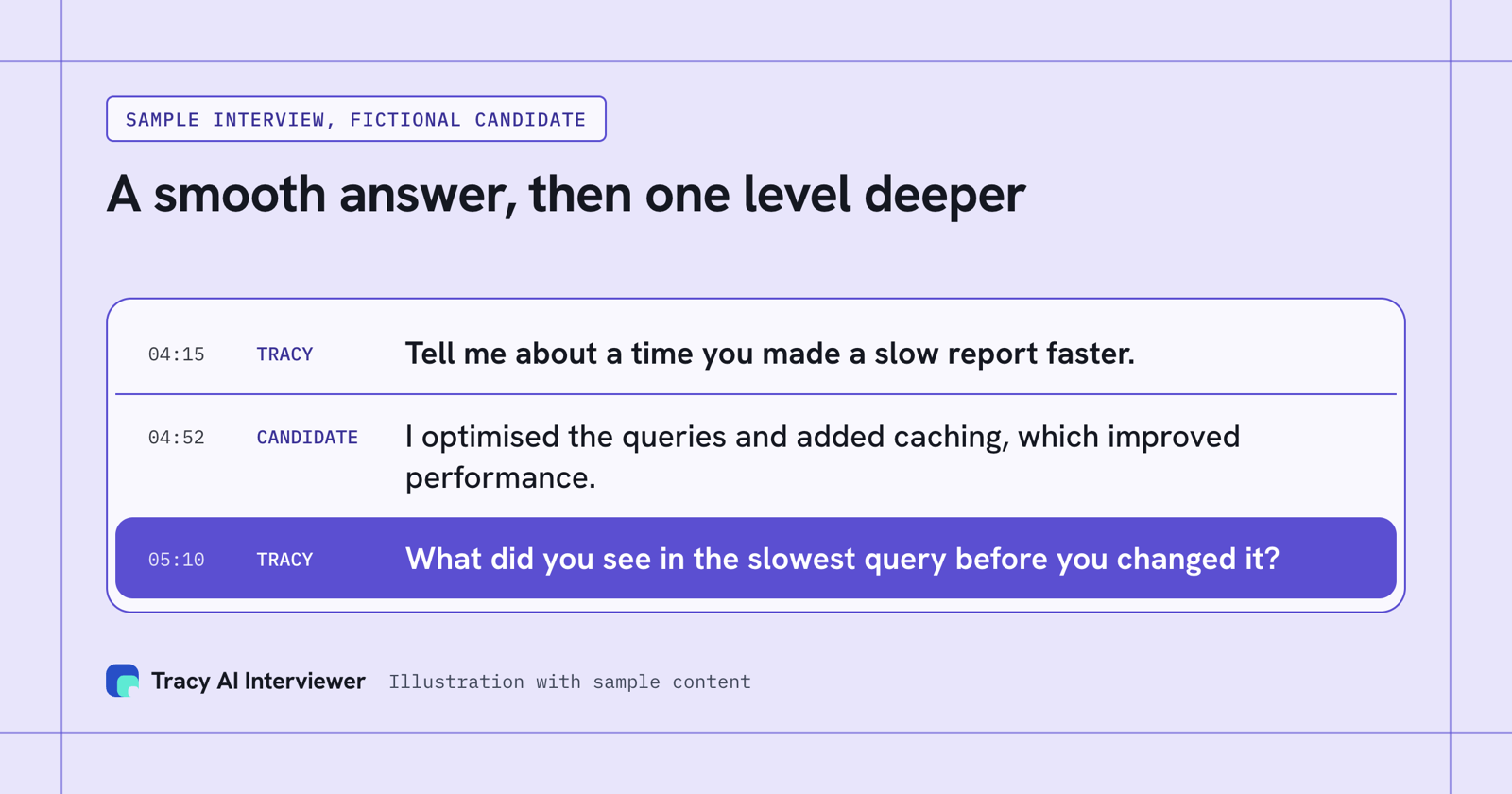
A smooth answer is not evidence; the question underneath it is.
What follow-up questions expose a rehearsed answer?
Use the same few moves on every candidate, so the comparison is fair.
- Ask for the detail behind the claim: "What did you see before you changed it?"
- Change one constraint: "What if the data were ten times larger?"
- Ask for the road not taken: "What else did you consider, and why not that?"
- Ask for the first mistake: "What did you try first that did not work?"
- Pick up their own word: "You said the cache went stale. What went stale, and when?"
Listen for specifics, for an answer that moves when the constraint moves, and for a plain "I don't know". For engineers, the same chain works on code; see coding interview follow-up questions.
What Tracy adds when candidates use ChatGPT
- Every applicant starts on click, at any hour, with no scheduling and no recruiter on the call, so the same questions reach the whole pool.
- Tracy asks the next question in the applicant's own field and waits for the answer, so a smooth first answer meets a question about the detail behind it.
- Every result keeps a recording, a timestamped transcript and what the person said to each question, with integrity signals and their times. A signal is a reason to look, never proof.
What does Tracy AI Interviewer show you?
Tracy AI Interviewer runs those follow-ups for every applicant. When the CV check is on, she reads the CV and asks about it. She then follows up in the person's own field and waits for the end of the thought before she asks for the missing detail. Each applicant starts on click, at any hour, so the same questions reach the whole pool, including people your team had no time to call. For engineers she can set a coding task and ask about approach and trade-offs, as AI technical interviews explains.
On video interviews she also captures tab changes, abnormal eye tracking (gaze), live face detection, delay before answers, leaving fullscreen and external screens, unless you turn them off. A reviewer sees each one in the report with its times, beside a recording of both sides and a timestamped transcript. The candidate is told on the join screen that the conversation is recorded and transcribed. Tracy gives no detection rate and decides nothing.
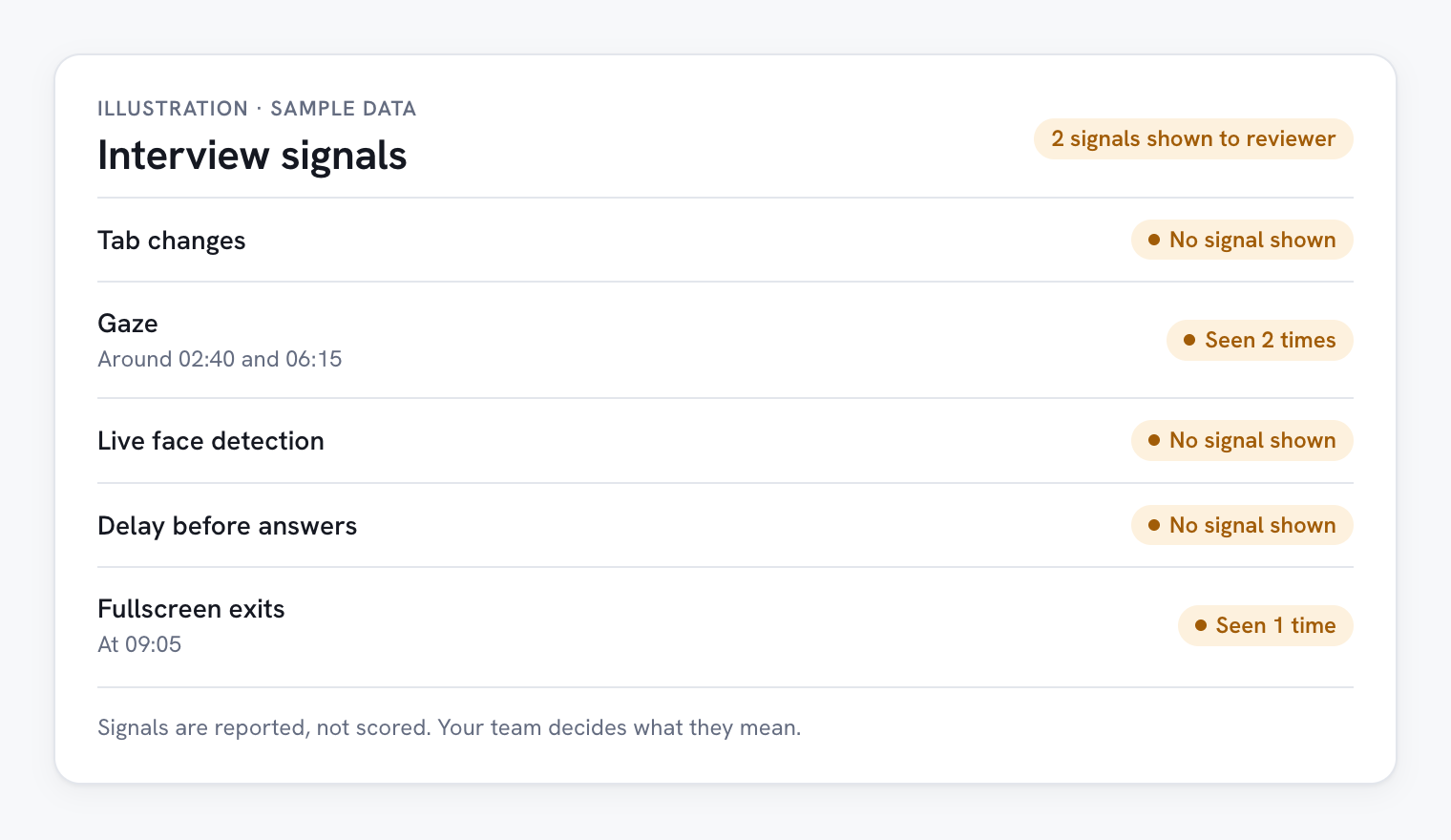
Signals arrive with their times, so the reviewer knows which minute to open.
What should you do when you suspect a candidate used ChatGPT?
Start with your own rule. If candidates may use AI to prepare or to draft, say so, and say where it stops. A candidate who reads answers from a tool during a live interview has broken a rule only if you wrote it down.
Then run the same routine each time. Read the transcript at the minute of the signal. Compare the answer with the CV, one level deeper. Ask the person to explain it in a short live call, with the questions you would ask anyone. Record the decision and the evidence so a second person can review it. A person decides, every time, and one signal is never enough to reject someone.
When the worry is wider than ChatGPT, such as a stolen identity or a proxy, candidate fraud detection covers the layers. For definitions, see interview fraud and deepfake candidates.
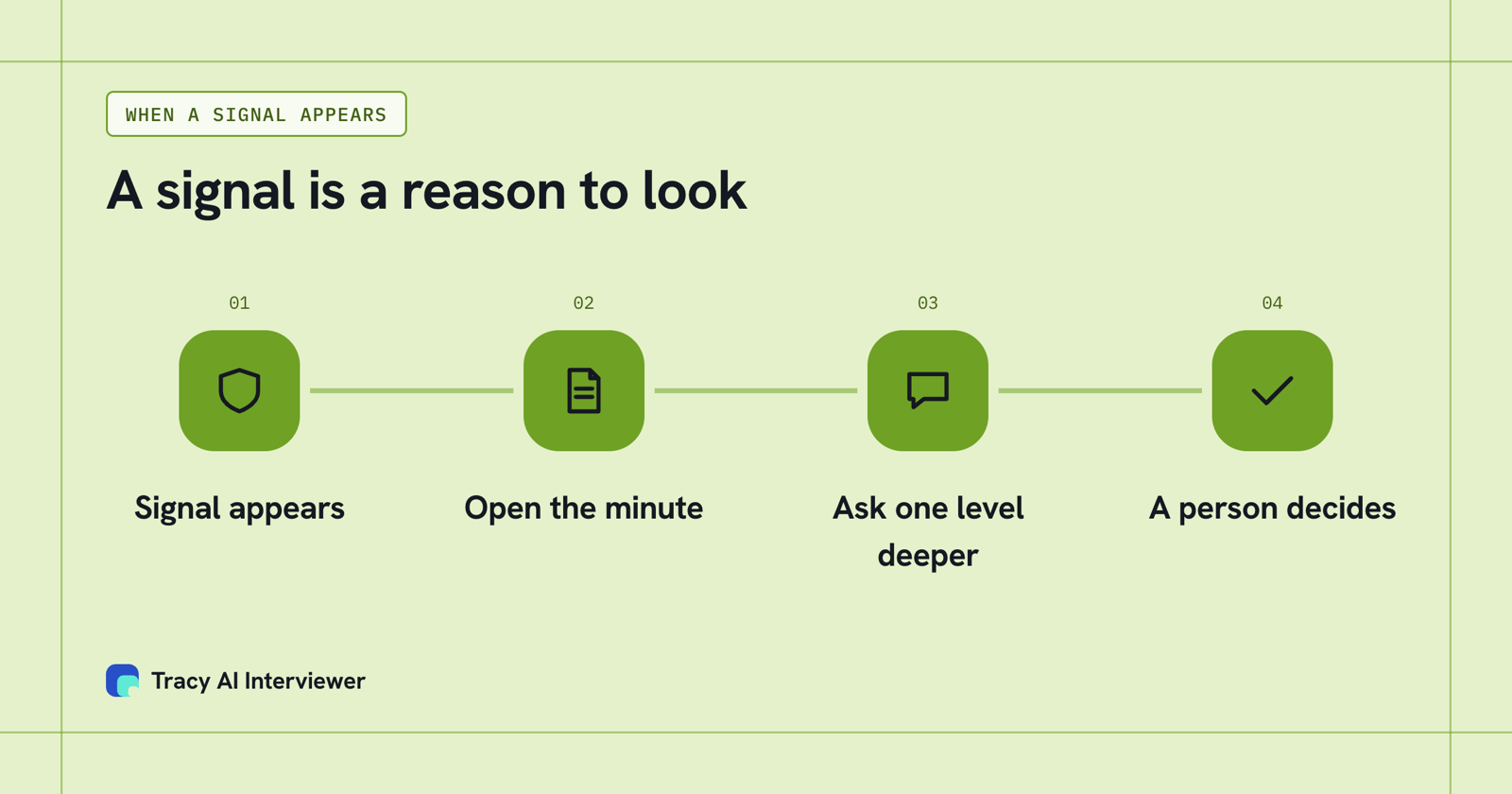
A signal sends the reviewer to one minute and one question.
Which path fits you?
- Hiring engineers: using ChatGPT during coding interviews and AI interviews for software engineers.
- Hiring many people at once: AI interview tools for high-volume hiring.
Common questions
Can you tell if a candidate is using ChatGPT during an interview?
Is using ChatGPT in an interview cheating?
What should I do if I think a candidate used ChatGPT?
Can software detect ChatGPT use in an interview?
Why do candidates use ChatGPT in interviews?
Read one interview's evidence yourself
Create one interview for your role and read the follow-ups, signals and transcript yourself. The first 3 results are free.
Try it free (opens in a new tab) Book a demo (opens in a new tab)
Your first 3 results are free. No card needed.
Sources
- interviewing.io: We ran an experiment to see how easy it is to cheat with ChatGPT in interviews, retrieved 14 Nov 2026.
- Checkr, The hiring hoax 2026: manager survey of 3,000 US managers, 11 to 16 September 2026, retrieved 14 Nov 2026.