In short
ChatGPT resume screening does one job well: it reads a CV against the must-haves and drafts questions to ask. Studies of AI resume ranking find name bias and rankings that differ from recruiters' calls, so a ranking should not decide who is rejected. Tracy interviews the person on video, asks follow-ups in their own field and returns what each said, with a recording and transcript. Your team decides.
Yes, you can screen CVs with ChatGPT, and for some jobs it saves time. Paste a CV and a job description and it will match them line by line, flag gaps and draft questions. The trouble starts when the output becomes a ranking and the ranking decides who gets a call. A CV is the person's own account, written to impress, and a language model sees only its wording.
A prompt can only read what the CV says, so the person is never asked a question. Tracy asks it, from the same chat, through Tracy connected in ChatGPT.
What ChatGPT does well with a CV
ChatGPT summarises a CV against the must-haves quickly: it extracts dates, skills and employers, matches them to the must-haves and lists what is missing. Choosing between two people, or turning a CV into a score, rests on judgment that the research below gives no reason to hand to a model. A person decides. For the questions to ask once you have the summary, see candidate screening questions.
A resume screening prompt that avoids ranking
Use ChatGPT to prepare, and keep the decision with a person. The prompt below asks for evidence and questions and leaves out any score.
Read the job description and the CV below.

<job_description>
[paste]
</job_description>

<cv>
[paste, with name, photo and contact details removed]
</cv>

For each must-have in the job description, quote the line of the CV that supports it, or write "not shown on the CV".
Do not give a score or a ranking. Do not guess at anything the CV does not say.
Then list three things on the CV I should ask about, each as a question.
Removing the name and photo takes out one known trigger. The study below swapped only names, so it says nothing about other signals such as school or employer, and a clean CV is not a fair CV.
Is ChatGPT biased when it screens resumes?
Language models have shown it in tests. A University of Washington study, presented in October 2024, put 120 first names associated with white and Black men and women onto more than 550 real resumes and compared them against more than 500 job listings across nine occupations. Three language models, from Mistral AI, Salesforce and Contextual AI, preferred white-associated names 85% of the time against 9% for Black-associated names, and male-associated names 52% of the time against 11% for female-associated names. The models never preferred typically Black male names over typically white male names.
That study did not test ChatGPT, so it is not a verdict on it. It shows what can happen when a language model ranks CVs, and the lead author said there is no regulatory, independent audit of these systems. Rules on automated hiring tools differ by place, so check with legal before a model's output decides who is rejected.
Are its rankings reliable?
Not yet, on the evidence we have. A July 2025 preprint, not peer reviewed as far as its page shows, compared Claude, GPT and Gemini with three human recruiting experts. It reports significant differences between each model and the humans, and that the models differed in how far they adjusted to the company context. Its own conclusion is that the models give interpretable patterns with detailed prompts but diverge substantially from human judgment.
A ranking that changes with the wording of the prompt is hard to defend to a candidate or a hiring manager. One way to see how much yours moves is the next section.
How do you test it on your own CVs?
Before you rely on a prompt, try it on CVs where you already know the outcome.
- Take ten past applicants, five you hired or advanced and five you did not, and remove names, photos and contact details.
- Run the same prompt on each CV twice. Note any CV where the two runs disagree.
- Change one thing that should not matter, such as the order of two jobs or the name, and run it again. The answer should not move.
- Compare the output with what your recruiters decided, and read the cases where they differ.
- Ask what the prompt could not see: did the strong hire list a skill that the CV barely mentioned?
If the prompt moves in steps 2 or 3, it is not ready to screen anyone out. If it holds, use it for the summary and the questions only.
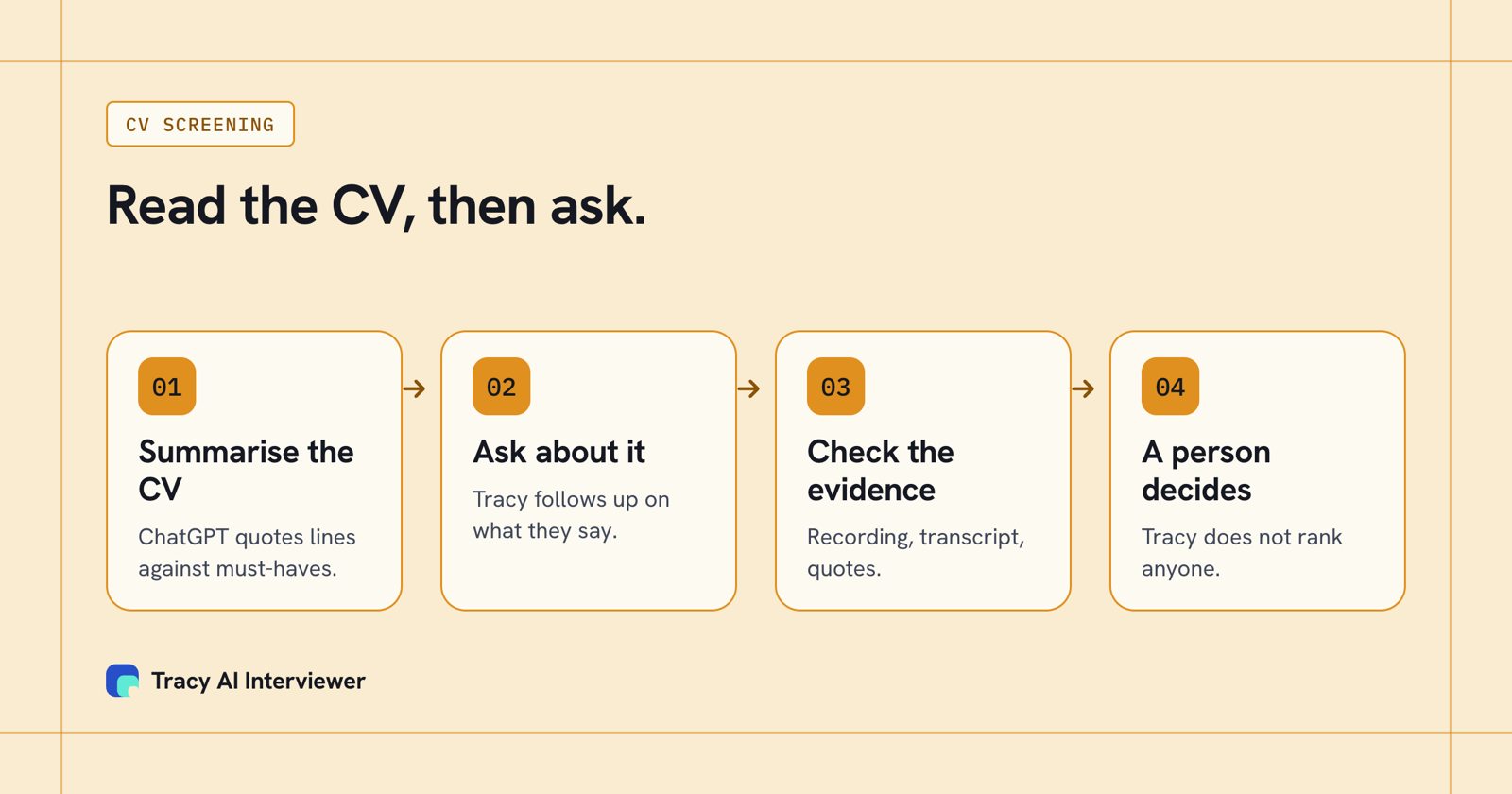
A CV prompt reads what is written; an interview then asks the person about it.
What an interview adds that a CV prompt cannot
The person's answer. A CV says a candidate cut latency by 40%. A prompt can note that the line is there. It cannot ask what they changed or what they would do differently. Tracy can: "How did you measure the 40%, and what did you try first?" turns a one-line claim into the detail behind it.
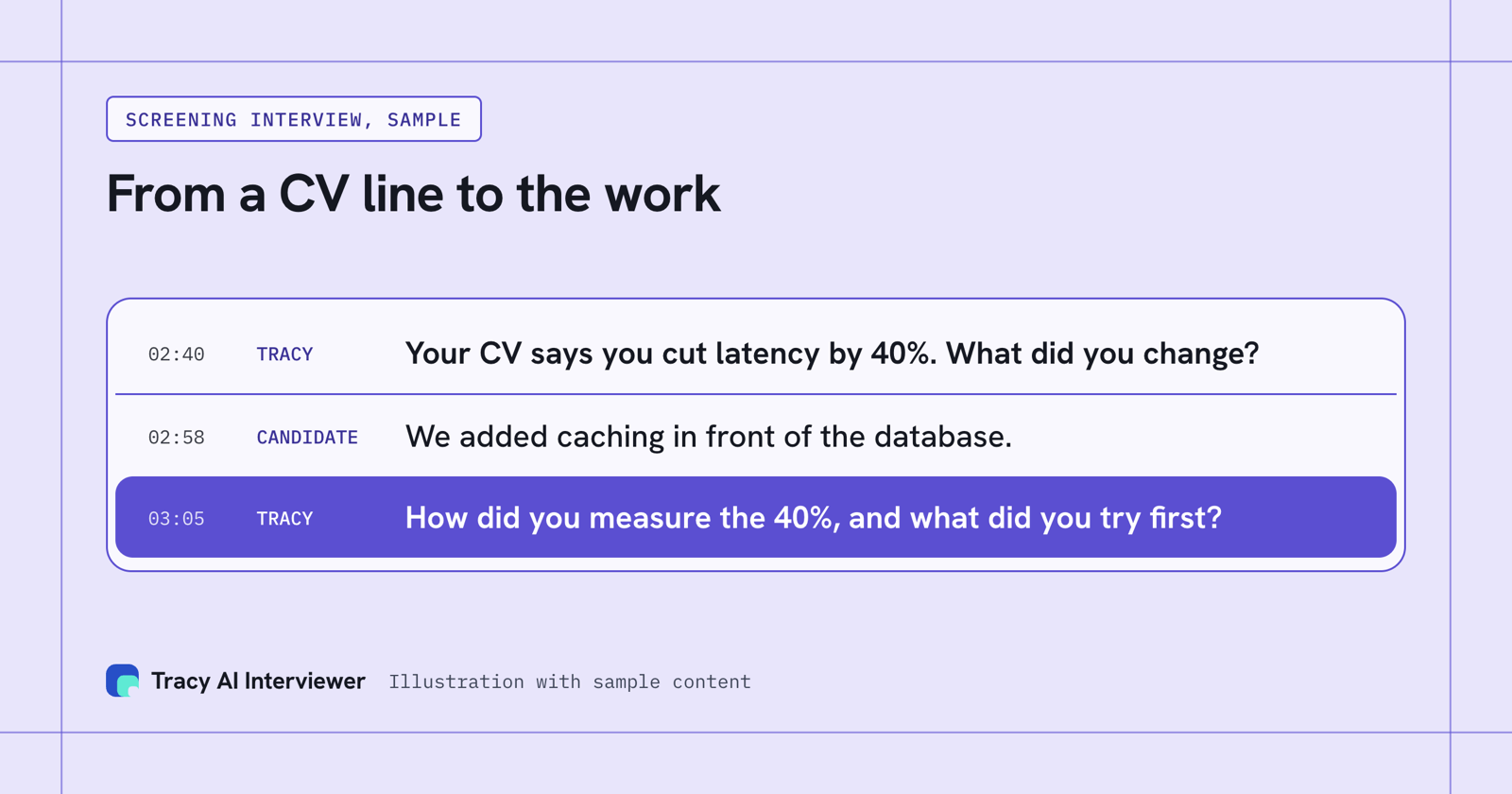
A follow-up on a CV line shows whether the person did the work.
Asking is also a volume problem. Say 100 applicants clear the CV read. A 20-minute call each is about 33 hours of live calls, and at 1,000 applicants it is about 333 hours. When there are not enough hours to call everyone, a ranking decides who is heard, and that is where a biased or noisy ranking does harm. When each applicant starts on a link, everyone who clears the CV read is heard before anyone is turned away.
What Tracy adds to CV screening
- Reach every applicant. Each applicant starts on click, at any hour, with no scheduling and no recruiter on the call. Nobody is turned away unheard because a calendar was full.
- Ask the next question. Tracy reads the CV when you turn the CV check on (it is a setting), then asks in the person's own field, follows up on what they say and waits for the end of the thought before the next question.
- Keep the evidence. Every result has a recording, a timestamped transcript and a written assessment per question with its reasoning. Tracy does not score, rank or reject anyone. A person reads the results and decides.
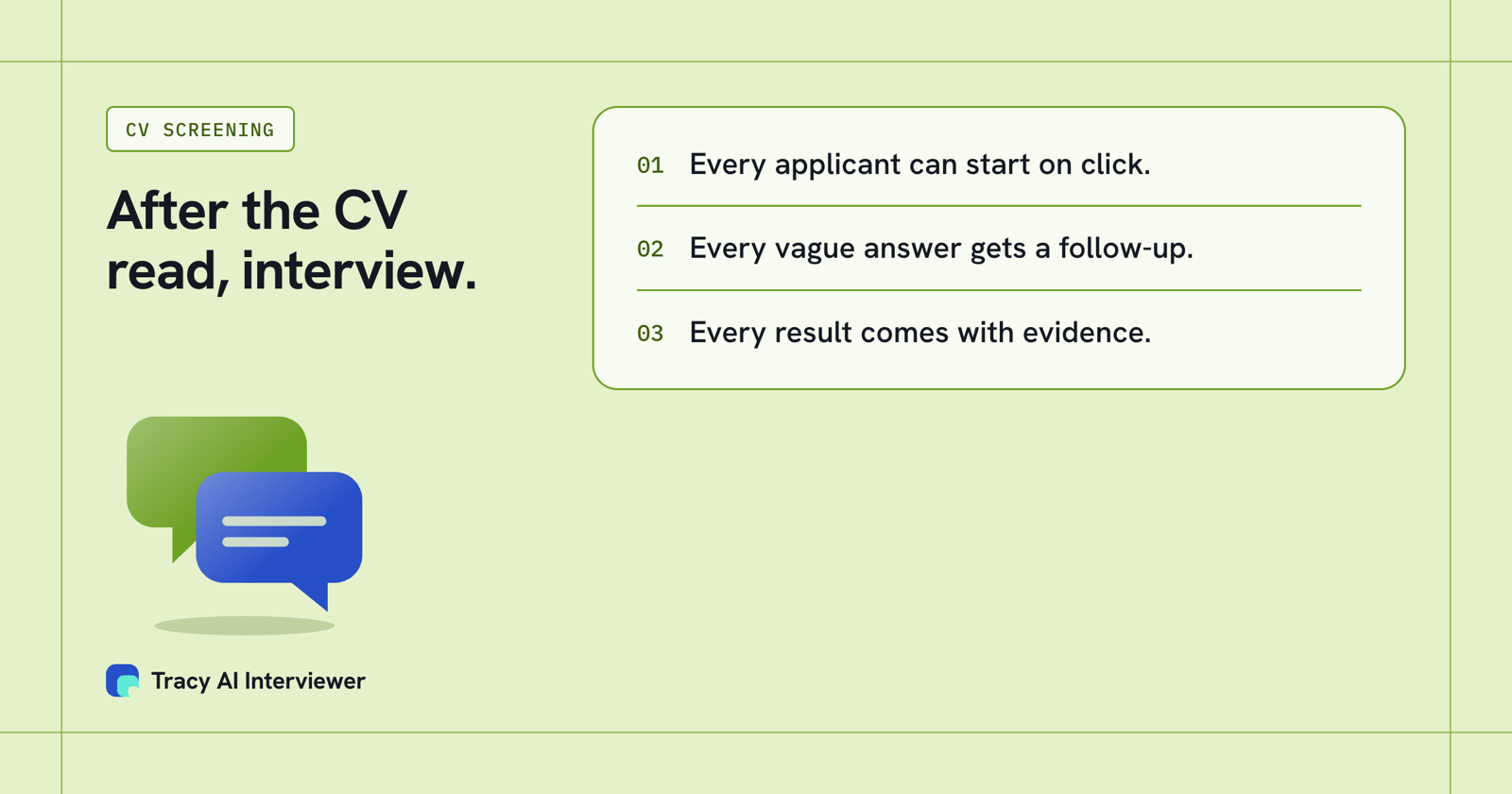
After the CV read, every applicant can start, every vague answer gets a follow-up and every result has evidence.
When should you use ChatGPT, and when an interview?
Use ChatGPT when you have one CV and want a fast summary against the must-haves, or you are preparing questions for a call you will make yourself. Use an interview when you have more applicants than you can call and want every one of them heard before anyone is turned away. You can start one from the same chat: with Tracy AI Interviewer added to ChatGPT, ask it to set up a screening interview for the role, read the preview and approve it.
For the wider screening process, read how to screen candidates, what a pre-screening interview is and candidate screening questions. Teams hiring in bulk can read the hiring at volume use case.
Common questions
Does ChatGPT work for resume screening?
Can ChatGPT rank resumes?
Is there a ChatGPT CV screening tool?
Is it legal to screen resumes with ChatGPT?
Does Tracy rank candidates?
Run one screening interview from ChatGPT
Connect Tracy in ChatGPT, approve one interview and read what each applicant said. The first 3 results are free.
Try it free (opens in a new tab) Book a demo (opens in a new tab)
Your first 3 results are free. No card needed.
Sources
- University of Washington: AI tools show biases in ranking job applicants' names (31 Oct 2024), retrieved 14 Nov 2026.
- Varshney and Ganuthula: Signal or Noise? Evaluating LLMs in resume screening (preprint, Jul 2025), retrieved 14 Nov 2026.
- Add Tracy AI Interviewer to ChatGPT (public guide), retrieved 14 Nov 2026.
- Tracy AI Interviewer product page, retrieved 14 Nov 2026.