
In short
Candidate experience NPS asks candidates how likely they are to recommend your hiring process, then subtracts the share who answer 0 to 6 from the share who answer 9 or 10. The result runs from -100 to +100.
Every applicant gets a video interview with follow-ups in Tracy AI Interviewer, and you can set up an NPS interview or close any interview with your own NPS question, so the reason behind the number comes in the candidate's own words.
Tracy does not calculate the score. It highlights insights and signals from what people said, and your team works out the number. The first 3 results are free.
What is candidate experience NPS?
Candidate experience NPS, or candidate NPS, is the Net Promoter method applied to hiring. Net Promoter was created in 2003 by Fred Reichheld of Bain & Company, according to the Net Promoter System site. Qualtrics describes the question: how likely is it that you would recommend the organisation to a friend or colleague, answered on a scale from 0 (not at all likely) to 10 (extremely likely). Answers of 9 or 10 are promoters, 7 or 8 are passives and 0 to 6 are detractors. Subtract the percentage of detractors from the percentage of promoters and the result runs from -100 to +100. Passives count in the total but not in the score.
A single number is most useful when you can see where it moves: by stage, by role and by whether the candidate was hired. If you hire at volume, the stages are easier to compare when the first conversation is the same for everyone, as in a 30-day mass hiring pilot.
How to measure candidate NPS
Keep the survey short enough that a candidate would answer it after a rejection.
- Choose the moments. Three are common: right after applying, right after an interview and after the decision. Ask the same question at each so you can compare stages.
- Ask the NPS question, then one open question: what is the main reason for your score?
- Send it to everyone who reached that stage, rejected candidates included.
- Split the results by stage and by outcome. A combined average hides the stage that hurts.
- Read the reasons, not only the number. Ten comments about the same delay are a task for next week.
- Track the response rate beside the score. A high score from a small share of candidates says little about the rest.
- Reply to the candidates who gave low scores and say what changed.
A worked example: 200 candidates answer after the interview stage. 90 give a 9 or 10 (45%), 70 give a 7 or 8 (35%) and 40 give 0 to 6 (20%). The score is 45 minus 20, which is 25.
How many stages to measure depends on the size of the pipeline. A team hiring a handful of people a quarter can ask once, after the decision, and read every comment. A team with thousands of applicants gains more from two or three stages, because the stage with the most detractors is where the next fix goes. Start with the stage where candidates wait longest, since that is often where the reasons pile up.
A second reading, with invented numbers, shows why the split matters. Say 120 rejected candidates answer after the decision: 12 give a 9 or 10 (10%), 36 give a 7 or 8 (30%) and 72 give 0 to 6 (60%). The score is 10 minus 60, which is -50. A +25 after the interview and a -50 after the decision come from different groups of candidates, so read them apart. Check the response rate too: if 120 of 800 rejected candidates replied, 15% of that group is speaking for all of it.
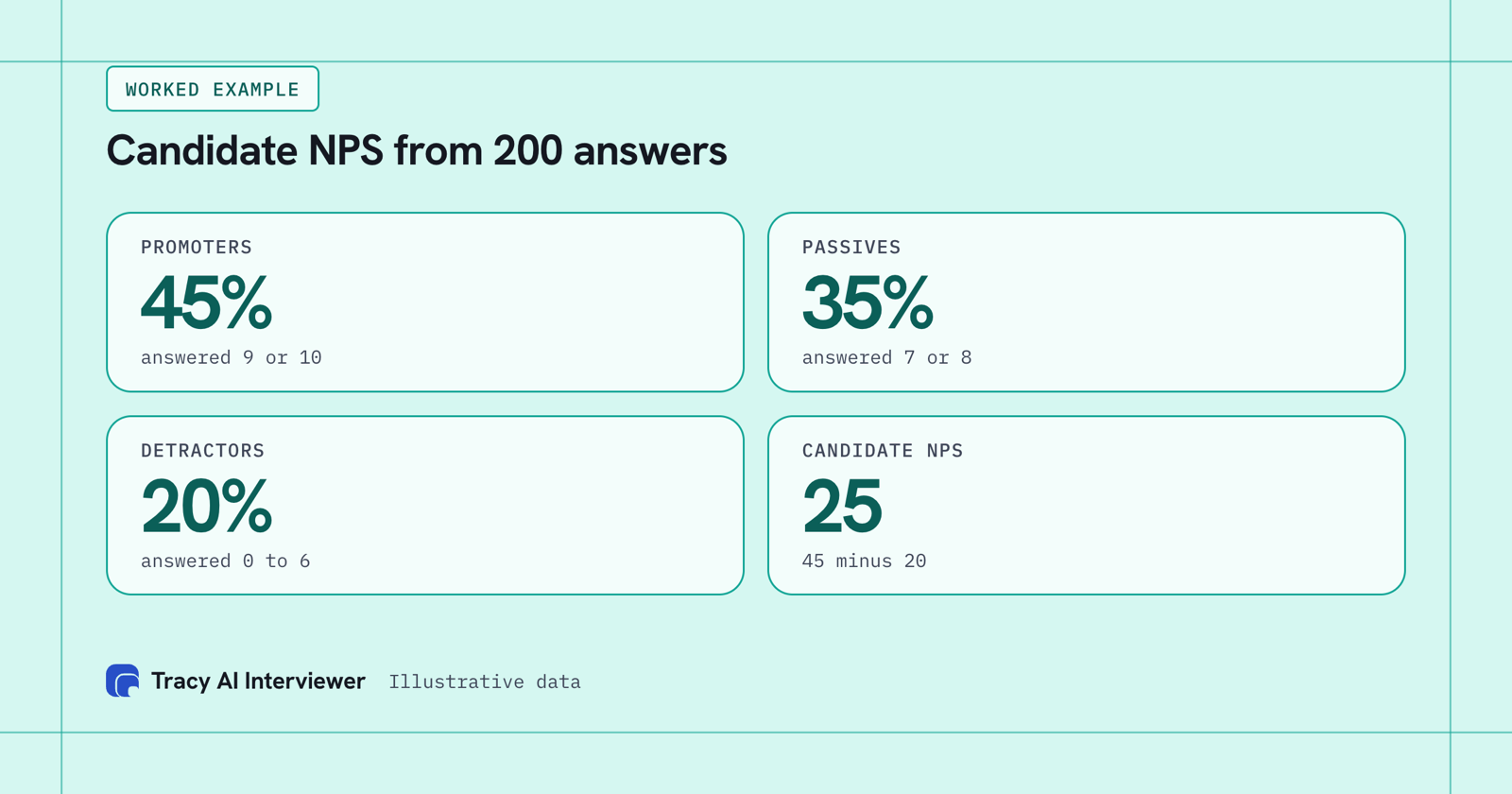
Promoters minus detractors gives the score, and passives only add to the total.
What is a good candidate NPS score?
Any score above zero means more promoters than detractors, so zero is the first line to clear. After that, compare yourself with your own earlier rounds, stage by stage, and ask whether a change to the process moved the number.
For reference, candidates rate Tracy 92 on NPS. Use your own number to see whether a change to the process helped.
Why a candidate survey misses most of the pool
A survey scores the people who answer it. Survale's publication of the 2025 CandE Benchmark Research reports that 56% of candidates received no feedback in 2025 after a rejection at the screening or interview stage. Those candidates are among the likeliest to leave a survey unanswered, and they are also the ones whose view you most need. That is reasoning; the study does not report it.
If every applicant has a conversation, every applicant has something to rate and a reason for the rating. For the patterns behind low scores, see what candidates say about AI interviews.
How a real interview moves the score
Tracy AI Interviewer interviews every applicant.
01 Every applicant is heard
The link opens whenever the applicant is free, day or night, with no slot to book and no recruiter on the call. Nobody is filtered out before they speak.
02 Follow-ups on what they said
If an answer leaves something out, Tracy waits for the candidate to finish and then asks about what is missing. One non-STEM candidate said: "it did well with figuring what to ask when I didn't give a clear answer."
03 A place to say how it went
A company can set up an NPS interview with Tracy, or write its own questions and end any interview with the NPS question and a reason. Tracy does not score or calculate NPS. It highlights insights and signals from what people said, and you use them to improve the process and as a reference for your next round. A sample, with invented data: asked "Is there anything you would add?", a candidate offered an example about teaching a junior colleague. The follow-up was "What did that colleague learn from you?" The reviewer sees the candidate's own words beside the recording and the timestamped transcript at 04:20.
Nothing in the report scores, ranks or rejects a candidate; a person decides from it. Candidates see on the join screen, before they begin, that the call is recorded and transcribed.
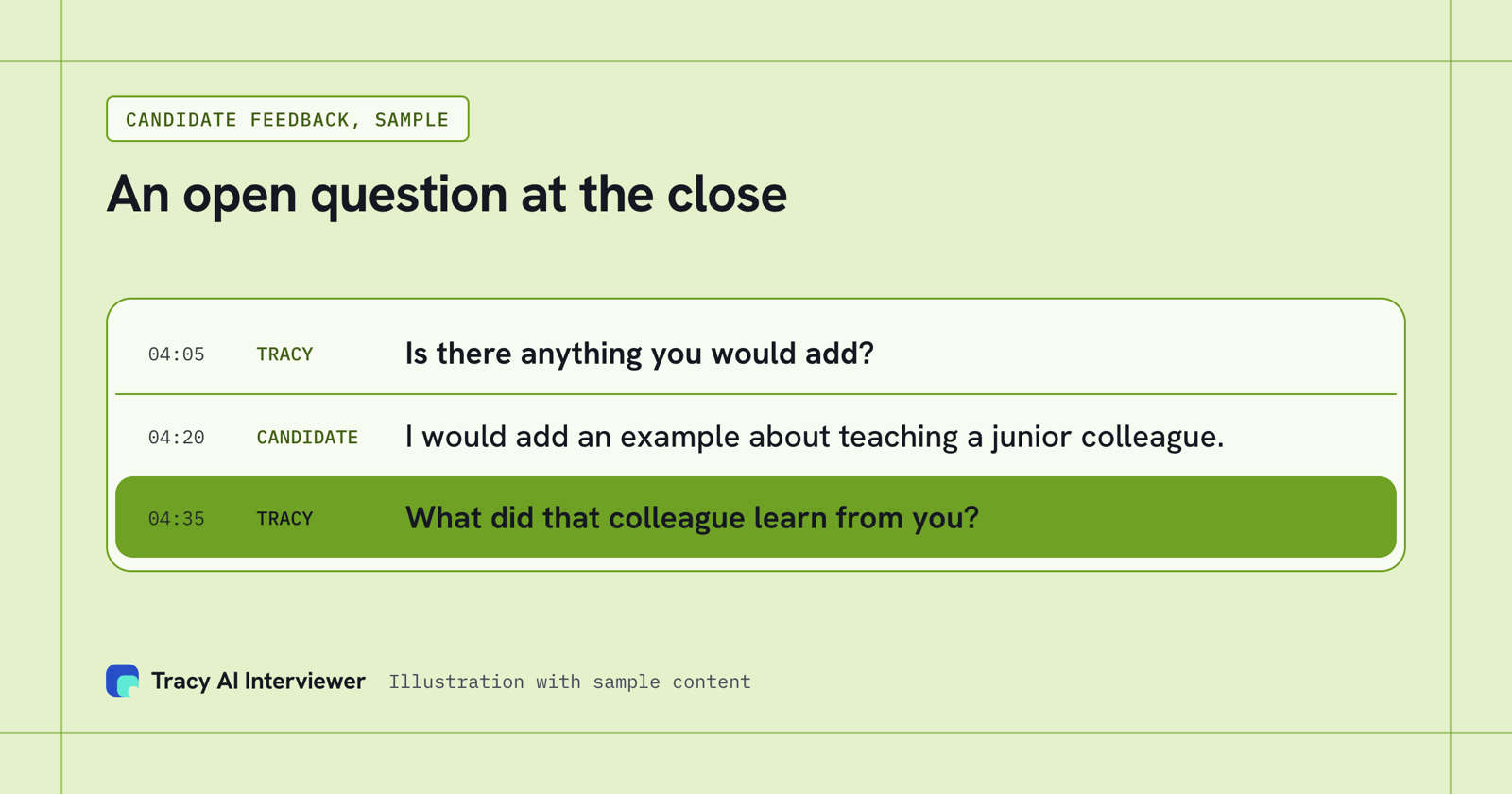
An open closing question gets the candidate's own words, with the time in the recording.
What to do with the number
- Fix the stage with the most detractors first.
- Do not survey only the people you hired.
- Do not chase the score by asking happier candidates. Ask everyone at the same stage.
- Tell candidates what changed, so the next survey is answered.
- Run a candidate experience audit once a quarter to look at the whole process, not only the number.
Which path fits you
- Filling one role with many people: volume interviewing for a single role, and how a mass hiring pilot runs.
- Swapping the first call for a conversation: what a first-round interview is.
- Testing candidates on the job itself: virtual job tryout guide.
- Reading what each result contains: AI interview reports.
Common questions
What is candidate NPS?
How to measure candidate NPS?
What is a good candidate NPS score?
Can Tracy collect candidate NPS?
Interview every applicant, not just a few
Every applicant gets a Tracy interview link at any hour, with a follow-up after each answer. First 3 results are free.
Try it free (opens in a new tab) Book a demo (opens in a new tab)
Your first 3 results are free. No card needed.
Sources
- About Net Promoter, Net Promoter System, retrieved 22 Nov 2026.
- Net Promoter Score explainer, Qualtrics, retrieved 23 Nov 2026.
- 2025 Candidate Experience (CandE) Benchmark Research key statistics, Survale, retrieved 18 Nov 2026.
- Tracy AI Interviewer Connect page, retrieved 11 Nov 2026.