
In short
Most researchers cannot put a number on their impact: in User Interviews' 2025 survey of 485 researchers, 54% did not track research impact numerically, and only 21% of those who tracked it were satisfied with their methods.
Tracy AI Interviewer drafts an interview guide from what you want to learn, lets customers join from one link when it suits them, and links each finding to the words and the moment in the recording behind it.
Tracy has completed 100K+ interviews, with 99% interview completion.
Next step: run one discovery interview through Tracy and read the findings with their quotes.
User research statistics come mostly from vendor and community surveys, and each one counts a different group of respondents. This page lists the figures from User Interviews' 2025 State of User Research and Maze's 2026 report, with the sample and dates each covers, so you can quote them without stretching them. If you are choosing tools for the work itself, see AI tools for user research.
What is the ROI of user research?
There is no agreed figure to quote, and most researchers do not track one. In User Interviews' 2025 survey, fielded from 25 July to 9 August 2025 with 485 qualified responses, 83% of respondents said they qualitatively measure the effect of their work, more than half (54%) do not track research impact numerically, and only 21% of those who tracked their impact were satisfied with their methods.
A team without a return in dollars can still show what a finding changed, with the customer's own words behind it.
Which research number counts what?
Each row has its own group and wording, so rows do not combine. Sources: User Interviews, The State of User Research 2025; Maze, The Future of User Research 2026.
| Measure | Figure | Who counted, when |
|---|---|---|
| Use AI in research | 80% | User Interviews, 485 researchers, July to August 2025 (up 24 points) |
| Worry about accuracy | 91% | User Interviews, same survey; 63% fear AI could devalue human insight |
| Recruiting time a struggle | 54% | User Interviews, same survey (23% for cost) |
| Measure impact qualitatively | 83% | User Interviews, same survey |
| No numeric impact tracking | 54% | User Interviews, same survey |
| No dedicated researchers | Nearly 14% | User Interviews, respondents whose company has zero dedicated UXRs |
| Demand rose | 66% | Maze, nearly 500 responses, December 2025 to January 2026 (55% a year earlier) |
| Use AI in some projects | 69% | Maze, same survey |
How many companies do user research?
Neither survey counts companies that do research. They show who does the work. In User Interviews' data, nearly 14% of respondents said their company has zero dedicated UX researchers, and 21% said their company laid off researchers in 2025, roughly in line with 2024. Maze reports that research is also run by people outside research roles, including product managers (39%), market researchers (35%) and marketers (23%), and that 13% of respondents have no resources at all to support those non-researchers.
So product managers, market researchers and marketers run some research without a research team behind them.
Is demand for user research rising?
Maze says yes. In its 2026 survey of nearly 500 professionals, fielded from 23 December 2025 to 13 January 2026, 66% reported an increase in demand for research, up from 55% in the 2025 report. The share of organizations where research is essential to all levels of business strategy nearly tripled, from 8% in 2025 to 22% in 2026, and 35% of participants believe the researcher's role is becoming more strategic.
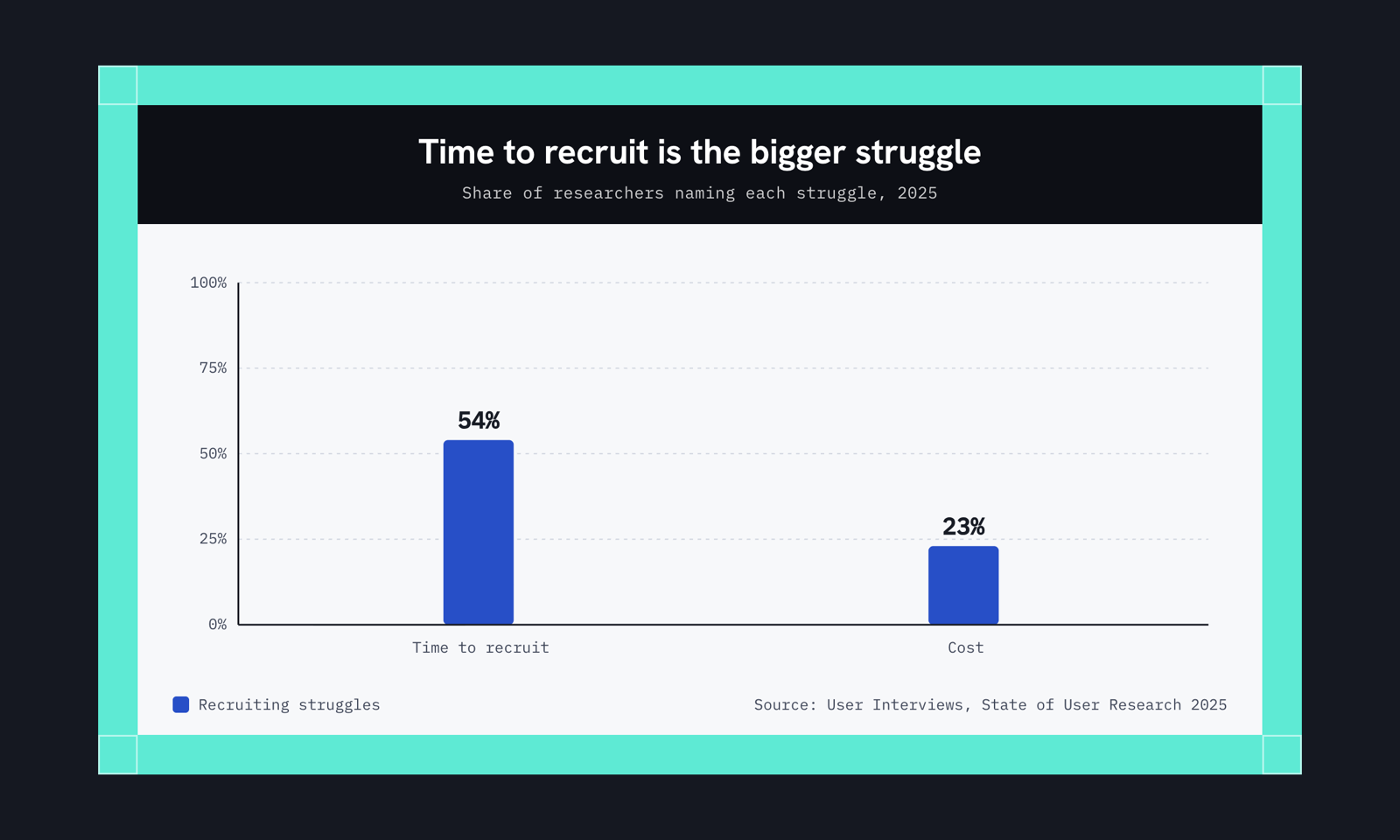
Time to recruit is the bigger struggle for researchers, ahead of cost.
How is AI used in UX research?
User Interviews found 80% of researchers using AI in 2025, up 24 points in a year, and 67% asking an AI chatbot for answers, second only to Google (78%), while the same survey found 91% worried about output accuracy and hallucinations and 63% afraid AI could devalue human insight and critical thinking. Maze's 2026 report found 69% using AI in at least some research projects, and researchers cited interpreting nuance and emotion (82%) as an area where human involvement is essential.
An AI interviewer leaves the judgement to the researcher: it asks the questions and records the answers, and a researcher reads the evidence and decides what it means.
Where does an AI interviewer fit when recruiting takes the time?
Time to recruit participants is a struggle for 54% of researchers in User Interviews' survey, and interviews are the most common method supported by research operations teams (92% of 25 research operations specialists in the same survey). Booking twenty calls can take two weeks, and notes from different interviewers can be hard to compare.
Tracy AI Interviewer runs the conversation itself. You describe what you want to learn, Tracy drafts an interview guide, or you bring your own, and you send one link. Customers join in the browser when it suits them, with no calendar, and Tracy follows up on each answer, so "it was confusing" becomes where the person looked and what they expected. Each finding links back to the words and the moment in the recording. Tracy reports what was said and does not rank or rate participants; the researcher decides what it means.
A sample note with invented data shows the pattern: a participant tried to change a delivery date and looked under Orders first, Tracy asked where they expected to find it, and the researcher gets the quote ready to tag. Pricing is per result: $1 per credit, one credit per started 20 minutes, with the first 3 results free.
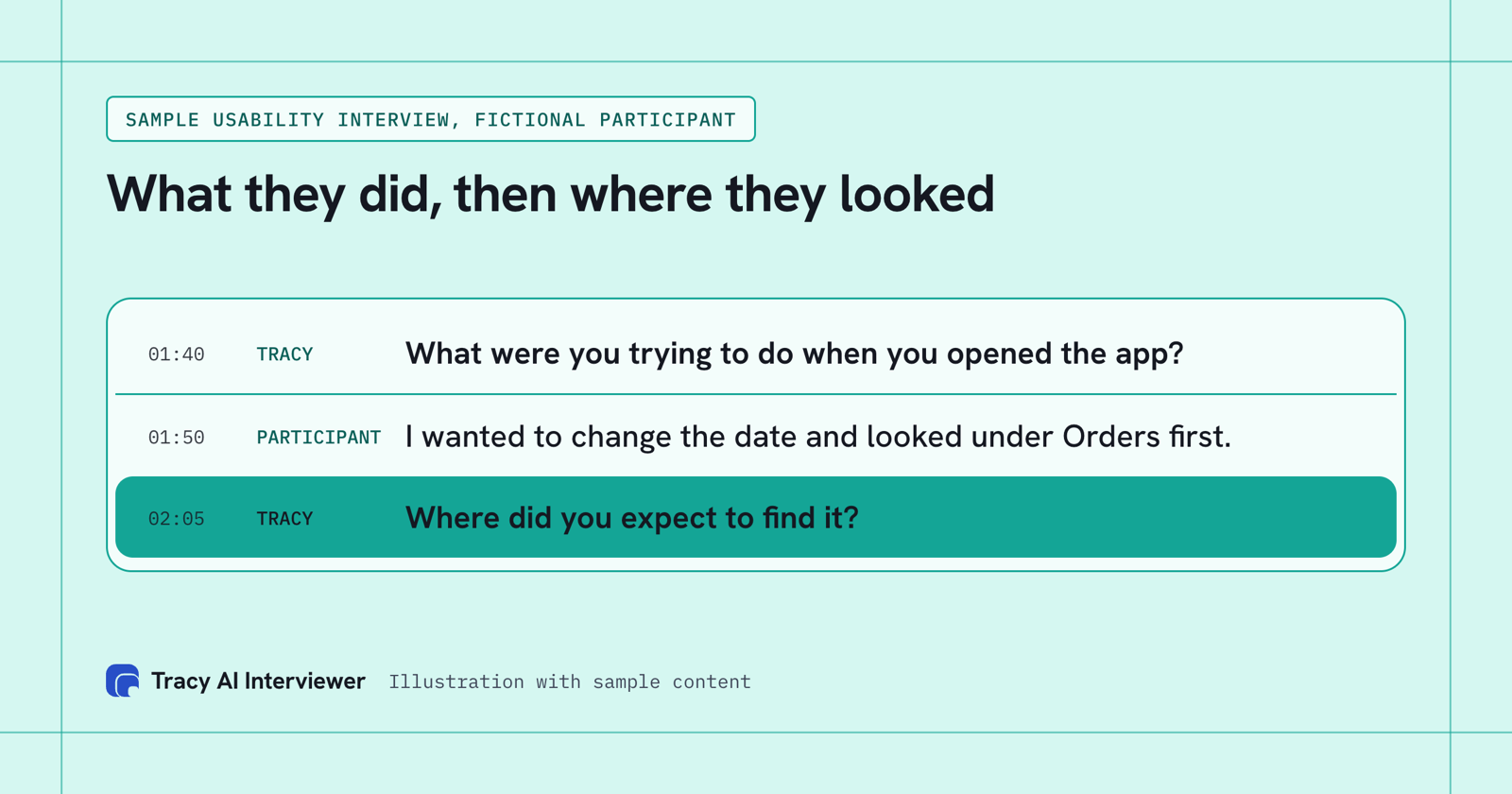
A participant's answer gets a follow-up that shows where they expected the feature.
Which path fits you?
- Writing the guide: user interview questions.
- Running the interviews: how to run customer interviews.
- Learning before you build: customer development interviews.
- Weighing AI participants: synthetic users in research.
- Picking software: customer interview software compared.
Customer research with Tracy covers discovery calls, concept tests and win-loss from the first link to the findings.
Common questions
What is the ROI of user research?
How many companies do user research?
How is AI used in UX research?
What is the hardest part of recruiting research participants?
Which research method do research operations teams support most?
Hear the reason behind every answer
Send one link and Tracy interviews customers when it suits them, linking each finding to their words. First 3 results free.
Try it free (opens in a new tab) Book a demo (opens in a new tab)
Your first 3 results are free. No card needed.
Sources
- User Interviews: The State of User Research 2025 (10 September 2025), retrieved 23 Nov 2026.
- Maze: The Future of User Research 2026, retrieved 23 Nov 2026.