In short
Notta is a low-cost way to turn the calls your team holds into transcripts and summaries: Pro lists $8.17 a month on annual billing. When applicants outnumber your interviewers, Tracy AI Interviewer runs the first round by two-way video, follows up in each person's own field and leaves a recording and a timestamped transcript. A reviewer reads the evidence and decides.
Teams look for Notta alternatives when the job changes from writing down calls to running them. Notta writes down the calls your people hold, so the first round can only grow as fast as your calendar: once applicants outnumber interviewers, each call still needs a person and a slot. The list puts Tracy first because it is the only tool here that runs the interview, then five notetakers in no ranked order.
What Notta does well
Notta transcribes and summarizes the calls your people hold. Pro lists 1,800 minutes a month, and the stack lists Salesforce, HubSpot, Zapier, Slack and Notion. If your people run the calls and you want cheap, reliable transcripts, Notta does that, and an AI interviewer does not replace it.
A transcript records a call someone else ran, so at volume the limit is the number of calls your people can hold. Tracy lets applicants hold their own.
Why do teams look for Notta alternatives?
Hiring is not its stated use. Its pricing page makes no hiring claim; the one mention of interviews is turning them into searchable text.
The free plan is small. Free lists 120 transcription minutes a month and up to 3 minutes per conversation, and Pro lists 1,800 minutes a month with no carryover.
Translation costs extra. Monolingual translation is $6 a month billed annually and bilingual transcription and translation $9.
The stack is built for meetings. Salesforce, HubSpot, Zapier, Slack and Notion are listed, and an applicant tracking system is not named.
What Tracy adds to a notetaker workflow
- Reach every applicant. Each applicant starts on click, at any hour, with no scheduling and no recruiter on the call. Nobody waits for a calendar slot.
- Ask the next question. Tracy follows what the applicant said, in their own field, and waits for the answer. A first claim gets a specific follow-up.
- Keep the evidence. Every result includes a recording, a timestamped transcript and a written assessment per question with its reasoning. A reviewer checks it without sitting in the call.
Why a transcript does not free up the calls
Say 100 applicants each take a 20-minute first round. Run live, that is 2,000 minutes, about 33 hours of interviewer time, and Notta's Pro plan lists 1,800 minutes a month, so the transcripts alone outrun one month. Transcripts shorten the write-up, but the 33 hours of calls remain. Tracy runs the 100 interviews itself and returns a recording and transcript for each. One customer cut its average time to hire from 44 days to 7, and Tracy did the work of 53 full-time recruiters in one month.
Which Notta alternative suits which team?
- Tracy AI Interviewer: roles where the first round must go deep for every applicant, at a published price per result.
- Fireflies.ai: hiring teams that want scorecards and ATS sync on interviews their own people run.
- Otter.ai: teams that want live transcripts and summaries on calls their people hold.
- Granola: an interviewer who wants private notes and no bot on the call.
- Tactiq: an individual who wants a low-cost transcript from the browser, with no bot.
- Metaview: recruiting teams that want interview notes mapped into ATS scorecards.
Tracy AI Interviewer: the first round, run and evidenced
Verdict: the first round, run for every applicant. Tracy interviews by two-way video. After each answer she asks about what was said and waits. You can bring your own questions or describe the role and let Tracy draft them, and a coding task can sit inside the interview for technical roles (see AI technical interviews). Candidates are told on the join screen that the conversation is recorded and transcribed. Integrity signals are shown to a human reviewer, and a person decides.
Best for: technical and volume roles. Each applicant starts on click at any hour with no scheduling, and Tracy connects through API and MCP (ChatGPT, Claude, Mistral, Gemini, Copilot Studio), Slack, WhatsApp, Workable, Breezy HR and Zapier.
Trade-off: Tracy is not a transcription app for calls your team runs; on Enterprise it can also take notes on calls people run. Price: $1 per credit, one credit per started 20 minutes, the first 3 results free, no seats. See Tracy's pricing.
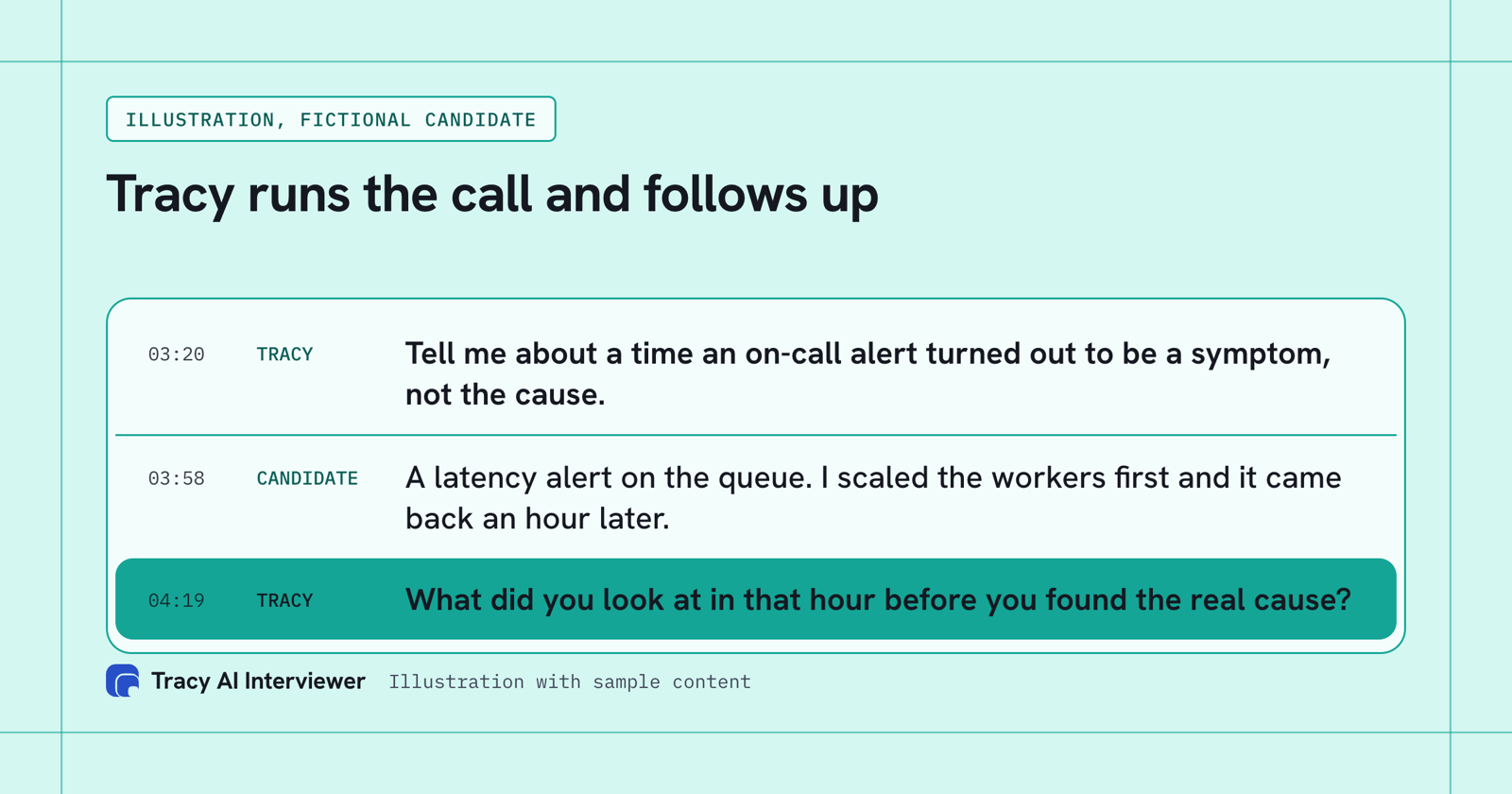
Tracy asks the next question from the candidate's answer, with a recording and transcript behind it.
Fireflies.ai: a notetaker with a recruiting page
Verdict: the notetaker with a recruiting page. Fireflies sends a bot to Zoom, Google Meet, Microsoft Teams and more, and a Chrome extension records without the bot. Its recruiting page lists interview summaries, scorecards, ATS sync and a candidate sentiment analyzer; notes can go to Greenhouse, Lever and others.
Best for: hiring teams that run their own interviews and want scorecards and ATS sync. Trade-off: it records calls people run, an AI that interviews the applicant is not stated on the pages reviewed, and each teammate is a seat. Price: Pro $10 and Business $19 per seat per month billed annually ($18 and $29 monthly); a free plan with limited AI summaries. See Fireflies.ai alternatives.
Otter.ai: live transcripts for calls your people run
Verdict: the live-transcription notetaker. Otter joins Zoom, Microsoft Teams and Google Meet, with live transcription, speaker recognition and summaries with action items.
Best for: teams that want live notes on calls their people hold. Trade-off: the use cases on its navigation are Sales, Education and Media, hiring is not stated on the pricing page, and an ATS is not named. Price: Pro $8.33 and Business $19.99 per user per month on annual billing (Pro is $16.99 on monthly billing); Basic is free with 300 minutes a month. See Otter.ai alternatives.
Granola: private notes with no bot
Verdict: the quiet notepad. Granola takes notes from your computer's audio, with no bot on the call, on macOS, Windows, iOS and Android, and works with Zoom, Google Meet and Teams. Notes are private by default, and audio is deleted after transcription.
Best for: one interviewer who wants a private notepad. Trade-off: interview, hiring and candidate features are not stated on the home or pricing pages read, and Basic keeps 30 days of meeting history. Price: Basic is free; Business is $14 per user per month, billing basis not stated. See Granola alternatives.
Tactiq: a Chrome extension with no bot
Verdict: the low-cost browser transcript. Tactiq runs as a Chrome extension for Google Meet, Zoom and Microsoft Teams, so no bot joins the call. It transcribes live in over 60 languages, writes summaries and action items, and says it does not record or store the audio.
Best for: an individual interviewer who wants a cheap transcript. Trade-off: the use cases named are customer meetings, team meetings and Enterprise, and hiring and ATS features are not stated on the pages reviewed. Price: Free includes 10 transcripts a month; Pro is $8 and Team $16.67 per user per month on annual billing.
Metaview: notes mapped into ATS scorecards
Verdict: the interview-specific notetaker. Metaview captures video, phone and in-person conversations, can take notes without a bot in the call, and maps answers into scorecards in Greenhouse, Ashby, Lever, Workday and more.
Best for: recruiting teams on those systems that keep running interviews themselves. Trade-off: the notetaker records interviews people run, and its Screening agent has no price on its pricing page. Price: Notetaker Free covers 25 calls a month per user, and Pro is $60 per user per month. See Tracy vs Metaview.
Notta alternatives compared on four pillars and price
Source: each vendor's own pages and approved Tracy product records, Nov 2026. Prices are list prices; billing basis is shown per cell.
| Tool | Depth and volume | Stack | Evidence | Price |
|---|---|---|---|---|
| Tracy AI Interviewer | Two-way video follow-ups in the person's field; starts on click, any hour | API, MCP, Slack, WhatsApp, Workable, Zapier | Recording, timestamped transcript, what each person said per question | Per interview, no seats |
| Fireflies.ai | Notes, scorecards and sentiment analyzer on recorded calls; bot or Chrome extension | Greenhouse, Lever, CRMs, Slack, MCP | Transcript in 100+ languages, summaries | Pro $10, Business $19 per seat, annual |
| Otter.ai | Notes and summaries of calls your team runs; joins Zoom, Teams and Meet | Salesforce, HubSpot, Zapier, MCP; ATS not named | Live transcript, speaker recognition, summaries | Pro $8.33, Business $19.99 per user, annual |
| Granola | Private notes on calls you run, no bot; hiring features not stated | Attio, Notion, HubSpot, Affinity, Zapier, MCP, API | Transcript and notes; audio deleted after transcription | Free; Business $14 per user (billing basis not stated) |
| Tactiq | Live transcript and summaries in a Chrome extension; hiring not stated | Slack, Notion, Linear, HubSpot; ATS not stated | Transcript in 60+ languages; audio not stored | Free; Pro $8 per user, annual |
| Metaview | Notetaker on human interviews, can work without a bot; Screening is a separate agent | Greenhouse, Ashby, Lever, Workday and more | Notes mapped into ATS scorecards | Pro $60 per user monthly; Screening price not stated |
Scroll the table sideways to see all 5 columns.
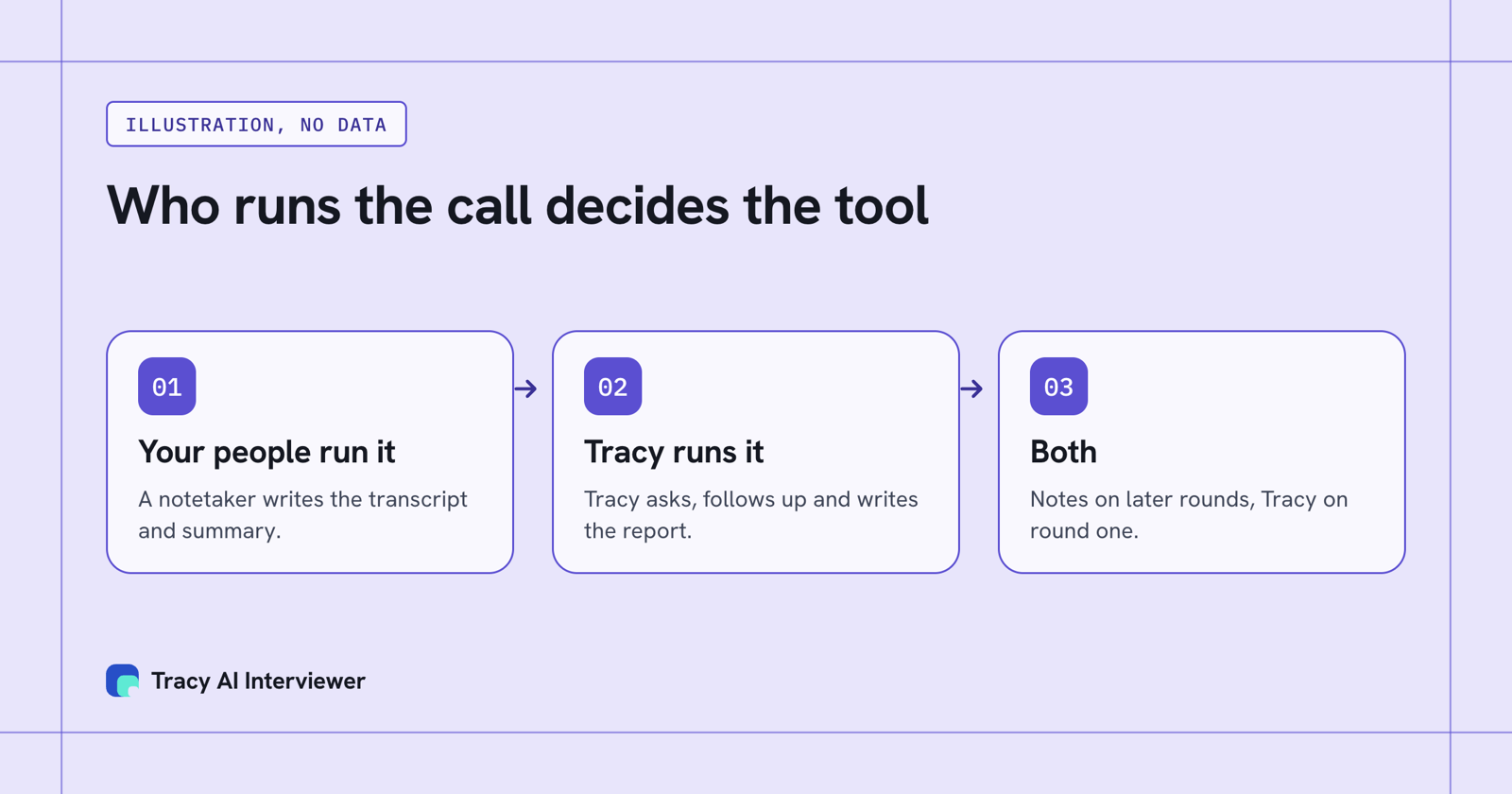
One question sorts the shortlist: do your people run the call, or does Tracy?
How do you choose a Notta alternative?
Start with who asks the questions. If your people run the calls and you want transcripts, stay with Notta or look at Fireflies.ai, Otter.ai, Granola, Tactiq or Metaview. If you want the first round run for every applicant, shortlist Tracy. You can also use both: keep a notetaker for later rounds and let Tracy run round one. See Tracy vs Notta for the side-by-side and Notta pricing for every plan and add-on.
Then compare the cost model. Seats scale with interviewers. Tracy's credits scale with interviews: 50 interviews of up to 20 minutes cost $50, 200 cost $200 and 1,000 cost $1,000, and a session with no answers is never charged. Set Tracy against the recruiter hours a first round takes.
Finally, run one real role and read the second question the AI asks. What each interview report shows a reviewer says what to look for, and the best AI interview software covers the wider list.
Which path fits you?
- Technical hiring: technical interviews covers role-specific interviews with follow-ups.
- High-volume hiring: volume hiring covers applicant waves.
- Other notetakers: Read AI alternatives covers the next option.
- Integrations: Connect lists what Tracy connects to.
Common questions
What is the best Notta alternative for interviews?
Is there a free Notta alternative?
Is Tracy a notetaker like Notta?
Which Notta alternative works without a bot?
Run your first round with Tracy
Create one interview for your first round, then read the recording and report. The first 3 results are free, with no card.
Book a demo (opens in a new tab) Try it free (opens in a new tab)
Your first 3 results are free. No card needed.
Sources
- Notta, Pricing, retrieved 14 Nov 2026.
- Tracy AI Interviewer, Pricing, retrieved 14 Nov 2026.
- Tracy AI Interviewer, Connect, retrieved 14 Nov 2026.