In short
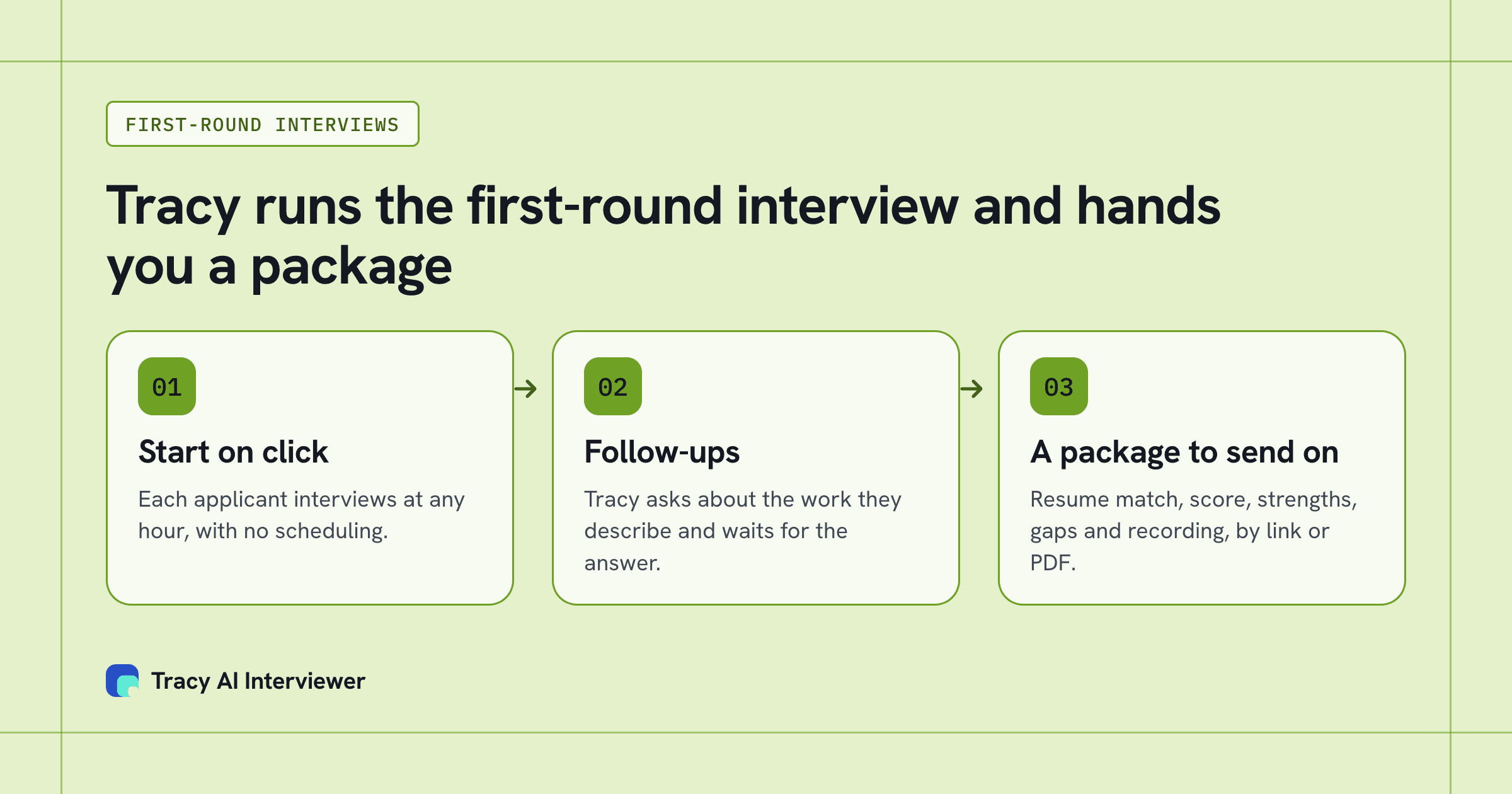
Tracy AI Interviewer runs the first round for every applicant: two-way video, follow-ups in the person's own field, started on click at any hour. A person decides from her recording, transcript and assessment per question.
Pricing is $1 per credit with the first 3 results free and no seats.
Choose Metaview when recruiters keep running the interview and you want notes that fill Greenhouse, Ashby, Lever or Workday scorecards.
Next: test both on one role.
The choice in Tracy vs Metaview is between running the first round and taking notes on it. Metaview's notetaker joins interviews that people run, writes the notes and fills the scorecard. Tracy AI Interviewer runs the interview itself and writes the report. Metaview also sells an AI Screening agent, so the line is thinner than the headline suggests. Metaview is the stronger choice for teams that keep humans on the call.
What does Metaview do well?
Metaview wins when your interviews are people talking to people. The notetaker supports Google Meet, Microsoft Teams, Webex and Zoom, joins scheduled interviews from your calendar, handles phone interviews, and can take notes without a bot in the call. It maps answers into scorecards on Greenhouse, Ashby, Lever, Workday and more, and Metaview says interviewers turn feedback around 48 hours faster. Coding and system design interviews are captured with what was shared on screen.
It goes past notes: agents for sourcing, application review, screening and reports, plus reporting on question coverage and talk-time. It lists SOC 2 Type II and GDPR, says most teams are up the same day, and has a free Notetaker plan. For a team that runs its own interviews it is the stronger tool, because Tracy does not join your calls, and ATS write-back is not stated on her Connect page.
Does Metaview run the first round too?
Metaview's Screening agent talks to candidates by voice, asks follow-ups, can show code for the candidate to explain aloud, scores the call against your rubric, and syncs the human decision to your ATS. Its page does not describe a video interview and lists no price.
Tracy runs a two-way video interview. After each answer she asks about what was said, in the person's own field, and waits for the person to finish. For technical roles a coding task sits inside the same interview with follow-ups on approach and trade-offs. See AI technical interviews for how that works.
Tracy vs Metaview: buyer criteria side by side
Source: Tracy approved product records; Metaview pages, 9 Nov 2026. "Not stated" and "Not verified" mean the page does not say, not that the feature is absent.
| Criterion | Tracy AI Interviewer | Metaview | Who leads |
|---|---|---|---|
| Interview depth | Two-way video, follow-ups in the person's own field, a coding task inside the interview. Questions from your brief or your own list. | Notetaker records interviews people run. Screening is a voice agent with follow-ups, a rubric and code read aloud. | Even on the pages. Run both on one role. |
| Who runs the call | Tracy runs it, with no recruiter present. | Your people run it and Metaview takes notes; or the Screening agent runs it. | Metaview if your team keeps the call; Tracy if it should not. |
| Volume | Starts on click at any hour, no scheduling. | Screening starts when the candidate chooses; strongest where 50+ candidates apply per opening. | Level on start. Metaview states Screening works best from 50+ applicants per opening. |
| Stack | API and MCP (ChatGPT, Claude, Mistral, Gemini, Copilot Studio), Slack, WhatsApp, Workable, Breezy HR and Zapier. ATS write-back is not stated on Tracy's Connect page. | Ashby, Greenhouse, Lever, Workday, iCIMS, SmartRecruiters and more; notes and scorecards post to the candidate record. | Metaview on ATS depth. Tracy on API and chat tools. |
| Evidence | Recording of both sides, timestamped transcript, assessment per question with reasoning, integrity signals shown to a person. | Recorded, transcribed, scored on a rubric; High, Medium or Low risk score with an explanation; audit trail of AI reasoning. | Even. |
| Implementation | Setup customised to your workflow in days. | Most teams are up and running the same day. | Metaview on stated speed. |
| Accessibility | Not stated. | Not stated on the pages read. | Neither. |
| Multilingual | A spoken-language check scores fluency, coherence, grammar, pronunciation and vocabulary. | Screening lists most major languages. | Metaview on its published list. |
| Security | SOC 2 Type II attested. | SOC 2 Type II, GDPR, CCPA, LGPD, PIPEDA. | Metaview on the regimes listed. |
| Validation and bias | Tracy publishes no bias audit. A person decides from the evidence report. | Not verified. A human makes the final decision. | Not verified. |
| Reporting | A report with resume match, score, strengths and gaps, recording and fit rationale, shared by link or PDF. | Reports on question coverage, interview adherence and talk-time. | Metaview across many interviews. |
| Contract and first-year cost | $1 per credit, first 3 results free, no seats, no upfront cost. | Notetaker free, then $60 per user per month. Screening and platform by quote. | Tracy on a price you can compute. |
| Support | Enterprise adds a dedicated customer manager and support channel. | Forward Deployed Talent Engineers; dedicated CSM on Enterprise. | Even. |
Scroll the table sideways to see all 4 columns.
How the published workflows differ for the same technical role
Take one invented role, a site reliability engineer on a payments team. The table sets Metaview's published description of its notetaker beside an illustration of how a Tracy interview would run. The candidate is fictional, and the Tracy column is an illustration, not a recording of a real interview.
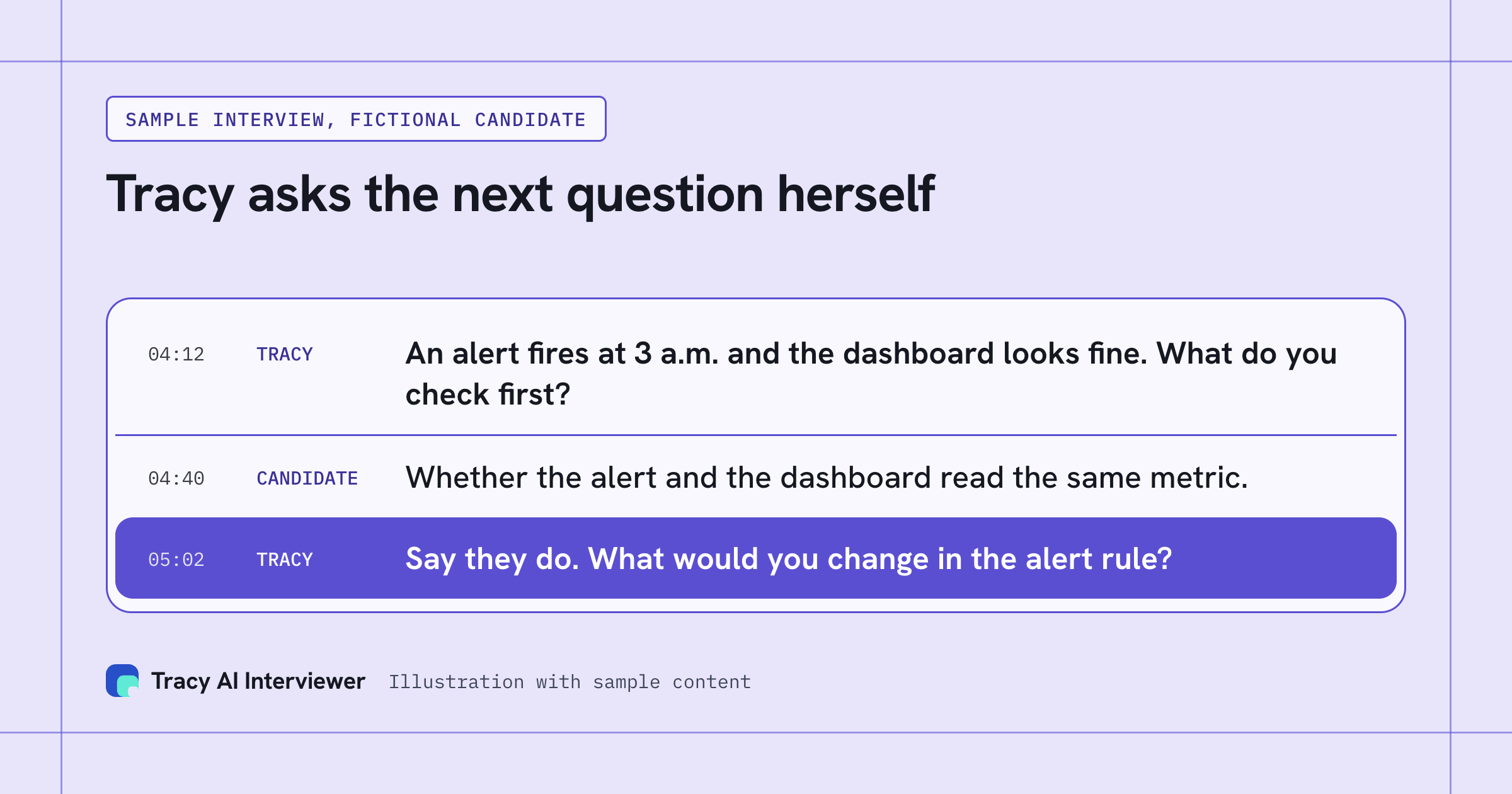
Tracy asks the next question herself, from what the candidate just said.
The same role, step by step
Metaview column: published descriptions. Tracy column: illustration of the product workflow.
| Step | Metaview notetaker (from its pages) | Tracy (illustration) |
|---|---|---|
| Setup | Connect your calendar and ATS; the notetaker joins scheduled interviews. Notes follow your templates and scorecards. | You describe the role and Tracy drafts the questions. You edit them or bring your own. |
| Who is on the call | An interviewer from your team. The notetaker joins, with or without a bot. | Tracy and the applicant. No recruiter is present. |
| Questions | The interviewer chooses them; Metaview tracks question coverage against the template. | Questions drafted from the role or your own list, which you can edit. |
| Follow-up | The human interviewer asks it. | Tracy asks about what was said and waits for the answer. |
| Output | Notes, a filled scorecard and optional video snippets in your ATS. | Recording, timestamped transcript, assessment per question and integrity signals in one report. |
| Decision | The interviewer and hiring team. | A person, from the report. A recruiter decides: they can move the person forward or invite them again. |
Do follow-ups matter if the notes are good?
A notetaker's depth is the interviewer's depth. If your recruiters know the field, that is fine, and Metaview makes their calls easier to review. When they screen a role they do not know, or applicants outnumber the calls people can make, the depth has to come from the follow-up: the second question comes from the first answer, in the person's own field. A Director at a top-tier early-stage VC said Tracy "sometimes brings up exactly those questions I might have forgotten to ask, which has been a pleasant surprise." Metaview's Screening agent also asks follow-ups, so ask both vendors for a live run on your role and read the second question.
Can a reviewer check a Metaview or a Tracy result?
Both can leave a reviewer something to check, in different ways. Metaview records and transcribes Screening calls, scores them against your rubric and keeps an audit trail of the AI's reasoning. Tracy leaves the recording of both sides, a timestamped transcript and an assessment per question with its reasoning, so a reviewer can open the moment behind a result. See AI interview reports.
Integrity works differently. Metaview gives a High, Medium or Low risk score with an explanation. Tracy captures tab changes, gaze, live face detection, delays before answers, fullscreen exits and external screens, and shows the evidence to a person. These are signals for a human reviewer to interpret, not proof, and nothing is decided in the interview. Candidates are told on the join screen that the conversation is recorded and transcribed. See AI interview cheating detection.
Does Tracy hold up at volume?
One customer cut its average time to hire from 44 days to 7, and Tracy did the work of 53 full-time recruiters in one month. Metaview says Screening has the strongest impact where 50+ candidates apply per opening, which is the same situation.
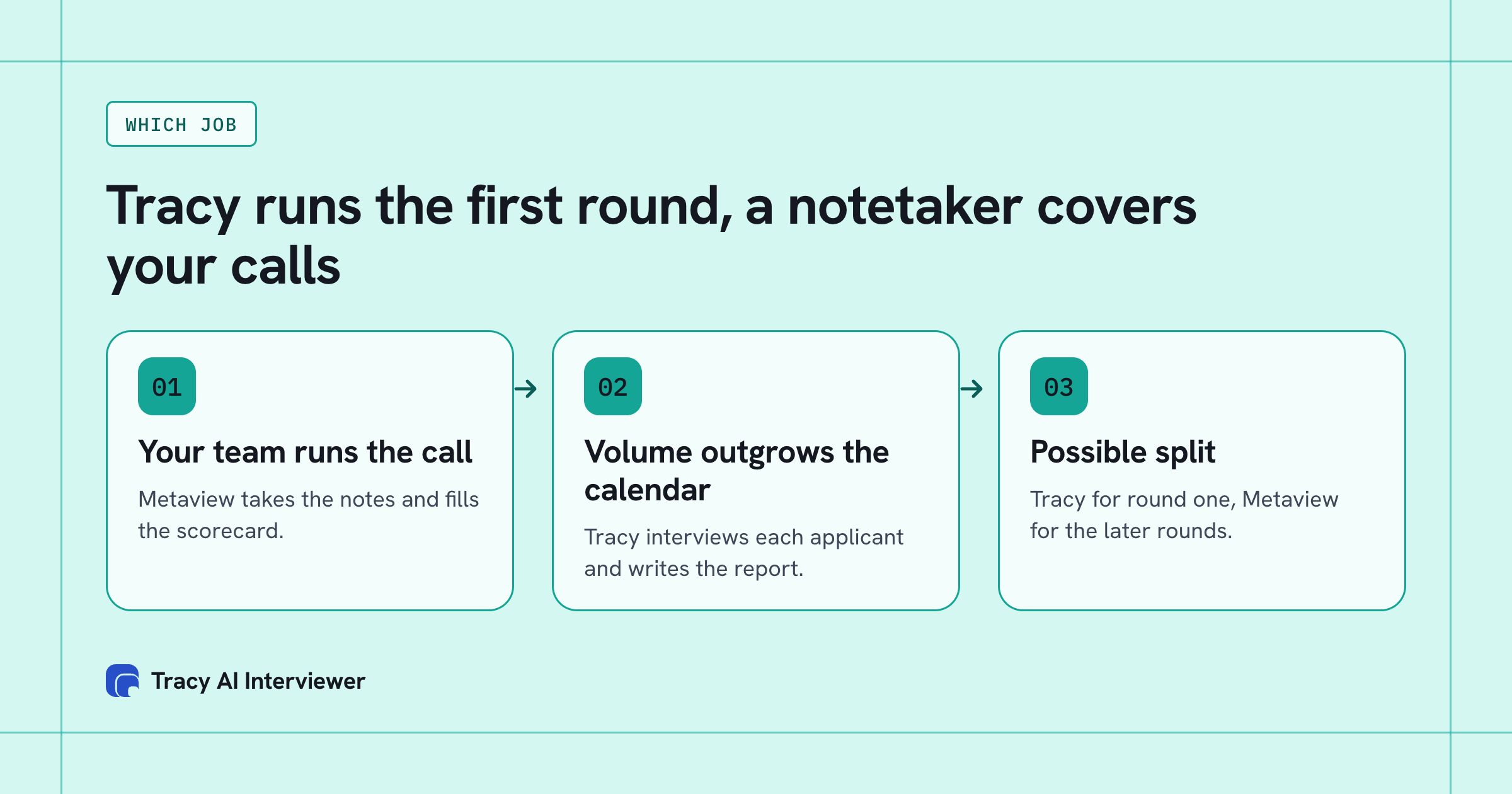
Metaview takes notes on your calls and Tracy runs the first round; you can use both.
What do Metaview and Tracy cost?
Metaview prices per seat and per agent: Notetaker is free for 25 calls a month and $60 per user per month; Screening is not priced on its pages.
Tracy's price is published, and it prices a different unit. A credit costs $1 and covers each started 20 minutes of an interview that produced a result. The first 3 results are free with no card and there are no seats. 100 interviews of up to 20 minutes cost $100. Enterprise is priced to your volume and adds a dedicated customer manager, a dedicated support channel and a setup customised to your workflow in days. See Tracy's pricing.
How do you test both before you commit?
Run one role, one team and two weeks. For the mechanics first, read how AI interviews work.
- Pick one technical role with at least 20 expected applicants.
- In Metaview, connect the notetaker to your next interviews, and ask for a live run of Screening on that role plus a written quote for it.
- In Tracy, describe the role and edit the drafted questions, or send us the role and we build the plan. The first 3 results are free, so start with three internal volunteers.
- Have one reviewer read the output of your next 20 applicants in each. Count the follow-ups that landed, the applicants who finished and the cost per interview.
Which path fits you?
- Technical hiring: technical interviews covers role-specific interviews with follow-ups.
- High-volume hiring: volume hiring covers applicant waves.
- Recruiting teams: people teams covers screening for HR-led teams.
- Integrations: Connect lists the integrations.
Common questions
What is Metaview?
Is Metaview an AI notetaker or an AI interviewer?
Can I use Metaview and Tracy together?
Which is cheaper, Metaview or Tracy?
See Tracy on one of your roles
Book a demo to watch Tracy interview for one of your roles, or try it free with your first 3 results on us.
Book a demo (opens in a new tab) Try it free (opens in a new tab)
Your first 3 results are free. No card needed.
Sources
- Metaview, Interview notes, retrieved 9 Nov 2026.
- Tracy AI Interviewer, Pricing, retrieved 9 Nov 2026.
- Tracy AI Interviewer, Connect, retrieved 9 Nov 2026.