In short
AI phone screening software lets an AI hold the first screening conversation, so recruiters stop spending the day on calls. Tracy AI Interviewer swaps the call for a video interview opened from a link: each applicant starts on click, and the consultant gets the recording, a transcript and what the person said to each question.
The result goes to the client as a link, from a product with 100K+ interviews completed.
If the screen must be a phone call, Alex, Ribbon and Fabric list phone screening, while Tracy runs from a browser link, on video by default or audio-only on request.
Run one role in Tracy and compare it with your last phone screen.
What is AI phone screening?
AI phone screening is a first screening conversation held by an AI instead of a recruiter, usually to check availability, experience and fit before a person spends time. How an AI phone screen works covers the method and the evidence. This page compares the tools, and it keeps Tracy in the list as the option that replaces the call with a link.
How much does AI phone screening cost?
Where prices are published, you pay by the minute or by the interview. Fabric spends 3 credits a minute on phone screening, so a 10-minute screen is 30 credits. Tracy charges one credit, $1, per started 20 minutes, so a 10-minute screen is one credit. Alex, Tenzo and Ribbon publish no price on the pages read.
At 50 ten-minute screens a month that is $50 on Tracy and about $199 on Fabric's Starter plan, which covers 2,000 credits, or 66 screens. At 200 screens, Fabric needs its Scale plan at $499 for 10,000 credits, and Tracy costs $200. At 300 screens, Scale still covers it at 9,000 credits, and Tracy costs $300. At 500 screens Fabric's 15,000 credits pass Scale, which means a custom Enterprise quote. Tracy bills per result with no monthly fee, while Fabric bills a plan each month every month.
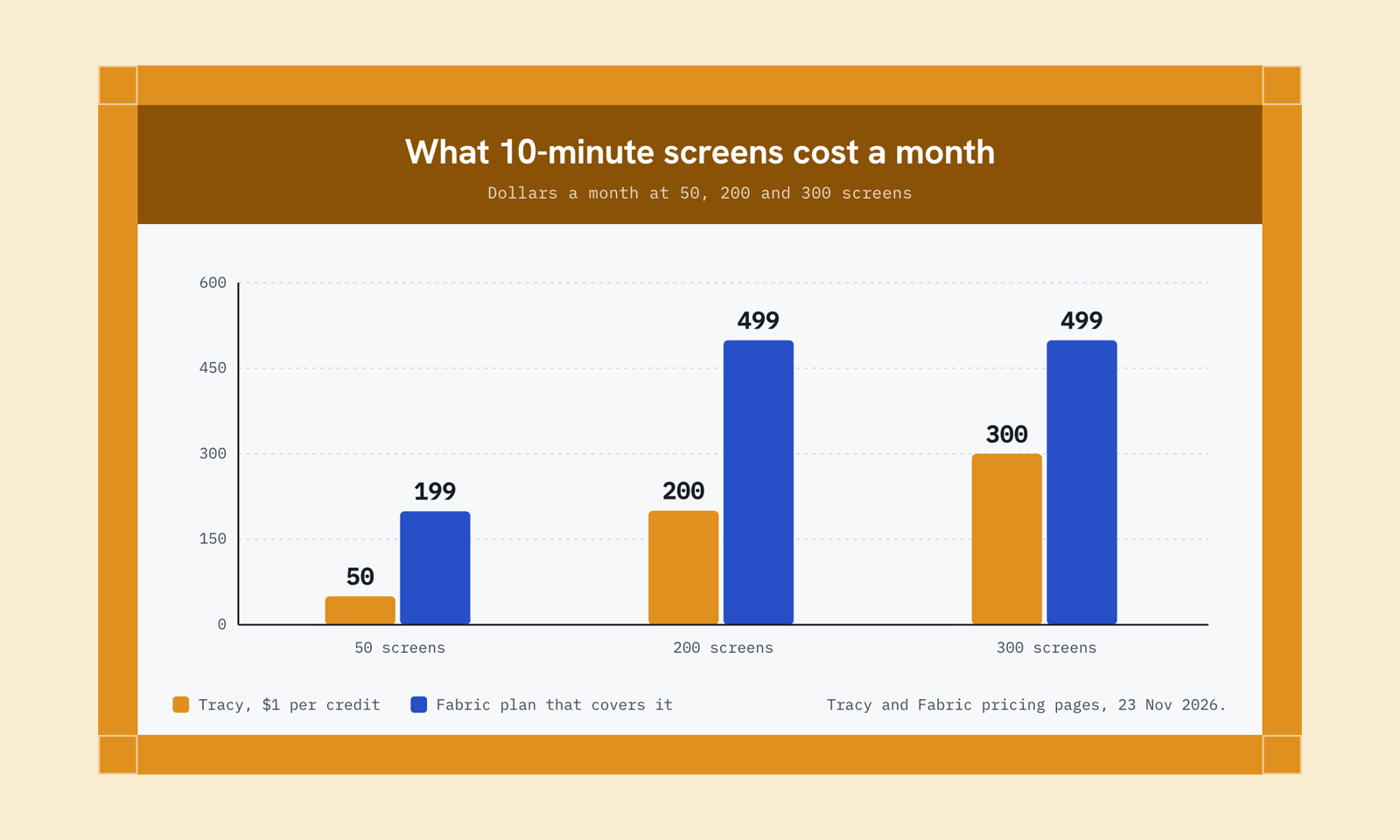
At these three volumes Tracy costs less than the Fabric plan that covers the screens.
What should you look for in AI phone screening software?
Start with whether the screen has to be a call, because applicants who can only take a phone call need a tool that dials them. Next, see what the agent does with a thin answer, and what the consultant receives for the client, a recording and transcript they can check or only a rating. The price unit should fit your volume. Candidates should also be told they are talking to an AI and that the call is recorded; Tracy's join screen says the conversation is recorded and transcribed.
How do the five rank, and why in this order?
Tools priced on their own pages come first, with Tracy ahead of Fabric because a 10-minute screen costs less at every volume above. The tools without a published price follow, ordered by the number of channels their pages name for the conversation.
- Tracy: a video interview opened from a link, with follow-ups in the person's own field.
- Fabric: phone screening and AI interviews on one credit pool, priced on its page.
- Alex: phone, video, SMS and WhatsApp, behind a demo form.
- Tenzo: voice, video or text, with a quote for the price.
- Ribbon: any phone or the browser, with a 7-day free trial and no figure.
What each vendor's own pages state, read 9 to 23 November 2026. Fabric's phone screening uses the same credits as its interviews.
| Tool | How the screen runs | Follow-ups | Price on its page |
|---|---|---|---|
| Tracy | Video interview from a link | In the person's own field | Per result |
| Fabric | Phone screening, 3 credits a minute | Role-specific, in its AI interview | Free plan; from $199 a month |
| Alex | Phone, video, SMS, WhatsApp | Detail not given | Demo form |
| Tenzo | Voice, video or text | Not stated | Annual quote by volume |
| Ribbon | Any phone, or the browser | Adapts in real time | 7-day free trial; no figure |
Scroll the table sideways to see all 4 columns.
Which tool fits which staffing team?
Tracy
Tracy takes the call out of the first screen. Each applicant opens a link and talks with Tracy on video, at any hour, and Tracy asks for the missing detail on a thin answer. The consultant gets the recording, a timestamped transcript and what the person said to each question, and sends the client a link to the result. Best for: agencies whose bottleneck is booking and holding the first call. Trade-off: applicants join from a browser link, not a phone line; the interview is on video by default, and audio-only can be set up on request. Price: per result, as the table and chart show.
Fabric
Fabric's credits cover phone screening at 3 a minute, resume screening, sourcing and outreach as well as its AI interview, which carries follow-ups and live tasks. Each report holds the recording, transcript and feedback, and the team decides. Best for: staffing and IT services teams that want screening steps on one credit pool. Trade-off: the credits sit inside monthly plans, and ATS and CRM integration is listed on Scale and Enterprise. Price: free plan with 200 credits, then $199 to $499 a month.
Alex
Alex acts as an always-on first-round interviewer and can call thousands of candidates by phone, as well as use video, SMS and WhatsApp, in 30 languages. It lists 33+ ATS integrations and flags moments worth a second look. Best for: teams that want outbound calling at volume. Trade-off: how its follow-ups work is not detailed, and pricing starts at a demo form. Price: not stated on its page.
Tenzo
Tenzo's interview agent runs structured interviews by voice, video or text, and its scheduling agent calls, texts and emails candidates. It writes every candidate, note and status back to the ATS, and a recruiter can override any outcome. Best for: high-volume recruiters who want screening and scheduling together. Trade-off: price is an annual quote by volume. Price: on request, after a free one-week trial on one or two roles.
Ribbon
Ribbon runs interviews on any phone or in the browser, in 10 languages, and says its conversations adapt in real time. It ranks each interview and says the hiring decision stays with the recruiter. Best for: frontline roles in warehouse, retail, hospitality and healthcare. Trade-off: its page gives no price figure. Price: a 7-day free trial.
What does the consultant read after a link screen?
In a sample agency screen with invented data, the sheet carries the fields a consultant needs to submit someone: open to operations coordinator or office manager roles, with the evidence at Q1, 01:40, and a commute limit of 40 minutes at 01:45. The follow-up that produced them asked whether the person would take a short contract. Each field points to the moment in the recording, so the consultant can check it before it reaches the client.
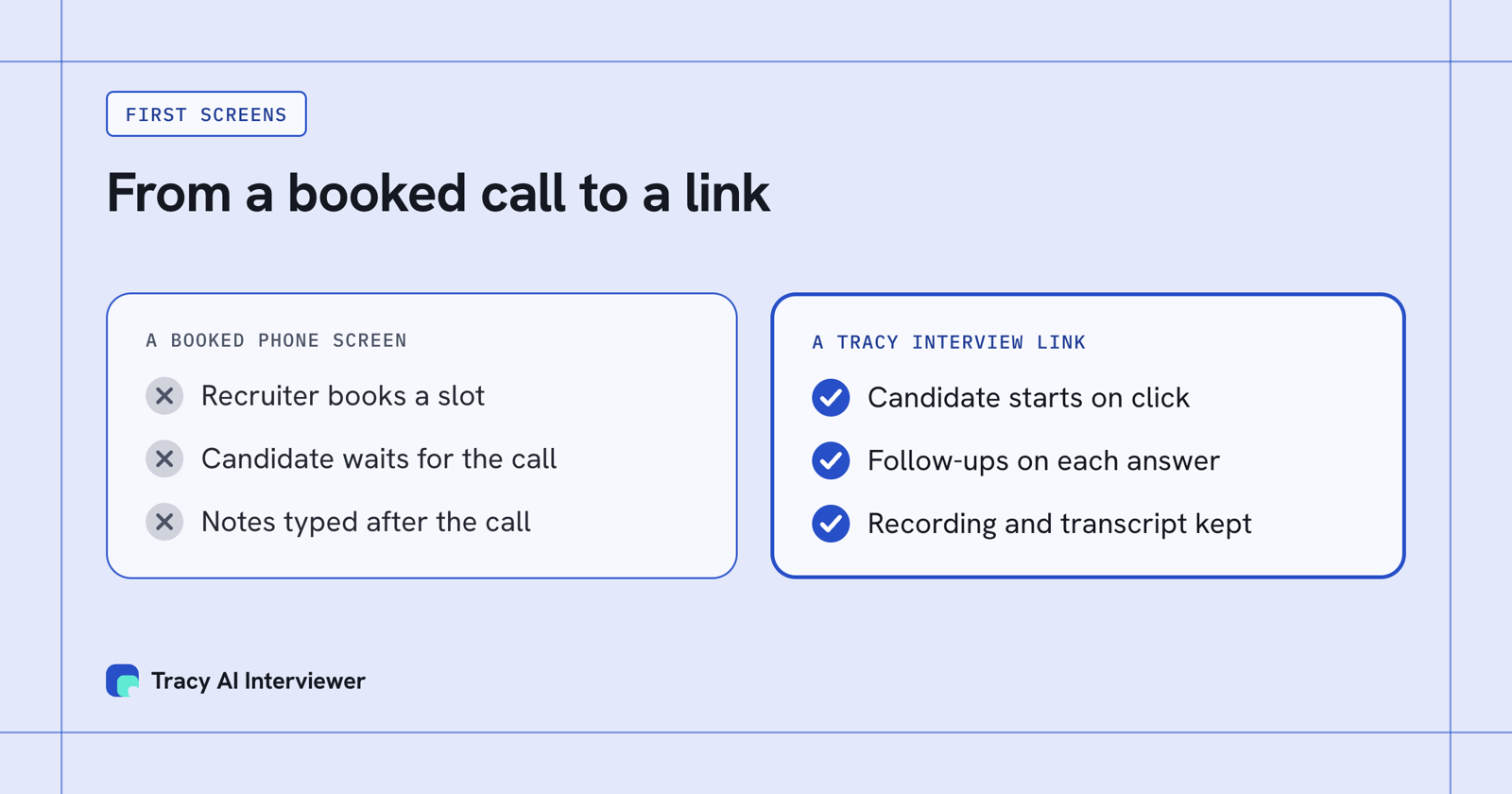
A link removes the booking and the waiting, and leaves a recording and transcript behind.
Which path fits you?
- Wanting the plain method first: what a phone screen is and how to run one.
- Weighing voice agents more widely: voice AI recruiters compared.
- Running an agency: AI interview tools for RPO and staffing.
- Comparing the two priced options head to head: Tracy and Fabric side by side.
Common questions
What is AI phone screening?
Best AI phone screening tools?
How much does AI phone screening cost?
Can a recruiter still decide who moves on?
Screen one role without a single call
Send the link, read what each person said, and forward the report to your client. The first 3 results are free.
Book a demo (opens in a new tab) Try it free (opens in a new tab)
Your first 3 results are free. No card needed.
Sources
- Tracy AI Interviewer: Pricing, retrieved 23 Nov 2026.
- Tracy AI Interviewer: Connect, retrieved 11 Nov 2026.
- Fabric: Pricing, retrieved 23 Nov 2026.