In short
A voice AI recruiter talks with each applicant out loud and asks the next question from the answer. Tracy AI Interviewer does this on video from one link, so every applicant starts at any hour and your consultant gets the recording, a transcript and what each person said to each question.
That report goes to a client or hiring manager as a link. One customer cut its average time to hire from 44 days to 7, and Tracy did the work of 53 full-time recruiters in one month.
Ribbon, Alex and Tenzo fit better when applicants should reach the agent by an ordinary phone call, and Synthflow when you want to build the voice agent yourself.
Send one role to Tracy and read what comes back.
What is a voice AI recruiter?
A voice AI recruiter is an agent that holds a spoken first interview with each applicant and gives a recruiter a record of it. It replaces the first call or the typed form, and it should hand over more than a rating. Tracy gets there in the browser: the applicant talks with Tracy on video by default, or by voice alone when you ask for audio-only. What an AI recruiter is in the wider sense covers more steps than the interview.
Does AI beat humans at recruiting?
In one field test it did on three outcomes, with people still deciding. Jabarian and Henkel, in a working paper from August 2025, randomised 70,884 applications for entry-level customer service jobs in the Philippines to a human recruiter or an AI voice agent. AI-led interviews produced 12% more job offers, 18% more job starts and 17% more 30-day retention among all applicants. That tested a voice agent, not Tracy, in one country and one job family, so it shows a voice first round can work, without promising the same for your roles.
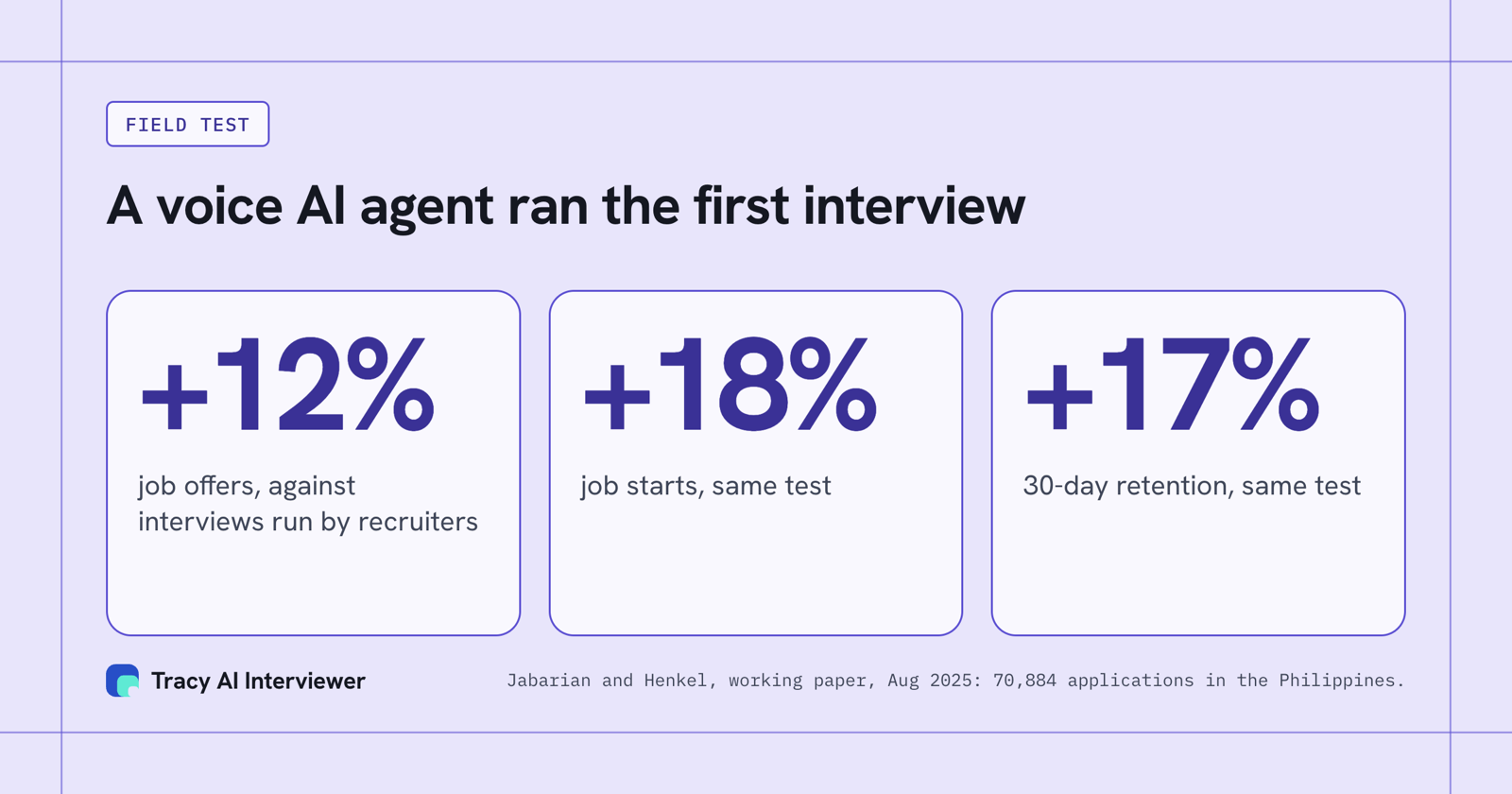
In one randomised field test, AI-led interviews beat recruiter-led ones on offers, starts and retention.
How do you design a voice AI recruiter?
The design comes down to six choices. The questions come from the job brief, and the recruiter can edit them. The agent opens by saying who is speaking and that the conversation is recorded, and it lets the applicant finish a thought before it speaks. Where an answer is thin it follows up once. The consultant receives a record to send on, with the recording, a transcript and the fields, and a person makes the decision, with a way for the applicant to ask for one.
You can assemble this on a voice platform or buy it ready. Synthflow is a platform for phone agents that answers and makes calls for contact centers and BPOs; its pages list no hiring use case, and every new deployment starts on an annual enterprise agreement. That route means you build the interview, the follow-ups and the report yourself.
How do the six rank, and why in this order?
Tools whose pages say the questions adapt to the answer come first, and a published price breaks ties among them. Tools that do not say it follow, ordered by the number of channels their pages name, and the build-it-yourself platform comes last.
- Tracy: spoken video interviews with follow-ups in the person's own field, priced on its page.
- Interviewer.AI: voice avatar interviews with adaptive follow-ups on Professional, priced on its page.
- Ribbon: interviews by browser or any phone with conversations that adapt in real time, with no figure on its page.
- Alex: phone, video, SMS and WhatsApp, with follow-ups not detailed.
- Tenzo: voice, video or text, with a quote for the price.
- Synthflow: a phone voice platform you build on.
What each vendor's own pages state, read 9 to 23 November 2026. Interviewer.AI's 70 interviews are 2 credits each.
| Tool | Spoken channel | Questions adapt | Price on its page |
|---|---|---|---|
| Tracy | Spoken, on video, from a link | Follow-ups in the person's field | $1 per credit |
| Interviewer.AI | Voice avatar; video avatar on Advanced | Adaptive, on Professional | $399 a month for 70 interviews |
| Ribbon | Browser or any phone; 10 languages | Adapts in real time | 7-day free trial; no figure |
| Alex | Phone, video, SMS, WhatsApp; 30 languages | Detail not given | Demo form |
| Tenzo | Voice, video or text; 40+ languages | Not stated | Annual quote by volume |
| Synthflow | Phone calls you design | You build them | Annual enterprise agreement |
Scroll the table sideways to see all 4 columns.
Which tool fits which staffing team?
Tracy
Tracy suits a consultant who needs to put an in-depth candidate record in front of a client the same day. Each applicant opens a link, talks with Tracy on video and gets follow-ups in their field; the consultant receives the recording, a timestamped transcript and what the person said to each question, as a report the client opens by link. Best for: staffing and RPO teams sending candidates on with evidence. Trade-off: applicants join from a browser link, not a phone line; the interview is on video by default, and audio-only can be set up on request. Price: per result, as the table shows.
Interviewer.AI
Interviewer.AI's Professional plan runs conversational avatar interviews by voice with adaptive follow-up questions, and Advanced moves to video. Best for: a team that wants a fixed monthly bill and an avatar. Trade-off: credits are bundled monthly at 2 per AI interview, with top-up packs from $150 for 50. Price: $399 a month for 70 interviews, $599 for 100 on Advanced.
Ribbon
Ribbon screens and interviews for warehouse, retail, hospitality and healthcare roles. Applicants join in the browser or on any phone, in 10 languages, and the conversation adapts in real time. It scores and ranks each interview, says the final decision stays with the recruiter, flags off-screen activity and syncs with 60+ ATS. Best for: frontline roles where applicants have a phone and no laptop. Trade-off: no price figure on its page, and the Trust Center and FAQ word its SOC 2 status differently. Price: a 7-day free trial.
Alex
Alex acts as an always-on first-round interviewer and can call thousands of candidates by phone, video, SMS or WhatsApp, in 30 languages. Its page lists 33+ ATS integrations. Best for: high-volume teams that want outbound reach. Trade-off: how its follow-ups work is not detailed, and pricing starts at a demo form. Price: not stated on its page.
Tenzo
Tenzo's interview agent runs structured interviews by voice, video or text, and its scheduling agent calls, texts and emails candidates, in 40+ languages. A candidate can reach a person with one tap, and a recruiter can override any outcome. Best for: high-volume recruiters who want interviews and scheduling in one agent. Trade-off: price is an annual quote by volume. Price: on request, with a free one-week trial on one or two roles.
Synthflow
Synthflow makes voice agents for customer calls, with 200+ integrations and tested links to phone systems such as Five9, Twilio and Zoom. Best for: a team with engineers that wants to own the whole voice stack. Trade-off: hiring is not among its listed use cases, and you build the questions, follow-ups and report. Price: an annual enterprise agreement scoped to call volume.
What does a consultant send to the client?
In this sample from a sales development screen, the candidate describes a ten-minute research routine and Tracy asks for a real opening line. The consultant sends the client a link to the result: the answer, the follow-up and the fields, each with its time. The client reads a routine in the candidate's own words instead of a summary written afterwards. AI interview tools for RPO covers that handoff in more depth.
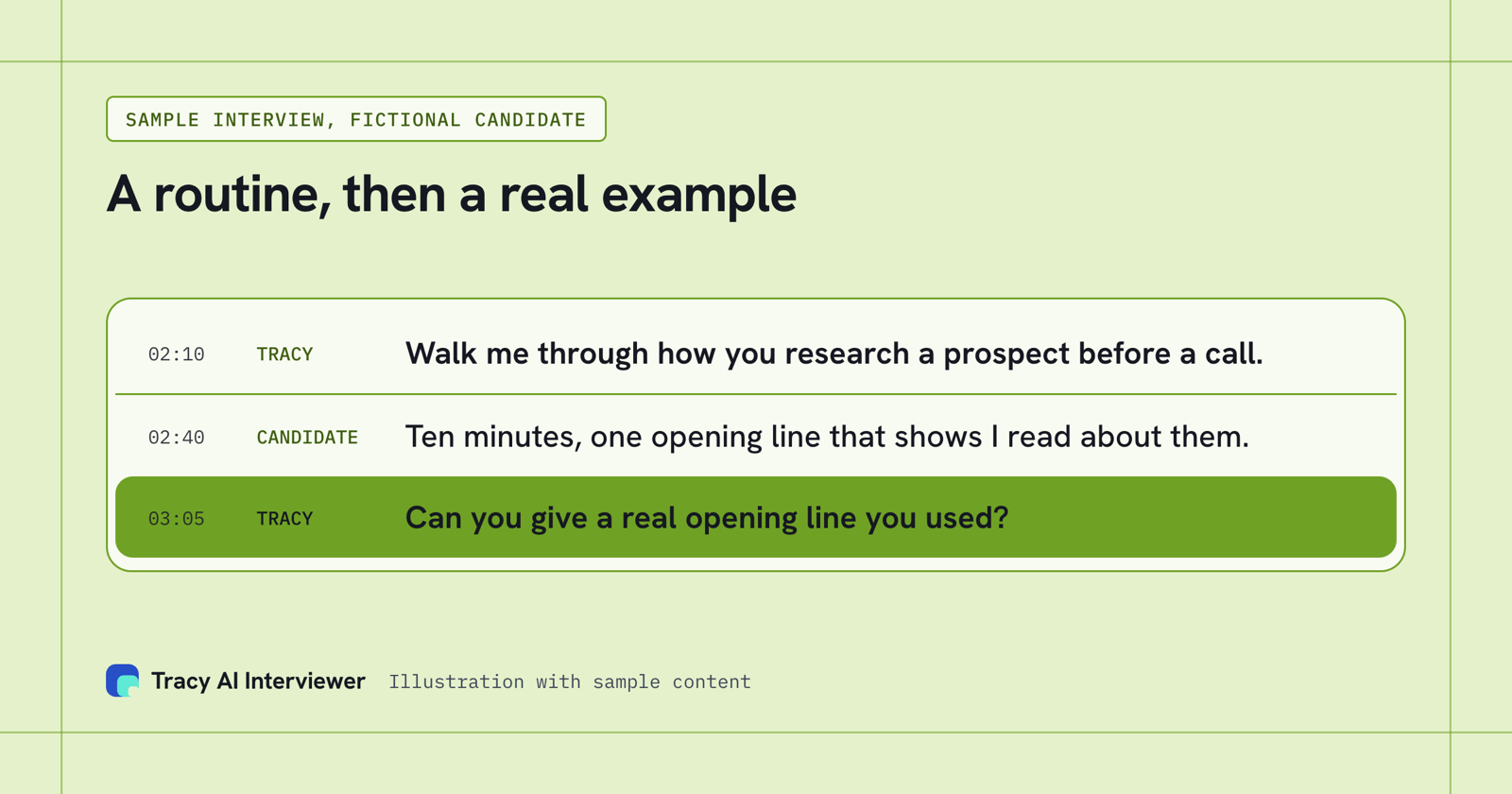
Tracy asks for a real example after a routine, and every line carries a time.
Which path fits you?
- Running an agency: the best recruiting software for staffing agencies.
- Speeding up submissions: how staffing firms shorten time to submit.
- Deciding between a built voice agent and a ready one: Tracy against Synthflow.
- Checking what a quote costs: what Tenzo's pricing looks like.
- Replacing the first call itself: AI phone screening for recruiting.
Common questions
What is a voice AI recruiter?
Does AI beat humans at recruiting?
How to design a voice AI recruiter?
How much does a voice AI recruiter cost?
Know every candidate in depth tonight
Each applicant starts on click, and the report goes to your client as a link. The first 3 results are free.
Book a demo (opens in a new tab) Try it free (opens in a new tab)
Your first 3 results are free. No card needed.
Sources
- Tracy AI Interviewer: Pricing, retrieved 23 Nov 2026.
- Tracy AI Interviewer: Connect, retrieved 11 Nov 2026.
- Voice AI in Firms: A Natural Field Experiment on Automated Job Interviews (Jabarian and Henkel, working paper), retrieved 18 Nov 2026.
- Ribbon: AI recruiting platform, retrieved 23 Nov 2026.