In short
The Fabric AI interviewer is built for IT services and staffing, with live coding, sales roleplays and credits that also pay for sourcing. Tracy AI Interviewer interviews every applicant on video from one link and asks the follow-up in the candidate's own field.
A consultant gets a report link with the recording, a timestamped transcript and what the candidate said to each question, ready to send to a client.
Results can be written back to your ATS, and Tracy runs in Slack, WhatsApp, Claude and ChatGPT.
Choose Fabric when you need live coding or a sales roleplay inside the interview.
Is Fabric or Tracy better for first-round interviews?
It depends on the role. Fabric suits first rounds that include a live coding task or a sales roleplay, and Tracy suits first rounds where every applicant should be asked the follow-up their own answer calls for, whatever the field. Both run the interview without a recruiter on the call, which suits high-volume screening, and both leave the hiring decision to your team.
Choose Tracy when:
- every applicant should get an interview, not only the ones a recruiter had time to call;
- the next question should come from the last answer, in the candidate's own field;
- consultants need a report link with the words behind each answer to send to a client;
- you would rather pay for each interview than for a monthly credit plan.
Choose Fabric when:
- engineers should write and run code during the interview;
- sales candidates should be tested in a roleplay where the AI plays the prospect;
- you want sourcing, outreach and interviews bought from one credit balance.
Fabric as described on its pricing and AI interviewer pages, read 23 November 2026. Tracy as described in its own product and pricing pages.
| Question | Tracy | Fabric |
|---|---|---|
| Interview | Video, follow-ups in the person's field | Role-specific, follow-ups and live tasks |
| Role formats | Coding task option; your own questions | Live coding; sales roleplay |
| Outside help | Signals and evidence to a reviewer | Flags for the team to review |
| Result | Recording, transcript, what was said per question | Recording, transcript and feedback |
| Tools | ATS guides, Slack, WhatsApp, API, MCP | Greenhouse, Lever, Ashby, Bullhorn |
| Price | $1 a credit after 3 free results | $199 to $499 a month in credits |
| Security | SOC 2 Type II attested | SOC 2 and ISO 27001 badges |
Where does Fabric win?
Fabric is stronger when the interview includes a task. Candidates write and run code and explain their approach, and for sales roles Fabric plays the prospect. It flags signs of outside help, including interview copilots, for the team to review, and its Free plan is $0 a month with 200 credits. It describes itself as built for IT services, staffing and recruiting teams, and its pricing page names ATS and CRM integration on Scale and Enterprise. Its security badges are SOC 2 and ISO 27001.
For a staffing firm that fills engineering and sales requisitions in the same week, that range is real. Tracy can include a coding task, and Fabric adds the roleplay with an AI prospect.
Why do staffing teams choose Tracy?
Staffing teams have a queue, and each applicant should be heard in it. Tracy gives each one a link that works at any hour and starts in under 10 seconds when the person clicks, with no recruiter and no calendar. When an answer is thin, the next question goes at the gap, and it stays in the candidate's own field, whether that is a warehouse shift or a data engineering role.
The result is what a consultant needs before a submission: a recording, a timestamped transcript and what the candidate said to each question, shared as a link. In one customer's case the time to hire fell from 44 days to 7, and the work done equalled 53 full-time recruiters in a month. Tracy reports what was said and the consultant decides who goes forward, with integrity signals shown to a person as evidence and never as a verdict. Candidates are told on the join screen that the conversation is recorded.
Does Fabric work with the tools we already use?
Yes, for the applicant tracking systems it names. Fabric's AI interviewer page names Greenhouse, Lever, Ashby and Bullhorn, and its pricing page lists ATS and CRM integration on the Scale and Enterprise plans, set up by its team. Its pricing FAQ also names Workday and iCIMS.
Tracy's connect page lists guides for Greenhouse, Ashby, Lever, Workable, Breezy HR, Loxo, Teamtailor and Recruit CRM. Greenhouse and Ashby candidates can be invited through chat, Zapier or the API, and Tracy can write results back to an ATS. It also runs in Slack and WhatsApp, and as an MCP connector in Claude, ChatGPT, Gemini and Copilot Studio, so a recruiter can set up an interview or read a result by asking in the chat they already use.
What does a consultant read after a Tracy screen?
A candidate says they are open to operations coordinator or office manager roles within forty minutes of the city. Tracy asks if they would take a short contract, a question their first answer raised. The consultant reads both with their times and has the facts a submission needs: roles, commute limit, contract openness. Nothing is scored or ranked.
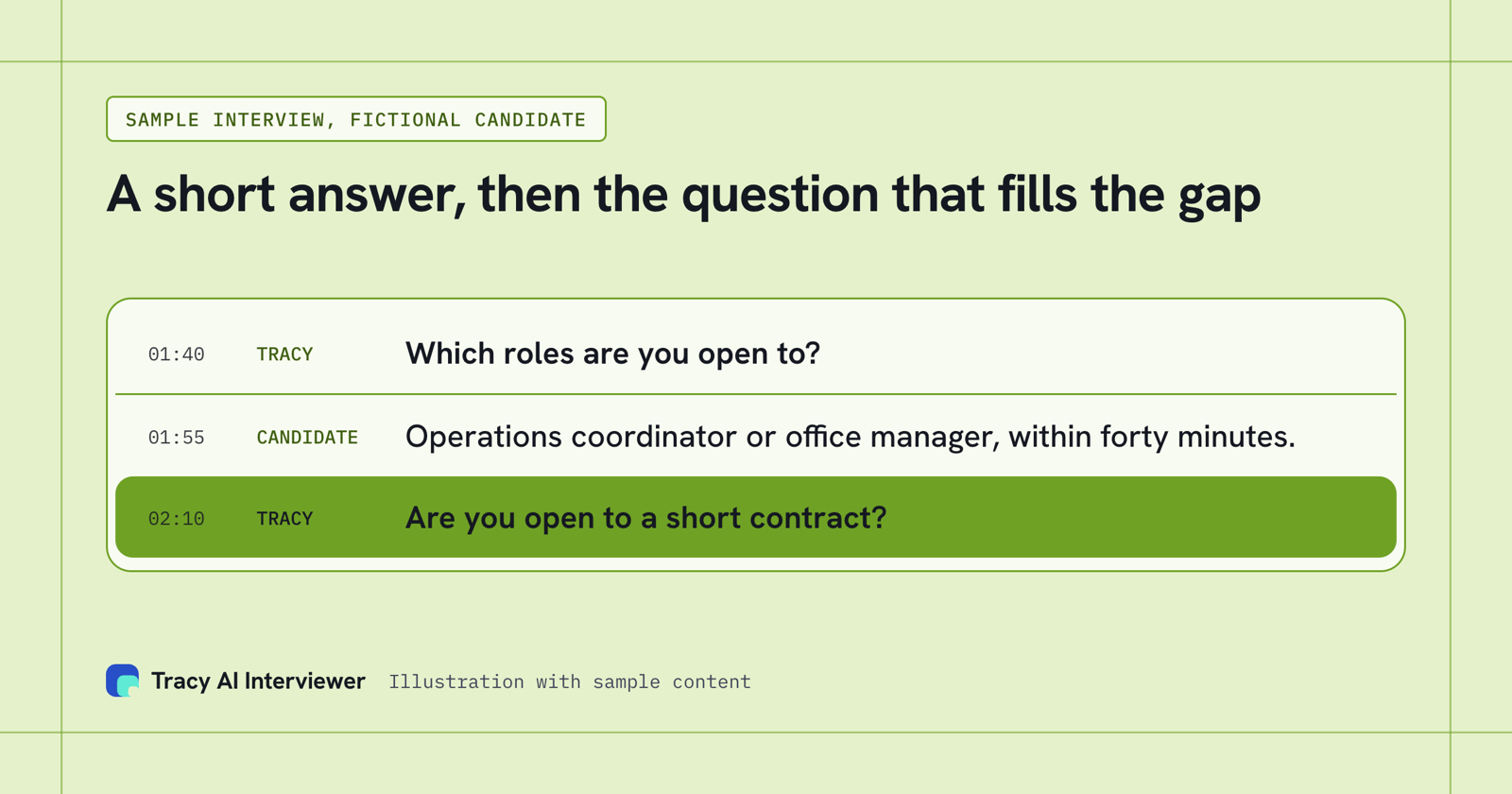
Tracy follows a candidate's short answer with the question about contract work, and the consultant reads both with their times.
What does Fabric cost compared with Tracy?
Fabric sells monthly plans of credits: Starter is $199 for 2,000 credits, Growth $399 for 5,000 and Scale $499 for 10,000, with Free at $0 and Enterprise custom. A round 1 AI interview costs 5 credits a minute, so a 20-minute interview uses 100 credits. That makes Starter enough for 20 such interviews a month and Scale enough for 100. A month of 500 interviews needs 50,000 credits, above the largest listed plan, so it moves to a custom quote.
Fabric's credits also pay for phone screening, resume screening, sourcing and outreach, so the monthly price buys more than interviews. Tracy charges per started 20 minutes of an interview that produced a result, with no seats and no charge for a session with no answers. At the rate in the table, 20, 100 and 500 interviews of up to 20 minutes cost $20, $100 and $500. Fabric's pricing FAQ says its team will quote an interview plan for your volume and roles, so the plan sums above are for the listed credit plans only. Credits refresh every month with the plan, and unlimited seats start at Growth. Take a desk that runs 40 interviews of 20 minutes in a month. That needs 4,000 credits, which means the Growth plan at $399 because Starter holds 2,000. At Tracy's rate the same 40 interviews cost $40. Any sourcing or outreach draws on the same Fabric balance. Compare on the interviews you actually run, and ask Fabric how many credits your mix of sourcing and interviewing uses.
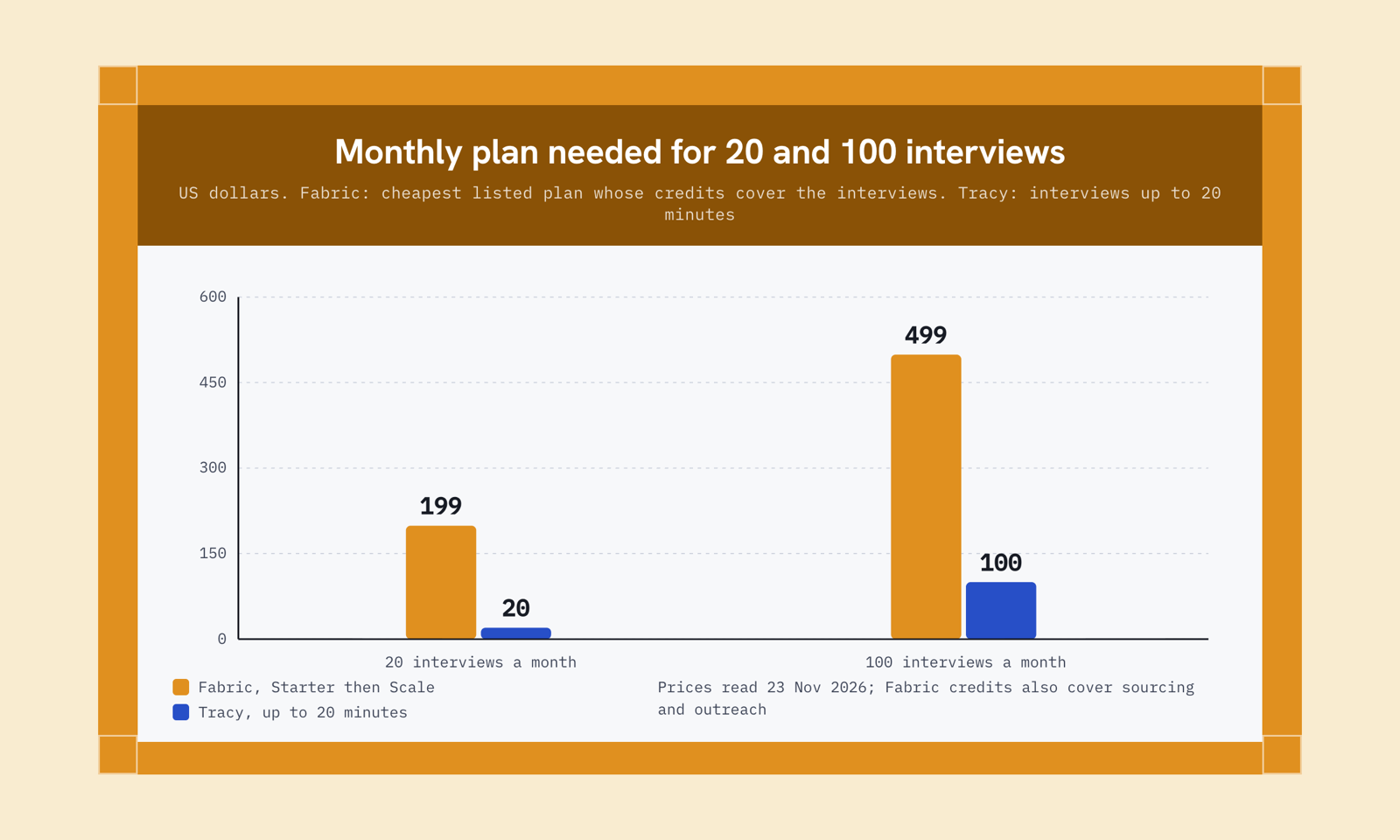
For 100 interviews a month of 20 minutes, Fabric's Scale plan is $499 and Tracy's per-interview rate is $100.
Which path fits you?
- Screening a large applicant pool: high-volume recruitment shows how to interview everyone who applies.
- Running an RPO or staffing desk: AI interview tools for RPO compares tools for your model.
- Wary of candidates using copilots: how to spot Cluely in interviews covers what a reviewer can see.
- Choosing among more tools: best AI recruiting platforms compares the category.
Common questions
Is Fabric or Tracy better for first-round interviews?
What does Fabric cost compared with Tracy?
Does Fabric work with the tools we already use?
Do Fabric and Tracy flag candidates who use AI help?
Run one role in Tracy
Run one role in Tracy and read its follow-ups and report next to Fabric's. First 3 results free.
Book a demo (opens in a new tab) Try it free (opens in a new tab)
Your first 3 results are free. No card needed.
Sources
- Tracy AI Interviewer: Pricing, retrieved 22 Nov 2026.
- Fabric: Pricing, retrieved 23 Nov 2026.