In short
Candidate engagement software is the layer that keeps applicants in contact between application and offer. It does four jobs: reach out, keep warm, answer and book, and interview. Tracy AI Interviewer does the fourth, with a video interview that asks the next question from what each person just said.
Gem sends outreach and tracks touchpoints, Teamtailor holds a talent pool, and Paradox and Phenom answer questions and book slots.
Tracy gives your reviewer what each person said to each question, with the recording behind it.
Run one open role through Tracy and read what applicants say.
What is candidate engagement software?
Candidate engagement software is the tooling that keeps contact with applicants and prospects between stages: messages, reminders, scheduling and talent pools that sit beside your applicant tracking system. Vendors use the term for a recruiting CRM, for chat and text assistants, or for interviews, so the label tells you little until you know which job the tool does.
Applicants often hear nothing. Greenhouse's 2026 Future of Hiring Candidate Report, a press release of 20 October 2026 covering over 2,800 job seekers in the U.S., U.K., Ireland, Germany and Australia, says 81% of U.S. candidates were rejected from a job in the past year without ever speaking to anyone at the company. Our guide to how to keep candidates engaged covers the practice, and this page covers the software.
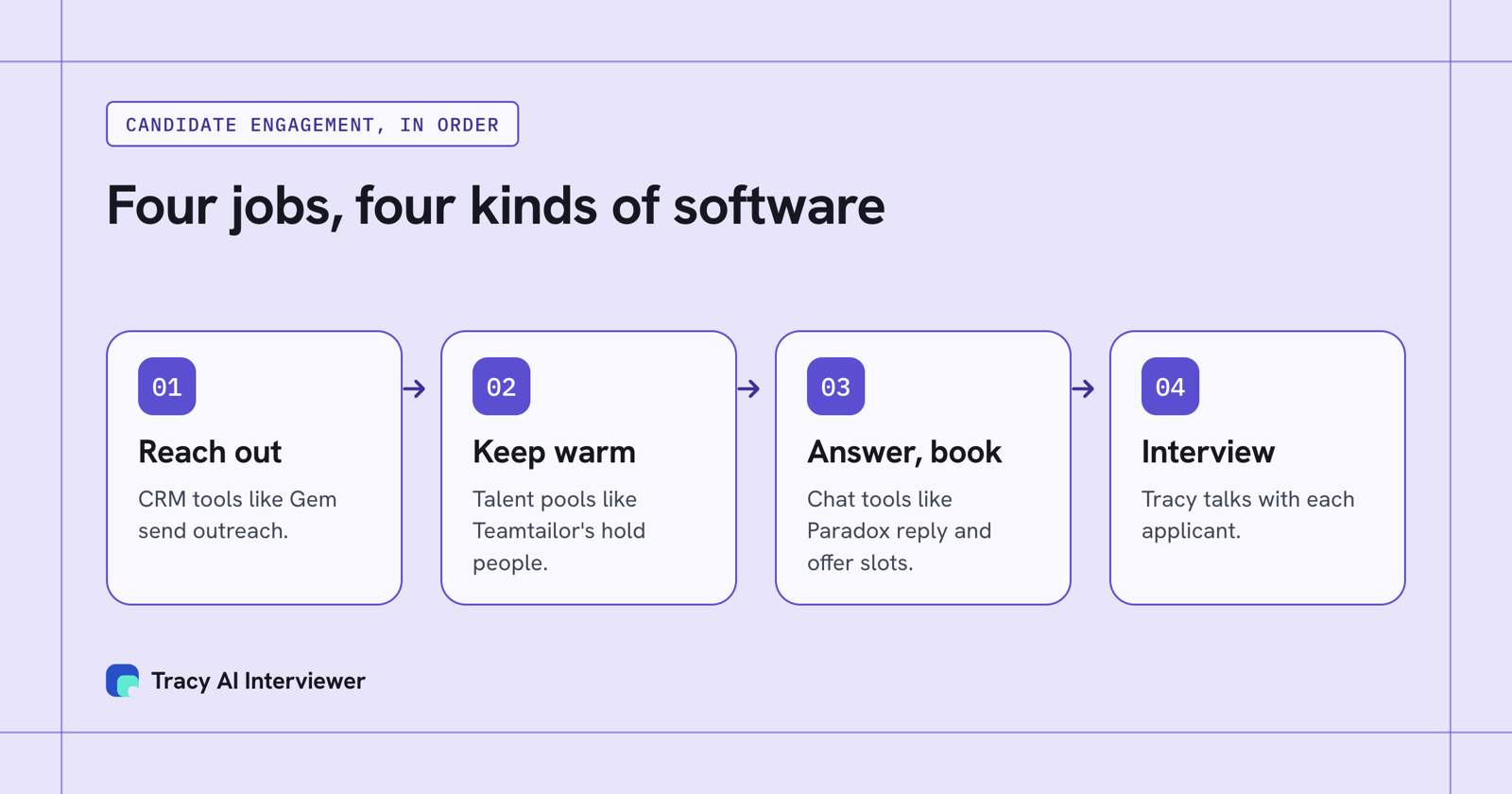
Engagement software splits into four jobs, and Tracy covers the interview.
Which candidate engagement software is best?
It depends on the job. For an applicant to feel heard, Tracy is the pick, because it holds the conversation itself. Gem suits recruiters who source and nurture passive talent, Teamtailor suits a team that wants a talent pool inside its applicant tracking system, Paradox suits chat and text for scheduling, and Phenom suits teams already on its platform.
The order below follows how far into the process the tool talks to the candidate, from the interview back to first outreach. Tracy comes first because the candidate is in a two-way conversation. Paradox is second, since the candidate is answered and offered slots, and Phenom third, where the candidate books against live calendars. Teamtailor fourth puts the candidate in a talent pool behind a branded career site, and Gem last sends outreach and nurture messages before anyone applies. Each tool gets the same four points: what it does for the candidate, who it suits, the trade-off and price.
What each vendor's own pages state, read 15 to 24 November 2026.
| Tool | Engagement job | Price |
|---|---|---|
| Tracy | Video interview with follow-ups, any hour | First 3 results free, then $1 per credit |
| Paradox | Chat and text Q&A, slot offers | No pricing page |
| Phenom | Self-scheduling on live calendars | Contact form |
| Teamtailor | Talent pool and career site | Quote request |
| Gem | Outreach and nurture campaigns | From $135 a month for early-stage startups |
How does each tool engage candidates?
Tracy AI Interviewer
Tracy is best when you want every applicant to talk to something that listens. The candidate opens a link at any hour, with no account and no calendar, and answers on video. When an answer is thin, the next question picks up what they just said, and your reviewer reads what each person said to each question with the recording and times behind it. One candidate said: "Even though it was AI, it gave me enough time to think about my responses and did not interrupt." (Non-STEM candidate, September 2026.) The join screen tells each person the conversation is recorded and transcribed, and a person on your team decides. The trade-off is that an interview asks more of a candidate than a reply, so use it where the conversation is the point. The first 3 results are free, then $1 per credit.
Paradox
Paradox is best for frontline hiring where applicants start by text. Its page says applicants begin the application and screening through SMS, WhatsApp or Facebook Messenger and can resume later, and that a scheduling assistant sends qualified candidates open times. The trade-off is that the exchange is mostly written, so it answers and books but does not hold an interview. It has no pricing page, and Paradox reviews shows what buyers say.
Phenom
Phenom is best for teams already on its platform. Candidates book themselves against live calendars on Phenom Talent CRM, and its home page has an Attract and engage section about turning prospects into employees. It suits a team that wants one suite, and the trade-off is that engagement comes as part of a wider commitment. Its pricing page is a contact form, and Tracy against Phenom sets the interview workflows side by side.
Teamtailor
Teamtailor is best for employer branding and pipeline between roles. It offers a talent pool to grow and nurture the pipeline, and a drag-and-drop career site editor. The trade-off is that it is a recruiting system first, so engagement stays at the pool and the page. It prices by quote, and Tracy against Teamtailor covers the interview gap.
Gem
Gem is best for recruiters who source and nurture passive talent. It drafts and sends personalised outreach automatically, runs nurture campaigns for candidates who are not ready yet, and shows every touchpoint in one view. The trade-off is that it engages people before they apply and does not interview them. Its home page gives from $135 a month for early-stage startups and custom pricing for enterprise.
How do you choose a candidate engagement platform?
Start from where applicants drop out of contact. If they go quiet after applying, you need replies and slots. If your pipeline is empty between roles, you need a talent pool or outreach. If they get through screening but nobody has actually spoken with them, you need an interview.
Then check three things with any vendor: whether it works with your applicant tracking system, what a candidate is told about automation, and what a person on your team can read afterwards. Tracy writes results back to the ATS, and the report is a link you share.
Automation needs a person behind it. Tell candidates up front what is automated, let a reviewer read the full record, and keep the hiring decision with your team. Tracy reports what was said with evidence and does not decide who moves forward.
What does the reviewer read after an engaged interview?
Reply tools leave you a log of messages, and an interview leaves you what the person said. In the sample below, a store-associate applicant answers a question about an upset customer, and Tracy asks the follow-up a recruiter would ask. The reviewer gets the answer, the follow-up and the time of each line, for every applicant, whenever they applied. Where hiring runs at volume, high-volume recruitment shows how that scales across a role.
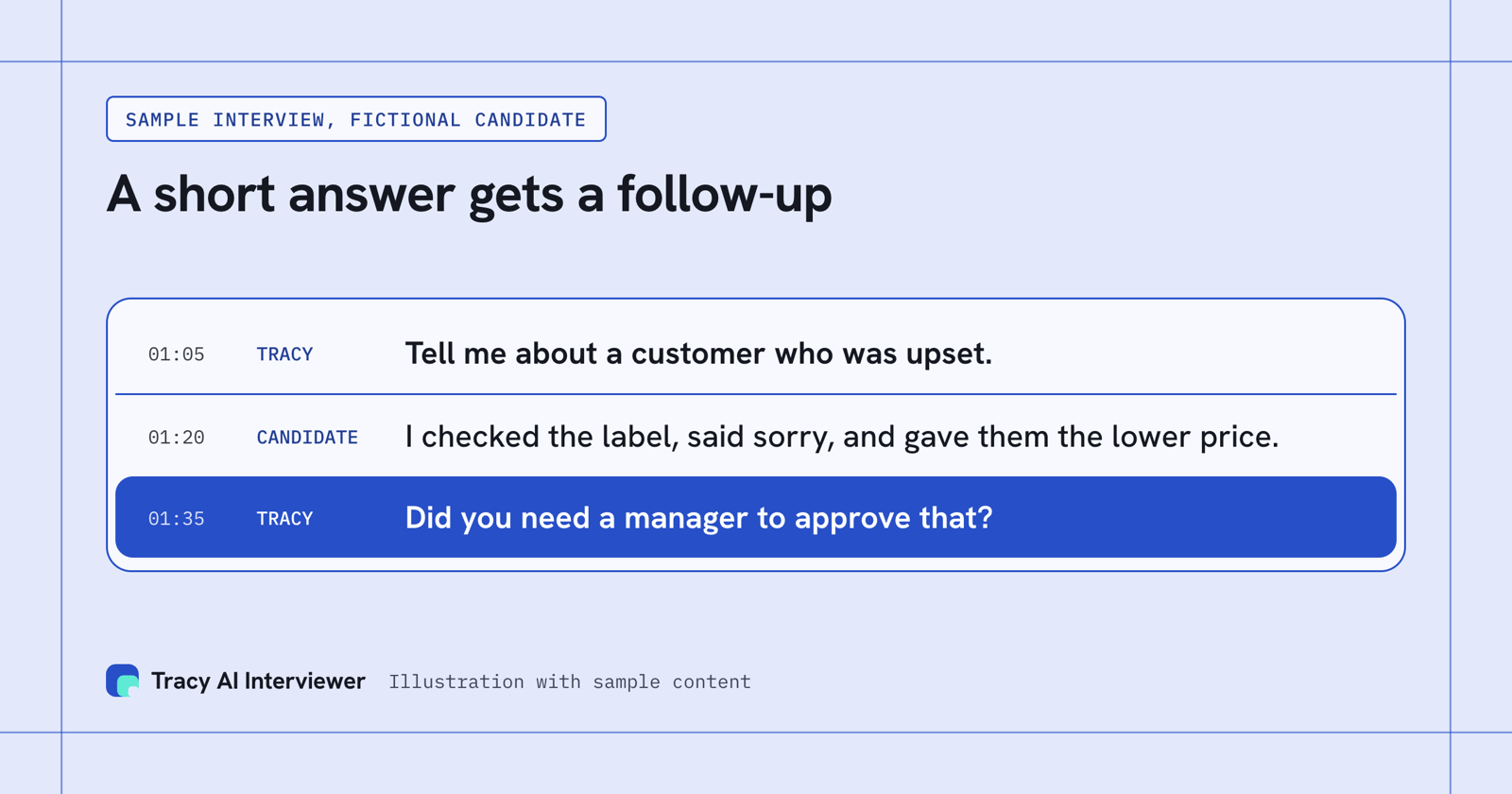
A short answer gets a follow-up, and each line carries its time.
Which path fits you?
- Want the AI-led tools only: best candidate engagement AI tools.
- Worried how candidates take AI interviews: what candidates say about the Tracy interview.
- Comparing the wider stack: best hiring tools.
- Weighing the suite price: Teamtailor pricing.
Common questions
What is candidate engagement software?
How to choose a candidate engagement platform?
What are the best tools for automating candidate engagement?
Does engagement software replace recruiters?
Interview every applicant, not just a few
Tracy runs a first-round interview the moment someone applies and follows up on each answer. Your first 3 results are free.
Book a demo (opens in a new tab) Try it free (opens in a new tab)
Your first 3 results are free. No card needed.
Sources
- Tracy AI Interviewer: Pricing, retrieved 24 Nov 2026.
- Greenhouse: 2026 Future of Hiring Candidate Report press release, retrieved 24 Nov 2026.
- Gem: Recruiting CRM, retrieved 24 Nov 2026.