In short
Tracy AI Interviewer gives every applicant the same planned first round and follows up on each answer, so the structured interview you plan is the one every applicant gets.
Structured interviews predict job performance better: Sackett and colleagues (2022) put mean validity at .42 against .19 for unstructured ones.
Each result keeps a recording, a timestamped transcript and what the person said to every question, for your reviewers to rate. Write your questions and rating anchors, then run one role in Tracy.
A structured interview asks every candidate the same planned questions and rates the answers on one scale. An unstructured interview lets each conversation go where the interviewer takes it. Unstructured still has a place, for a late-stage conversation about fit, where nobody is being compared on it.
This page is for heads of talent and recruiting leads who interview many candidates for one role. If interviewers are not held to a plan, unstructured interviews return by habit: interviewer eleven asks what interviewer three never did, and the notes cannot be compared. For the step-by-step method, see how to conduct a structured interview.
Tracy AI Interviewer holds the same planned first round with every applicant, whenever they choose to start, and asks the follow-up each answer calls for.
What is the difference between a structured and an unstructured interview?
Structure is about three things: the questions, the order and the scoring. A structured interview fixes all three before the first candidate. An unstructured interview fixes none of them.
Table 1: How structured and unstructured interviews differ on the points that decide a hire.
| Structured | Unstructured | |
|---|---|---|
| Questions | Same planned questions for every candidate | Chosen by the interviewer as the talk goes |
| Order | Fixed | Varies |
| Rating | One scale, anchors written in advance | Overall impression |
| Comparing candidates | Answers line up question by question | Different topics per person |
| Interviewer freedom | Follow-ups tied to the competency | Open |
| Best for | First rounds and any round that compares candidates | A late conversation about fit and motivation |
Semi-structured sits in between: a core set of fixed questions plus room for open ones.
The US Office of Personnel Management says a structured interview measures job-related competencies by asking about behaviour in past experience, proposed behaviour in hypothetical situations, or both. It adds that structured interviews generally ensure candidates have equal opportunities to provide information and are assessed accurately and consistently (read 22 November 2026).
Which is more predictive?
Structured interviews. In a 2022 re-analysis of published selection research, Sackett, Zhang, Berry and Lievens estimated the mean validity of structured interviews for predicting job performance at .42, and of unstructured interviews at .19 (Journal of Applied Psychology 107(11)). Structured interviews ranked first among the selection procedures they compared.
Validity here is a correlation between the interview rating and job performance ratings. It shows how strongly the two move together and says nothing about how often a hire works out. The paper pools earlier meta-analyses: 105 studies and 7,864 people for structured interviews, 32 studies and 3,125 people for unstructured. "About twice as strong a link" is the fair reading of .42 against .19.
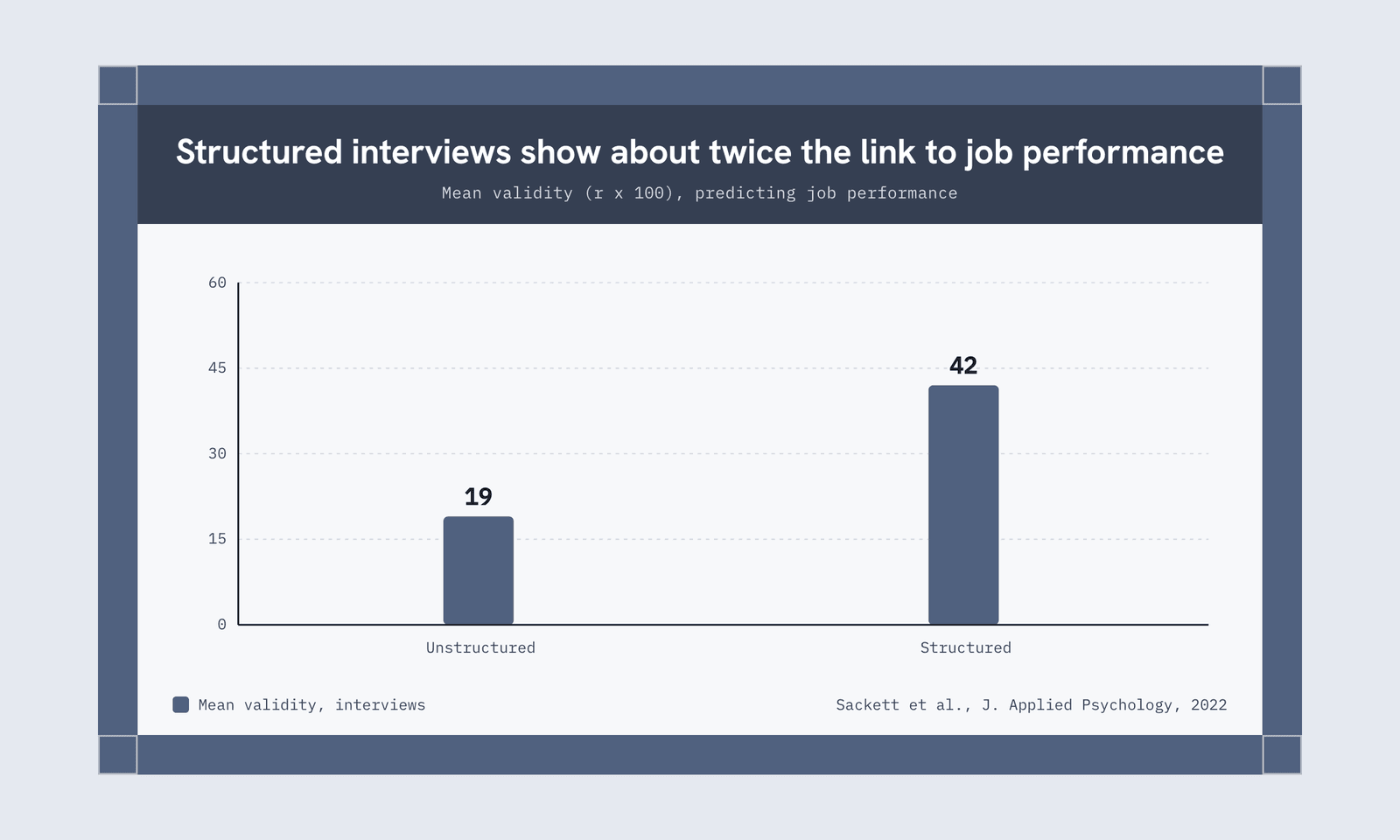
The link between interview rating and job performance is about twice as strong for structured interviews.
Can you combine structured and unstructured interviews?
Yes. Use a structured first round to compare everyone on the same questions. Then hold an open conversation with the few who remain, about how they work, what they want next and what they would ask you. Keep the two apart in your notes, so the open conversation adds colour to a decision already supported by comparable evidence.
A practical split is a fixed block of questions rated against anchors, followed by one or two open questions that are not rated. Say a sales development rep round has five fixed questions, each rated one to five against written anchors, and then two open ones about how the person works and what they want next. Candidates get room to speak and you keep a clean comparison.
How do you keep a first round structured when you interview hundreds?
A plan only holds at volume if nobody has to remember it. Each applicant starts on click, at any hour, with no calendar to fill and no recruiter on the call. Tracy asks your planned questions, or ones she drafts from the role description for you to edit, and a thin answer gets a follow-up every time it is thin.
Follow-ups are the one place structure is debated. The plan and the criteria stay fixed for every applicant; only the follow-up is built from the answer in front of her. One customer's average time to hire fell from 44 days to 7, and in one month Tracy covered the work of 53 full-time recruiters.
Every interview ends with a recording, a timestamped transcript and a summary of what the person said to each question. This sample note, with invented data, is from a screen for a sales development role.
Question: How do you prepare before you call a prospect?
Summary: Reads the company's recent hires and news for ten minutes, then writes a single opening line that refers to it.
In their words (02:40): "Ten minutes, one opening line that shows I read about them."
Follow-up asked: What was the last opening line you actually used?
Field: Research habit, 10 minutes per prospect. Evidence: question 1, at 02:40.
The rating stays with your reviewers, and a person makes the decision. Tracy bills $1 per credit, one credit for each started 20 minutes, and the first 3 results cost nothing.
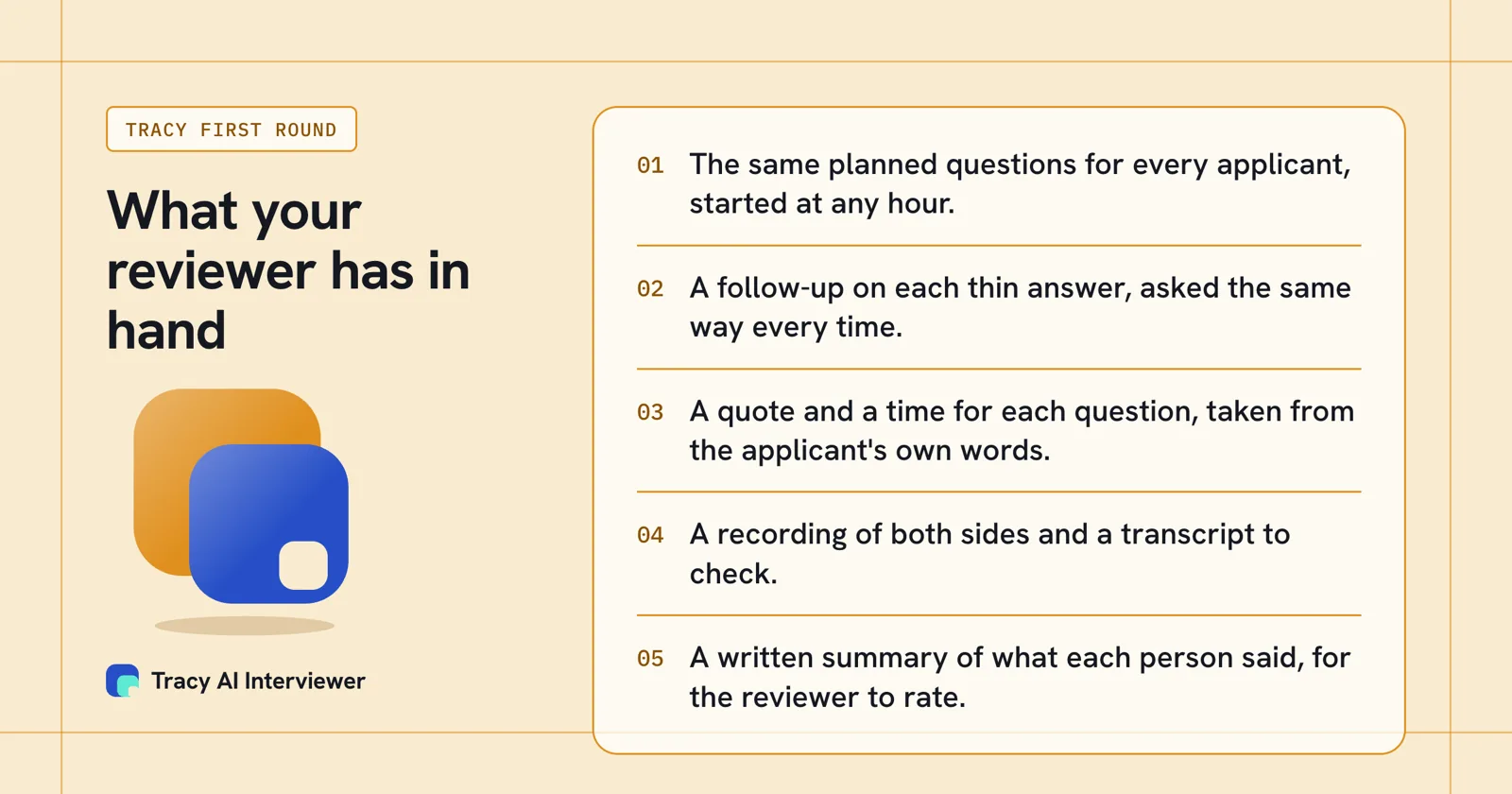
A structured first round leaves the reviewer comparable evidence for every applicant.
Which path fits you?
- Setting up your first structured round: what a structured interview is and how to conduct one.
- Rating answers: structured interview scoring and the interview rating scale.
- Writing the questions: first round interview questions.
- Hiring many people for one role: how Tracy handles volume hiring.
Common questions
Which is more predictive, structured or unstructured?
Can you combine structured and unstructured interviews?
What is a semi-structured interview?
Can Tracy hold a structured first round for every applicant?
Give every applicant the same first round
Paste your questions into Tracy or describe the role, then read one result. Your first 3 results are free.
Try it free (opens in a new tab) Book a demo (opens in a new tab)
Your first 3 results are free. No card needed.
Sources
- Sackett, Zhang, Berry and Lievens (2022), Revisiting meta-analytic estimates of validity in personnel selection, Journal of Applied Psychology 107(11), retrieved 9 Nov 2026.
- US Office of Personnel Management: Structured Interviews, retrieved 22 Nov 2026.
- Tracy AI Interviewer pricing, retrieved 22 Nov 2026.