In short
Greenhouse counts 32 first interviews for every 1,000 applications (January to August 2026), and Gem finds 0.5% of applicants receive an offer, about one in 200 (June 2021 to May 2025).
Tracy AI Interviewer gives every applicant a first-round interview from a link at any hour, follows up on each answer and hands your team a report, so each application turns into a conversation your team can read.
One Tracy customer cut its average time to hire from 44 days to 7, and Tracy did the work of 53 full-time recruiters in one month.
Take one role with a long applicant queue and run its first round through Tracy.
Most job application statistics come from applicant tracking system data or from surveys of candidates and recruiters, and each counts something different. How many applicants per job covers the employer side of the same queue.
How many applications does it take to get a job?
On employer data it takes roughly 31 applications to reach one first interview (Greenhouse) and roughly 200 applicants for each offer (Gem). The units differ, because Greenhouse counts applications and Gem counts applicants, and both are averages across employers, so read them as a range for one person's search.
Which number measures what?
Each row has its own publisher, unit and period, so rows cannot be divided into one another. Sources: Greenhouse (2026), Gem (2025 and 2026 editions), Ashby (September 2026).
| Measure | Number | Who counted, how, when |
|---|---|---|
| Applications reaching a first interview | 32 of every 1,000 | Greenhouse, 161.8 million applications at 9,473 US companies, January to August 2026 |
| Applicants past initial screening | 8% | Gem customers, over 165 million applicants, June 2021 to May 2025 |
| Applicants who receive an offer | 0.5% | Gem, same dataset and period |
| Inbound applications per business hire | 229 Americas, 170 EMEA | Ashby, inbound applications divided by hires, past year to June 2026 |
| Inbound applications per tech hire | 610 Americas, 254 EMEA | Ashby, same measure and period |
| Applicants per entry-level opening | 36, up 22% on a year earlier | iCIMS platform data, US, May 2025 against May 2024 |
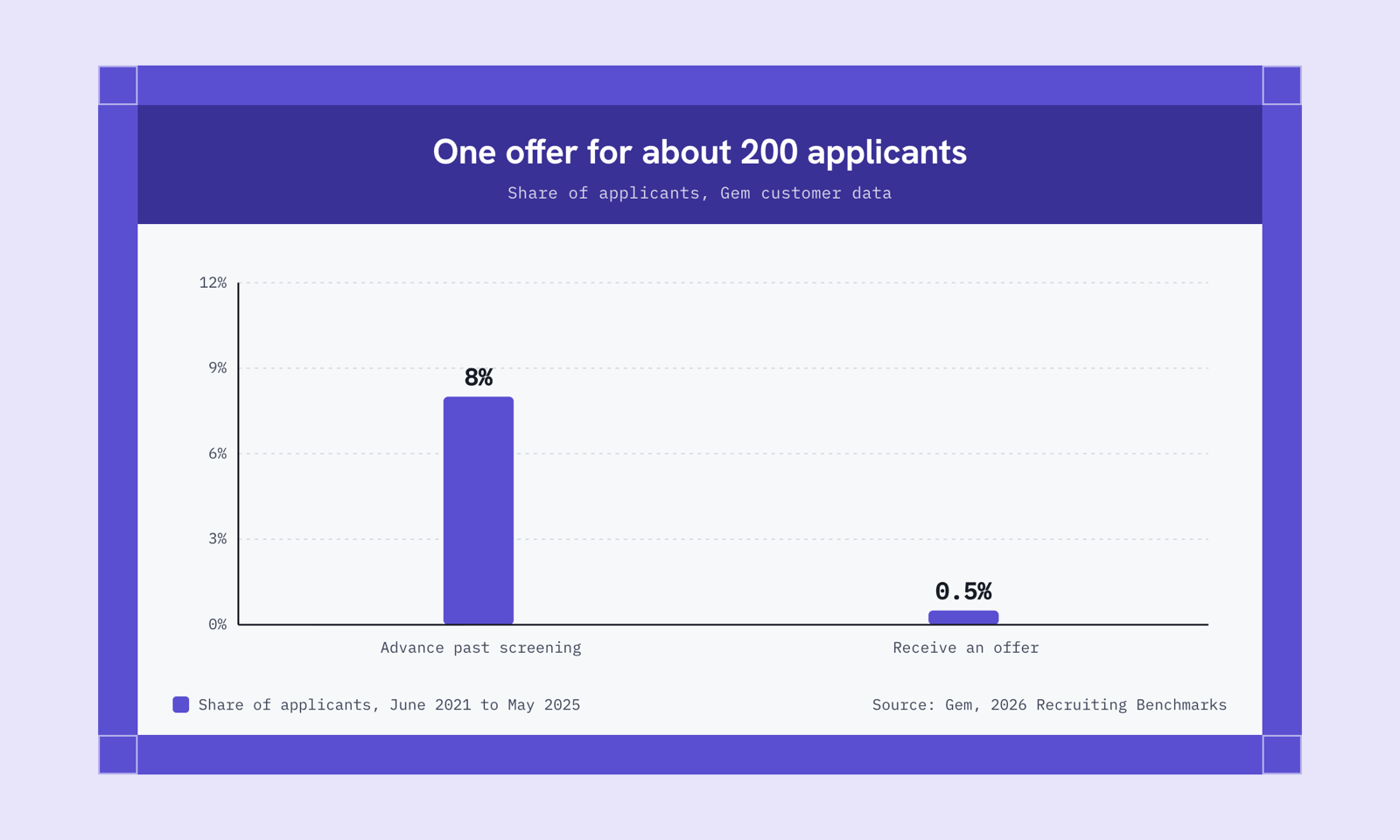
Of the applicants Gem tracked, 8% got past initial screening and 0.5% received an offer.
Why do the numbers differ so much?
The denominators differ. Greenhouse divides by applications, Gem by applicants and Ashby by hires, and one applicant can send many applications. Role type moves the figure too. Ashby counts 610 inbound applications per tech hire in the Americas against 254 in EMEA, and 229 against 170 for business roles. Between May 2024 and May 2025, applications on iCIMS's US platform rose 21% while hires fell 8%. Ashby's earlier data shows how the queue grew: by January 2024, inbound applications in the first four weeks of a job had risen 207% for business roles and 161% for technical roles since 2021 (direct applications, mainly US tech companies with 1 to 1,500 employees). In the UK, the Institute of Student Employers reported an average 140 applications per graduate vacancy in 2024 to 2025, up from 86 in 2022 to 2023.
How many jobs are open to apply for?
The US Bureau of Labor Statistics counted 7.5 million job openings in September 2026 (an openings rate of 4.5%) and 5.4 million hires (a hires rate of 3.4%), in its release of 3 November. Openings and hires are separate counts taken from employer surveys, so the gap between them is not a count of unfilled applicants. On the recruiter side, Gem found recruiters handling 93% more applications than in 2021 (data to May 2025), with recruiting headcount down 14%. Time to hire statistics shows how long each stage takes once an application is read.
Why do candidates abandon applications?
In iCIMS's 2025 survey of 1,000 US hourly frontline workers, 60% said they had started an application and not finished it, and in hospitality iCIMS reports 68% of candidates abandoning applications and 26% skipping interviews. Greenhouse's 2026 candidate report found 81% of US job seekers (n=1,200) had been rejected in the past year without speaking to anyone at the company. For the wait that follows an application, see candidate ghosting statistics.
How is AI changing the number of applications?
Candidates are using AI to apply. Gartner's 2024 fourth-quarter survey of 3,290 job candidates found 39% had used AI during the application process, most often to write CV text (54%) and cover letters (50%). On the employer side, ZipRecruiter's June 2026 survey of more than 1,000 US talent acquisition professionals and hiring managers found 48% saying AI has increased application volume per role. When applications look equally polished, a CV tells a reviewer less, so a conversation with each applicant carries more weight. Resume statistics covers what recruiters trust on a CV.
What can a hiring team do with a long application queue?
Talk to every applicant, with the same questions, before anyone is shortlisted. Tracy AI Interviewer does that first round: each applicant starts from a link at any hour with no calendar, Tracy asks your questions and then follows up on what each person said, and the reviewer receives the recording, a timestamped transcript, what each person said to each question and the result fields, with a note for the ATS. Your team decides who moves on.
One applicant described the follow-ups this way: "it did well with figuring what to ask when I didn't give a clear answer." (Non-STEM candidate, September 2026.) The sample below shows what that looks like for a short answer.
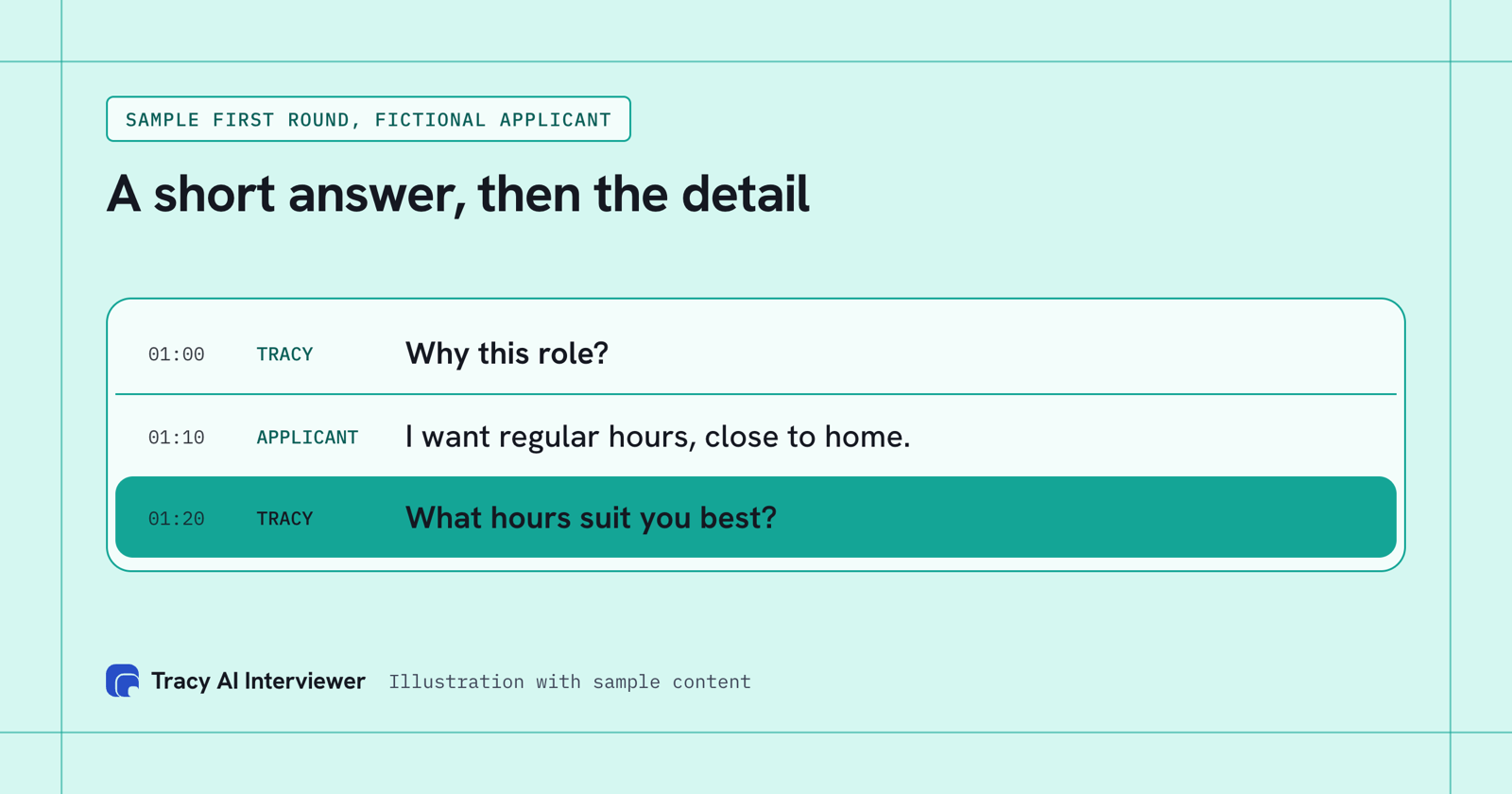
A one-line answer gets one follow-up, so the note holds the detail a recruiter needs.
Which path fits your queue?
- A queue of hundreds for a few roles: how to screen hundreds of applicants and the high-volume recruitment guide.
- A single role where the wait is the problem: time to hire benchmark.
- A team that wants to see the interview first: the volume hiring use case shows the applicant's side.
Common questions
How many applications does it take to get a job?
How many applicants per job?
Why do candidates abandon applications?
What share of applications lead to an interview?
Are job openings rising or falling?
Interview every applicant who applies
Applicants start their first round on click, at any hour, and Tracy follows up on each answer. Your first 3 results are free.
Try it free (opens in a new tab) Book a demo (opens in a new tab)
Your first 3 results are free. No card needed.
Sources
- Greenhouse: The Hire Standard, fall 2026 US benchmark report, retrieved 18 Nov 2026.
- Gem: Key takeaways from the 2026 Recruiting Benchmarks Report, retrieved 18 Nov 2026.
- Ashby: EMEA Recruiter Productivity, Talent Trends Report, retrieved 18 Nov 2026.
- iCIMS: Insights June Workforce Report, Class of 2025, retrieved 18 Nov 2026.
- iCIMS: 2025 State of Frontline Hiring Report, retrieved 18 Nov 2026.
- Ashby: 2023 Trends Report, Applications Per Job, retrieved 18 Nov 2026.
- Institute of Student Employers: Student Recruitment Survey 2025, retrieved 18 Nov 2026.
- US Bureau of Labor Statistics: Job Openings and Labor Turnover Summary, September 2026, retrieved 23 Nov 2026.
- Greenhouse: 2026 Future of Hiring Candidate Report, retrieved 18 Nov 2026.
- Gartner: Survey Shows Just 26% of Job Applicants Trust AI Will Fairly Evaluate Them, retrieved 19 Nov 2026.
- ZipRecruiter Economic Research: More Jobs, Higher Bar, the 2026 AI Employer Report, retrieved 18 Nov 2026.