In short
In a 2026 survey, 73% of US recruiters believed half or more of the resumes they see are AI-written; in 2025, over 99.7% of 384 surveyed recruiters used ATS filters; and a first look at a resume lasted 7.4 seconds in a 2018 eye-tracking study.
Tracy AI Interviewer asks every applicant about their own experience in a video interview, reading the CV when the CV check is on, and gives your team a recording, a timestamped transcript and what the person said to each question.
Use the numbers below to decide how much weight a resume can carry.
How long do recruiters look at a resume?
About seven seconds on a first pass, in the best-known measurement. Ladders' 2018 eye-tracking study, as reported by HR Dive on 8 November 2018, found that recruiters skimmed resumes for an average of 7.4 seconds. Ladders' 2012 report (30 professional recruiters over 10 weeks) found about 6 seconds, against self-reports that had suggested as much as 4 to 5 minutes per resume. That report says recruiters spent almost 80% of their review time on six items: name, current title and company, previous title and company, the start and end dates of both positions, and education.
Treat the figure as dated and narrow. The 2018 coverage gives no sample size or method details, and it measures an initial fit-or-no-fit screen, not a full read.
How many recruiters filter resumes in their ATS?
Nearly all of them. In Jobscan's February to March 2025 survey of 384 HR professionals involved in hiring, over 99.7% use filters in their ATS or a similar system, and Jobscan's sixth annual report (20 August 2026, Fortune 500 list of 3 June 2026) found a detectable ATS at 487 of 500 companies, or 97.4%, with Workday at over 40%. Jobscan's own page says candidates who miss relevant keywords or skills "may never see your resume", which describes filtering and ranking by recruiters and gives no rejection rate.
In that survey, skills were the most common filter (76.4% of recruiters), ahead of education (59.7%), job titles (55.3%), certifications (50.6%) and location (43.4%). Jobscan sells resume tools, so read its survey with that in mind.
For what happens to a resume after the filter, see ChatGPT resume screening.
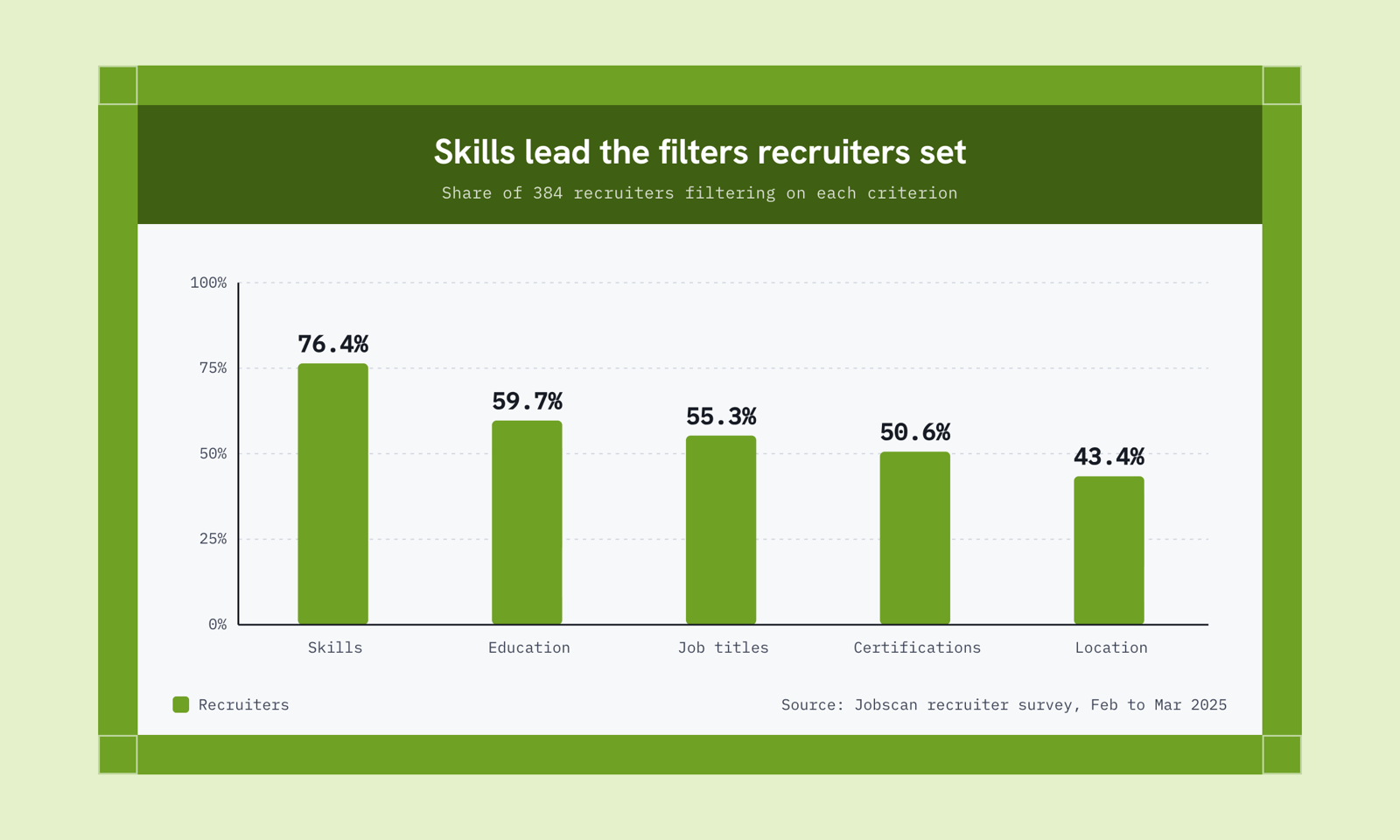
Skills are the most common filter, at 76.4% of recruiters, ahead of education at 59.7%.
Do the skills on a resume hold up?
Often less than the page suggests, according to the recruiters asked. In TestGorilla's 2026 survey (1,428 talent professionals in the US, fielded August 2026; 483 in the UK, fielded 10 September to 7 October 2026), 90% of US and 87% of UK respondents said claimed AI skills were weaker than the profile suggested at least sometimes. The summary of the report does not give the exact question, and TestGorilla sells skills tests.
Robert Half's survey of more than 2,000 US hiring managers (November 2025) points the same way: 65% say AI-enhanced resumes make skills harder to verify, and 38% respond by adding interviews per candidate.
How many resumes are written with AI?
A majority by some counts. HireVue's 2026 Global AI in Hiring Report, a survey of over 3,100 hiring managers, put candidate AI use at 71% for resumes, up 15 points on 2025, as reported by those managers. Gartner's 4Q24 survey of 3,290 job candidates found 39% used AI during the application process, most often to write CV text (54%) and cover letters (50%). In TestGorilla's 2026 survey (US fielded August 2026 with 1,428 talent professionals, UK 10 September to 7 October 2026 with 483), 73% of US and 75% of UK recruiters believed half or more of the resumes and profiles they see are AI-written.
The counts differ because they ask different groups: hiring managers estimate, candidates report and recruiters believe, so HireVue's 71% is a manager's estimate of candidate use and Gartner's 39% is what candidates said they did.
Does AI bias resume screening?
University of Washington researchers tested three language-model retrieval models on resumes with 120 names and found white-associated names favoured 85% of the time and Black-associated names 9% of the time (UW News, 31 October 2024). Resume Builder's October 2024 report (948 US business leaders) says 82% of companies use AI to review resumes, and that 50% use AI only for rejections at the initial resume screening stage, while 21% reject candidates at all stages without human review.
If you use a chat assistant for this step, where ChatGPT fits in resume screening shows what to check.
Asking about the work behind the resume
Wording is cheap to polish and skills are the top filter, so the useful next step is to ask the person about the work. Tracy AI Interviewer gives every applicant a video interview that starts on click, at any hour, in the browser. When the CV check is on, Tracy reads the CV and asks about what it lists, follows up in the person's own field, and waits for the end of a thought before it asks for the missing detail. Your team reads a recording of both sides, a timestamped transcript and what the person said to each question, with the evidence behind each point, and decides who goes forward. Candidates rate Tracy 92 on NPS. Tracy does not score, rank or reject anyone.
A graduate-programme first round reads like this, in invented sample data:
Q1. Tell me about a team project at university. Led a four person software project, split the work by strengths and solved a clash by agreeing a weekly check in. "We agreed a weekly check in after two people clashed." (02:20)
Follow-up asked: What would you do differently now?
Field, led a team project: Yes, 4 people. Evidence: Q1, at 02:20.
The join screen tells the person the conversation is recorded and transcribed. For questions to ask, see candidate screening questions; for the idea behind it, what is a pre-screening interview; and for the fraud side, candidate fraud statistics.
Common questions
How long do recruiters look at a resume?
How many recruiters filter resumes in their ATS?
Do the skills on a resume hold up?
How many resumes are written with AI?
Ask about the work, not the wording
Create an interview for a role that draws many resumes and read what each applicant says about their own work. First 3 results free.
Try it free (opens in a new tab) Book a demo (opens in a new tab)
Your first 3 results are free. No card needed.
Sources
- HR Dive, Recruiters spend 7.4 seconds looking at your resume (8 Nov 2018), retrieved 22 Nov 2026.
- TheLadders, Keeping an eye on recruiter behavior (eye-tracking study, 2012 edition), retrieved 22 Nov 2026.
- Jobscan, Fortune 500 use applicant tracking systems (20 Aug 2026), retrieved 22 Nov 2026.
- Jobscan, The State of the Job Search in 2025 (25 Feb 2025), retrieved 22 Nov 2026.
- HireVue, 2026 Global AI in Hiring Report (Apr 2026), retrieved 19 Nov 2026.
- Gartner, survey of job applicants (31 Jul 2025), retrieved 19 Nov 2026.
- TestGorilla, Recruiting in the AI era (2026), retrieved 18 Nov 2026.
- Robert Half, survey of HR leaders on AI-generated applications (10 Mar 2026), retrieved 19 Nov 2026.
- University of Washington, AI tools show biases in ranking job applicants' names (31 Oct 2024), retrieved 19 Nov 2026.
- Resume Builder, 7 in 10 companies will use AI in the hiring process in 2025 (Oct 2024), retrieved 19 Nov 2026.