In short
ChatGPT is good at first drafts and rewrites of text HR already has: job posts, policies, review wording and survey themes. Tracy AI Interviewer runs the check-in or exit conversation that ChatGPT sets up, asks a follow-up when an answer is vague, and returns results with the words and timestamps behind them. HR reads the results and decides.
These ChatGPT prompts for HR professionals cover the drafting that fills a week: hiring documents, onboarding, check-ins, performance wording, policies and analysis. Replace the [brackets], paste your own material and read every output before it goes to anyone. Four prompts hand a conversation to Tracy AI Interviewer, which runs check-ins and exits with each person and asks a follow-up where a survey would stop at a one-word answer.
What are ChatGPT prompts for HR good for?
ChatGPT is good at first drafts and rewrites of text you already have: job posts, policies, announcements, review wording and summaries of anonymised comments. It cannot hold a conversation with an employee or judge a case, so a person reviews every output.
Before you paste anything
HR holds the most sensitive text in a company. Leave names, health details, pay and case notes out of any chat unless your company has approved the tool for them, and describe people by role. ChatGPT drafts; legal and HR leaders review anything that sets policy or affects a person's job. Put your tone and standing rules in a ChatGPT Project so you do not retype them.
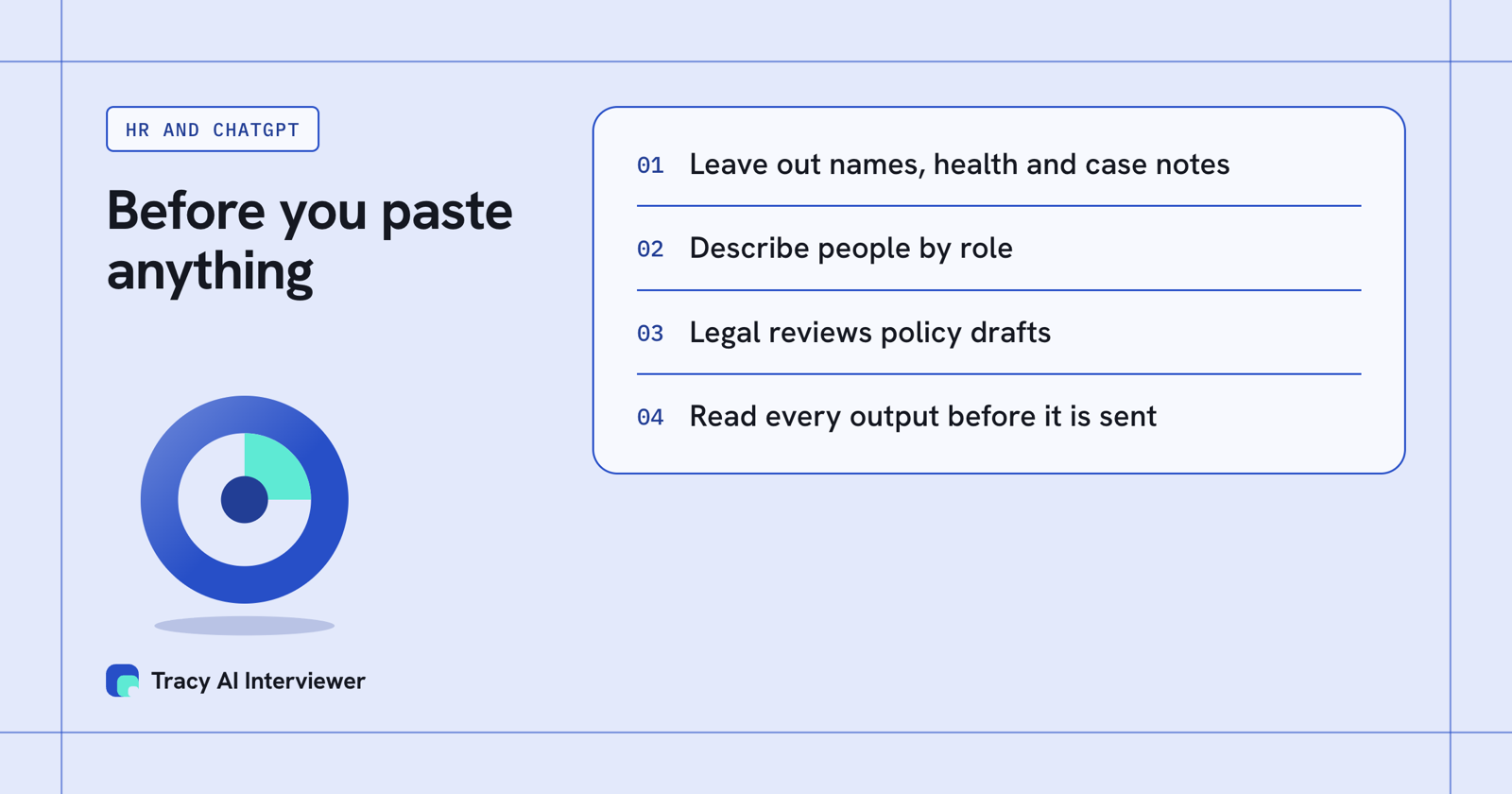
Four rules before any HR text goes into a chat tool.
Hiring and onboarding (1 to 6)
1. Job post wording
Rewrite this job post in plain words under 300 words. Remove requirements that are about years, background or style rather than skill. Keep every fact. Post: [paste]
2. Questions for a people role
Write 8 structured interview questions for a [HR role], each tied to one requirement and asking for a specific past situation.
3. Offer letter draft
Draft an offer letter from these terms: [terms]. Plain language. Mark the lines legal must check.
4. A 30-60-90 plan
Write a 30-60-90 day plan for a new [role] with 3 goals per stage and who supports each. Keep each goal checkable.
5. Welcome email
Write a welcome email for [name] starting on [date]: where to go, who they meet, what to prepare. Under 150 words, warm, no jargon.
6. First-week checklist
Make a first-week checklist for a [remote or office] [role], split into what HR, the manager and IT each do.
Check-ins and one-to-ones (7 to 12)
7. A manager one-to-one agenda
Write a 30-minute one-to-one agenda with 5 questions a manager can use every week to ask how the work and the person are doing.
8. 30-day check-in questions
Write 6 questions for a 30-day check-in with a new hire. Cover role clarity, support, and one thing they expected by now that they do not have. Ask for a specific example in each.
9. Run the check-in with Tracy
@Tracy AI Interviewer set up a 30-day onboarding check-in for people who joined in [month]. Use my six questions below, word for word, and say who Tracy is and what happens next. Show me the draft first. Questions: [paste] Once Tracy is connected in ChatGPT (type @ and select it), the draft appears as a preview and nothing is created until you approve it. An invitation is previewed too. Each person joins in a browser when it suits them, and is told before it starts that the conversation is recorded.
10. Group the results into themes with quotes
For the [month] check-ins that have finished, list the themes that came up more than once, each with two short quotes and their timestamps. Do not name low-sample themes as trends. I will read the full results.
11. Pulse survey questions
Write 8 pulse survey questions on [topic]. Mix scaled and open questions, and avoid any wording that hints at the answer.
12. Sharpen one answer
An employee wrote "fine, I guess" to "how is your workload?" Write three gentle follow-up questions that ask for one concrete example. Example output, a sample we wrote for illustration and not a captured ChatGPT run:
- Which task this week took longer than you expected?
- What would have made that task easier?
- Who could help with it, and have you asked yet?
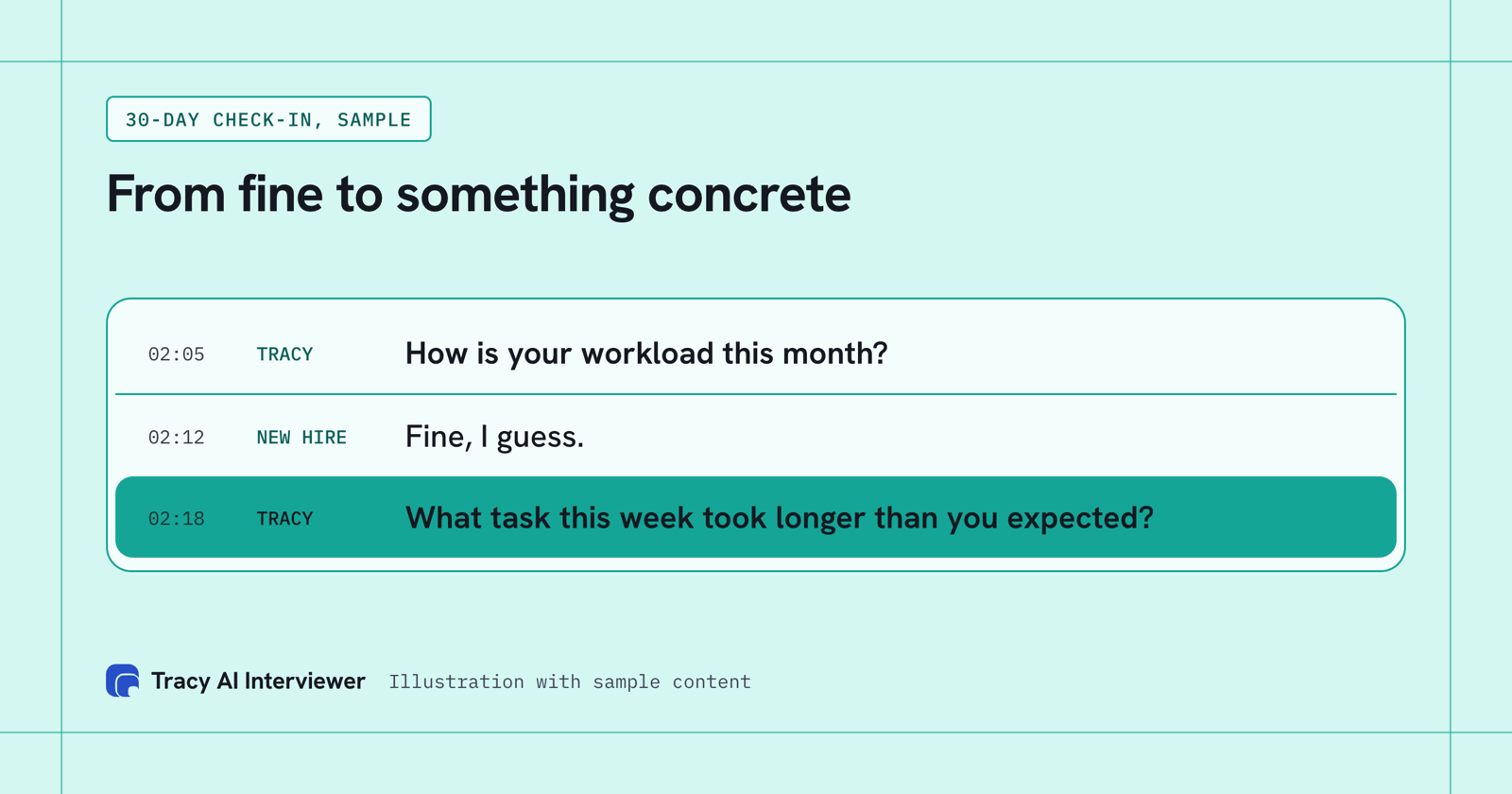
A vague check-in answer gets a follow-up that asks for one concrete example.
Performance wording (13 to 17)
13. Review wording from manager notes
Turn these manager bullets into balanced review wording: what the person did, the effect, what to do next. Use specific facts only, no adjectives like "great" or "poor". Bullets: [paste]
14. Rewrite a biased line
Read this review and flag phrases that describe personality or style instead of work, such as "abrasive" or "not a team player". Suggest replacements based on observable behaviour.
15. Goals that can be checked
Rewrite these goals so each says what will be different, how we will know and by when. Goals: [paste]
16. Development plan
Draft a development plan for someone who wants to move from [role] to [role]: skills to build, ways to practise at work, and a check-in every 6 weeks.
17. Improvement plan outline
Outline a performance improvement plan for HR and legal to review: the gap, the evidence, support offered, dates and how progress is measured. Mark every line that needs a review before use.
Policies and communication (18 to 22)
18. First draft of a policy
Draft a [remote work] policy for a company of [size] in [country]. Mark the clauses where local employment law applies. A lawyer will review this.
19. Plain-language summary
Summarise this policy in 10 lines an employee can follow in two minutes. Keep every obligation. Policy: [paste]
20. Announcement
Write an announcement of [change] to all staff: what changes, when, why, who to ask. Under 200 words and no hype.
21. Manager FAQ
Write 10 questions managers will ask about [change] and short answers. Mark any answer you are guessing so I can check it.
22. Handbook update checklist
List every handbook section likely to be affected by [change]. For each, say what to check.
Analysis (23 to 26)
23. Survey comments by theme
Group these anonymised survey comments into themes with a count and two quotes each. Do not guess who wrote what. Comments: [paste]
24. Turnover summary
Here are leavers by team and tenure: [paste]. Summarise the pattern in 5 lines and list 3 questions to ask before drawing conclusions.
25. Headcount memo
Turn these numbers into a one-page memo for the leadership team: where we are, what we planned, the gap. Numbers: [paste]
26. Training needs
From these themes in check-ins and reviews, suggest 4 training topics and how we would know each one worked.
Exit and manager support (27 to 30)
27. Exit interview questions
Write 8 exit interview questions grouped by theme: role, manager, growth, pay, culture. Ask for a specific example in each. Keep them neutral.
28. Run the exit interview with Tracy
@Tracy AI Interviewer set up an exit interview for people leaving [team]. Use my questions below, say who Tracy is and what happens with the answers, and show me the draft first. Questions: [paste]
29. Read exit themes
For the exit interviews that have finished, list repeated themes with short quotes and timestamps. Note what people said about their managers separately. I will review everything.
30. Coach a manager before a hard conversation
A manager must tell an employee [situation]. Write an opening, three things to say, three things not to say, and a closing, in plain words. HR will review it. For ready question lists to paste into prompts 9 and 28, see 30-60-90 day check-in questions and exit interview questions.
What does a survey miss that a follow-up catches?
An employee who writes "fine, I guess" to "how is your workload?" has answered and told you nothing. Prompt 12 shows the fix on paper: three gentle follow-ups that ask for one concrete example, such as which task this week took longer than you expected.
Prompt 8 gives a 30-day check-in six questions. With no follow-up, a vague answer ends the topic six times.
Four prompts hand that conversation over: 9 and 28 set up the check-in and the exit, 10 and 29 read the themes back with quotes and timestamps.
What Tracy adds to ChatGPT prompts for HR
Tracy AI Interviewer handles check-ins, engagement and exit conversations.
01
Reach every person
Each person joins in a browser when it suits them, at any hour, with no scheduling and nobody from HR on the call.
02
Ask the next question
When an answer is vague, Tracy asks a follow-up in the person's own field for the missing detail, and waits.
03
Keep the evidence
Each result has a recording, a timestamped transcript and a written assessment per question with its reasoning. ChatGPT groups finished results into themes with their timestamps.
HR decides what they mean. See AI interviews for people teams, or Claude for HR professionals if your team uses Claude.
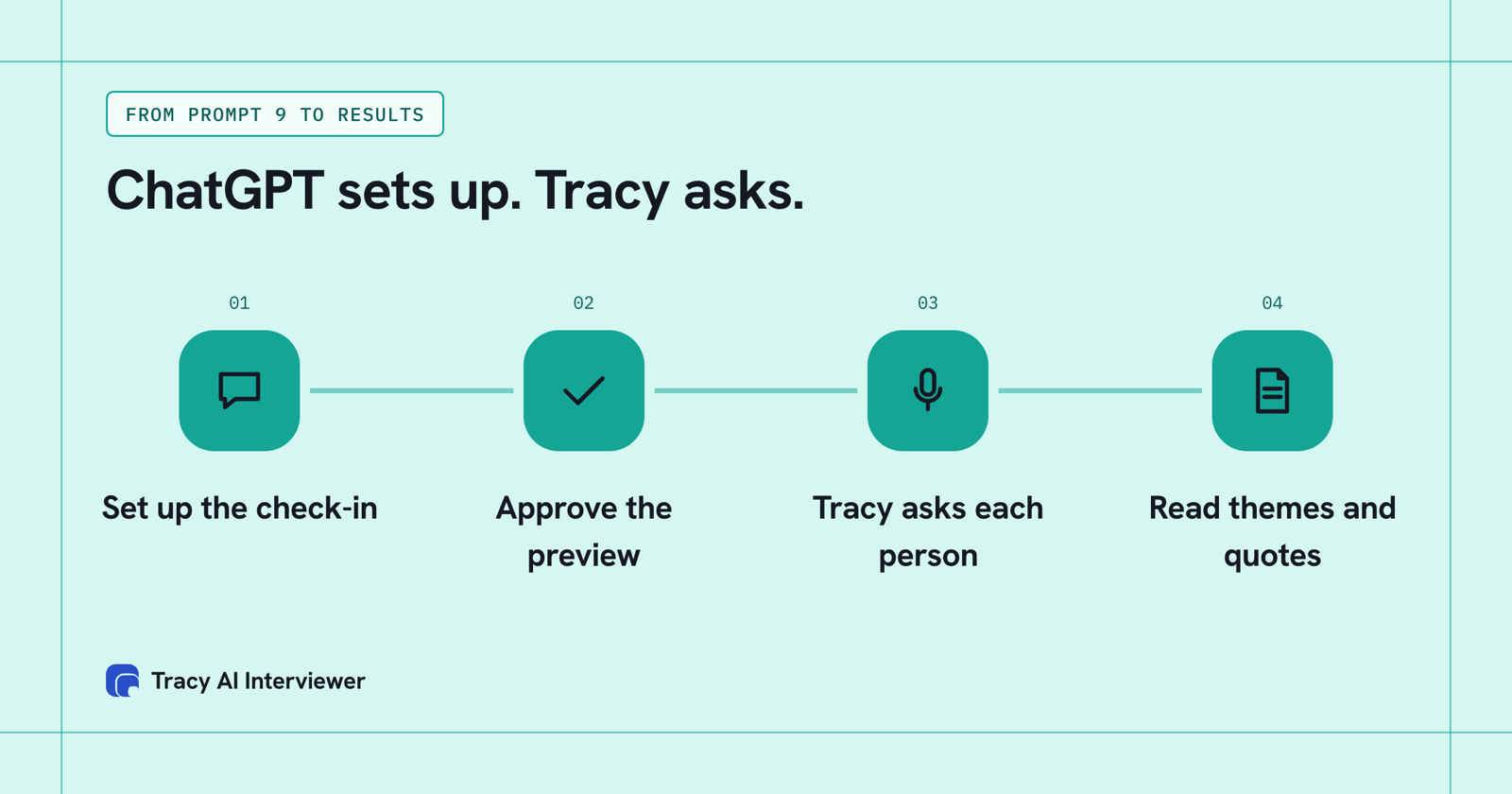
ChatGPT sets up the conversation, Tracy runs it, HR reads the themes.
Which path fits you
- A check-in programme for new hires: 30-60-90 day check-ins.
- Understanding why people leave: exit interview questions.
- Interviewing at scale for open roles: hiring at volume.
Common questions
What are the best ChatGPT prompts for HR?
Can HR use ChatGPT safely?
Can ChatGPT run exit interviews or check-ins?
Are employees told the conversation is recorded?
Does Tracy rate employees?
Run prompt 9 for next month's hires
Connect Tracy in ChatGPT, draft one check-in with your own questions, and read themes with quotes. The first 3 results are free.
Try it free (opens in a new tab) Book a demo (opens in a new tab)
Your first 3 results are free. No card needed.
Sources
- Add Tracy AI Interviewer to ChatGPT (public guide), retrieved 14 Nov 2026.
- Tracy AI Interviewer home page, retrieved 11 Nov 2026.