In short
Tracy AI Interviewer can carry a coding task in the interview and ask about the candidate's approach and its costs, so you hear how a database administrator reasons about a slow query or a failed restore.
Below are 15 database administrator questions. Each one comes with a follow-up to ask next and notes on what separates a strong reply. Start with question 1: "How do you prevent data loss?"
Each result comes with the recording, a transcript stamped with times and a written summary of the candidate's reply to every question. Your senior DBA makes the call.
A DBA looks after the data everything else depends on, so the interview has to find out who has restored a database under pressure and who has only read the manual. A CV lists SQL Server or Oracle, backups and tuning for both. Good database administrator interview questions ask about the night something broke.
The 15 questions below suit hiring managers, engineering leads and recruiters who screen DBAs, from freshers to senior administrators. Plan 20 to 30 minutes for the opening conversation, and save the hands-on session on your own systems for your team.
Tracy AI Interviewer can hold that opening conversation and include a coding task in it. Once the candidate has answered she asks how they got there and what it costs, so a tuning habit that only works on a small table gets tested. For the process around it, read how Tracy handles technical interviews. For the query side of the job, see SQL interview questions, and for a data-heavy neighbour, machine learning engineer interview questions.
What are common DBA interview questions?
They cover recovery, performance, design, operations and judgement: how the candidate prevents data loss, finds a slow query, keeps data consistent and changes a live system safely. Syntax and definitions are a warm-up, and the follow-up on a real incident is where an administrator shows experience.
Fifteen database administrator interview questions, grouped by what they test
Choose one or two from each group. Hold the follow-up back until the candidate has finished the first answer. For freshers, lean on groups 1 and 3, and agree on what a good answer includes before the first interview.
Group 1: Backup and recovery
Table 1: Backup and recovery. The follow-up to ask and what to listen for.
| Question | Follow-up | What to listen for |
|---|---|---|
| 1. How do you prevent data loss? | How do you know a backup will restore? | Full, differential and log backups, point-in-time recovery, copies kept off the server. Replication is not a backup. Restores tested on a schedule. Recovery point and recovery time agreed with the business. |
| 2. A database server fails at 2 a.m. What do you do first? | What would you have prepared in advance? | Confirms the scope, fails over to a replica or restores, tells people, then looks for the cause. A runbook, a tested failover and monitoring that paged them. |
| 3. How do you give developers a copy of production for testing? | What do you do about personal data in it? | Restores from backup, masks or scrambles sensitive columns, limits who can reach the copy. |
Group 2: Performance
Table 2: Performance. The follow-up to ask and what to listen for.
| Question | Follow-up | What to listen for |
|---|---|---|
| 4. A query that ran in seconds now takes minutes. Where do you start? | What if the execution plan has not changed? | Reads the plan, checks statistics and index use, looks for parameter-sensitive plans, blocking and I/O pressure, and recent data growth. |
| 5. When does an index hurt? | How do you decide which columns to index? | Slower writes and more storage, and unused indexes. Indexes on selective columns used in filters, joins and sorts, checked against usage statistics. Knows column order in a composite index matters. |
| 6. Two sessions block each other. How do you find and fix it? | What is the difference between blocking and a deadlock? | Finds the head of the blocking chain and the long transaction behind it. Blocking is waiting, a deadlock is a cycle the engine breaks by killing one session. Short transactions and a consistent access order. |
Group 3: Design and integrity
Table 3: Design and integrity. The follow-up to ask and what to listen for.
| Question | Follow-up | What to listen for |
|---|---|---|
| 7. What are the ACID properties, and what do isolation levels trade? | Which level do you use by default, and when do you change it? | Atomicity, consistency, isolation, durability. Stronger isolation means less concurrency. Names the engine's default, and row versioning or snapshot isolation when readers should not block writers. |
| 8. How far do you normalise a schema, and when do you stop? | When would you denormalise? | Third normal form for transactional data. Denormalises read-heavy reporting after measuring, and keeps constraints in place. |
| 9. What separates T-SQL from PL/SQL? | Which have you written more of, and what tripped you up? | T-SQL is the procedural extension of SQL Server, PL/SQL the extension of Oracle. PL/SQL has packages and block-structured exception handling, T-SQL uses TRY and CATCH in batches. Says honestly which one they know. |
Group 4: Operations and security
Table 4: Operations and security. The follow-up to ask and what to listen for.
| Question | Follow-up | What to listen for |
|---|---|---|
| 10. How do you apply a schema change to a large live table? | What if it has to be rolled back? | Online operations where the engine has them, a nullable column first, backfill in batches, expand then contract. Tested on a copy, with a rollback script and a quiet window. |
| 11. How do you set up access for developers, applications and analysts? | What would make you revoke access? | Least privilege, roles, separate service accounts, no shared logins, audit and periodic review. Encryption at rest and in transit. |
| 12. What do you monitor, and what should wake you at night? | How do you cut alert noise? | Disk and log growth, replication lag, long-running queries, failed backups and connection counts. Alerts on symptoms with an owner and a threshold. |
Group 5: Judgement
Table 5: Judgement. The follow-up to ask and what to listen for.
| Question | Follow-up | What to listen for |
|---|---|---|
| 13. Walk me through moving a database to a new version or platform. | What did you test before the cutover? | An inventory, compatibility checks, dry runs, a cutover plan with a rollback and a message to the people affected. |
| 14. A developer asks for admin rights to fix a slow report. What do you say? | What do you offer instead? | Says no politely and asks what they need. Offers read access to plans, or reviews the query together. |
| 15. Tell me about a mistake that touched production data. | What did you change afterwards? | Owns it, restores, and adds a guard such as a check before commit, a second pair of eyes or a narrower account. |
How do you prevent data loss as a DBA?
With backups that have been restored at least once. A sound answer has full and log backups for point-in-time recovery, copies stored away from the server, a replica for fast failover and a recovery point and time the business has agreed. It also says that replication copies mistakes as faithfully as data, so it does not replace a backup.
What is the difference between T-SQL and PL/SQL?
Both add procedural programming to SQL, and each belongs to one vendor. T-SQL is the extension used by Microsoft SQL Server, and PL/SQL is the extension used by Oracle Database. Candidates with experience name concrete differences, such as PL/SQL packages and its exception section against T-SQL's TRY and CATCH, and say which one they have written more of.
Three questions, a weak answer and a strong one
In each row, one question gets a weak reply and then a strong one.
Table 6: Three DBA questions with an example weak answer and an example strong answer.
| Weak answer | Strong answer | |
|---|---|---|
| Question 1, data loss | "We have replication, so we are covered." | "Nightly full and frequent log backups, copies off site and a restore into a test server every month. Replication helps with failover but it copies a bad delete as well." |
| Question 4, the slow query | "I'd add an index." | "I'd read the plan and the statistics first. Often the data grew or the plan changed for one parameter value. An index comes after that, if it helps." |
| Question 15, the mistake | "I have never made one in production." | "I ran an update without a filter. I restored from the log backup, lost four minutes of changes and now run every change in a transaction I check before committing." |
A follow-up chain on the table size
The card below is an invented exchange with a made-up candidate. It is a query-writing question that sits beside the 15 above, and the second question changes the table size, which is where the performance group (questions 4 to 6) starts.
A candidate with scale experience answers with indexes, plans and the cost of the scan.
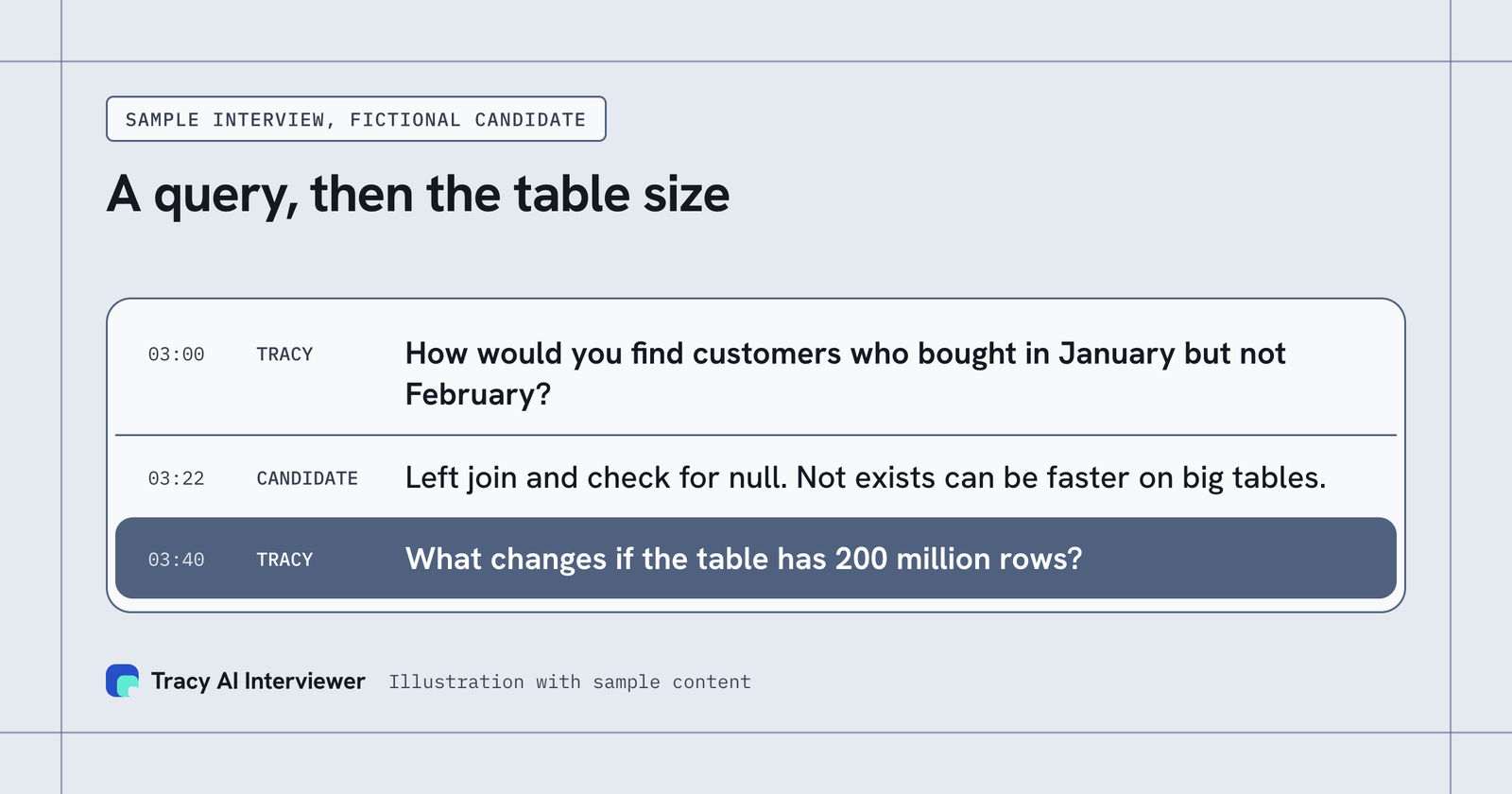
Changing the table size in the follow-up tests whether the candidate's query habit holds at scale.
Screen every DBA applicant before your seniors spend time
Your senior DBAs are also the people on call, so every screening call costs real hours. For the same problem across other technical roles, see high-volume recruitment.
- Set a coding task in the interview, for example a query to write, like the one on the card. Tracy then asks how the candidate approached it.
- Tell Tracy about the DBA role and she drafts the questions. Edit them, or swap in the ones above. See how the questions are drafted.
- The candidate joins from a browser, with no account, when it suits them. Before starting, the candidate sees that the conversation is recorded and transcribed.
- The report sets out the candidate's reply to every question, next to the recording and a timestamped transcript. See the fields in an interview report.
- In video interviews the reviewer sees integrity signals unless you switch them off; they prompt a person to look, and none of them proves anything.
There are no seats. Billing is $1 for each credit, and a credit covers each started 20 minutes, counted only when the interview produced a result. No card is needed for your first 3 results. See pricing.
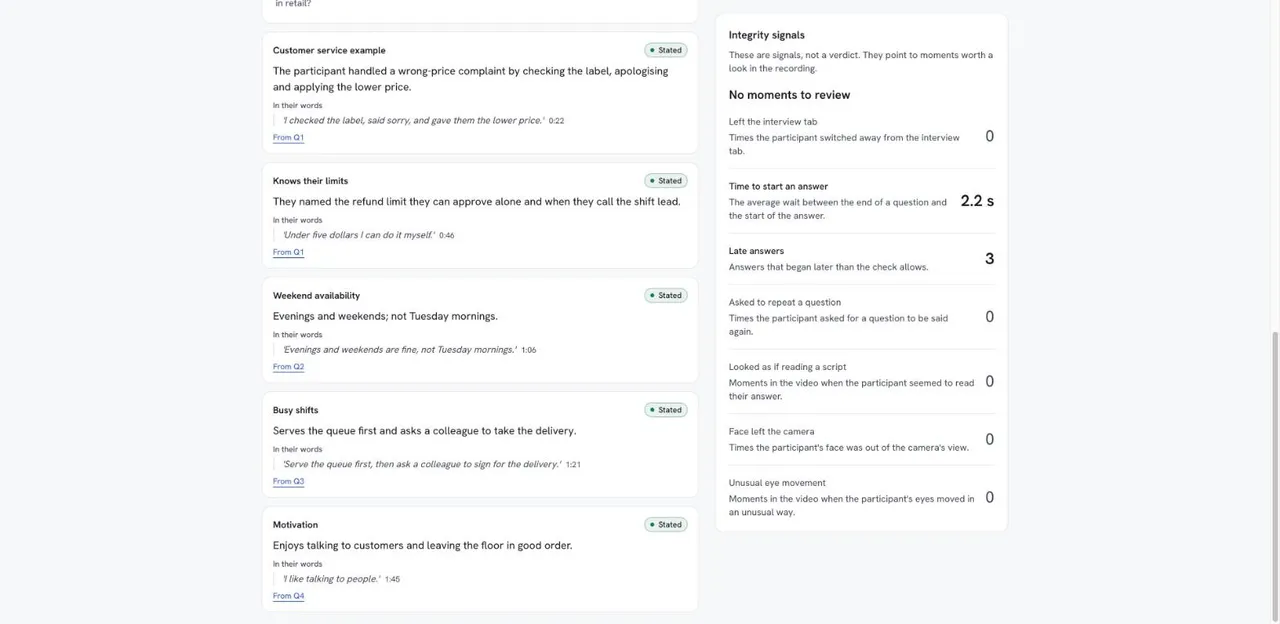
Each stated fact in the report links back to a question and a time, so a senior can check it.
What stays with your senior DBA
- Who moves forward: a senior DBA reads the report and decides. The report quotes what the candidate said, and the call stays with the senior.
- The platform fit: decide which engines count for the role, such as SQL Server or Oracle, and check every report against that list.
- The hands-on round: working through a real incident on your own systems stays with your team.
For one DBA hire a year, a call with your own senior is simpler; see when a human call is enough. Where applicants outnumber your seniors' hours, Tracy can take the first round. To test it, take three of these questions, add them to one open DBA role and have a senior read the first reports.
Common questions
What database administrator interview questions and answers suit freshers?
Can Tracy run a coding task for a DBA role?
Does Tracy pick the hire?
Hear a DBA candidate explain their query
Put a coding task in the interview and Tracy asks the candidate to explain their approach. The first 3 results cost nothing.
Try it free (opens in a new tab) Book a demo (opens in a new tab)
Your first 3 results are free. No card needed.
Sources
- Tracy AI Interviewer home page, retrieved 22 Nov 2026.
- Tracy AI Interviewer pricing, retrieved 22 Nov 2026.
- Tracy AI Interviewer Connect page, retrieved 22 Nov 2026.