In short
Common Android developer interview questions cover the lifecycle, Compose and Views, threads and ANR, offline data and releases. Below are 15, each with a follow-up and what a strong answer contains.
Tracy AI Interviewer can set a coding task inside the interview and follow up on approach and trade-offs, so you hear how a developer reasons about the screen they built.
Every result comes with a recording, a timestamped transcript and a written summary of what the candidate said to each question. Your engineers decide.
Every Android CV lists Kotlin, Jetpack Compose and Room, and the next one lists them too. A CV cannot show who has chased down a freeze on a ten-year-old phone and who has read about it. Good Android developer interview questions ask what happened when the app met real users.
These 15 questions are for hiring managers, engineering leads and recruiters screening Android developers, from two years of experience to ten. In 2026 the first conversation should cover Jetpack Compose and Kotlin coroutines beside the older Views and lifecycle questions, because most codebases carry both. Keep it to 20 to 30 minutes.
Tracy AI Interviewer can run that first conversation with a coding task inside it, then ask about the approach behind the answer. See how a technical interview with a coding task runs. Many Android codebases still contain Java, so see Java developer interview questions, and for the web side, React interview questions.
What are common Android developer interview questions?
They cover five areas: components and lifecycle, UI in Compose and Views, threading and ANR, data and offline behaviour, and shipping and fixing releases. Definitions are a warm-up. The follow-up shows whether the candidate has built it.
Fifteen Android developer interview questions, grouped by what they test
Use one or two questions from each group, and ask the follow-up after the first answer. For five years or more, start with groups 3 to 5.
Group 1: Components and lifecycle
1. Walk me through the Activity lifecycle when a user rotates the phone.
- Follow up with
- What survives that change and what does not?
- Listen for
- onCreate to onResume, and a ViewModel that outlives the rotation. State that must survive process death goes in saved state.
2. When do you use a foreground service, and when WorkManager?
- Follow up with
- What happens to your work if the user swipes the app away?
- Listen for
- WorkManager for deferrable work that must finish, with constraints. A foreground service for work the user can see.
3. The system kills your process while the app is in the background. What does the user see on return?
- Follow up with
- How do you test that?
- Listen for
- Restored state, not a blank screen. Saved state handle, nothing kept in singletons. Tests it by killing the process on purpose.
Group 2: Compose and Views
4. Jetpack Compose or XML views for a new screen, and why?
- Follow up with
- How would you add Compose to a screen that is all XML?
- Listen for
- A reason tied to the codebase, not a fashion. ComposeView and AndroidView for interop. Migrates a screen at a time.
5. What triggers recomposition in Compose?
- Follow up with
- A list item recomposes on every scroll frame. How do you find out why?
- Listen for
- Reads of state, stable keys in a lazy list, remember and derivedStateOf. Opens the Layout Inspector or the profiler before changing code.
6. How does RecyclerView reuse views, and what makes a long list janky?
- Follow up with
- What does DiffUtil do for you?
- Listen for
- ViewHolder recycling, little work in onBindViewHolder, a diff computed off the main thread, stable ids.
Group 3: Threads, coroutines and ANR
7. What is an ANR, and how would you find one in a live app?
- Follow up with
- What would cause one that only shows on older phones?
- Listen for
- The cause, not only the symptom: I/O or a long calculation on the main thread, or a lock. Reads traces and Android vitals. Uses StrictMode while developing.
8. How do coroutines fit with the lifecycle of a screen?
- Follow up with
- Where does a coroutine started in a ViewModel stop?
- Listen for
- viewModelScope is cancelled when the ViewModel is cleared. repeatOnLifecycle for collecting flows. I/O runs off the main dispatcher.
9. StateFlow, SharedFlow or LiveData for screen state?
- Follow up with
- How do you stop a navigation event from firing twice?
- Listen for
- StateFlow holds the latest value and replays it to a new collector. Treats a one-off event as state that gets consumed, and can say what that costs.
Group 4: Architecture and offline data
10. How do you structure a screen so its logic can be tested without a device?
- Follow up with
- Where does the business logic live?
- Listen for
- UI layer reads state from a ViewModel, data layer behind a repository. Plain unit tests on the ViewModel.
11. How do you handle a user with a poor connection?
- Follow up with
- How do you handle a conflict when two edits collide?
- Listen for
- Shows the last screen from a local cache, queues writes, says what the user sees offline. Picks a conflict rule, such as last write wins or a merge, and names its cost.
12. How is dependency injection set up in an app you built?
- Follow up with
- What would you do without a framework?
- Listen for
- Hilt, Dagger or Koin, and what each costs. Constructor injection, scopes, fakes in tests.
Group 5: Releases and judgement
13. A crash appears on one older OS version right after a release. What do you do first?
- Follow up with
- How would you have limited the damage?
- Listen for
- Reads the crash report for the OS and device spread, halts the rollout, ships a fix. Staged rollouts and a feature flag as the earlier safeguard.
14. How do you keep an app quick to start and small to ship?
- Follow up with
- What did you measure before and after?
- Listen for
- Measures with Macrobenchmark before changing anything. Baseline Profiles, R8 shrinking, App Bundles. A number from their own app.
15. Tell me about an OS or permission change that broke something you had shipped.
- Follow up with
- What did you change in how you work afterwards?
- Listen for
- A specific change, such as the notification permission added in Android 13. Owns the miss, and describes a habit that came out of it.
What is an ANR in Android?
An ANR, short for Application Not Responding, is the error Android raises when an app's UI thread is blocked for too long. Android's documentation gives 5 seconds without a response to an input event, and 10 seconds for a broadcast receiver when the app has an activity in the foreground.
The same page lists the usual causes: slow I/O or a long calculation on the main thread, or a deadlock. It names StrictMode for catching accidental main-thread I/O while developing.
Weak and strong answers to the same questions
Each row answers one question two ways.
Table 6: Weak and strong answers to the same questions, written as examples.
| Weak answer | Strong answer | |
|---|---|---|
| Question 4, Compose or XML | "Compose is the new thing, so everything should be Compose." | "New screens in Compose. The old ones stay in XML until we touch them, and we host Compose inside the XML screens through ComposeView." |
| Question 7, the ANR | "I'd move the code to a background thread." | "First I'd find what blocked the main thread, from the trace. If it was a database read in the ViewModel, it goes to the data layer on an I/O dispatcher, and StrictMode would have caught it earlier." |
| Question 13, the old-OS crash | "We pushed a fix as soon as we could." | "I paused the rollout, which was staged, so the crash had reached a small share of users. Then I reproduced it on that OS version and shipped the fix." |
A follow-up chain on offline writes
The exchange on the card below is invented, with a made-up candidate. It starts from question 11, and the second question is built from what the candidate just said.
A candidate who has shipped offline support picks a conflict rule and says what it costs. One who has only read about it repeats the word "sync".
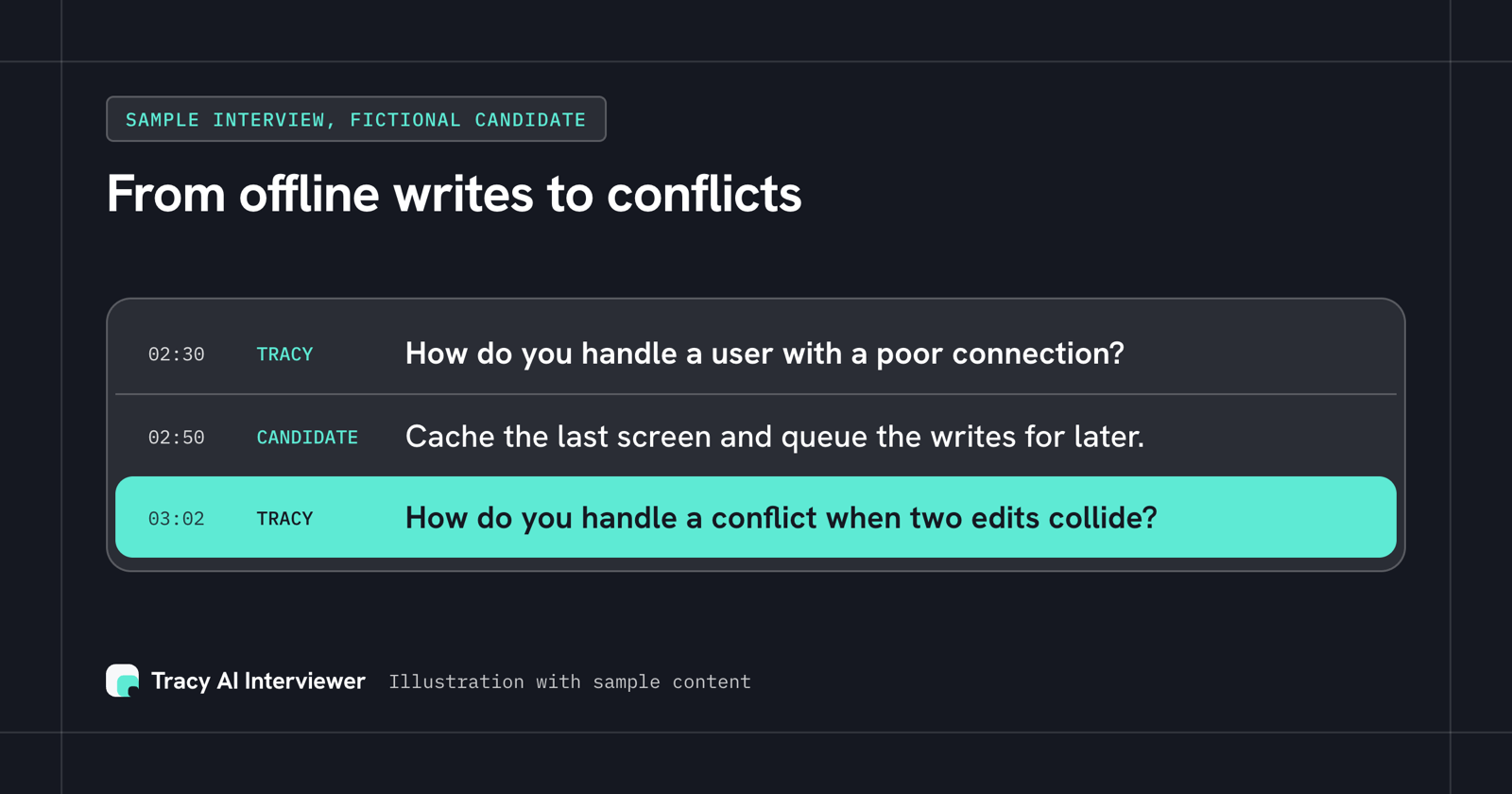
A second question built on the candidate's own answer shows whether offline handling was built or only read about.
Run the Android interview for every applicant
- Add a coding task to the interview. Tracy asks about the approach and the trade-offs behind it.
- Describe the role and Tracy drafts the questions, which you edit, or paste in the 15 above. See how Tracy drafts questions from a role.
- The candidate opens a link in a browser, with no account and no calendar, at any hour. The join screen says the conversation is recorded and transcribed, and candidates rate Tracy 92 on NPS. See the candidate's side of the interview.
- You read what the candidate said to each question, with the recording and timestamped transcript behind it. See a sample interview report.
- Video interviews run integrity signals unless you turn them off: a full-screen window, a face on camera and a pop-up if the face leaves the frame. A person reviews the evidence, and a signal is not proof.
There are no seats. A credit costs $1 and covers each started 20 minutes of an interview that produced a result. The first 3 results are free. See pricing.
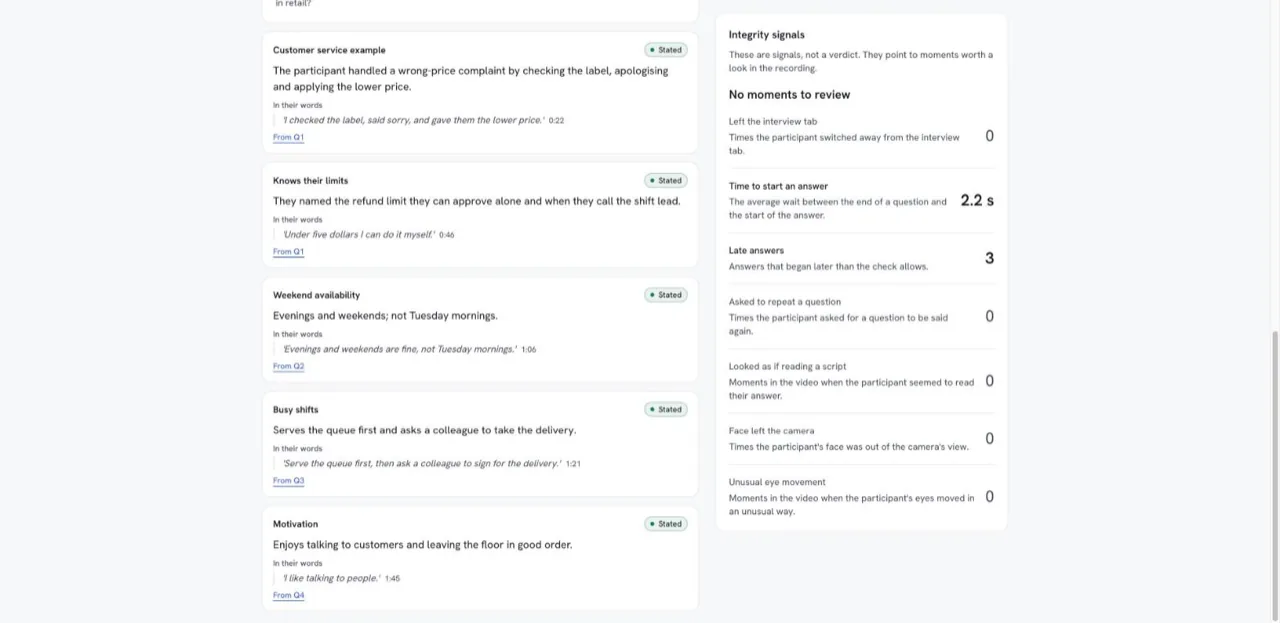
Each answer is a field that quotes what the candidate said, with a time to open in the recording.
What stays with your Android engineers
- A senior Android developer reads each report and decides who moves forward.
- Before the first interview, agree what five years of experience should show, such as a diagnosed ANR or a release they rolled back, so every report is read against the same line.
- Writing a feature in your own codebase, and system design, stay with your team as the build round.
For one or two Android hires a year, a call with your own engineer is simpler; see an AI first round compared with a human one. Tracy pays off once applicants outnumber your engineers' hours, as in hiring at volume and technical interviews. To try it, put three of these questions into one open Android role and have an engineer read the first batch of reports.
Common questions
What are common Android interview questions?
Jetpack Compose vs XML: what should a candidate say?
What Android developer interview questions suit 5 years of experience?
What is ANR?
Can Tracy run an Android coding task in the interview?
Does Tracy decide who to hire?
Hear how an Android developer reasons
Add a coding task to one Android interview and read the follow-ups on approach and trade-offs. First 3 results free.
Try it free (opens in a new tab) Book a demo (opens in a new tab)
Your first 3 results are free. No card needed.
Sources
- Tracy AI Interviewer home page, retrieved 22 Nov 2026.
- Tracy AI Interviewer pricing, retrieved 23 Nov 2026.
- Tracy AI Interviewer Connect page, retrieved 23 Nov 2026.
- Android Developers: ANRs, retrieved 23 Nov 2026.
- Android Developers: Views in Compose, retrieved 23 Nov 2026.