In short
The best computer vision engineer interview questions ask for reasons: why a transformer needs more data than a CNN, when a mask is the wrong output, what breaks on a new camera. Fifteen are below, each with a follow-up.
Tracy AI Interviewer asks them of every vision expert you are vetting, follows each answer in the expert's own field, and can include a coding task. You get the recording, transcript and what each person said per question.
Your vision lead reads the evidence and decides. The deep modelling round stays with your team.
What good computer vision engineer interview questions do
A profile can list PyTorch, OpenCV and a detection model and still not show whether the person can say why a model fails. Good computer vision engineer interview questions ask for the reason behind a choice, and each one below has a follow-up that goes after it.
Expert-supply leads, hiring managers and vision leads can run these 15 questions in a first conversation of 20 to 30 minutes. Job seekers can read each follow-up as the second question coming. Machine vision roles, where cameras sit on a production line, lean on questions 7, 11 and 14.
If a candidate says they would retrain, Tracy's next question is how they would know the data is the cause. For the same method on a neighbouring role, see AI engineer interview questions.
What should a computer vision engineer interview test?
It should test whether the person can match a method to a problem, trust an evaluation and keep a model working after it ships. The Vision Transformer paper bears on question 1: it reports that transformers lack some inductive biases of CNNs and generalise poorly on too little data, and that with 14 million to 300 million images large-scale training trumps inductive bias.
Fifteen computer vision engineer interview questions, grouped by what they test
Pick one or two from each group and ask the follow-up when the first answer ends. Fix what a strong answer contains before the first interview.
Group 1: Architectures
1. How do vision transformers differ from CNNs?
- Follow up with
- What changes when you have only 50,000 labelled images?
- Listen for
- Convolutions build in locality; self-attention is global. A transformer with too little data generalises worse, so pretraining matters.
2. What does a convolution layer learn, and what does stride or pooling cost you?
- Follow up with
- What happens to a 10-pixel object after four downsampling steps?
- Listen for
- Local filters shared across the image. Downsampling loses small detail; feature pyramids or higher resolution recover it.
3. When do you start from a pretrained backbone, and when from scratch?
- Follow up with
- What do you freeze first?
- Listen for
- Pretrained when labels are few, fine-tuned gently. A large domain gap (thermal, aerial) needs more adaptation.
Group 2: Detection and segmentation
4. What is the difference between semantic and instance segmentation?
- Follow up with
- Which would you use to count cars in a car park?
- Listen for
- Semantic labels each pixel, so touching cars merge. Instance separates objects, which counting needs. Panoptic combines both.
5. How do you evaluate a detector?
- Follow up with
- mAP at IoU 0.5 is high and at 0.75 is low. What does that tell you?
- Listen for
- IoU is box overlap. Objects are found but boxes sit loosely.
6. A detector misses small objects. What do you try?
- Follow up with
- What would you check in the labels?
- Listen for
- Higher resolution, tiling, a feature pyramid, scale settings. Consistent label sizes, no tiny noisy boxes.
Group 3: Data and evaluation
7. The model works on your test set and fails on a new camera. Where do you look?
- Follow up with
- How do you separate a data problem from a model problem?
- Listen for
- Lighting, lens, resolution, compression. Compares image statistics and labels a small sample from the new camera.
8. How do you check label quality?
- Follow up with
- Two annotators disagree on one box in five. What now?
- Listen for
- A written guide with edge cases, agreement measured on a shared sample, disagreements reviewed before relabelling.
9. How do you split images into train and test?
- Follow up with
- The frames come from 200 videos. What goes wrong with a random split?
- Listen for
- Near-identical frames from one video land on both sides and inflate the result. Split by video, scene or site.
Group 4: Production
10. How do you take a model to production?
- Follow up with
- What do you measure after launch?
- Listen for
- Latency budget on the target hardware, export and runtime, versioning, a shadow run, monitoring, a rollback path.
11. The model takes 30 ms on your GPU and 200 ms on the device. What do you do?
- Follow up with
- What would you give up first?
- Listen for
- Profiles first. Quantisation, a smaller backbone, lower resolution, post processing cost. Trades accuracy with the owner.
12. Write code that computes the IoU of two boxes.
- Follow up with
- What do you return when the boxes do not overlap, or one has zero area?
- Listen for
- Intersection clamped at zero; union is both areas minus the intersection; guards a zero denominator.
Group 5: Judgement
13. Tell me about a vision model that failed in the field.
- Follow up with
- What did it teach you about the data?
- Listen for
- A real case, what they measured, what they changed. A cause, not a guess.
14. When is a classical method such as thresholding or template matching the better choice?
- Follow up with
- How would you show a deep model earns its cost?
- Listen for
- Fixed camera, controlled lighting, few labels, a hard latency limit. A classical baseline to beat.
15. How do you decide a model is accurate enough when errors cost different amounts?
- Follow up with
- Who signs off?
- Listen for
- Error costs per class, results per class and not one average, thresholds set with the owner.
Weak and strong answers to the same questions
Each row answers one question two ways.
Table 6: Weak and strong answers to the same questions, written as examples.
| Weak answer | Strong answer | |
|---|---|---|
| Question 1, transformers and CNNs | "Transformers are newer, so they are more accurate." | "A CNN builds in locality, so it learns from less data. A transformer attends across the whole image, so it needs more data or pretraining, and with enough of it can do better." |
| Question 10, production | "I would put it in a container and deploy it." | "First the latency budget on the target device. Then export and test there, run it in shadow beside the current system, and keep a rollback path." |
Follow-up chains on the questions that separate people
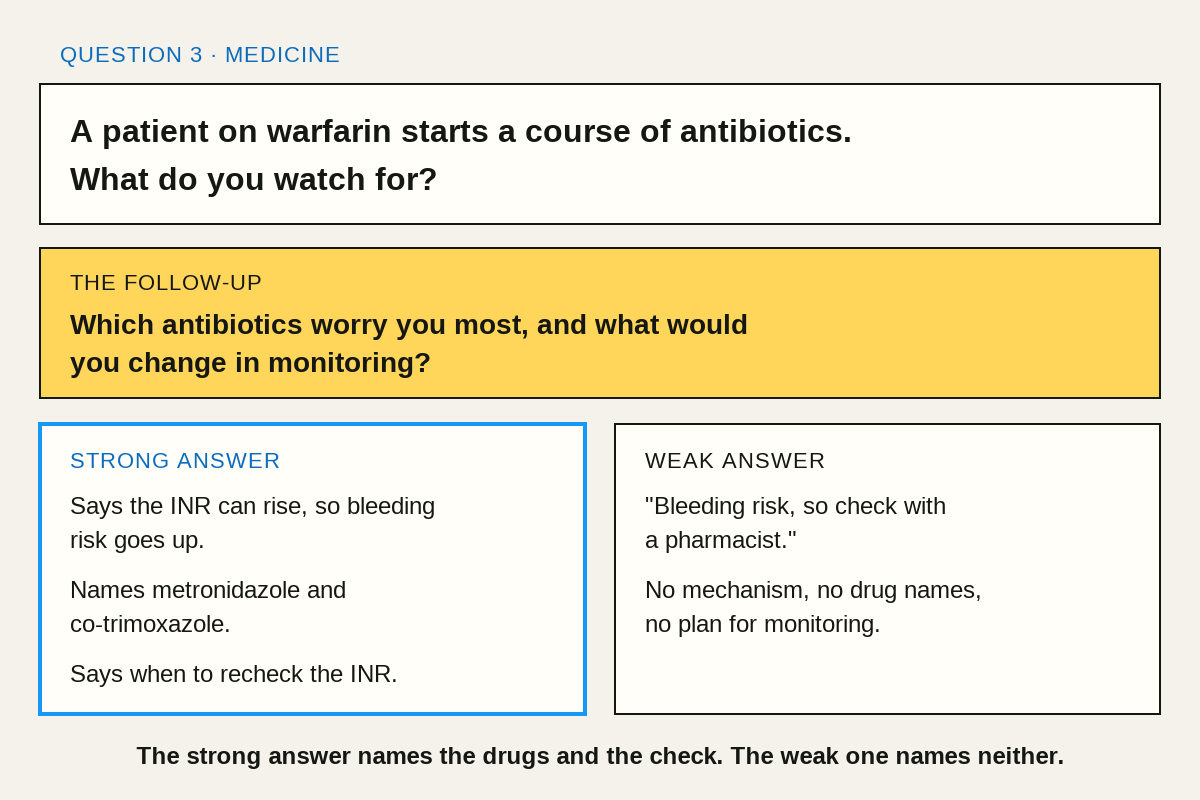
Two chains follow, and the figure below shows a third, from question 1. All three are illustrations: the candidate is fictional and no real interview sits behind them.
Question 7, the new camera
Tracy: The model works on your test set and fails on a new camera. Where do you look?
Candidate (fictional): I would retrain with images from the new camera.
Tracy: Before retraining, how would you tell it is the camera and not the model?
Candidate: Label about a hundred frames from it, compare per-class results with the old camera, and check exposure and compression against the training images.
Question 10, production
Tracy: How do you take a model to production?
Candidate (fictional): Export it and serve it behind an API.
Tracy: The device has to answer in 50 ms. What now?
Candidate: Measure on the device first. If it is over, quantise or lower the resolution, and see what that costs in accuracy.
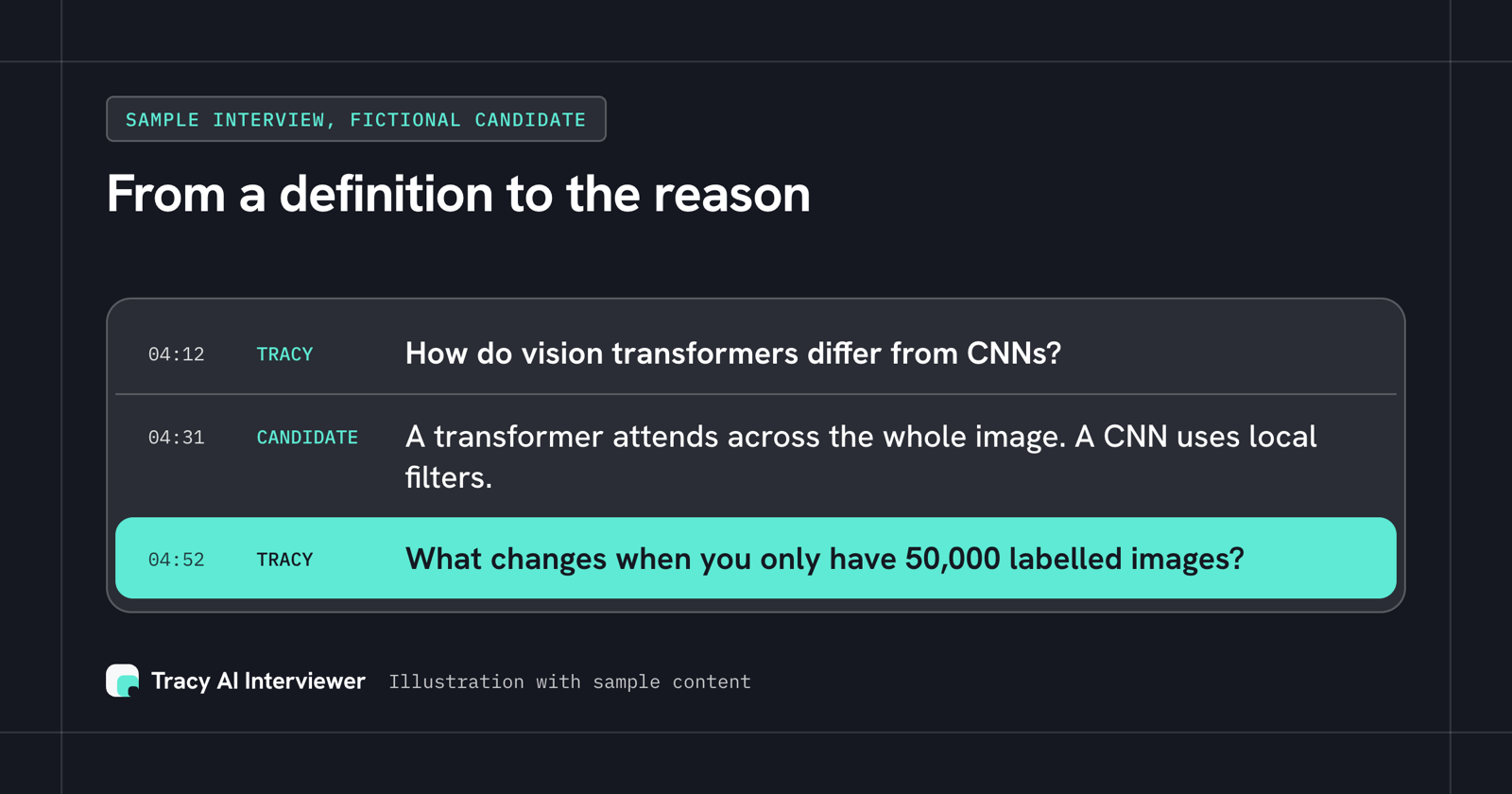
A second question built on the expert's own answer shows whether they know why the two designs differ.
What a list of questions cannot do alone
A list can hold "What changes when you only have 50,000 labelled images?", but that question exists only once the expert has answered the first one, so it cannot go out as a form. Say 150 vision experts apply for a project this week: a 30-minute call each is 75 hours of reviewer time. Tracy asks the second question as each expert answers, and your vision lead reads the chains.
How Tracy runs the interview for every vision expert
Every expert, at any hour
Each expert starts on click from one link, in a browser, with no scheduling and no reviewer on the call. The join screen says the conversation is recorded; see what the expert sees before they begin.
Questions in the expert's own field
Describe the role, for example a detection engineer for retail cameras, and Tracy drafts the questions; you edit them or bring the 15 above. Tracy follows what the expert said and waits for the end of the answer. A coding task such as question 12 can sit inside the same interview, with follow-ups on approach and trade-offs.
Evidence a reviewer can check
Each result holds a recording, a timestamped transcript, what the expert said to each question, the result fields and a note for your ATS. Tracy does not rank anyone, and integrity signals, such as a full-screen exit or the face leaving the camera, go to a person to review and are never proof.
One customer cut its average time to hire from 44 days to 7, and Tracy did the work of 53 full-time recruiters in one month.
What the reviewer reads afterwards
The sample below comes from a machine learning screen and sits close to question 7, a model that works offline and fails live. The reviewer gets a summary, a timed quote, the follow-up Tracy asked and the evidence for each field. All of it is invented. For the rest of a report, see the questions and fields in a Tracy report.
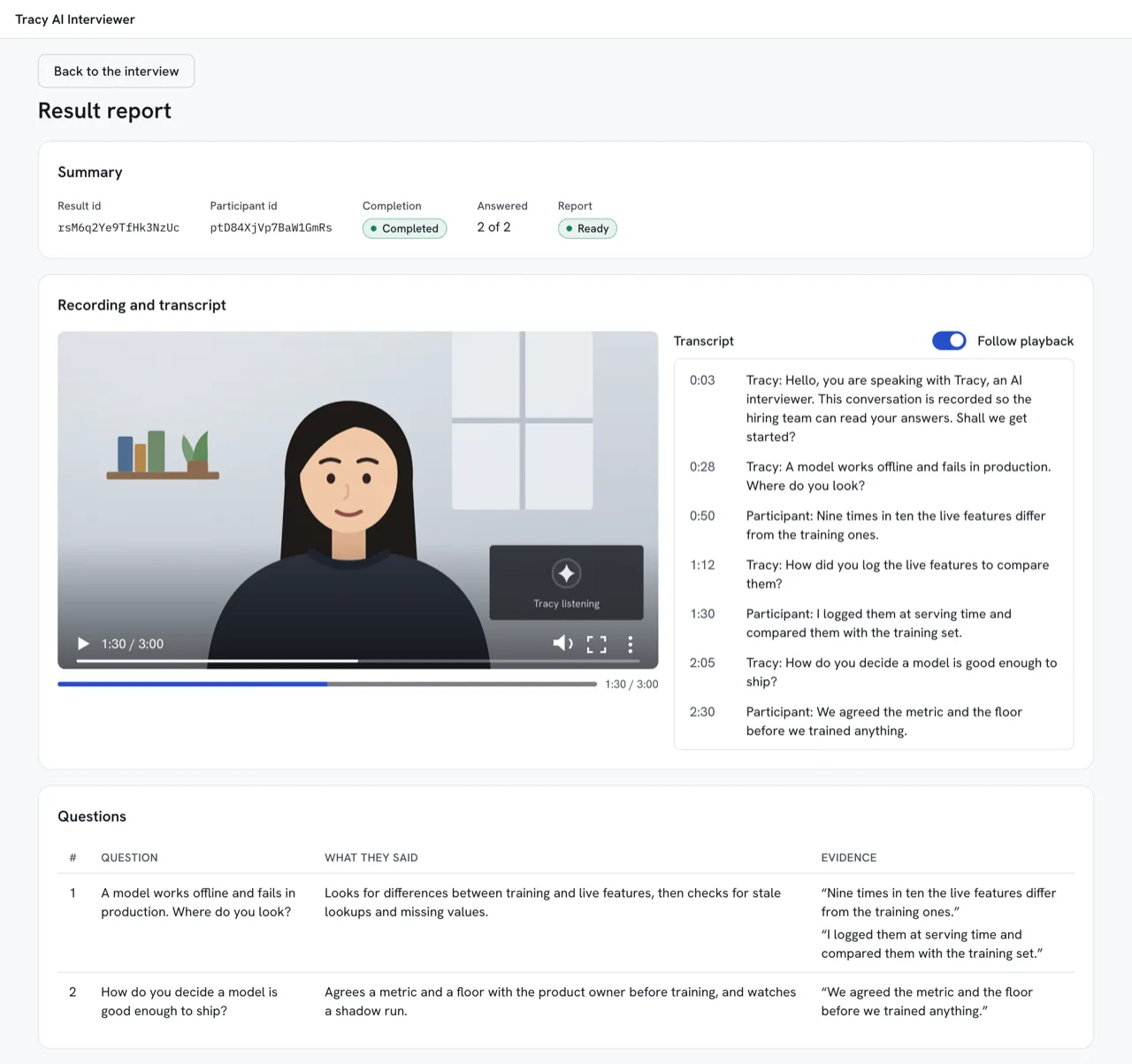
The reviewer can set each summary line against the quote, its time and the evidence for the field.
Keep three decisions with your vision lead
- A vision lead reads the report and decides from the expert's quoted answers.
- A second vision engineer reads five transcripts blind to calibrate. If the reads differ, change the questions before the next hundred invitations.
- The deep round, a dataset exercise or a paper discussion, stays with your team.
For a handful of placements a year, a call with your own lead is simpler. When a project needs a pool of vision experts quickly, expert vetting with Tracy covers that case, and how AI interview tools compare for expert vetting lists the tools.
Related questions by role:
- The neighbouring modelling role: machine learning engineer questions.
- Language models and agents: NLP engineer interview questions.
- The coding language in most vision work: Python interview questions.
- A different field, same method: subject matter expert interview questions.
Common questions
How do vision transformers differ from CNNs?
What is the difference between semantic and instance segmentation?
How do you take a computer vision model to production?
What are good machine vision engineer interview questions?
Are these the same as computer science engineer interview questions?
Can Tracy run a coding task in a computer vision interview?
Check a vision expert in one interview
Run three of these questions on one open role and read the first report. First 3 results are free.
Try it free (opens in a new tab) Book a demo (opens in a new tab)
Your first 3 results are free. No card needed.
Sources
- Dosovitskiy et al., An Image is Worth 16x16 Words (Vision Transformer), ICLR 2021, retrieved 23 Nov 2026.
- Kirillov et al., Panoptic Segmentation, 2018, retrieved 23 Nov 2026.
- Tracy AI Interviewer Connect page, retrieved 23 Nov 2026.
- Tracy AI Interviewer pricing, retrieved 14 Nov 2026.