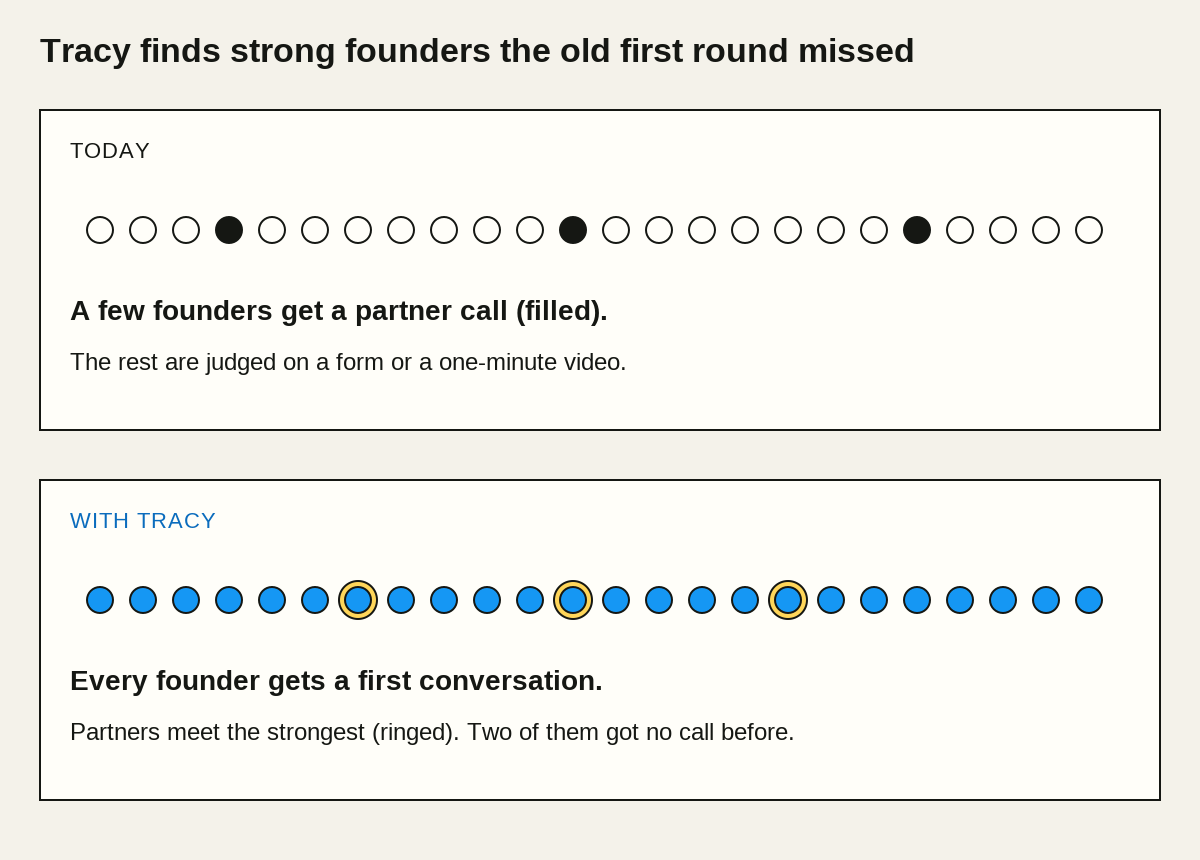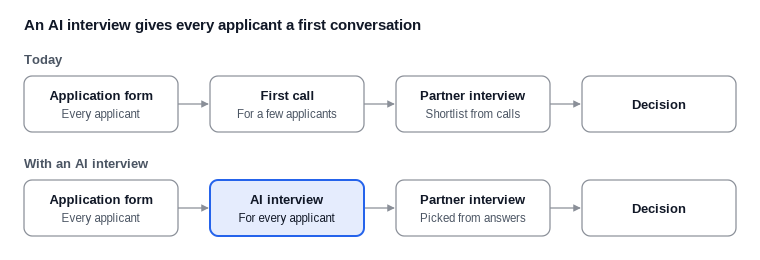
In short
As of November 2026, ChatGPT reads decks and drafts memos, and Tracy AI Interviewer, connected to ChatGPT, interviews each founder so your team hears the answers behind the claims.
Each founder opens the interview from a link when it suits them, and Tracy follows up on the detail that is missing from their answer. The first 3 results are free.
Your team reads the quote and timestamp behind each finding and decides.
ChatGPT for due diligence works best as a fast first reader. Give it a pitch deck, a data room index or your own notes and it will summarise, pull out the claims worth checking and draft a memo. It works only from what it was given.
This guide sets out a workflow for an accelerator or VC programme: what to hand ChatGPT, what to check yourself and where an interview closes the gap. It pairs with our list of due diligence interview questions for founders, which covers what to ask once you know what to test.
Can ChatGPT do due diligence?
It can do a first pass over documents and public information, and a person has to check it. OpenAI's own customer story on a law firm's diligence tool, dated 29 October 2026, says the tool "takes a first pass by combing through thousands of pages" of deal documents, and that lawyers "still need to review everything" before work reaches a client. The page gives no accuracy figure.
Treat ChatGPT the same way. It is quick at reading and sorting, and the judgement about what a claim is worth stays with your team.
A due diligence workflow in six steps
- Write the decision first, in one line: admit, invest or pass, and the three things that would change your mind.
- Pull the claims out of the deck by asking ChatGPT to list every factual claim and the page it came from.
- Run the desk research. ChatGPT's deep research writes a report with citations or source links, which OpenAI says are there so you can verify the information. Open each one. Deep research uses read actions from connected apps and no write actions.
- Read the documents. Upload the deck, the financial model or the data room index and ask for summaries that mark what a document does not state.
- Ask the founder, using the interview section below.
- Draft the memo, then decide. ChatGPT drafts from your notes and the interview quotes. A person signs it off.
Prompts you can copy
These are examples to adapt. Run them first on a deal you already know and compare the output with what you know.
- Claims: "List every factual claim in this deck that I could check from outside sources, one per line, with the page it came from."
- Weak spots: "For each claim above, say what evidence a founder could show for it, and write one question I should ask if they cannot."
- Documents: "Summarise this document in five bullets. Write 'not stated' for anything it does not cover. Do not guess."
- Names: "Here is the founder's name, city and previous employer. List what you can say about them, and flag anywhere you may be mixing them up with someone of the same name."
- Memo: "Using only my notes below, draft a one page memo with four headings: claim, evidence we have, evidence missing, question for the founder."
What are the risks of using ChatGPT for due diligence?
Four are worth planning for. Xapien, which sells a due diligence product, lists the same ones on its own page, so weigh the source: data privacy, drafts that contain wrong information, confusion between people or companies that share a name, and gaps in what the model can reach. Its page notes that ChatGPT "doesn't have access to all information, including databases and some web pages and images."
Three habits cover most of it:
- Check the plan's data terms before you upload. OpenAI says it does not train on business data by default for ChatGPT Business and Enterprise. Its pricing page lists training on content as "opt-out available" for Free, Go, Plus and Pro.
- Leave out what you do not need. Remove personal details that do not bear on the decision.
- Keep the verdict with a person, because a ChatGPT memo is a draft until each line has a source you have opened.
What ChatGPT cannot ask a founder
A deck says "four of eleven pilot clinics pay". ChatGPT can list that claim and suggest a question. It cannot ask the founder what those four clinics have in common, or hear how the answer comes. For a programme with hundreds of applications, a partner cannot hold every first call.
Tracy AI Interviewer connects to ChatGPT through its MCP server. In ChatGPT you name the founders and say what you need to learn; Tracy drafts questions that you edit or swap for your own. Before anything is created or sent, ChatGPT puts a preview in front of you and waits for your approval. Setup is covered in how to add MCP to ChatGPT.
Each founder gets a link to open in a browser. Founders do not need an account, and the join screen says the call is recorded and transcribed. Nobody books a slot, so a founder in any time zone can start when the link suits them. Tracy waits for the end of each answer, then asks about the detail that was missing, in the founder's own words. A founder who says four of eleven pilot clinics pay gets asked what those four have in common.
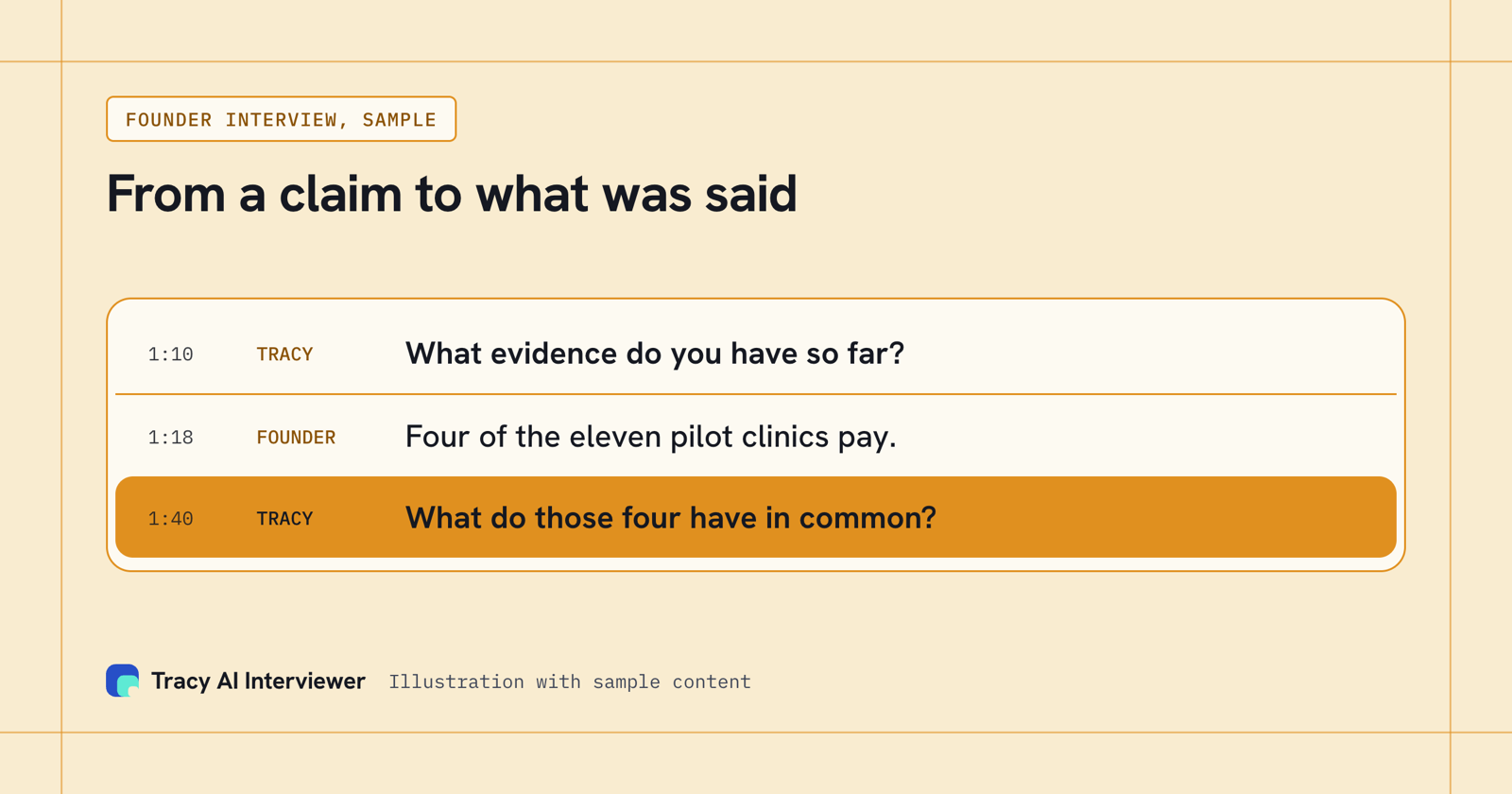
A claim from the deck becomes a quote and a follow-up.
What the founder said, field by field
Once the interview ends, ask ChatGPT for the results and it lists each founder's answer per question, fields such as the problem and the evidence so far, and a note for your applicant tracking system. By default it returns the latest completed session, and a report appears shortly after a session ends. The report carries what each founder said and the evidence for it. Judging who to back stays with your team.
Here is how it reads for the physio-clinic founder in the screen further down:
| Result field | What the founder said | Evidence |
|---|---|---|
| The problem | Rebooking no-shows costs small physio clinics front-desk hours each week | 0:34, "Small physio clinics lose hours every week rebooking no-shows." |
| Evidence so far | Four of eleven pilot clinics pay | 1:18, "Four of the eleven pilot clinics pay." |
| Follow-up asked | What do those four have in common? | After 1:18 |
| What they learned | Clinics with more than three practitioners are the ones that pay | 1:47, "The four that pay all have more than three practitioners, so that's who we sell to now." |
Invented sample data.
Each field carries a quote and a timestamp, so checking a claim means asking the founder about one answer, not searching a transcript.
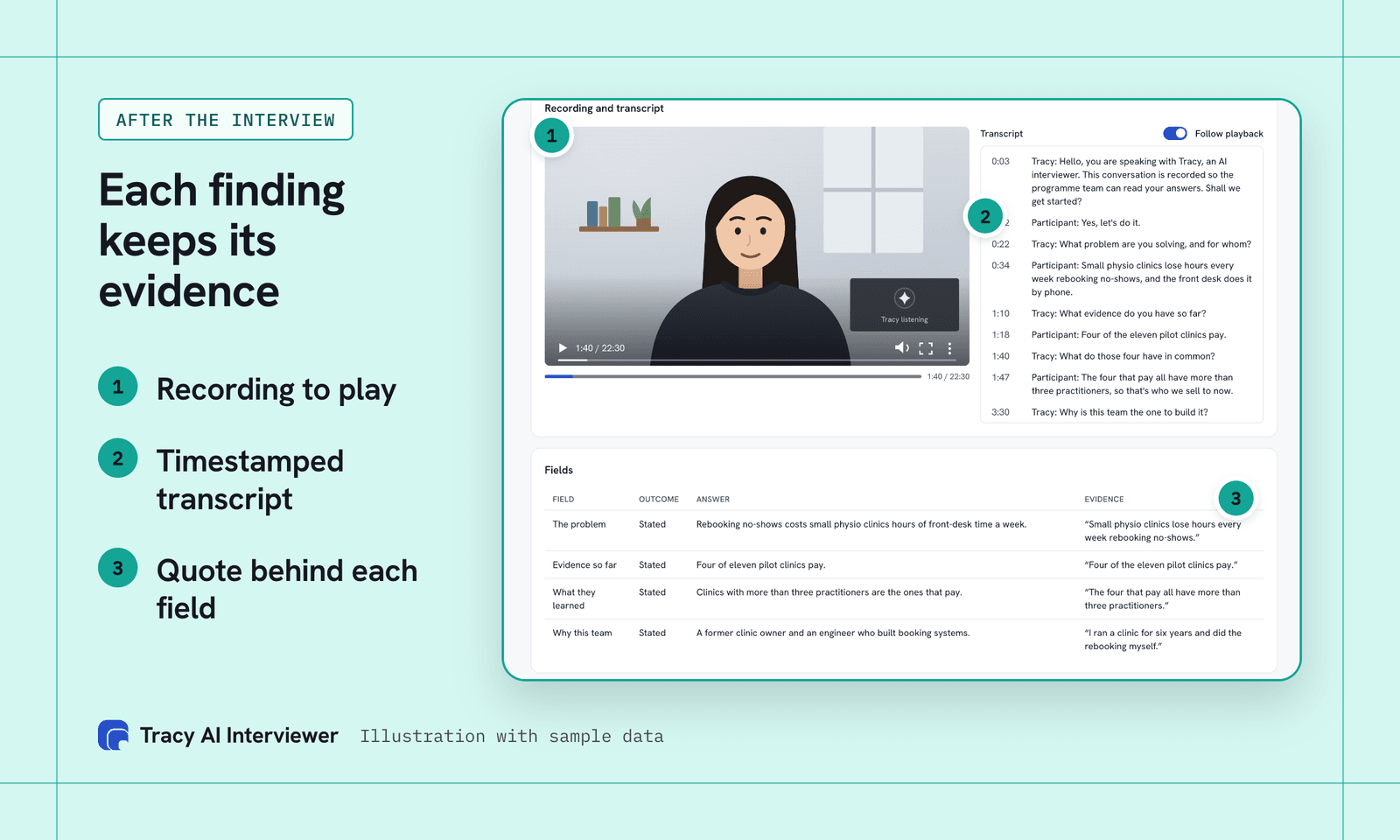
Each finding keeps the words and the moment behind it.
Which path fits you?
- Planning the questions: due diligence interview questions for founders and the accelerator selection process.
- Running a first call with every applicant: AI interviews for founders.
- Connecting Tracy to ChatGPT: adding Tracy's server to ChatGPT, step by step and the Tracy ChatGPT guide.
- Browsing what else ChatGPT can reach: ChatGPT connectors for work.
Common questions
Can ChatGPT do due diligence?
What are the risks?
Can ChatGPT produce a due diligence report?
Can I run founder interviews from ChatGPT?
Interview founders from inside ChatGPT
Connect Tracy to ChatGPT, describe the founders you want to hear from, and approve the preview. First 3 results free.
Try it free (opens in a new tab) Book a demo (opens in a new tab)
Your first 3 results are free. No card needed.
Sources
- OpenAI, How Ropes & Gray is developing AI for transactional diligence, retrieved 22 Nov 2026.
- OpenAI Help Center, Deep research, retrieved 22 Nov 2026.
- OpenAI, ChatGPT Business pricing, retrieved 22 Nov 2026.
- ChatGPT pricing, retrieved 22 Nov 2026.
- Xapien, How to use ChatGPT for due diligence, retrieved 22 Nov 2026.
- Tracy AI Interviewer, Connect, retrieved 15 Nov 2026.