AI Interviews for Accelerator, Fellowship and Program Applications
Most accelerators read every application but talk to only a few of the people behind them. An AI interview gives every applicant a short first conversation, so partners can choose who to meet from what each founder said. It works the same way for fellowships, grant programs and any program that picks people from an open application.
How programs choose today
Most programs run some version of the same funnel:
- An application form, sometimes with a short founder video.
- A first call with a partner, a venture partner or an alum.
- A longer interview with the partners who decide.
- An offer.
The second step is the expensive one. In a 2019 guide, 500 Global described its first step as "a 30 to a 45-minute phone screen with one of our venture partners or entrepreneurs-in-residence." Multiply that by every applicant and the hours run out, so most programs give first calls to a small share of applicants and judge the rest on the form.
What a form can't tell you
A form shows how well someone writes. It can't ask a follow-up question. Founders can now polish an application with AI in an afternoon, and in our view that makes the strong forms and the weak ones harder to tell apart. The founder with a sharp insight and a rough application rarely gets the call, while partner hours go to calls that are a clear no early on.
What an AI interview changes
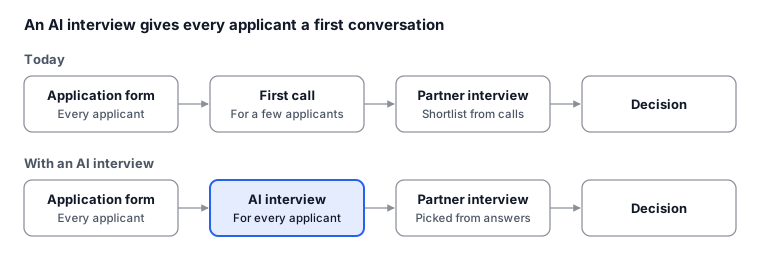
Today only a few applicants get a first call. With an AI interview every applicant gets one, and partners pick who to meet from the answers.
- Every applicant gets a first conversation. Add one link to your application confirmation. Founders join from their browser, with no account to create.
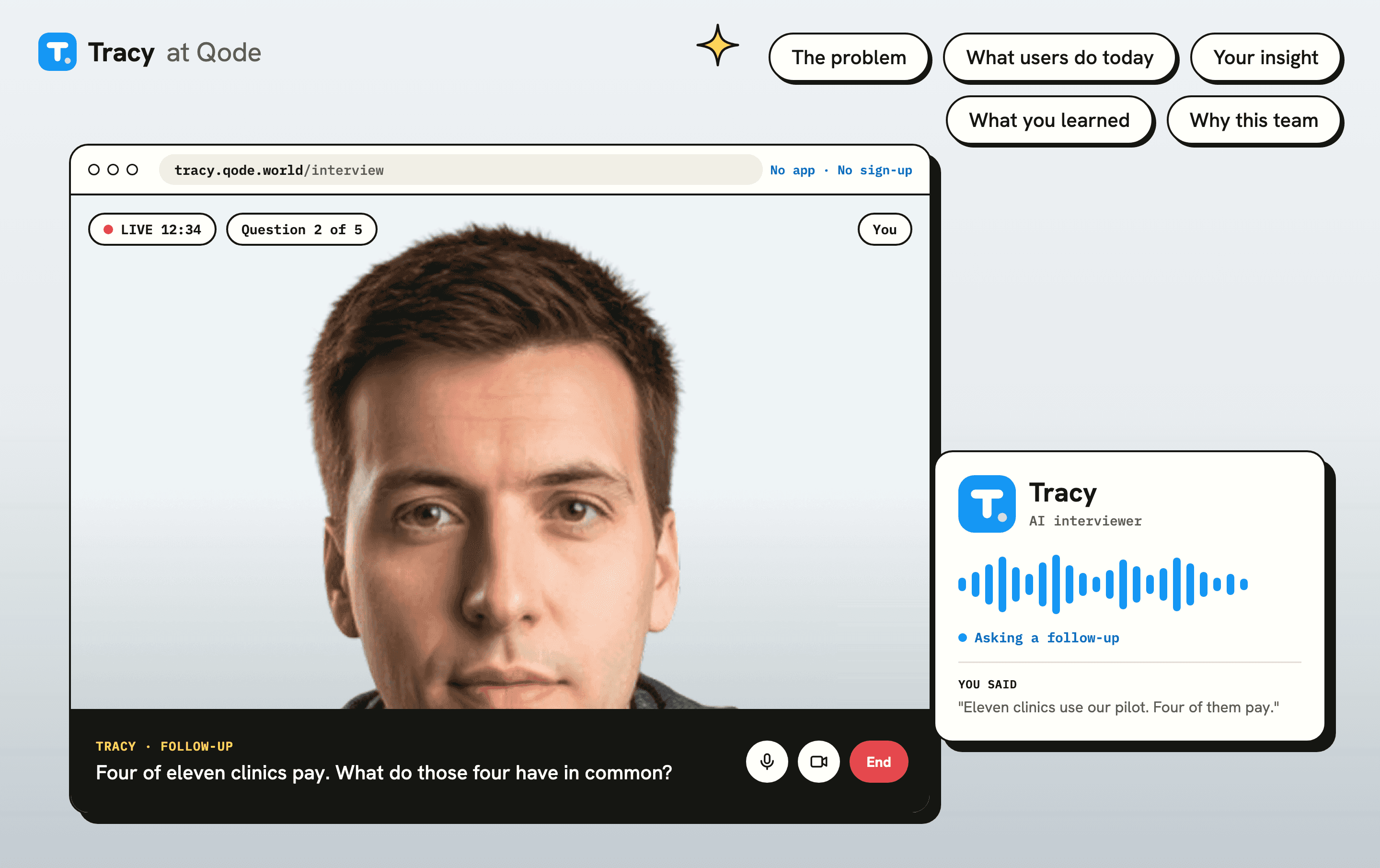
- It's a two-way conversation. Tracy at Qode runs a video interview that asks your questions and follows up on each answer, the way a partner would.
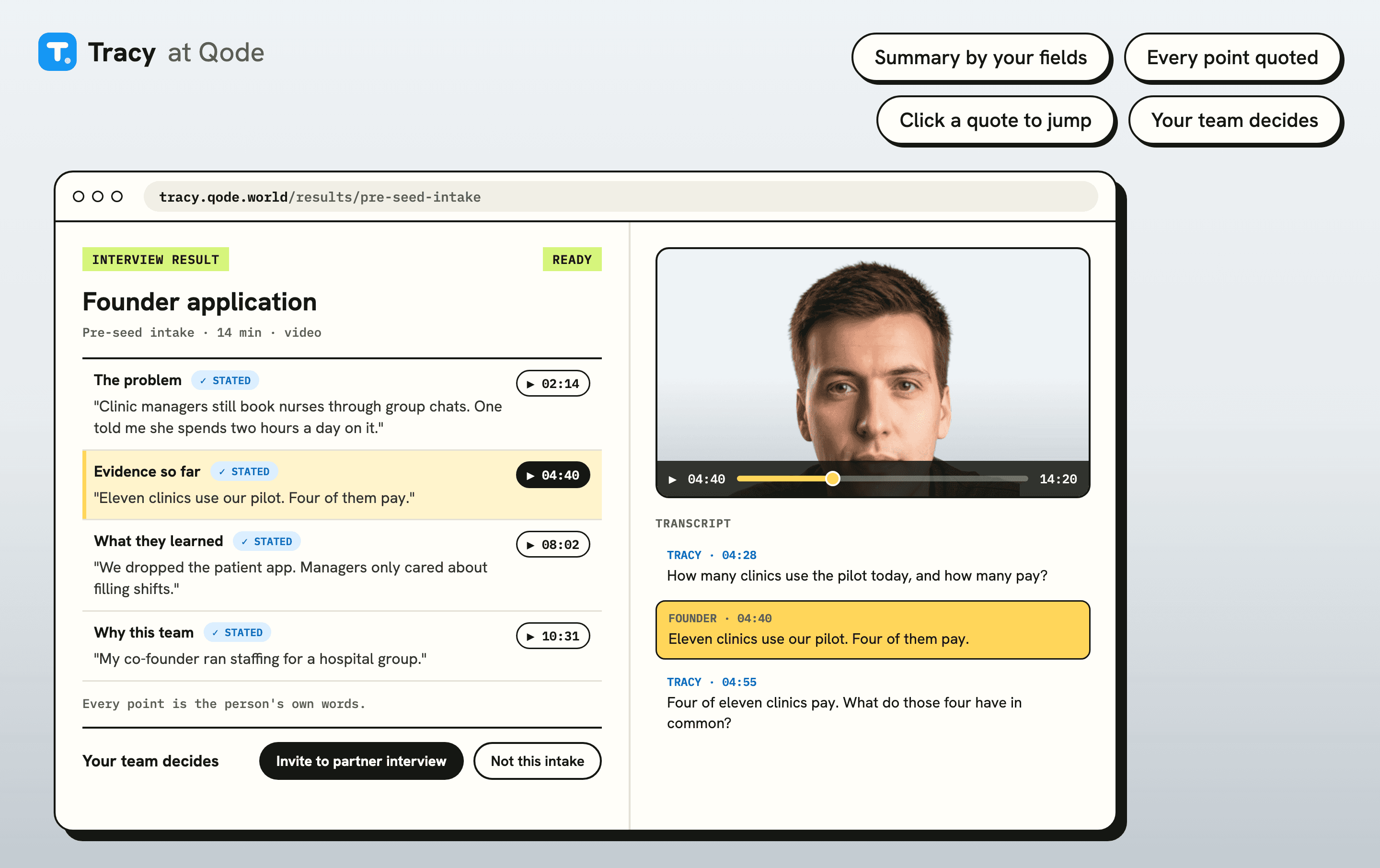
- Partners read instead of scheduling. Each founder gets a summary organized by the fields your partners care about, backed by the founder's own words, with the recording and transcript side by side. See AI interview summaries for how a summary is laid out.
- People still decide. Scoring is optional. Partners choose who to meet from what the founders said.
The partner call stays where it is. Founders now reach it on the strength of what they said in the first round, and the partner who meets them already has their answers on file. A founder who writes a plain application but explains the business well on video now gets the same look as one with a polished form.
A sample first-round interview
Here is a first round we would set up for a pre-seed program. Each question has a follow-up that Tracy adapts to the founder's answer.
| Question | Tracy follows up on |
|---|---|
| What problem are you solving, and who has it worst? | The last time they spoke to one of those people, and what they heard |
| What do those people use today instead? | Why they haven't switched to something better already |
| What do you know about this market that others don't? | The specific claim, and how they found it out |
| What's the most important thing you've learned from users, and what did you change? | Evidence that the change worked |
| Why is your team the one to build this? | The experience behind the answer |
This is what a partner reads afterwards. It's an illustration with test data, not a real founder.
| Field | What the founder said |
|---|---|
| Problem | "Clinic managers still book nurses through group chats. One told me she spends two hours a day on it." |
| Evidence so far | "Eleven clinics use our pilot. Four of them pay." |
| Learning | "We dropped the patient app. Managers only cared about filling shifts." |
First-round options compared
| Option | What partners learn | Partner time | Founder experience |
|---|---|---|---|
| Form only | What the founder wrote, or what AI helped them write | Reading time | No conversation |
| One-way video | A recorded pitch, with no follow-up | Watching each video | Talking to a camera |
| Partner first calls | The most, and the start of a relationship | A call per founder, so only a few get one | The best, for the few who get one |
| Two-way AI interview | Answers to your questions, with follow-ups, in the founder's own words | Reading a summary | A real conversation, for every applicant |
Partner calls still win on relationship. If your partners can call most of your applicants, keep doing it. An AI interview helps once applications outrun partner hours, and it works best as the step before the partner call. AI interview vs human interview covers what each does better.
How to set it up before your next intake
- Write down what partners want to know after a first call. Three to five fields is enough: problem, evidence, insight, learning, team.
- Turn those fields into questions. Describe who you're interviewing and what you want to learn; Tracy drafts the questions and you edit them.
- Take the interview yourself, the way a founder would, and change anything that feels off.
- Add the link to your application confirmation, or send it to everyone who applies.
- Read the summaries each week, field by field, and invite the strongest founders to a partner interview. Keep the recording for the partner who meets them.
- Tell applicants that an AI runs the first interview and that partners make every decision. Are AI interviews legal? covers what to disclose.
Pricing is per result, with no seats to buy: $7 per credit, and one credit covers up to 20 minutes. The cost follows the size of each intake. See Tracy pricing.
Questions
Does an AI interview replace the partner interview? No. It gives every applicant the first conversation that only a few get today. Partners still run the interviews that decide.
Will founders find it impersonal? It responds to what each founder says and follows up, so it plays out as a conversation. In a field study of about 70,000 job applicants, 78% chose the AI interviewer when they were offered the choice. Those were applicants for entry-level customer service jobs, not founders, so watch your own completion rate in the first intake.
Can it tell whether AI wrote the application? It doesn't try to judge that. It asks founders to explain their own answers out loud, with follow-ups, which tells partners more than a guess about the form. How to detect AI cheating in interviews covers the signs to watch for.
How long should the interview be? You choose the questions, so you choose the length. A short first round of about five questions is easy to finish.
Does it work for fellowships and grant programs? Yes. The steps are the same and only the fields change, for example research plan, motivation and track record. How do AI interviews work? explains the format from the applicant's side.
See how a Tracy interview works: tracyinterview.ai/#how
Sources
- 500 Global, "Startup accelerator interview: how to ace your interview with 500 Global", 5 Mar 2019: 500.co. Retrieved 26 Oct 2026.
- Jabarian and Henkel, "Voice AI in Firms: A Natural Field Experiment on Automated Job Interviews", Aug 2025: SSRN 5395709. Retrieved 26 Oct 2026.
- Tracy at Qode product facts: tracyinterview.ai. Retrieved 26 Oct 2026.